
基金限购

Search documents
帮主郑重:基金集体“闭门谢客”?这几个信号藏着中长线机会
Sou Hu Cai Jing· 2025-11-04 13:10
Core Viewpoint - Recent fund purchase restrictions indicate a shift in the industry, with fund companies prioritizing investor returns over scale, reflecting a more responsible approach to fund management [4] Group 1: Fund Purchase Restrictions - Several high-performing funds have implemented purchase limits, with some reducing daily purchase limits from 1 million to 10,000, indicating a strategic response to influxes of capital [1][3] - The rationale behind these restrictions includes the challenge of managing large inflows without diluting existing investors' returns, as seen with funds that have experienced significant growth in assets [3] Group 2: Industry Transformation - The China Securities Regulatory Commission has introduced a plan emphasizing high-quality development of public funds, shifting the focus from scale to investor returns [4] - Fund managers are now more inclined to limit inflows to maintain performance standards, as poor performance over three years can lead to reduced compensation [4] Group 3: Investment Strategies - For existing investors in restricted funds, the limits may stabilize net asset values by preventing short-term speculative inflows [4] - New investors are advised to diversify their investments rather than fixate on a single restricted fund, suggesting the exploration of similar funds that align with their investment strategies [4] - Dollar-cost averaging through regular investments in restricted funds is recommended as a prudent long-term investment strategy [4] Group 4: Market Implications - Historical trends show that fund purchase restrictions do not necessarily indicate market peaks, as seen in previous years where markets continued to rise post-restriction [5] - Current restrictions may serve as a warning to investors to avoid impulsive decisions and to adopt a more measured investment approach [5]

太突然!刚刚,又爆了!
中国基金报· 2025-11-04 07:21
Core Insights - The article highlights the recent surge in the issuance of new funds in the Chinese market, particularly two "daylight funds" that were fully subscribed in one day, indicating strong investor interest amid the A-share market's fluctuations around the 4000-point mark [2][4][6]. Fund Issuance Trends - On November 4, 2023, the Fuquan Xinghe Fund managed by Fan Yan raised over 30 billion yuan, reaching its fundraising cap and leading to an early closure of subscriptions [4][6]. - Similarly, the Penghua Qihang Quantitative Stock Fund managed by Su Junjie also surpassed the 30 billion yuan cap on the same day, prompting an early end to its fundraising [6]. - The issuance of equity and mixed funds has seen a significant increase, with stock funds and mixed funds reaching 3600.65 billion units and 1230.83 billion units respectively by November 3, 2023, marking increases of 43.86% and 76.04% compared to the previous year [9]. Market Dynamics - The article notes a trend of "daylight funds" emerging frequently, with several funds achieving rapid fundraising success in recent months, such as the Huatai-PB Yingtai Fund raising approximately 55 billion yuan in one day [8]. - In October 2023, the average issuance of mixed funds reached 7.57 million units, the highest since November 2022 [9]. Fund Management Strategies - A number of high-performing funds have announced a suspension of new subscriptions to manage inflows and protect existing investors' interests. For instance, the Yifangda Pingwen Growth Fund and Yifangda Kexiang Fund suspended subscriptions starting November 4, 2023 [11][14]. - The industry is witnessing a shift where fund companies are prioritizing performance over scale, as evidenced by the decision to limit new investments in successful funds to maintain operational stability and mitigate risks [15].

陈光明旗下专户产品宣布“封盘”
Zhong Guo Ji Jin Bao· 2025-11-01 02:53
Core Viewpoint - Several sales channels have announced that Ruiyuan Fund's Ruiyuan Insight Value series private placement products will be "closed" starting in November, indicating a trend of limited purchases across multiple public and private equity funds as the capital market continues to improve [1] Group 1 - The recent trend of "closing" funds is a response to the recovering fund issuance market and increasing enthusiasm for new capital entering the market [1] - The implementation of purchase limits is aimed at controlling product scale, protecting the interests of existing investors, and facilitating better investment operations by fund managers [1]
国投瑞银白银期货(LOF)开启限购 A份额最高仅100元
Zhong Zheng Wang· 2025-10-17 13:19
Core Viewpoint - Guotou Ruijin Fund announced the suspension of large-scale subscriptions for its silver futures fund starting October 20, with specific limits on A and C share subscriptions [1] Fund Subscription Limits - A share subscription limit is set at 100 yuan, while C share is limited to 1000 yuan [1] - The fund management has the right to refuse subscriptions exceeding these limits for accounts registered under the same identification type and number [1] Market Context - The recent surge in investment interest in the non-ferrous metals sector, including silver, gold, copper, and aluminum, has led to significant price increases [1] - Implementing subscription limits at relatively high market levels aims to prevent excessive short-term inflows that could disrupt the fund's stable operation and dilute the interests of existing investors [1] - Additionally, these measures are intended to protect investors from potential losses due to entering the market at peak prices [1]
汇添富基金限购黄金相关产品,管理人上半年报酬224万元
Sou Hu Cai Jing· 2025-10-17 04:44
Core Viewpoint - The recent surge in gold prices has led multiple banks to warn about investment risks, prompting fund companies to limit purchases of gold-related products [2][3] Fund Management and Restrictions - Huatai Fund announced that starting from October 16, 2025, the maximum amount for single or multiple purchases and regular investment in Huatai Gold and Precious Metals (QDII-LOF-FOF) A and C shares will be capped at 20,000 yuan [2] - A month prior, the fund had already set a limit of 50,000 yuan for large purchases and regular investments [4] Fund Performance - For the first half of 2025, Huatai Gold and Precious Metals (QDII-LOF-FOF) A shares achieved a net value growth rate of 24.64%, while C shares had a growth rate of 24.14%, both compared to a benchmark return of 25.48% [6] - The fund reported a revenue of 89.47 million yuan, a year-on-year increase of 452%, and a net profit of 86.37 million yuan, up 468% [7] Fund Expenses - Total operating expenses for the fund were 3.10 million yuan, a 211% increase year-on-year, with management fees rising to 2.25 million yuan, up 224% [8][9] Fund Management and Strategy - The fund's risk rating is classified as medium, with investment strategies including precious metals asset allocation, ETF investment, money market instruments, and financial derivatives [5] - The fund manager, Guo Beibei, has 14 years of experience in the securities industry and is the deputy director of the index and quantitative investment department at Huatai Fund [5] Company Overview - Established in 2005, Huatai Fund is known for its active equity management capabilities and has developed a diverse product matrix covering various risk-return profiles [10] - In July 2025, Huatai Fund appointed a new chairman, Lu Weiming, who has a background in securities and has been with the company since 2022 [11]
永赢基金,能别让限购 “带节奏”吗?
Sou Hu Cai Jing· 2025-10-16 03:35
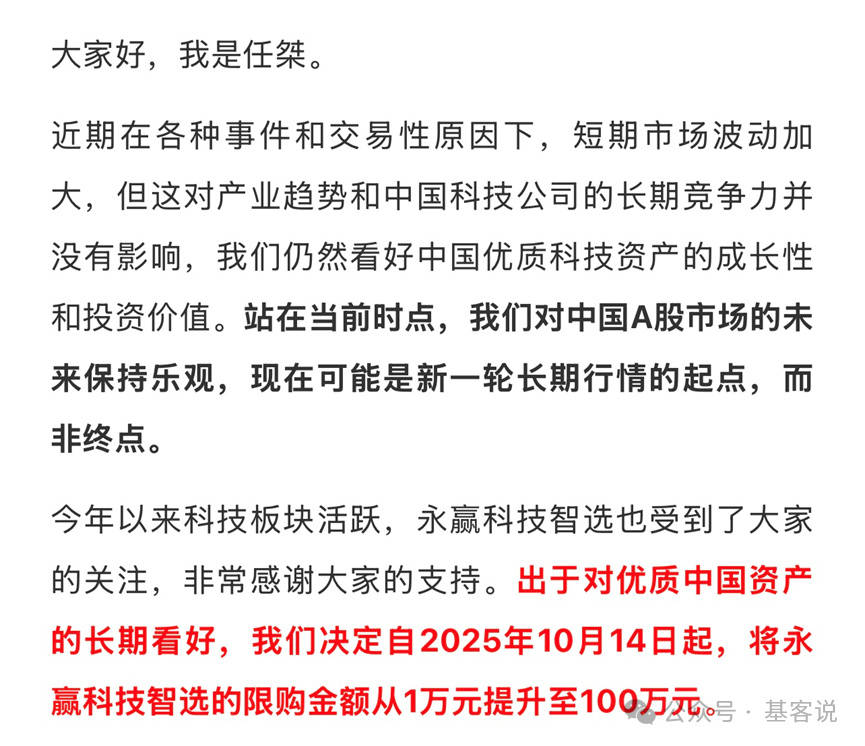
Core Viewpoint - The recent decision by Yongying Technology Smart Mixed Fund to lift the daily purchase limit from 10,000 to 1,000,000 during a market downturn raises questions about the motivations behind such a move and its implications for investors [1][2][4] Fund Purchase Limit Dynamics - The fund manager, Ren Jie, explained that the relaxation of the purchase limit is due to short-term market volatility, while maintaining a long-term positive outlook on quality Chinese technology assets [2][4] - The fund had previously tightened the purchase limit to 10,000 just a month ago, suggesting a potential inconsistency in their long-term outlook [3][4] - The primary purpose of purchase limits is to protect the interests of existing investors and maintain fund stability, rather than to signal market outlook [4][6] Implications of Linking Purchase Limits to Market Views - Linking purchase limits to market perspectives can mislead investors into thinking that tightening indicates danger and loosening indicates confidence, which could lead to irrational behavior such as mass redemptions or rush purchases [10][12] - The rationale for purchase limits includes managing fund size, strategy capacity, and liquidity, rather than solely reflecting market sentiment [9][10] - It is suggested that fund companies should keep purchase limits focused on operational stability and avoid intertwining them with market views to prevent creating dangerous investor habits [8][14] Recommendations for Investors - Investors should focus on the long-term performance and stability of the fund's strategy, rather than overinterpreting short-term operational changes like purchase limits [14] - Transparency in communication from fund managers regarding market views should be maintained separately from operational decisions to avoid confusion [14]
上百只基金启动大额限购
Di Yi Cai Jing Zi Xun· 2025-09-29 16:00
Core Viewpoint - The recent surge in large purchase restrictions for money market and short-term bond funds is primarily aimed at protecting existing investors' interests and managing liquidity risks during the holiday period [2][4][5]. Group 1: Fund Purchase Restrictions - Over 100 funds have implemented large purchase restrictions in the days leading up to the holiday, with many set to resume on October 9 [2][4]. - Specific funds, such as Guoshou Anbao and Changjiang LeXiang, have announced limits on institutional investors' purchases, with caps of 10,000 yuan and 100,000 yuan respectively [3][4]. - The majority of restricted funds are low-risk products, particularly bond funds, which account for over 70% of the total [4]. Group 2: Reasons for Restrictions - The restrictions are intended to prevent large inflows from diluting the returns for existing investors, as bond interest continues to accrue during the holiday [5]. - There is also a concern about liquidity risks, as large withdrawals post-holiday could force fund managers to sell assets at unfavorable prices [5]. Group 3: Market Outlook - The A-share market is currently experiencing a period of adjustment, with a modest increase in major indices leading up to the holiday [6]. - Analysts suggest that the market's micro liquidity remains ample, and external risks are easing, which may support the A-share market moving forward [6]. - The focus for the fourth quarter includes monitoring consumer recovery, investment pressures, and persistent low inflation [6]. Group 4: Investment Strategies - Fund managers recommend focusing on technology and growth sectors, while also being cautious of potential market risks [9][10]. - The upcoming market dynamics may favor sectors such as consumer electronics and renewable energy equipment, driven by manufacturing upgrades [9][10].

节前限购节后重启 多家公募机构稳健应对
Zheng Quan Ri Bao Wang· 2025-09-29 13:12
Core Viewpoint - Multiple public fund institutions have implemented purchase limits or suspended subscriptions for low-risk products ahead of the National Day and Mid-Autumn Festival holidays, indicating a proactive approach to managing liquidity risks and protecting existing investors' returns [1][2][3] Group 1: Fund Management Actions - Fund managers, including Invesco Great Wall Fund and Yinhua Fund, have announced limits on large subscriptions for various low-risk funds starting from September 29, with plans to resume subscriptions on October 9 [2] - As of September 29, 3,111 funds implemented purchase limits, an increase from 2,950 funds on August 29, indicating a growing trend in managing fund inflows [2] Group 2: Rationale Behind Limitations - The primary reason for the pre-holiday purchase limits is to mitigate risks associated with asset trading during holidays and to manage frequent capital fluctuations, ensuring liquidity safety and fair returns for investors [4][5] - Analysts suggest that the timing of these limits is crucial, as holidays typically see peaks in fund inflows and outflows, which can disrupt fund operations if not managed properly [4][5] Group 3: Investor Guidance - Investors are advised to pay attention to fund limit announcements and plan their subscription and redemption strategies accordingly to avoid missing opportunities due to purchase limits [6]
长假前夕,基金公司为何纷纷限购低风险产品?
Huan Qiu Wang· 2025-09-27 01:56
Core Viewpoint - Several fund companies are implementing purchase limits or suspending subscriptions for low-risk products such as money market funds and short-term bond funds ahead of the National Day and Mid-Autumn Festival holidays, with plans to resume subscriptions after the holidays. This practice aims to manage the significant inflow and outflow of funds around the holiday period, which can lead to volatility in fund sizes and affect investor returns and product stability [1][3]. Group 1: Fund Company Actions - Huian Fund announced a limit on single account daily subscriptions exceeding 100,000 yuan for its short-term bond fund starting September 24, resuming on October 9 [3]. - Xiangcai Fund's Xiangcai Jiuying short-term bond fund will limit single account daily subscriptions to 10,000 yuan starting September 26, with a resumption date of October 13 [3]. - Changjiang Asset Management's Changjiang Lexiang money market fund will not accept subscriptions exceeding 1 million yuan per day starting September 25, resuming on October 9 [3]. - HSBC Jintrust Fund announced a suspension of subscriptions for its HSBC Jintrust CSI Interbank Certificate of Deposit AAA Index fund starting September 29, with a resumption on October 9 [3]. Group 2: Market Context and Investor Behavior - The equity market has shown signs of recovery this year, with some funds flowing back into equity funds, indicating a restoration of risk appetite [3]. - Despite the recovery, there remains a short-term demand for risk aversion and fund management, particularly during the holiday period, leading investors to prefer low-risk products for stable returns [3]. - Fund companies' purchase limit policies, while varying in specifics, share a common goal of managing fund sizes before the holiday and resuming normal operations afterward to stabilize the funding environment [3].

长假临近 基金公司为何纷纷限购低风险固收类产品?
Mei Ri Jing Ji Xin Wen· 2025-09-25 15:35
Core Viewpoint - Many fund companies are adjusting their subscription policies for certain products ahead of the upcoming double holiday, with a focus on limiting subscriptions for low-risk funds [1][2][3] Group 1: Subscription Policy Adjustments - Multiple fund companies, including Southern Fund, Huatai-PB Fund, and Huitianfu Fund, announced subscription limits for various products, primarily targeting low-risk funds such as bond and money market funds [1][2] - Subscription limits will generally take effect on September 29 and will be lifted on October 9, allowing for normal subscriptions to resume [1][3] - Specific limits include a cap of 50 million yuan for individual accounts and a daily subscription limit of 1,000 yuan for certain equity funds [3][5] Group 2: Rationale Behind Limitations - The adjustments are aimed at managing fund inflows during peak periods before holidays, which can lead to significant fluctuations in fund sizes and impact existing investors' returns [3][4] - Analysts suggest that limiting subscriptions helps to stabilize fund operations and protect the interests of existing fund holders, preventing dilution of shares for long-term investors [3][4] Group 3: Types of Affected Funds - The subscription limits primarily affect low-risk products, including money market funds, short-term bond funds, and index funds based on interbank certificates of deposit [3][5] - Some equity funds are also implementing subscription limits, which is less common compared to previous years where primarily low-risk products were restricted [5][6] Group 4: Market Context and Investor Behavior - The equity market has shown signs of recovery, leading to a shift in investor preference towards stock funds, but there remains a strong demand for low-risk products during the holiday period [6] - Investors are advised to prepare for potential large inflows and outflows around the holiday, which could impact fund managers' asset allocation decisions [6]