Accelerated Computing

Search documents
Nvidia Stock 2x To $350?
Forbes· 2025-10-07 09:35
Core Viewpoint - Nvidia's stock is projected to potentially reach $350 in the coming years, supported by significant earnings growth and a strong position in AI and computing markets [2] Revenue Growth Potential - Nvidia's revenues have nearly doubled in the past year, with an average annual growth rate of about 69% over the last three years, and could continue to grow at approximately 60% annually for the next two years, reaching around $486 billion by FY'28 [3][4] - The company has secured major AI-related agreements, including a $100 billion partnership with OpenAI and a $19.4 billion contract with Microsoft, which will enhance its revenue streams [4] Market Trends and Innovations - The evolution of AI from text-based models to multimodal capabilities is driving demand for more computing power and GPU shipments, positioning Nvidia favorably in the market [4] - The potential development of Artificial General Intelligence (AGI) could significantly increase global GDP growth and create substantial demand for Nvidia's high-performance computing solutions [4] Profitability and Margins - Nvidia's net margins have improved from approximately 25% in FY'19 to around 51% in FY'25, benefiting from economies of scale and a favorable product mix [5][6] - The introduction of high-end products is expected to maintain stable margins, allowing for a potential 3.7x increase in earnings alongside revenue growth [6] Valuation and Earnings Multiples - If earnings increase by 3.7x, the price-to-earnings (PE) multiple could stabilize around 32x, suggesting a potential stock price increase to over $350 [7] - The timeline for achieving this growth is flexible, as long as Nvidia maintains its revenue growth trajectory and stable margins [7]

I know, I am a believer, says Jim Cramer on the AI trade
Youtube· 2025-10-06 23:41
Group 1 - OpenAI is expected to spend tens of billions of dollars on high-end chips from AMD and Nvidia, which has led to a significant increase in AMD's stock price by 24% [3] - AMD's CEO, Lisa Su, and OpenAI's co-founder, Greg Brockman, express confidence in OpenAI's ability to pay for the ordered chips, indicating a strong belief in the financial backing of OpenAI [2] - Despite skepticism surrounding AI investments, the market reaction suggests a strong belief in OpenAI's financial capacity, contributing to a broader market movement with the NASDAQ rising significantly [3] Group 2 - The discussion around accelerated computing and artificial intelligence has been ongoing since at least 2018, highlighting the potential for a technological revolution in this sector [4]

Quantum stocks Rigetti Computing and D-Wave surged double-digits this week. Here's what's driving the big move
CNBC· 2025-10-03 15:58
Group 1 - Quantum computing stocks have experienced significant gains, with shares of Rigetti Computing, D-Wave Quantum, and Quantum Computing rising over 20% [1] - Rigetti and D-Wave Quantum have seen their stock prices more than double and triple, respectively, since the beginning of the year [1] - Arqit Quantum's shares surged more than 42% this week, reflecting a broader positive trend in the quantum computing sector [1] Group 2 - Rigetti has secured purchase orders totaling $5.7 million for two of its 9-qubit Novera quantum computing systems [2] - A significant investment of 300 million euros was made by the owner of Novo Nordisk and the Danish government into a quantum venture fund [2] - Nvidia has emphasized the importance of accelerated computing in enabling future breakthroughs in quantum computing [2] Group 3 - Major tech companies such as Microsoft, Nvidia, and Amazon have increased their investments in quantum computing technology through new chip announcements and research initiatives [2]



The Future of Accelerated AI
NVIDIA· 2025-09-30 18:41
AI Strategy & Industry Support - NVIDIA's Neotron aims to accelerate AI development through optimized models and accelerated computing [1] - The company is committed to supporting the entire AI industry by providing open technologies [1][2] - NVIDIA partners with diverse companies globally, offering support for their AI solutions [2] Technological Approach - A faster model equates to a smarter model, enabling more computations within the same timeframe [1] - Neotron's open nature allows organizations to customize and deploy AI solutions based on their specific needs [2]

How this $130 billion energy management company is fueling Nvidia's infrastructure growth
CNBC· 2025-09-30 16:00
Core Insights - Schneider Electric has announced new data center blueprints in collaboration with Nvidia, aimed at accelerating construction timelines and facilitating the adoption of AI-ready infrastructure [1][2] - The partnership focuses on developing sustainable, AI-ready infrastructure, particularly for power, cooling, and high-density rack systems, to support the next generation of AI factories [2][6] - Schneider Electric is a leader in energy management for data centers, which constitute approximately 25% of its business [2] Group 1: Partnership and Innovation - The collaboration with Nvidia is a research and development initiative that addresses the growing demand for energy-efficient solutions in data centers [2][6] - The integration of power management and liquid cooling control systems is a key component of the new designs, which also support Nvidia's Blackwell chips [5][6] - The partnership is expected to be highly lucrative, especially in light of Nvidia's significant investment in AI technologies [6] Group 2: Energy Efficiency and AI - AI technologies are projected to enhance energy efficiency, potentially achieving four to nine times more efficiency than the energy consumed [8] - The new computing engines will allow for real-time integration of various energy sources and consumption patterns, optimizing energy usage [9] - The shift towards decentralized energy production, including renewable sources, is transforming the energy market [10][11] Group 3: Market Trends and Future Outlook - The transition to electrification and digitization is seen as essential for competitiveness, particularly in regions with limited fossil fuel resources [11][12] - Companies are increasingly adopting innovative energy solutions due to rapid advancements in technology and decreasing costs [12] - The energy sector is expected to undergo a significant revolution in the next two decades, driven by the convergence of electrification, digitization, and AI [13][14]
Jensen Huang doesn’t care about Sam Altman’s AI hype fears: He thinks OpenAI will be the first ‘multitrillion-dollar hyperscale company’
Yahoo Finance· 2025-09-29 19:18
Core Insights - Nvidia CEO Jensen Huang predicts that OpenAI will become the world's next multitrillion-dollar hyperscale company, despite growing caution in the AI sector from other leaders like Sam Altman and Mark Zuckerberg [1][2][6] - Huang argues that the current skepticism overlooks fundamental changes in the economy driven by accelerated computing and AI, which he believes will not follow traditional boom-and-bust cycles [2][5] AI and Computing Trends - Huang asserts that general-purpose computing is becoming obsolete, with a generational shift towards accelerated computing and AI [3] - He introduces the "three scaling laws" of AI—pretraining, post-training, and inference—which he claims will exponentially increase demand for computing resources [3][5] - Inference, the real-time reasoning process essential for applications like chatbots and recommendation systems, is highlighted as a growing area of demand that will drive continuous processing power needs [5][4] Nvidia's Strategic Moves - Nvidia recently announced a $100 billion investment in OpenAI to support the company's data center expansion, marking a significant example of Nvidia's "circular financing" strategy [6] - This strategy involves Nvidia investing in or lending to customers who subsequently spend billions on Nvidia's GPUs, aligning incentives with key partners [6][7] - Huang views this investment as a smart opportunity to capitalize on OpenAI's rapid scaling, which he believes is unprecedented in history [7]
NVIDIA OpenAI, Future of Compute, and the American Dream BG2 w Bill Gurley and Brad Gerstner
Youtube· 2025-09-26 06:00
Core Insights - The discussion emphasizes the transformative potential of AI, particularly in inference, which is expected to grow exponentially, potentially reaching a billion times increase in capability [1][2][3] - OpenAI is projected to become a multi-trillion dollar hyperscale company, presenting significant investment opportunities for those familiar with the AI space [3][4][5] - The integration of training and inference in AI systems is evolving, with a focus on post-training and reasoning, enhancing the quality of AI outputs [2][6] Company Developments - NVIDIA is actively partnering with OpenAI to build self-sufficient AI infrastructure, moving away from reliance on Microsoft for data center construction [4][5] - The company is experiencing exponential growth in customer demand and computational requirements, necessitating extensive project build-outs [4][5][6] - NVIDIA's revenue is closely tied to the power and performance of its AI infrastructure, with projections indicating a significant increase in data center power requirements [10][11] Market Trends - The shift from general-purpose computing to accelerated computing is highlighted as a critical trend, with AI applications becoming ubiquitous across various sectors [7][8] - The AI industry is expected to grow rapidly, with estimates suggesting AI revenue could reach $100 billion by 2026 and potentially $1 trillion by 2030 [12][13] - The demand for AI-driven solutions is leading to a transformation in traditional computing paradigms, with a focus on enhanced performance and efficiency [9][10] Competitive Landscape - NVIDIA's competitive advantage is attributed to its ability to deliver extreme co-design across hardware and software, enabling significant performance improvements [24][25][26] - The company is positioned to capitalize on the growing demand for AI infrastructure, with a robust supply chain ready to meet customer needs [15][16] - The discussion contrasts NVIDIA's comprehensive AI ecosystem with competitors focusing on ASICs, emphasizing the complexity and scale of AI infrastructure [29][30][31]
Nvidia CEO on the $100 billion investment in OpenAI: This partnership is 'monumental in size'
CNBC Television· 2025-09-22 16:49
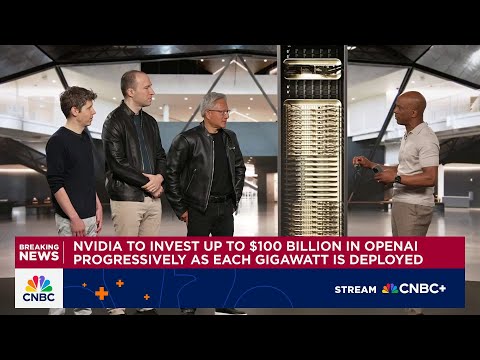
Strategic Investments & Partnerships - Nvidia is making significant investments, including a partnership with Intel, to integrate Nvidia technology at the PC and data center levels [2] - The Intel partnership aims to fuse Intel's architecture with Nvidia's to advance accelerated computing and AI [3] - Nvidia views its ecosystem as valuable and is actively investing in it [2] AI's Expanding Role - AI is transitioning from early adoption in labs to widespread use across industries and use cases [5] - AI is expected to influence almost every digital interaction, including images, videos, and general computing experiences [5] - AI infrastructure will be pervasive, powering computing experiences for everyone daily [6] Infrastructure Development - A monumental engineering project is underway to build AI infrastructure [4] - The initial phase involves a 10 gigawatt undertaking, highlighting the scale of AI infrastructure development [6]
Nvidia CEO on the $100 billion investment in OpenAI: This partnership is 'monumental in size'
Youtube· 2025-09-22 16:49
Core Insights - The partnership between Intel and Nvidia signifies a shift towards accelerated computing and AI, marking a departure from traditional general-purpose computing that has dominated for the past 60 years [3][4] - The collaboration aims to integrate Intel's architecture with Nvidia's to enhance capabilities in accelerated computing and AI, indicating a monumental engineering project of unprecedented complexity and scale [4] - AI is transitioning from early adoption in labs to widespread application across various industries, suggesting that future computing experiences will be heavily influenced by AI technologies [5][6] Company and Industry Summary - The Intel investment is smaller than previous ones but is significant due to its integration of Nvidia technology at the data center level, highlighting the evolving ecosystem around Nvidia [2] - The partnership is expected to create a robust AI infrastructure that will permeate every industry, transforming daily computing experiences for users [6] - The scale of the AI initiative is substantial, with the first phase involving 10 gigawatts, underscoring the transformative potential of AI across all sectors [6]
英伟达50亿美元下赌注,给CPU和GPU「修高速」
3 6 Ke· 2025-09-19 01:42
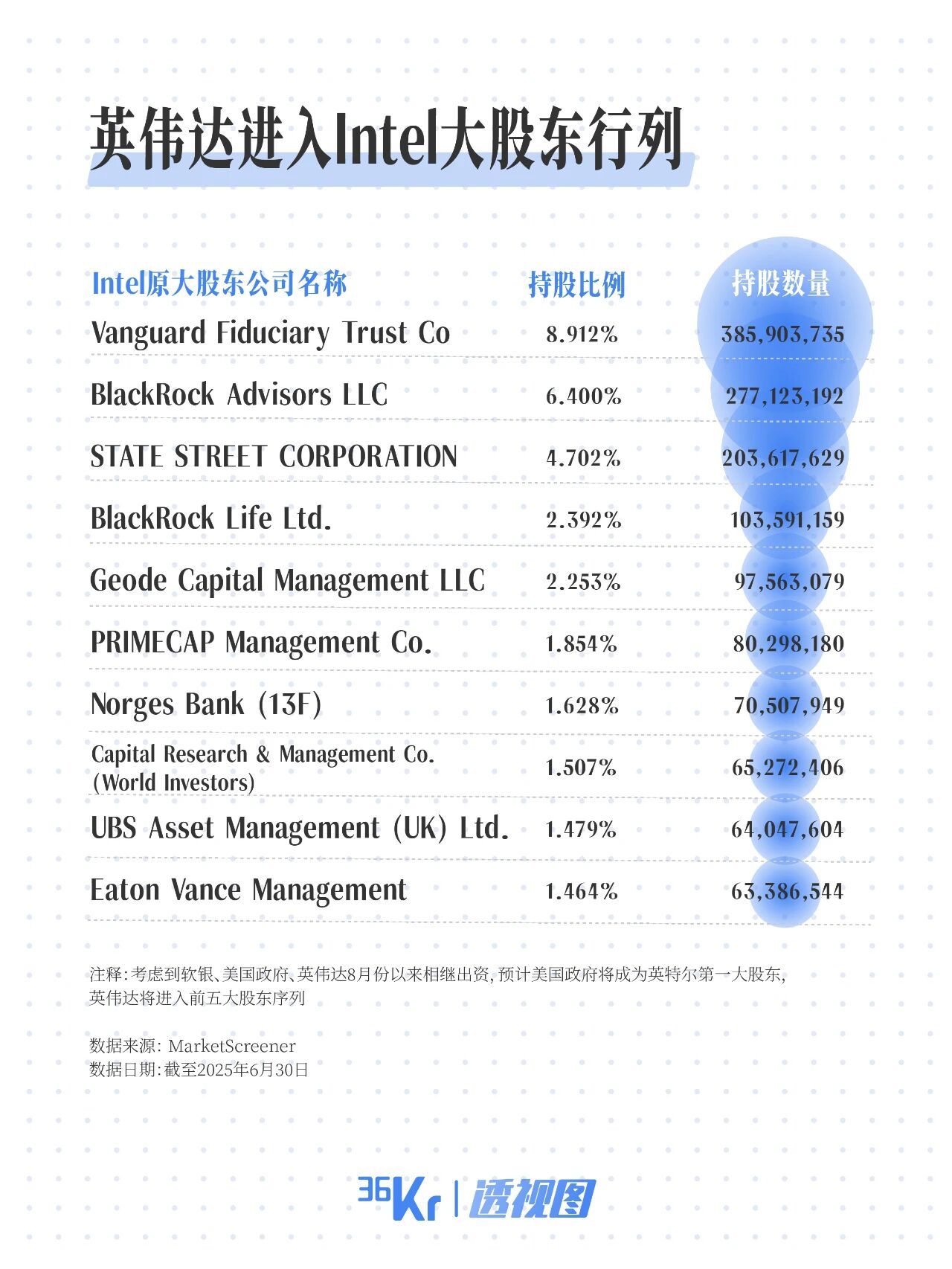
Core Insights - NVIDIA announced a $5 billion investment in Intel at a price of $23.28 per share, which will result in NVIDIA holding over 4% of Intel's shares [1] - Following the announcement, Intel's stock price surged by 22.77%, while NVIDIA's stock rose by 3.54% [3] Investment Details - NVIDIA's investment will position it among Intel's top five shareholders, alongside major investors like Vanguard and BlackRock [2] - The investment is part of a broader collaboration where Intel will customize x86 processors for NVIDIA, and NVIDIA will integrate its RTX GPU into Intel's x86 system-on-chip offerings [3] Technological Collaboration - The partnership aims to leverage NVLink technology for seamless architecture interconnection, combining NVIDIA's strengths in AI and accelerated computing with Intel's advanced CPU technology [6] - NVIDIA's Grace CPU, which integrates NVLink, allows for high bandwidth and low latency connections between CPU and GPU, addressing previous bottlenecks associated with PCIe [6][8] Future Implications - By enabling Intel's x86 CPUs to support NVLink, NVIDIA expands the application of NVLink from its proprietary ecosystem to a larger and more open x86 server and PC ecosystem [9] - This strategic move is expected to enhance NVIDIA's leadership in the accelerated computing sector by providing more enterprises and developers access to NVLink's high-speed interconnect advantages [9]