Capex

Search documents
Rising tide is lifting all hyperscaler boats right now, says Madrona's Matt McIlwain
CNBC Television· 2025-10-31 20:49
AI Capex and Hyperscaler Dynamics - Hyperscalers are experiencing a rising tide, with Meta showing potential at a better rate [3] - All four major tech companies (Meta, Amazon, Google, Microsoft) possess the capital to build data centers and train AI models [4] - These companies are building "reasoning machines" by combining models, context, and data [5] - The industry is still determining which companies are building superior AI chips for operational advantages [6] - The industry is shifting focus from topline growth to operational efficiency and cost [7] Company-Specific AI Strategies - Google has shown strong progress with its Gemini models [8] - Microsoft's partnership realignment with OpenAI positions it well for the next 5+ years [9] - Amazon's relationship with Anthropic and its Bedrock offering provide price, convenience, and selection for building reasoning machines [10] Nvidia's Dominance and Market Demand - Overwhelming demand for AI and data centers benefits Nvidia, despite companies developing their own chips [11] - The five companies that announced earnings this week are projected to spend over $500 billion on capex next year [11] - Nvidia's strength lies not only in GPUs but also in CUDA and its investments in private companies [12] - Nvidia and Intel are partnering to facilitate growth, as CPUs are needed alongside GPUs for reasoning machines [12]







Big Tech earnings show a sector going industrial
Yahoo Finance· 2025-10-31 19:16
Core Insights - The current phase of growth in the tech industry is characterized by significant capital expenditures (capex) driven by the AI arms race, with major players like Microsoft, Amazon, Alphabet, and Meta heavily investing in infrastructure to support AI and cloud services [1][5][27] - The competition among Big Tech firms has shifted from abstract growth metrics to tangible infrastructure investments, with a focus on power, capacity, and physical assets [3][7][20] Company Summaries - **Alphabet**: Increased its projected 2025 capex to $91–93 billion, focusing on servers and networking gear, with analysts noting that its ad revenue growth supports this infrastructure investment [2][13] - **Microsoft**: Reported record revenue of $77.7 billion for the quarter, up 18%, with a backlog of $392 billion, showcasing its operational efficiency and strong demand for Azure services, which grew approximately 40% year over year [12][18][17] - **Amazon**: Achieved a 20% growth in AWS revenue, reaching $33 billion, and emphasized its strategy of acquiring energy contracts to support its infrastructure needs, which contributed to a 10% increase in its stock price post-earnings [6][19][14] - **Meta**: Announced plans to spend $70–72 billion in 2025, despite lacking a rentable cloud, indicating a commitment to infrastructure investment to catch up with competitors [4][27] - **Apple**: Continued to show strong performance in its services segment, with revenue climbing 15% to $28.8 billion, maintaining high margins even as hardware sales softened [25][27] Industry Trends - The cloud and AI sectors are converging, with companies now competing for control over infrastructure rather than just software capabilities, marking a shift in how dominance is measured in the tech industry [7][20] - The ad economy remains a crucial funding source for infrastructure investments, with significant revenue growth reported by Meta and Alphabet, indicating that traditional revenue streams are still vital for supporting new capital expenditures [22][21] - The competitive landscape among Microsoft, Amazon, and Alphabet is intensifying, with each company demonstrating strong growth and infrastructure commitments, leading to a more complex and competitive environment [16][19][27]

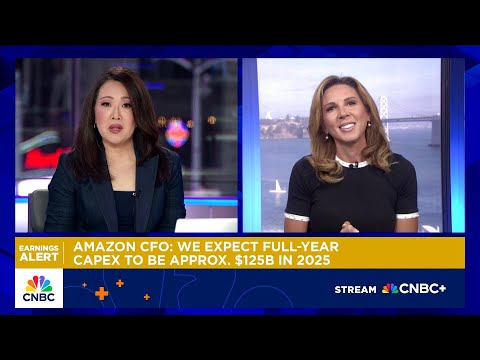
Amazon CFO expects full-year capex to hit $125B in 2025
CNBC Television· 2025-10-31 03:37
Capital Expenditure (CAPEX) - 公司预计全年资本支出约为 1250 亿美元 [1] - 资本支出预计在 2026 年将进一步增加 [1] - 资本支出主要用于支持 AWS 的 AI 需求 [1] - 公司正在加大对内部 AI 芯片 Tranium 的投资 [1] - 公司的年度资本支出低于微软的 1400 亿美元 [1] AI Investment - 公司 CEO 正在讨论 Project Rainer,这是一项大型 AI 投资项目 [2] - 公司正在与 Anthropic 密切合作 [2]
Amazon to round of big tech earnings. Here's what to know
Youtube· 2025-10-30 18:46
Core Insights - Amazon is under pressure to demonstrate a solid plan to maintain its leading position in the cloud market, especially with increased capital expenditures from competitors like Google, Meta, and Microsoft [2][5] - AWS currently holds a 30% market share, significantly ahead of Microsoft Azure at 20%, but faces challenges as competitors grow their cloud revenues at a faster rate [2][3] - Amazon's backlog is weaker compared to Microsoft and Oracle, which could impact future revenue growth, although AWS CEO Matt Garmins notes that backlog is not a perfect metric for gauging future performance [3] Company Positioning - Amazon has lost significant AI workloads to competitors, with Anthropic expanding its partnership with Google Cloud and Meta signing a new contract with Alphabet for compute services [4][5] - The key question for Amazon heading into earnings is whether it can match competitors' capital expenditures and demonstrate a return on investment from that spending [5]

Analysts Hit META with Price Target Cut Over A.I. CapEx Spending
Youtube· 2025-10-30 16:01
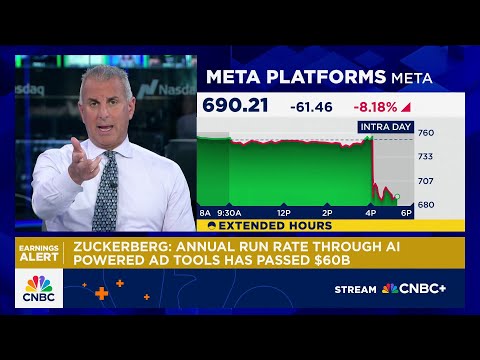
Core Viewpoint - Meta Platforms' stock is experiencing a sell-off despite reporting record revenue in Q3, primarily due to increased capital expenditures and a significant one-time charge impacting earnings per share [1][6][13]. Financial Performance - Meta reported revenue of $51.24 billion, exceeding expectations of $49.6 billion, indicating strong performance [7]. - The company faced a one-time charge of nearly $16 billion, which significantly reduced earnings per share to $15, compared to expectations of $6.72, marking a substantial miss [6][13]. Capital Expenditures - Meta is raising its capital expenditure (capex) estimates for the year to a range of $70 to $72 billion, up from a prior outlook of $66 to $72 billion [9]. - The CFO indicated that capex in 2026 is expected to be even higher than in 2025, with total expenses projected to grow significantly faster in 2026 than in 2025, driven by infrastructure costs and hiring [10][11]. Analyst Reactions - Oppenheimer downgraded Meta to "perform," citing concerns over high spending and the inability to rationalize the current price-to-earnings (PE) ratio of about 29 until visibility into 2027 improves [12][13]. - Benchmark also downgraded Meta to "hold," removing their price target due to increased competition and a belief that shares will remain range-bound in the near term [15]. Market Comparison - Analysts are favoring Alphabet over Meta, noting that Alphabet offers predictable earnings at a reasonable valuation, trading at a similar PE ratio [14][16]. - The overall sentiment in the market suggests that Meta's aggressive spending strategy is viewed with caution compared to competitors like Google and Amazon, which are perceived to be better positioned [16].

'Fast Money' traders talk how to play Meta following Q3 results
CNBC Television· 2025-10-29 22:01
Capital Expenditure (Capex) & Investment - Meta raised its 2025 capital expenditures range to $70-72 billion, up from a prior range of $66-72 billion, to invest in AI strength [1] - Meta expects capital expenditure dollar growth to be notably larger next year (2026) [1] - Meta has recent cloud deals including a $10 billion deal with Google, a $14 billion deal with CoreWeave, and a $20 billion deal with Oracle [2] - Tech sector is shifting from "capex light" to "capex heavy," similar to energy exploration companies [4] - Companies are investing ever larger amounts of capex to keep up with AI growth, potentially diminishing the value proposition and return on investment [5] Financial Implications & Market Concerns - Increased capex spending is raising concerns about ROI [3][5][6] - Meta's data center build-out is starting to hit the debt markets [10] - Blue Owl is lending $27 billion for Meta's data center in Louisiana, with a 20% stake [11] - Some debt is being issued at 1% above, potentially becoming junk and finding its way into ETFs [12] - Companies have been funding buildout through cash flow, but this may not be sustainable as it reaches 30% of revenue [13] Meta's Performance & Strategy - Meta AI is currently behind other chatbots, and the company is investing to improve it [8] - Meta's ad targeting has been good, but there's a potential wall and increased competition from companies like OpenAI [9][10] - Meta took a $16 billion charge, and without it, EPS would have been 10% better than expected [16] - Margins are now north of 40% [16]
Options Corner: META
Youtube· 2025-10-29 13:15
Core Viewpoint - The discussion focuses on bullish options strategies for a stock priced over $750, with an emphasis on the upcoming earnings report and the implications of capital expenditure (capex) and AI monetization [2][12]. Group 1: Options Strategies - The first strategy involves buying a 750 strike call in the November 7th weekly options, taking advantage of higher implied volatility [3]. - A short put vertical strategy is also presented, which involves selling a 720 put and buying a 700 put, aiming for a neutral to bullish position with a potential profit of approximately $500 per spread and a risk of $1,500 [4][5]. - The break-even point for the short put vertical is set at $715, which is about 5% below the current share price, with a 68% probability that the short 720 strike will be out of the money at expiration [6][7]. Group 2: Bullish Call Diagonal - A more aggressive strategy is introduced with a bullish call diagonal, involving buying a 750 strike call and selling an 800 strike call, with a risk of approximately $2,200 per spread [8][10]. - Profitability for the bullish call diagonal begins above $760, with the maximum profit occurring near the 800 strike [9][10]. - The strategy benefits from a disparity in implied volatility, as the 750 call has a 58% implied volatility while the 800 call has nearly 100%, which lowers the entry point for this aggressive position [10][11].

Is AI’s Capex Boom Built to Last? | Presented by CME Group
Bloomberg Television· 2025-10-28 18:28
[Music] Tech companies are pumping hundreds of billions of dollars into infrastructure to ramp up artificial intelligence. In fact, some projections show that spending may be fueling nearly half of this year's estimated GDP growth. In the second quarter, techreated categories contributed over 4 percentage points to overall investment growth, which offset declines elsewhere.Revenue is growing rapidly in a very short amount of time and margins at many of the largest AI companies are all on the rise. It's like ...

A big tech earnings miss would be a big problem for broader markets, says Solus' Dan Greenhaus
CNBC Television· 2025-10-28 13:53
Today we do begin with our talk of the tape. All that lies ahead this week with mega cap earnings, the Fed decision, and so much more looming large. Let's welcome in Solless's Dan Greenhouse and I Capitals Sali Basket.It's great to have you both with us. Dan Greenhouse, you first. Uh this is a resilient rally.This likes any positive headline it's getting on trade and it thinks it's going to get good stuff from the mega caps. How much is actually riding on what happens this week. Yeah.So, for viewers who wat ...

The Morning Trade: "High Risk" MSFT Example
Youtube· 2025-10-27 15:30
Core Viewpoint - Guggenheim has upgraded Microsoft shares to "buy," reflecting a nearly 99% bullish sentiment among analysts ahead of the upcoming earnings report on October 29 [2][6]. Company Analysis - The price target for Microsoft has been raised to $586, indicating a potential upside of approximately 12% from the last closing price [3]. - Guggenheim analysts express optimism regarding Microsoft's ability to leverage advancements in AI, positioning it as a key beneficiary in the current market landscape [4]. - Microsoft holds a near monopoly in the productivity suite market with its Office products, which are being monetized through AI offerings like co-pilot [4]. - The analysts also believe that Microsoft's Windows segment is well-positioned to exceed consensus estimates in the near to medium term, representing a second monopoly [4]. Market Sentiment - No analysts covering Microsoft have a "sell" rating, indicating strong market confidence ahead of the earnings report [5][6]. - The overall sentiment among analysts is favorable, with expectations focused on AI-related growth trends and insights into Microsoft's capital expenditures [6][12]. Earnings Expectations - Analysts anticipate that if Microsoft's capital expenditures align with or fall below expectations, and if the company demonstrates effective monetization of its AI investments, it could lead to significant stock price appreciation [15]. - There is a potential for the stock to reach around $575 post-earnings if results are strong, although there is also a risk of disappointment if capital expenditures exceed expectations [10][15]. Broader Market Context - The market is currently in a "risk-on" mode, with positive developments in U.S.-China trade negotiations contributing to a favorable trading environment [17][19]. - The recent CPI report has alleviated some market fears, supporting a bullish outlook as the NASDAQ trades at all-time highs [18][19].