Yield curve

Search documents
Inflation Expectations, Tech Valuations, Healthcare Opportunities
Seeking Alpha· 2025-09-17 19:20
分组1 - The Federal Reserve is expected to cut rates, with a 97-98% probability for a 25 basis point cut, and the market is curious about the dot plot indicating the endpoint of the rate-cutting cycle [4][5][12] - The yield curve remains flat, with a ten-year rate at 4.03% and a three-month rate at 3.97%, leading to questions about the attractiveness of long-term bonds [6][14] - The Bank of Japan (BOJ) meeting is anticipated to influence interest rate differentials, potentially strengthening the yen if the BOJ commits to future rate hikes [7][8] 分组2 - Nvidia faces challenges as China restricts chip sales, which could negatively impact its stock and the broader market due to its significant weighting in the S&P 500 [9][10] - The current tech market shows high concentration risk, with a significant portion of the S&P 500 being driven by a few large tech stocks, raising concerns about the sustainability of this trend [26][28] - The healthcare sector is viewed as undervalued, with companies like UnitedHealthcare and Zoetis being highlighted as attractive investment opportunities due to their strong fundamentals and growth potential [57][59][61] 分组3 - The discussion emphasizes the importance of understanding valuation metrics specific to different sectors, as well as the need for a long-term investment perspective [63][66] - Investors are encouraged to focus on long-term themes and growth opportunities, particularly in sectors that may be overlooked due to current market trends [66][70] - The market is characterized by confusion and volatility, with mechanical factors influencing price movements more than fundamental data [75][79]



Why the Fed's rate cut might not boost the economy
MarketWatch· 2025-09-16 18:27
Core Insights - The yield curve serves as an indicator of the bond market's confidence in the U.S. monetary policy management [1] Group 1 - The yield curve reflects the bond market's perception of the effectiveness of U.S. monetary policy [1]
Regulatory outlook for banks is the best I've seen in decades, says RBC's Gerard Cassidy
Youtube· 2025-09-16 15:19
Group 1: Valuation and Market Performance - The current trading valuation for banks is around two times tangible book value, which is higher than recent historical levels, but this is not seen as a concern due to potential for continued outperformance [1][2] - The cyclical high for banks was noted at 2.2 times tangible book value in January 2018, indicating that there is still room for growth in valuations [2][3] - There is a significant discrepancy in performance among banks, with Citigroup up 40% this year compared to Bank of America and Wells Fargo, which are up 14% [7] Group 2: Regulatory Environment - The regulatory outlook for banks is considered the best in decades, with expectations of increased profitability leading to higher valuations [3] - Recent changes in regulatory leadership suggest a less onerous approach, with new proposals expected to be more favorable for large banks [4][5] - The new Fed chair is anticipated to support economic growth, which could benefit banks through lower interest rates without triggering high inflation [6] Group 3: Interest Rate Environment - The current interest rate environment is favorable for banks, with potential Fed cuts of 50 to 75 basis points expected in the next three to six months [10] - A steep yield curve with a Fed funds rate above 3% has not been seen in over 20 years, allowing banks to benefit from low-cost deposits while lending at higher rates [11] Group 4: Company-Specific Insights - Citigroup is viewed as a turnaround story, successfully exiting unprofitable businesses and focusing on profitability, which has made it more attractive to investors [8] - Goldman Sachs is performing well in capital markets, benefiting from increased IPOs and merger and acquisition activity, indicating a positive outlook for the company [12]


We're not here yet with the Fed: Investment strategist
Youtube· 2025-09-16 06:00
分组1 - Tesla's stock has increased by 63% over the past six months, rising from approximately $224 to around $48 [2] - Elon Musk purchased 2.5 million shares of Tesla for about $1 billion, marking his first open market purchase since February 2020, indicating his commitment to the company's growth beyond electric vehicles [1][2] - Tesla is currently among the top performers in the S&P and NASDAQ, contributing to a potential record close for the NASDAQ index [1][3] 分组2 - The Federal Reserve is expected to announce a rate cut, with predictions ranging from 25 to 50 basis points, which could impact market sentiment [4][5] - Concerns have been raised by major banks about the potential for a slowing economy following any rate cuts, which may affect investor confidence [5][6] - The yield curve indicates that while short-term rates may benefit from cuts, large-cap stocks might not see significant gains, whereas small-cap stocks could present investment opportunities due to their higher leverage [9][10] 分组3 - ProShares is utilizing a daily options strategy to generate income from small-cap stocks, specifically through writing calls on the Russell 2000 index [10][12] - The strategy has yielded an 8.6% gain over three months, demonstrating effective management of options to capitalize on market movements [13] - The approach allows for consistent income generation through premiums, making it an attractive option for investors seeking exposure to small-cap equities without direct interest rate risk [12][13]
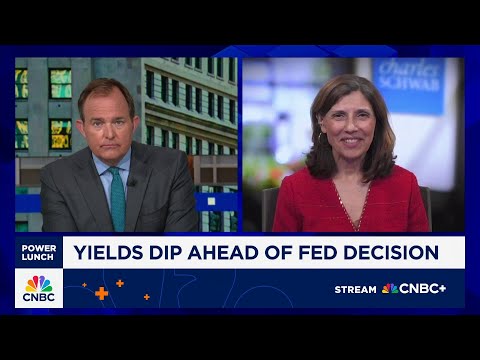
Ongoing inflation is more important than a Fed rate cut, says Charles Schwab's Kathy Jones
CNBC Television· 2025-09-15 19:13
Market Trends & Inflation - The bond market is heavily influenced by inflation, which is currently around 3% and edging higher, creating a stagflationary environment [3] - Inflation trends, rather than Federal Reserve actions, will primarily drive bond yields over the next 6 to 12 months [4] - There's hesitancy in longer-term bonds globally due to large fiscal deficits and concerns about inflation [6][7] Federal Reserve Policy & Impact - The market has already largely factored in the Federal Reserve cutting rates [2] - Cutting rates while the job market slows and inflation remains high presents a challenging situation for the bond market [3] - The Fed reducing its holdings of longer-term bonds raises concerns about whether private investors can compensate [7] - The possibility of the Fed matching its balance sheet maturities with Treasury issuance could impact long-term bond yields [10] - Quantitative tightening (QT) is important because the Fed's balance sheet management significantly influences borrowing costs [9] Mortgage Rates & Yield Curve - A Federal Reserve rate cut does not guarantee a decrease in mortgage rates; they could remain stable or even increase [4][5] - The yield curve may steepen even as the Fed cuts rates, as longer-term yields are influenced by inflation expectations, growth prospects, and supply and demand [5][6] - It's unlikely that mortgage rates will fall below 6% even after the anticipated Federal Reserve rate cut [8]
Sosnick: The Fed is likely to temper enthusiasm over future rate cuts
Youtube· 2025-09-15 11:40
Market Sentiment and Fed Rate Cut - The market is anticipating a Fed rate cut, with a significant psychological impact expected if it does not occur, leading to potential disappointment among investors [2][3] - There is a strong expectation for cuts, with a 100% positive attitude towards them, but the Fed may temper future enthusiasm due to ongoing inflation concerns [2][3] Inflation and Economic Indicators - Inflation measures, particularly core PCE and core CPI, are edging higher, moving closer to 3% annualized, which may influence the Fed's decision on rate cuts [3][4] Technology Sector and Nvidia - Nvidia is under investigation for allegedly violating anti-monopoly rules in China, which has put pressure on the stock and the broader chip sector [9][10] - The chip sector has been a key driver of market gains recently, but ongoing trade tensions and investigations could create volatility [6][7] Financial Sector Outlook - The financial sector is nearing a 52-week high, with banks potentially benefiting from a steeper yield curve if rate cuts occur [11][12] - There is a possibility that some banks may have gotten ahead of themselves in their stock performance, particularly larger banks, while smaller banks may still have room for growth [14] Tech Sector Concerns - There are concerns about a potential bubble in the tech sector, particularly following Oracle's results, which were heavily influenced by a single customer, OpenAI [15][16] - The significant cash burn associated with OpenAI raises questions about the sustainability of such projections and the overall health of tech investments [17][18]
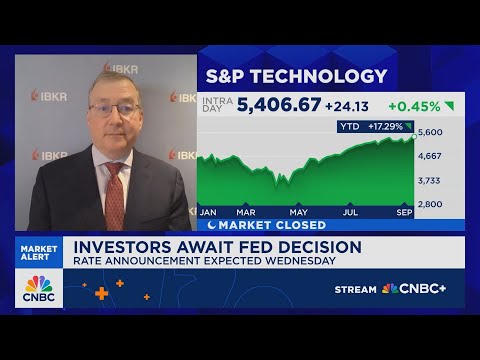
Sosnick: The Fed is likely to temper enthusiasm over future rate cuts
CNBC Television· 2025-09-15 11:40
Let's just talk about it. Uh it seems like like a lot of investors are kind of waiting for this Fed meeting, but there's also like a slim hope we could see that jumbo cut, a 50 basis point cut. How important is this cut for the markets right now.>> Well, the market needs this cut just because psychologically if we don't get it, there'll be very a lot of disappointed people. And so, of course, the Fed um I I think is in no has no desire to upset the majority of people who are expecting cuts. So, the vast maj ...
Investors wary of Treasury's 30-year bond auction after recent disappointments
Yahoo Finance· 2025-09-10 14:31
Group 1 - Investors are approaching the U.S. Treasury's sale of $22 billion in 30-year bonds with caution due to a previous auction's weak demand metrics, although some analysts believe this auction may perform better [1][2] - The auction size is $3 billion smaller than the previous one in August, which could facilitate easier absorption by the market [1] - Concerns over fiscal deficits and high national debt are pressuring the U.S. Treasury market, which is considered a cornerstone of the global financial system [2][3] Group 2 - The long end of the yield curve, particularly the 30-year bonds, is under pressure as global markets show negative sentiment towards long-dated bonds [3] - Last month's auction had a bid-to-cover ratio of 2.27, the lowest since November 2023, indicating weak investor demand [3][4] - End-user demand, combining indirect and direct bids, fell to 82.5%, the worst level since August 2024 [4] Group 3 - August is typically a "seasonally negative" month for 30-year bond supply, with only one successful auction since 2009 [5] - The five-year/30-year yield curve steepened to 126 basis points, the widest in over four years, indicating persistent selling pressure on 30-year bonds [6] - The yield curve has shown slight flattening as investors adjusted their positions ahead of the upcoming auction [6]
X @Bloomberg
Bloomberg· 2025-09-04 10:22
Market Indicators - Value stocks 表明市场预期货币政策将放松 [1] - Commodity prices 表明市场预期货币政策将放松 [1] - Yield curve 表明市场预期货币政策将放松 [1]
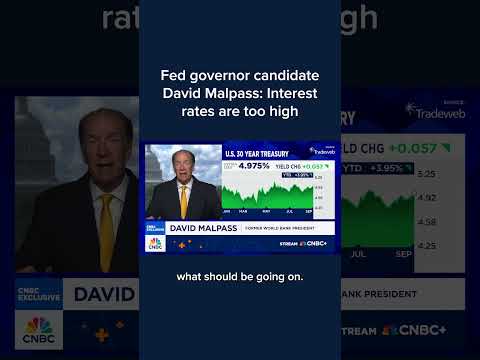
Fed governor candidate David Malpass: Interest rates are too high
CNBC Television· 2025-09-02 17:15
The interest rates in the US are too high right now given the the health of the economy. If you have an economy that's changing rapidly for the better, it will produce more goods. Uh and that that is not getting uh accommodated uh within the Fed's policies.So the US should have a lower yield curve because the economy is so strong. That's not part of the Fed's model. Central banks tend to say no if things are really good then we raise rates.That's the reverse of what the the what should be going on. Final po ...