
债务重组

Search documents
碧桂园(02007):占第2类债务本金总额逾77%的持有人已加入重组支持协议
智通财经网· 2025-08-18 15:23
智通财经APP讯,碧桂园(02007)发布公告,该公司已经与协调委员会协定重组建议主要条款,协调委员 会占现有银团贷款本金总额的49%。协调委员会的成员已加入重组支持协议(已作出下文概述的修订), 或正在进行内部程序以取得加入该重组支持协议的相关批准。 本公司很高兴能达到此重要里程碑,并谨此就协调委员会、专案小组及其他债权人的持续支持、耐心及 参与致以谢意。本公司现正与专案小组及协调委员会就建议重组的长式文件紧密合作,并继续致力于在 2025年年底前完成建议重组。本公司深知此目标远大,亦不会低估未来的挑战,但相信在专案小组、协 调委员会、其他债权人及持份者的持续支持下,此目标是可实现的。 本公司亦欣然宣布,占第2类债务本金总额逾77%的持有人已加入重组支持协议。 ...

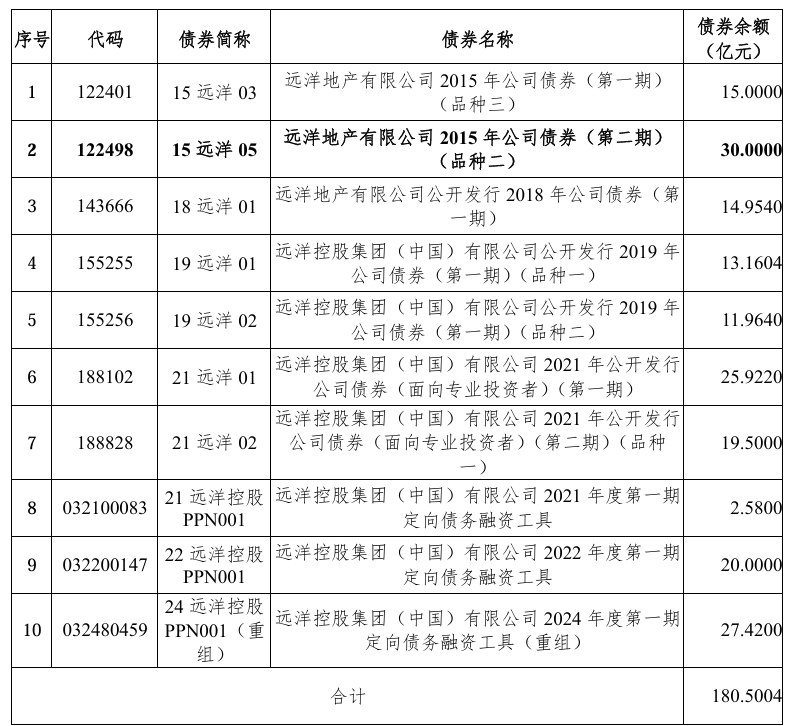
远洋集团公布境内债务重组方案:本金总额180.5亿元,现金购回上限8亿元
Xin Lang Cai Jing· 2025-08-18 14:23
增信保障措施调整。解除原18项增信资产(含商业、住宅项目收益权等)的担保措施全部解除。新担保机制:剩 余未用于重组选项的资产将按比例重新分配,为长期留债提供担保(需重新办理手续)。 发行人还给出了其他重组方案选项。一,现金购回方案,按债券面值的20%折价购回(即每张面值100元的债 券,购回价为20元);总额上限8亿元,若申报金额超额,按比例分配。资金来源于出售部分原始增信资产(如 北京王府井H2、中山远洋繁花里等项目的收益权)。 股票经济收益权选项。远洋集团拟在中国香港向特殊目的主体增发不超过28亿股,标的债券持有人登记选择股票 经济收益权选项后,拟采用设立境内信托等合法有效形式,使得获配股票经济收益权选项的标的债券持有人间接 持有定增股票的经济收益权。定价方面,每100元面值债券=【远洋股票交易均价×汇率×5倍】对应股数;申报总 智通财经获取的文件显示,8月18日,远洋集团(03377.HK)旗下北京远洋控股集团有限公司发布境内债务重组 方案,并将于9月9日至9月12日召开债权人会议,重组包括7笔公司债和3笔PPN,本金额合计180.5亿元。 | 序号 | 代码 | 债券简称 | 债券名称 | 债券余额 ...

融创中国拟发行强制可转换债券及采纳团队稳定计划
Zhi Tong Cai Jing· 2025-08-18 13:11
Core Viewpoint - Sunac China (01918) has announced that approximately 75% of creditors holding existing debt have joined the restructuring support agreement as of June 24, 2025, committing to vote in favor of the plan at the scheduled meeting [1] Group 1: Restructuring Details - The restructuring will involve the company's offshore debt, with an estimated total debt claim (including principal and accrued unpaid interest, excluding default interest) amounting to approximately $9.552 billion as of June 30, 2025, subject to verification by the plan administrator [1] - The restructuring will include the release of the company's debt and certain obligations of other entities within the group [1] Group 2: Convertible Bond Issuance - The company plans to issue two series of mandatory convertible bonds as consideration for the cancellation of existing debt and the release of related claims, with the total principal amount equivalent to the total claims of all plan creditors [2] - Creditors will have the option to choose between the two series of convertible bonds or a combination of both, subject to the terms of the restructuring support agreement [2] Group 3: Related Convertible Bonds - Mandatory convertible bonds will be issued to Sunac International as a plan creditor, which will convert into mandatory convertible bonds during the restructuring [3] - Additionally, convertible bonds will be issued to Mr. Sun Hongbin to maintain the stability of the shareholding structure and ensure his continued contribution to the group's operations and debt risk mitigation [4] Group 4: Team Stability Plan - The company aims to adopt a team stability plan to ensure a capable and stable team is in place for ongoing operations and long-term recovery, which includes granting shares to selected employees as a long-term supplement to their compensation [5] - This plan is intended to incentivize recipients to continue contributing to the group's operations and development [5] Group 5: Increase in Authorized Share Capital - The board of directors proposes to seek shareholder approval to increase the authorized share capital from HKD 1.5 billion (150 billion shares) to HKD 3 billion (300 billion shares) to facilitate the transactions under the restructuring, including the issuance of convertible bonds [6] - This increase is deemed to be in the overall interest of the company and its shareholders, providing more flexibility for future fundraising [7]
融创中国(01918)拟发行强制可转换债券及采纳团队稳定计划
智通财经网· 2025-08-18 12:31
Core Viewpoint - Sunac China Holdings Limited is undergoing a debt restructuring process, with approximately 75% of existing debt holders agreeing to a restructuring support agreement, which includes a total estimated debt claim of $9.552 billion as of June 30, 2025 [1] Group 1: Debt Restructuring - The restructuring support agreement involves the release of the company's debts and certain obligations of other entities within the group [1] - The restructuring will include the issuance of two series of mandatory convertible bonds to the plan creditors as a means to extinguish existing debts [2] - The total principal amount of the mandatory convertible bonds will equal the total debt owed to the plan creditors, with options for creditors to choose between different series of bonds [2] Group 2: Shareholder and Management Plans - The company plans to issue mandatory convertible bonds to its major shareholder, Sun Hongbin, to maintain a stable equity structure and ensure his continued contribution to the group's operations and debt risk mitigation [3] - A team stability plan is proposed to incentivize selected employees through the issuance of new shares as a long-term supplement to their compensation, aimed at ensuring a stable and capable team for the company's recovery [4] Group 3: Capital Increase Proposal - The board of directors proposes to increase the authorized share capital from HKD 1.5 billion (150 billion shares) to HKD 3 billion (300 billion shares) to facilitate the restructuring transactions, including the issuance of mandatory convertible bonds [5] - This increase in authorized share capital is deemed to be in the overall interest of the company and its shareholders, providing more flexibility for future fundraising [6]
融创中国(01918.HK)拟根据特别授权发行强制可转换债券及采纳团队稳定计划
Ge Long Hui· 2025-08-18 12:27
Group 1 - The company announced that approximately 75% of creditors holding existing debt have joined the restructuring support agreement as of June 24, 2025 [1] - The estimated total debt claim amount, including principal and accrued unpaid interest, is approximately $9.55 billion as of June 30, 2025, subject to verification by the plan administrator [1] - The restructuring will involve the cancellation of existing debts and certain obligations of other entities within the group [1] Group 2 - As part of the restructuring, two series of mandatory convertible bonds will be distributed to plan creditors as consideration for the cancellation of existing debts, with the total principal amount equivalent to the total claims of all plan creditors [1] - The company plans to apply for the listing and quotation of the mandatory convertible bonds on the new exchange [1] Group 3 - The company intends to distribute restricted shares to major shareholders or their designated persons to maintain the equity structure stability, ensuring the continued contribution of key individuals to the group's debt risk resolution and long-term business recovery [2] - According to the equity structure stability plan, for every $100 principal of mandatory convertible bonds allocated to plan creditors (excluding those belonging to the company), $23 will be issued to key individuals [2] Group 4 - The board of directors proposes to seek shareholder approval at a special general meeting to increase the authorized share capital from HKD 1.5 billion (15 billion shares) to HKD 3 billion (30 billion shares) by adding an additional 15 billion unissued shares [3]
安徽德豪润达电气股份有限公司关于子公司签署《和解协议书》暨债务重组的公告
Shang Hai Zheng Quan Bao· 2025-08-15 19:16
Debt Restructuring Overview - Anhui Dehao Runda Electric Co., Ltd. announced a debt restructuring plan involving its subsidiary Wuhu Dehao Runda Optoelectronics Technology Co., Ltd. to alleviate its debt burden and optimize its debt structure [2][11] - The total debt involved in the restructuring amounts to approximately 80.26 million yuan, with an expected debt reduction of no less than 44.28 million yuan, resulting in a remaining debt of no more than 35.98 million yuan [2][11] Debt Settlement Agreements - Wuhu Dehao Runda has signed settlement agreements with three creditors: Guangdong Zhongtu Semiconductor Technology Co., Ltd., Nanchang Delan Technology Co., Ltd., and Xuzhou Tongxin Optoelectronics Technology Co., Ltd. [2][10] - The agreements allow for various payment options, including a 6.5% discount on the principal amount owed, with specific payment schedules outlined for each creditor [9][10][11] Financial Impact - The debt restructuring is expected to have a positive impact on the company's financial status, with preliminary estimates indicating a benefit of no less than 44.28 million yuan [11][12] - The restructuring is part of the company's broader strategy to reduce historical debt burdens and improve financial health [11][12] Board Approval - The restructuring plan was approved during the eighth board meeting held on August 15, 2025, and does not constitute a related party transaction or a major asset restructuring as per relevant regulations [3][12] Creditors' Background - Guangdong Zhongtu Semiconductor Technology Co., Ltd. is a non-listed joint-stock company with a registered capital of approximately 426.02 million yuan [4][5] - Nanchang Delan Technology Co., Ltd. is a wholly-owned subsidiary of Dejing Technology Co., Ltd., with a registered capital of 20 million yuan [6] - Xuzhou Tongxin Optoelectronics Technology Co., Ltd. is a non-listed joint-stock company with a registered capital of approximately 262.16 million yuan [7]

华夏幸福基业股份有限公司关于债务重组进展等事项的公告
Shang Hai Zheng Quan Bao· 2025-08-15 18:38
Core Viewpoint - The company is actively progressing with its debt restructuring plan, aiming to mitigate debt risks and improve operational stability amid challenging macroeconomic conditions. Debt Restructuring Progress - As of July 31, 2025, the company has achieved a cumulative debt restructuring amount of approximately RMB 192.67 billion through signed agreements, which includes RMB 37.13 billion in domestic corporate bonds and USD 4.96 billion (approximately RMB 33.53 billion) in overseas bonds [2][3] - The company has established "Happiness Selected Platform" and "Happiness Preferred Platform" to offset financial and operational debts, with a total amount of approximately RMB 23.63 billion [2][3] - The total amount of debts that the company has failed to repay on time is RMB 23.11 billion, excluding interest [2][3] Debt Repayment and Litigation - From July 1 to July 31, 2025, the company incurred an additional RMB 0.90 billion in debts that were not repaid on time, bringing the total to RMB 23.11 billion [8] - The company has recently faced new litigation and arbitration cases amounting to RMB 0.883 billion, which represents 21.57% of the company's latest audited net assets of RMB 4.095 billion [9] Debt Compensation via Equity - As of July 31, 2025, the "Happiness Selected Platform" has compensated financial debts amounting to approximately RMB 17.45 billion, with creditors receiving about 43.00% equity [7] - The combined compensation for operational debts through both platforms amounts to approximately RMB 6.17 billion, with creditors receiving 2.90% and 11.85% equity in the respective platforms [7] Trust Plan and Asset Sale - The company has established a trust plan with a scale of approximately RMB 25.58 billion, which is intended to offset financial debts of up to RMB 24.00 billion [6] - As of August 9, 2025, the company has completed trust offset transactions amounting to RMB 22.35 billion [6]

ST德豪(002005.SZ):子公司签署《和解协议书》暨债务重组
Ge Long Hui A P P· 2025-08-15 12:09
Group 1 - The core point of the article is that ST Dehao (002005.SZ) has signed debt settlement agreements with creditors to alleviate its debt burden, involving a total debt amount of approximately 80.26 million yuan [1] - The debt settlement involves creditors including Zhongtu Semiconductor, Delan Technology, and Tongxin Optoelectronics, with a debt reduction amount expected to be no less than 44.28 million yuan [1] - After the debt reduction, the amount to be repaid is expected to be no more than 35.98 million yuan, indicating a significant restructuring of the company's debt [1]

华夏幸福(600340.SH):累计未能如期偿还债务金额合计231.10亿元
Ge Long Hui· 2025-08-15 12:04
Group 1 - The company announced a debt restructuring plan with a total financial debt restructuring amount of approximately RMB 192.669 billion as of July 31, 2025, including the company and its subsidiaries [1] - The company has utilized equity compensation through its subsidiaries' platforms, "Happiness Selected Platform" and "Happiness Preferred Platform," to address financial and operational debts totaling approximately RMB 23.625 billion as of July 31, 2025 [1] - The total amount of debts that the company has failed to repay on time, excluding interest, is RMB 23.110 billion as of July 31, 2025, with financial debts to be executed according to the agreed maturity dates in the debt restructuring agreement [1]
华夏幸福:累计未能如期偿还债务金额合计231.10亿元
Ge Long Hui· 2025-08-15 11:44
Group 1 - The company announced a total debt restructuring amount of approximately RMB 192.669 billion, which includes domestic corporate bonds and overseas USD bonds issued by its wholly-owned subsidiaries [1] - The company has utilized equity from its subsidiaries to build the "Happiness Selected Platform" and "Happiness Preferred Platform," resulting in a total equity compensation for financial and operational debts of approximately RMB 23.625 billion [1] - As of July 31, 2025, the total amount of debts that the company has failed to repay on time is RMB 23.110 billion, excluding interest [1] Group 2 - From July 1 to July 31, 2025, the company incurred new litigation and arbitration matters with a total amount involved of RMB 0.883 billion, and the outcomes of these cases remain uncertain [1]