
退市不免责

Search documents
全面“亮剑”!证监会月内已开8张财务造假罚单
Zheng Quan Ri Bao Zhi Sheng· 2025-09-17 04:35
Core Viewpoint - The Chinese regulatory authorities have adopted a "zero tolerance" approach towards financial fraud, significantly increasing penalties and enforcing accountability across the entire chain of responsibility, aiming to create a market environment where fraud is neither tolerated nor profitable [1][4][6]. Regulatory Actions - In September, ST Emergency was fined a total of 5.9 million yuan for financial fraud in its 2022 annual report, marking the eighth penalty issued for financial misconduct this month [1]. - Two companies that have been delisted, Yili Clean Energy and Shanghai Longyu Data, received fines of 38.1 million yuan and were penalized for financial fraud and fraudulent issuance of shares [2]. - Over 30 companies have been penalized for financial fraud this year, indicating a comprehensive regulatory crackdown that extends to both listed and delisted companies [2]. Penalty Amounts - The penalties for financial fraud have significantly increased, with several companies facing fines exceeding 1 billion yuan. For instance, Dongxu Optoelectronics was fined 4.2 billion yuan, and its controlling shareholder was fined 12.42 billion yuan for fraudulent activities [4][5]. - In August, Datang Gaohong was proposed to be fined 162 million yuan for continuous financial fraud over nine years [4]. Comprehensive Accountability - Regulatory authorities are expanding the scope of penalties to include third parties involved in financial fraud, such as suppliers and intermediaries, to dismantle the "ecosystem" of fraud [6][7]. - The accountability of intermediary institutions, including accounting firms and law firms, is being emphasized, with several cases of penalties for false documentation reported [6][7]. Legal Proceedings - Ongoing legal cases involve companies like Meishang Ecological Landscape and Jintongling Technology, with recent court rulings favoring investors in cases of securities fraud [8]. - There has been an increase in civil and criminal accountability for both the main perpetrators and accomplices of financial fraud, enhancing the overall deterrent effect of regulatory actions [7][8].
退市公司“顽疾”曝光 监管部门“一查到底”重拳整治
Shang Hai Zheng Quan Bao· 2025-09-16 18:32
Group 1 - Regulatory authorities continue investigations into delisted companies, with recent penalties amounting to billions for financial fraud, fraudulent issuance, fund occupation, and illegal guarantees [1][3][4] - The new "National Nine Articles" and delisting regulations emphasize the principle of "delisting does not exempt from liability," reflecting a zero-tolerance approach towards capital market violations [2][8] - Companies like Yili Clean Energy and Huatie Co. have faced severe penalties, with Yili Clean Energy's total fines reaching approximately 375 million yuan and significant bans imposed on its executives [3][4] Group 2 - Regulatory bodies are actively pursuing the recovery of occupied funds from delisted companies, ensuring that responsible parties are held accountable [5][6] - The case of Delisted Longyu illustrates ongoing investigations post-delisting, with fines totaling 38.1 million yuan for inflated income and undisclosed fund occupations [6] - The regulatory focus extends to intermediary institutions, which are also being penalized for their roles in facilitating financial misconduct [7][8] Group 3 - The Shanghai Securities Regulatory Bureau has reinforced its commitment to stringent oversight of delisted companies, ensuring that financial fraud is thoroughly investigated and that responsible individuals face increased penalties [8] - Investor protection mechanisms have been enhanced, providing various avenues for compensation and legal recourse for investors affected by delisted companies [8]
严监管!财报“难产”,这只A股拟被处罚
中国基金报· 2025-09-16 05:54
Core Viewpoint - The article highlights the administrative penalties imposed on *ST Jinli (Jinlitai) by the China Securities Regulatory Commission (CSRC) for failing to disclose its annual report on time, indicating a trend of strict regulatory oversight in the capital market [2][4][6]. Summary by Sections Administrative Penalties - Jinlitai received a notice of administrative penalties from the CSRC for not disclosing its 2024 annual report within the legal timeframe, resulting in fines ranging from 800,000 to 2 million yuan for the company and its executives [2][4][7]. - The CSRC's actions reflect a broader trend of stringent regulation, with recent penalties against other companies, including a 210 million yuan fine for Yili Clean Energy, emphasizing that even delisted companies are not exempt from accountability [6][9]. Company Actions and Timeline - On April 23, 2025, Jinlitai's management decided not to accept an audit report from Zhongxinghua Accounting Firm, which indicated an inability to express an opinion on the company's financial statements [4][5]. - Jinlitai issued multiple announcements regarding its inability to disclose the annual report on time, with the final report being released on July 1, 2025, after a significant delay [5][6]. Regulatory Environment - The CSRC's recent actions demonstrate a commitment to pursuing accountability for major violations in the capital market, with a notable increase in the number of companies being delisted due to serious infractions [9][10]. - The trend of "no exemption after delisting" is becoming a common understanding in the market, which is expected to enhance the regulatory framework and promote high-quality development in the Chinese stock market [10].


严监管!财报“难产”,这只A股拟被处罚
Zhong Guo Ji Jin Bao· 2025-09-16 05:17
Core Viewpoint - The China Securities Regulatory Commission (CSRC) has issued a prior notice of administrative punishment to *ST Jintai (Jinlitai) for failing to disclose its annual report on time, resulting in fines for the company and its executives [2][4]. Summary by Sections Company Penalties - Jinlitai received a warning and a fine of 200,000 yuan for failing to disclose its annual report within the legal timeframe [7]. - The company's former chairman and president, Luo Dian, was fined 1 million yuan, while the executive president and board secretary, Wu Chunchao, and the financial director, Sui Jingyuan, were each fined 800,000 yuan [7]. Regulatory Environment - The CSRC has intensified its regulatory actions, issuing multiple fines to companies, including a significant penalty of over 210 million yuan to Yili Clean Energy for serious violations such as financial fraud and market manipulation [6][9]. - The regulatory body emphasizes that even companies that have been delisted will not escape accountability for their actions, reinforcing a "zero tolerance" policy towards major violations in the capital market [9]. Market Implications - The increase in delistings in the A-share market, with 25 companies delisted this year, indicates a stricter enforcement of regulations, particularly against companies involved in significant legal and financial misconduct [9]. - Analysts suggest that as the concept of "delisting does not exempt from responsibility" becomes widely accepted, capital will be directed towards value-creating sectors, contributing to the high-quality development of the Chinese stock market [9].
亿利洁能公司及管理层被罚3.75亿元
Guo Ji Jin Rong Bao· 2025-09-15 10:10
Core Viewpoint - Lianeng 5 (formerly "Yili Clean Energy" and "ST Yili") is facing administrative penalties from the Inner Mongolia Securities Regulatory Bureau for alleged violations of information disclosure and fraudulent bond issuance, with a total fine of 375 million yuan proposed [1][2] Summary by Relevant Sections Allegations and Violations - The company is accused of financial fraud, related guarantees, and fund occupation leading to information disclosure violations from 2016 to 2023 [1] - Additionally, the company is charged with fraudulent bond issuance, with its controlling shareholder, Yili Resources Group, implicated in organizing and directing these actions [1] Penalties and Consequences - The proposed fines include 210 million yuan for Lianeng 5 and 30 million yuan for Yili Group, with 29 individuals facing penalties [2] - Certain individuals, including independent directors and supervisors, are also held accountable despite not being in executive positions, reflecting a broader accountability approach [2] - Seven individuals are subject to market bans ranging from five years to lifetime, enhancing the severity of the penalties [2] Regulatory Context - The case underscores the regulatory stance that "delisting does not exempt from liability," reinforcing the commitment of regulatory bodies to pursue accountability for significant violations [1]

资本市场丨牛市氛围渐浓 A股公司增持力度不减
Sou Hu Cai Jing· 2025-09-15 05:56
Group 1: Market Overview - Since August 2025, the A-share index has been rising, creating a bullish market atmosphere, which requires policy support and institutional improvements for future development [1][3][13] - The focus is on dividends, share buybacks, and delisting systems as key factors influencing the direction of the A-share market [1][3] Group 2: Shareholder Actions - As of September 9, 2025, 19 listed companies announced shareholder buyback plans, including several industry leaders [3][13] - Major shareholders and executives have been actively increasing their stakes, with significant announcements from companies like China Yangtze Power and Kweichow Moutai, indicating confidence in their long-term value [4][5][13] Group 3: Dividend Trends - In 2024, total dividends from A-shares reached 2.4 trillion yuan, with 89% of listed companies distributing dividends, although the distribution remains concentrated in five major industries [10][11] - The banking sector has been a significant contributor to dividends, with major banks consistently ranking high in dividend payouts [10][11] Group 4: Regulatory Environment - The A-share market is seeing an acceleration in delisting, with 24 companies delisted by September 7, 2025, primarily due to financial misconduct and regulatory violations [16][18] - The trend of "delisting without exemption" is becoming more common, indicating a stricter regulatory environment aimed at enhancing market integrity [16][19] Group 5: Recommendations for Improvement - Experts suggest establishing a rigid "profit equals dividend" mechanism to enhance the dividend culture and ensure more equitable distribution among companies [10][12] - There is a call for improved transparency and accountability in shareholder buyback and dividend announcements to prevent misleading practices and enhance investor confidence [8][9][12]


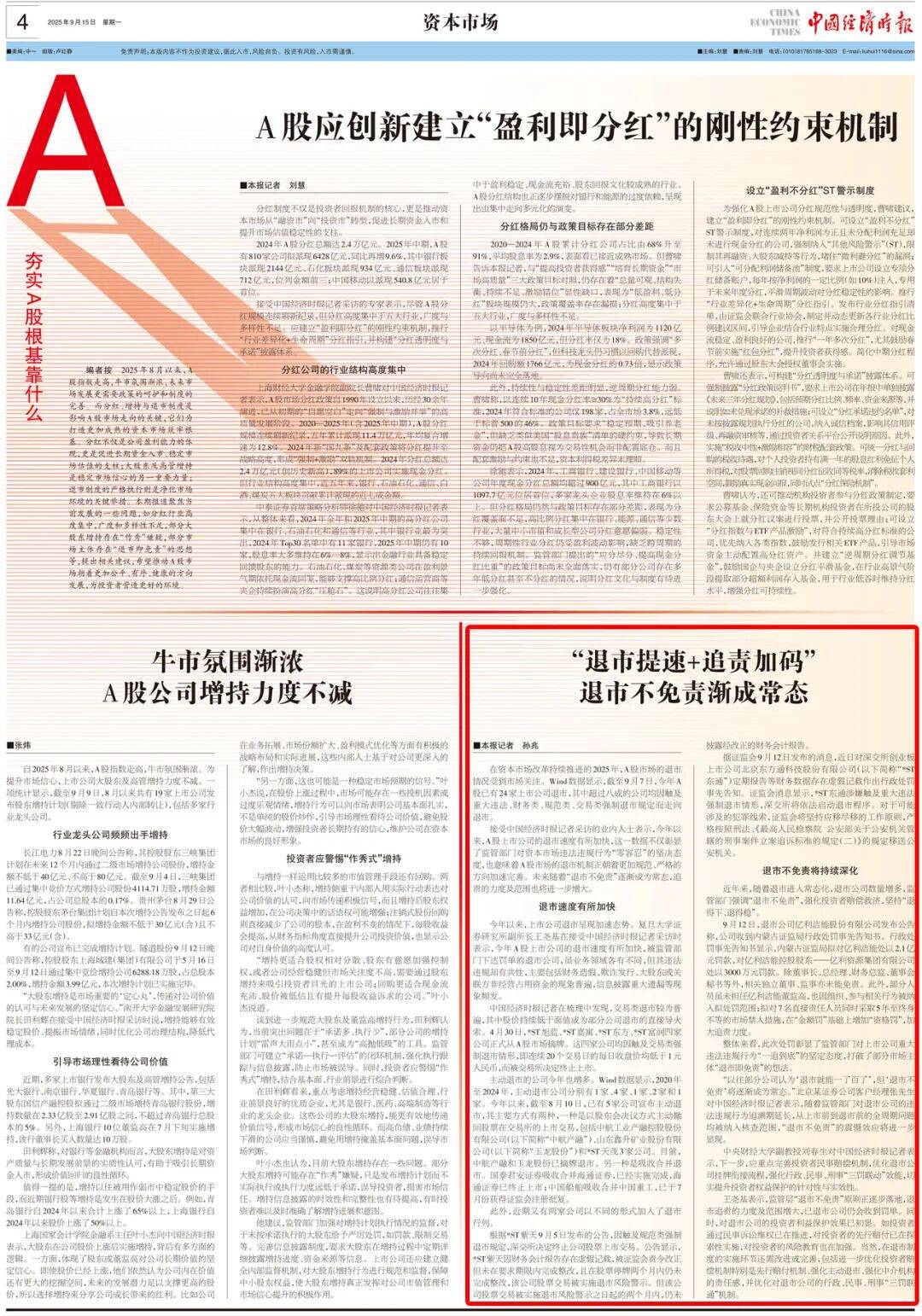
资本市场丨“退市提速+追责加码” 退市不免责渐成常态
Sou Hu Cai Jing· 2025-09-15 04:33
Core Viewpoint - The A-share market is experiencing a bullish trend since August 2025, necessitating policy support and institutional improvements to foster a mature capital market. Key factors influencing the market include dividend policies, share buybacks, and strict delisting regulations, which are essential for stabilizing market valuations and attracting long-term capital [1][2][15]. Dividend Policies - The total dividend payout in A-shares reached 2.4 trillion yuan in 2024, with 810 companies planning to distribute 642.8 billion yuan in the first half of 2025, a 9.6% increase year-on-year. The banking sector accounted for 214.4 billion yuan, while the petrochemical sector contributed 93.4 billion yuan [9][10]. - Despite record-high dividends, the distribution is highly concentrated in five industries, indicating a lack of diversity and breadth in dividend payments. The establishment of a "profit equals dividend" mechanism is suggested to enhance transparency and encourage broader participation in dividend distribution [9][10][11]. Delisting Mechanism - As of September 7, 2025, 24 companies have been delisted from the A-share market, with over 80% due to severe violations, including financial fraud and regulatory non-compliance. This reflects a stricter and more standardized delisting mechanism being implemented by regulatory authorities [2][15][17]. - The trend of voluntary delisting has also increased, with five companies opting for this route in 2025, compared to previous years where the numbers were significantly lower [4][15]. Share Buybacks and Stake Increases - Since August 2025, there has been a notable increase in share buyback announcements and stake increases by major shareholders and executives, aimed at boosting market confidence. For instance, major shareholders of companies like Yangtze Power and Kweichow Moutai have announced substantial buyback plans [12][13]. - The increase in share buybacks is seen as a stabilizing factor for stock prices and a signal of confidence in the company's long-term value, especially following significant price increases in the banking sector [12][14]. Regulatory Environment - The regulatory environment is evolving towards a "delisting does not exempt from liability" principle, which emphasizes accountability for companies that are delisted due to misconduct. This includes potential penalties and legal actions against responsible parties, reinforcing the message that delisting does not absolve companies from their obligations [6][17][18]. - There is a call for improvements in investor compensation mechanisms and the establishment of a more robust framework for handling delisted companies, including civil, administrative, and criminal penalties [7][17].
9.15犀牛财经早报:科创主题基金成上涨“领头羊” “退市不免责”常态化执法格局成型
Xi Niu Cai Jing· 2025-09-15 01:37
Group 1 - The performance of science and technology innovation theme funds has significantly increased, with an average net value growth of nearly 100% over the past year, particularly in the chip sector [1] - Regulatory authorities are intensifying their crackdown on financial fraud, with multiple companies receiving heavy fines, including cases exceeding 100 million yuan, indicating a strong stance against market misconduct [2] - The China Automobile Industry Association has issued a payment standard initiative for automotive suppliers, stipulating a maximum payment period of 60 days post-delivery and acceptance [3] Group 2 - The tourism market is experiencing a surge in demand as the Mid-Autumn Festival and National Day approach, with significant increases in short-distance and charter travel bookings [3] - Solid-state battery technology is advancing, with semi-solid batteries already in use, but material cost control remains a key challenge for mass production [3] - A breakthrough in microchip manufacturing has been achieved by an international team, developing new materials and processes for producing smaller, faster, and lower-cost high-performance chips [3] Group 3 - The iPhone 17 series has seen significant price reductions on platforms like Pinduoduo, with discounts of nearly 1,000 yuan compared to Apple's official pricing [4] - Xi Bei has confirmed the payment of 60 million yuan in consulting fees to Hua Yu Hua for ten years of service, amidst ongoing discussions about the company's strategy [4] - Zhongyou Securities' Xinjiang branch has received a warning letter for failing to report internal disciplinary actions, reflecting compliance issues within the firm [5] Group 4 - CIFI Group has been served with a civil lawsuit for 812 million yuan related to its subsidiary's failure to complete land development as agreed [6] - Shanghai Botai Internet Technology has submitted post-hearing documents for its IPO application in Hong Kong, indicating approval from the exchange [6] - Qianjin Pharmaceutical has received regulatory approval for the acquisition of stakes in two subsidiaries, enhancing resource integration and control [7][8] Group 5 - Colin Electric plans to raise up to 1.5 billion yuan through a private placement to supplement its working capital [9] - U.S. stock indices showed mixed performance, with the S&P 500 down 0.05% and the Nasdaq up 0.44%, as investors remain cautious ahead of the Federal Reserve meeting [10] - Tesla shares surged approximately 7.4%, marking its largest daily gain in nearly three months, while other stocks in the vaccine sector experienced significant declines [10]
惩防闭环织密监管防线 “退市不免责”常态化执法格局成型
Zhong Guo Zheng Quan Bao· 2025-09-14 20:58
Core Viewpoint - The regulatory authorities have adopted a "zero tolerance" approach towards financial fraud, as evidenced by significant penalties imposed on multiple listed companies, signaling a shift in enforcement where "delisting does not equate to immunity" [1][3][4]. Regulatory Actions - The China Securities Regulatory Commission (CSRC) has taken strict actions against *ST Dongtong for falsifying financial data over four consecutive years, proposing a fine of 229 million yuan and initiating delisting procedures due to serious violations [2][3]. - Similar actions have been taken against other companies like Delisting Longyu, which faces fines totaling 38.1 million yuan for inflating revenue and profits in multiple annual reports [2]. Market Impact - The recent enforcement actions have shattered the misconception that companies could escape accountability after delisting, reinforcing the message that the costs of fraud outweigh any short-term gains [3][4]. - A record number of companies, over ten, have faced potential delisting due to financial fraud this year, indicating a growing trend in regulatory scrutiny [3]. Governance and Compliance - The regulatory environment is pushing companies to enhance internal controls and governance, shifting the focus from "beautifying financial statements" to prioritizing compliance [4][5]. - There is a noticeable decrease in the motivation for companies to engage in fraudulent activities, with more firms opting for compliance improvements and strategic investments to optimize performance [5][6]. Future Directions - Experts suggest that a comprehensive prevention and punishment mechanism needs to be established, emphasizing the importance of improving foundational systems to support stringent enforcement against financial misconduct [7]. - Recommendations include leveraging new technologies for better detection of fraud, enhancing the responsibilities of intermediary institutions, and establishing clearer legal frameworks to support regulatory actions [7].
“退市不免责”常态化执法格局成型
Zhong Guo Zheng Quan Bao· 2025-09-14 20:14
Core Viewpoint - The China Securities Regulatory Commission (CSRC) has intensified its crackdown on financial fraud among listed companies, establishing a "zero tolerance" policy that undermines the notion that delisting offers immunity from accountability [1][2]. Regulatory Actions - The CSRC has issued significant penalties for financial fraud, including a proposed fine of 229 million yuan for *ST Dongtong, which was found to have inflated revenue and profits for four consecutive years [1]. - The case of *ST Dongtong has led to the initiation of delisting procedures due to serious violations, reinforcing the message that regulatory scrutiny will persist regardless of a company's delisting status [2]. Market Impact - The trend of "delisting does not equate to immunity" has become a norm, with over ten companies facing potential delisting due to financial fraud this year, marking a record high [2]. - From the beginning of 2024 to August 31, the CSRC has investigated 67 delisted companies for illegal activities, resulting in a total fine of 1.246 billion yuan for 46 of these cases [2]. Governance and Compliance - There is a shift in the responsibilities of company executives, moving from passive compliance to active accountability, as seen in the case of ST Lutong, where board members expressed concerns over the accuracy of financial reports [3]. - Companies are increasingly opting for compliance and proactive measures, such as introducing strategic investors and adjusting performance expectations, rather than resorting to fraudulent practices [3]. Future Directions - Experts suggest that enhancing the comprehensive prevention and punishment mechanism is essential for combating financial fraud, which includes improving the efficiency of on-site inspections and leveraging new technologies for better oversight [4][5]. - There is a call for stricter accountability for intermediary institutions and independent directors, emphasizing the need for audit firms to maintain independence and rigorously adhere to auditing standards [5].