
AI浪潮

Search documents
合肥半导体材料公司启动科创板 IPO!
是说芯语· 2026-03-26 12:13
Core Viewpoint - Hefei Andekeming Semiconductor Technology Co., Ltd. has officially launched its IPO counseling for the Sci-Tech Innovation Board, becoming a focal point in the domestic semiconductor materials localization wave due to its impressive operational performance and mature capacity layout [1][10]. Group 1: Company Overview - Established in 2018, Andekeming focuses on the research, production, and sales of advanced electronic-grade semiconductor thin film (ALD, CVD) precursor materials, achieving a full industry chain layout from R&D to mass production [4]. - The company has R&D and production bases in Hefei and Tongling, with a sales and market development center in Shanghai, and has secured 61 authorized patents, establishing a solid technological barrier [4]. - The annual production capacity of high-purity precursor materials is expected to reach 210 tons by 2025, with revenue from the Tongling base projected to reach 239 million yuan, driving significant growth [4]. Group 2: Market Position and Growth - Andekeming has successfully entered the supply chain of leading domestic wafer manufacturers, receiving strategic investments from industry capital, which enhances its market position and aligns its technology with downstream storage chip manufacturing needs [4][10]. - The domestic precursor market is projected to reach approximately $500 million by 2025, driven by the continuous demand from the semiconductor industry [5]. - The market for High-K precursors is particularly significant, as it is a critical material for advanced processes, with DRAM being the largest application scenario [6]. Group 3: Industry Challenges and Opportunities - Domestic precursor companies face high technical barriers and long customer validation cycles, particularly in high-end product areas, where they still lag behind international giants [8]. - The years 2026 will be a critical juncture for the domestic semiconductor precursor industry, with the release of advanced production capacity expected to create new development opportunities [10][11]. - The expansion plans of major storage manufacturers, such as Nanya Technology and others, are expected to drive demand for precursor materials significantly, with a projected compound annual growth rate of 27% from 2023 to 2028 [9]. Group 4: Strategic Importance of IPO - The IPO financing for Andekeming is crucial for expanding production capacity, enhancing R&D, and market expansion, which are essential for maintaining competitiveness in the industry [10]. - The company's successful entry into the capital market could facilitate further advancements in high-end product development and expansion of advanced production capacity, particularly in core areas like High-K precursors [10][11].


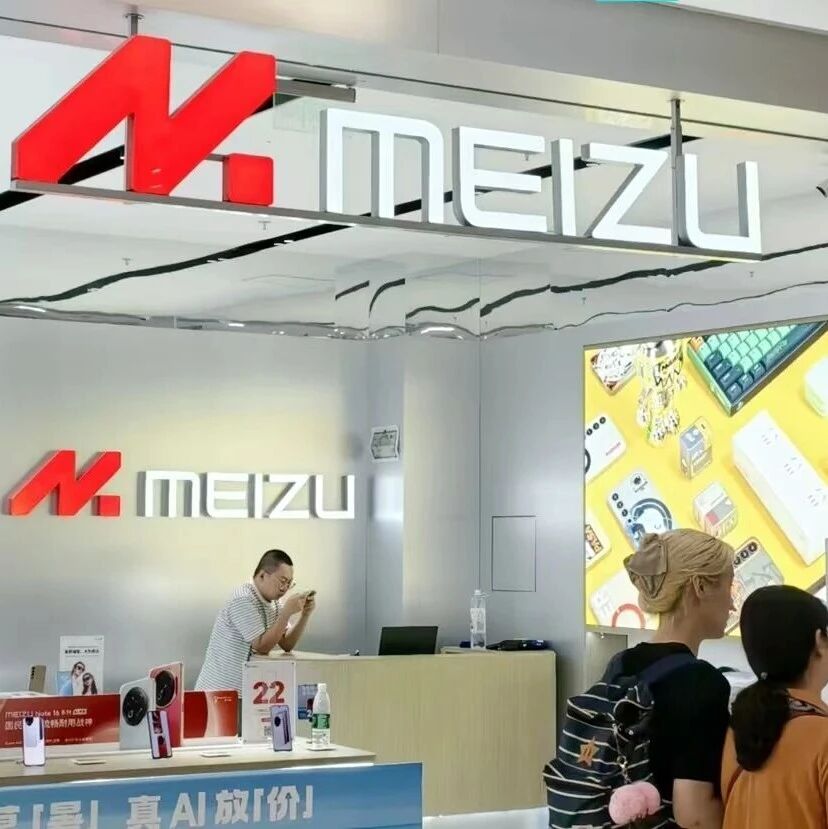
魅族手机「解体」:做车机,做AI,或者离开丨36氪独家
36氪· 2026-03-14 00:59
Core Viewpoint - The article discusses the significant impact of the AI wave on the smartphone industry, highlighting the recent turmoil faced by Meizu, a 23-year-old smartphone company, as it undergoes major organizational changes and strategic shifts due to rising component costs and market competition [4][20]. Group 1: Company Restructuring - Meizu has announced a major restructuring, with over 50% of its employees, approximately 400 individuals, set to leave the company [6][8]. - The remaining employees will be divided into different teams, with some integrating into the Flyme automotive team and others exploring AI software directions [8][9]. - Meizu's brand will no longer be used by the remaining team, which may also change its corporate structure [9]. Group 2: Market Challenges - The smartphone industry is facing severe challenges due to skyrocketing memory prices, which have significantly altered the BOM (Bill of Materials) cost structure for smartphones [14][15]. - For low-end smartphones (priced under $200), memory costs now account for 43% of the total cost, reflecting a 25% increase [17]. - Major smartphone manufacturers, including OPPO and Xiaomi, have begun raising prices across various models due to these cost pressures, marking the largest collective price increase in five years [19]. Group 3: Strategic Shifts - Meizu's strategic pivot includes pausing its domestic hardware development for new smartphone products and seeking partnerships with third-party hardware providers [8][9]. - The company aims to build a sustainable business model centered around the Flyme open ecosystem, indicating a shift towards software and services rather than hardware [9][11]. - The decision to halt new product development was influenced by the rising costs of memory components, which have made new product commercialization increasingly challenging [14].
观察丨莫被“养虾热”牵着鼻子走
证券时报· 2026-03-11 14:48
Core Viewpoint - The article discusses the recent trend of local governments in China rapidly implementing subsidy policies for AI technology, specifically focusing on the "OpenClaw" initiative for lobster farming, raising questions about the sustainability and strategic foresight of such policies [1][2]. Group 1: Policy Response and Competition - Local governments are competing to attract AI technology investments by offering substantial subsidies, with amounts reaching hundreds of thousands of yuan [1]. - This rapid policy response reflects a strong desire among cities to embrace new technologies and maintain competitiveness in the AI sector [1]. Group 2: Concerns and Risks - The article raises concerns that the uniformity and speed of these policies may exacerbate technological anxiety among businesses and society, fostering a mindset that failing to adopt such technologies equates to falling behind [1]. - The maturity, safety, and long-term viability of the "OpenClaw" initiative are questioned, suggesting that it may not fulfill the expectations for local industrial upgrades [1]. Group 3: Long-term Strategy and Innovation - The article emphasizes the need for a more thoughtful approach to innovation policy that goes beyond short-term subsidies, advocating for a focus on foundational research, innovation ecosystems, and talent development [2]. - It warns against the historical pitfalls of hasty subsidy programs that have led to issues like resource misallocation and fraud, urging for a nurturing environment for diverse innovation and tolerance for failure [2].

光通信后,美股存储公司也集体大涨,英伟达称“产多少用多少”
Xuan Gu Bao· 2026-03-10 23:16
Group 1 - The core viewpoint of the articles highlights a significant surge in the storage chip market driven by the AI boom, with major companies like SanDisk, Micron, and Western Digital seeing stock increases of over 5% following NVIDIA CEO Jensen Huang's statement on storage capacity demand [1] - Samsung Electronics plans to raise NAND Flash prices significantly, with a reported increase of over 100% in Q1 2023, leading to an expected cumulative price rise of over 200% in the first half of the year [1] - Other NAND manufacturers, including SK Hynix and Kioxia, are expected to follow suit with price increases, indicating a broader trend in the industry [1] Group 2 - According to Rongzhong Consulting, the price increase trend for storage chips is expected to continue at least until the second half of 2026, with projections of a 40%-50% rise in Q1 2026 and an additional 20% increase in Q2 [2] - The DRAM supply shortage is anticipated to last until Q1 2027, while NAND shortages are expected to persist until Q3 2026, indicating prolonged demand pressures in the market [2] - TrendForce data suggests that the growth rate for DRAM and NAND will accelerate in 2026, with DRAM growth projected at 26% and NAND growth at 21%, both higher than in 2025 [2]

值得信任的优秀女性基金经理
Morningstar晨星· 2026-03-05 01:04
Core Viewpoint - The article highlights the growing presence and success of female fund managers in China's public fund industry, showcasing their professional skills and ability to deliver stable returns for investors, particularly in the context of International Women's Day [1]. Group 1: Qiao Qian - Xingzheng Global Fund - Qiao Qian has 17 years of investment research experience, with over 8 years in public fund management, demonstrating a mature investment framework developed through various market cycles [3]. - Since taking over the Xingquan Commercial Model Preferred Mixed Fund (LOF) in July 2018, Qiao has achieved a 17.50% annualized return, ranking 10th among peers and outperforming the benchmark by 10.97 percentage points [4]. - Qiao employs a GARP strategy, focusing on the balance between valuation and growth, and has successfully identified undervalued stocks in smaller companies, contributing to a portfolio that is slightly below the average market capitalization of peers [4][5]. Group 2: Huang Jun - Bank of China Fund - Huang Jun has 17 years of experience in the securities industry, with 11 years in portfolio management, and has developed a comprehensive investment system through various market cycles [7]. - Since taking over the Bank of China Theme Strategy Mixed Fund in March 2019, Huang has achieved an 18.58% annualized return, ranking 9th among peers and outperforming the benchmark by 12.36 percentage points [9]. - Huang's investment style combines macro industry comparisons with bottom-up stock selection, focusing on sectors with upward trends and capturing opportunities in TMT and automotive parts [9]. Group 3: Song Qianqian - GF Fund - Song Qianqian has 14 years of experience in the securities industry, with over 5 years in public fund management, and has played a key role in the development of GF Fund's fixed income investment system [12]. - Since taking over the GF Pure Bond Fund in July 2020, the fund has achieved a 4.04% annualized return, surpassing the China Bond Credit Index by 0.71%, ranking in the top 6 among credit bond funds [14]. - Song's investment style emphasizes "odds priority, balanced allocation, trading enhancement, and strict risk control," allowing her to capture structural opportunities in volatile markets [13].

新书 | 杜雨博士新书《货币新秩序》出版:美伊冲突升级、黄金破5000,谁改写全球财富规则?
未可知人工智能研究院· 2026-03-02 04:58
Core Viewpoint - The article discusses the transformation of the global financial landscape driven by the rise of stablecoins, the challenges faced by traditional financial systems, and the implications for individual wealth management in the digital age [2][21]. Group 1: Traditional Financial System Cracks - The current global financial market, despite its apparent prosperity, is experiencing significant underlying issues, highlighted by the surge in gold prices as a reflection of declining trust in existing monetary systems [4]. - The inefficiencies of the SWIFT system and the inflationary pressures on the US dollar are leading to a growing trend of "de-dollarization" among nations [4][5]. - The emergence of cryptocurrencies aimed to disrupt traditional finance but faced challenges such as volatility and operational limitations, paving the way for the rise of stablecoins [4][5]. Group 2: The Stablecoin Landscape - Stablecoins are not a monolithic entity; they represent a complex interplay of power dynamics, including centralization versus decentralization, and the competition between issuers and regulatory bodies [6][7]. - Different types of stablecoins, such as fiat-collateralized (e.g., USDT, USDC) and crypto-collateralized (e.g., DAI), exhibit varying degrees of stability and risk, with concerns over transparency and regulatory compliance [7][8]. - The competition among stablecoin issuers and the regulatory landscape is crucial for understanding the future of digital currencies and their role in the financial system [8]. Group 3: Impact on Global Financial Order - The growing scale of stablecoins is challenging sovereign currencies and reshaping global financial infrastructure, affecting every country and individual [10][11]. - Stablecoins are emerging as alternatives for smaller nations facing economic instability, while major economies like the US and China are navigating their own digital currency strategies [11][12]. - The rise of decentralized finance (DeFi) is heavily reliant on stablecoins, which serve as essential components for various financial services, although they also introduce new risks reminiscent of past financial crises [12]. Group 4: Opportunities and Risks for Individuals - The new monetary war presents both unprecedented wealth opportunities and significant financial risks for ordinary individuals, driven by market volatility and the emergence of stablecoins [14][15]. - The book provides a guide for individuals to identify arbitrage opportunities and understand the potential of stablecoins as a hedge against inflation [15]. - However, the digital financial landscape also harbors risks such as money laundering and fraud, necessitating awareness and understanding of the underlying rules to protect assets [15]. Group 5: Future of CBDC and Stablecoins - The competition between stablecoins and central bank digital currencies (CBDCs) will shape the future of the monetary landscape, with implications for global financial power dynamics [17][18]. - The book outlines three potential scenarios for the future of digital currencies, emphasizing the importance of technological integration and regulatory frameworks [18][19]. - The ultimate question remains: who holds the power to issue credit, a theme that has evolved with the advent of stablecoins and their role in the digital currency era [19].
内存涨价潮波及手机终端市场
Ke Ji Ri Bao· 2026-02-27 23:49
Core Viewpoint - Meizu has announced the suspension of new domestic smartphone hardware development due to the soaring prices of memory chips, marking it as the first smartphone brand affected by this price surge [1] Group 1: Reasons for Price Increase - The continuous price increase of memory chips is attributed to a severe imbalance in market supply and demand, driven by a surge in AI server demand and the clearing of inventory in smart terminals [2] - The supply side has been in a state of destocking and capacity control for the past couple of years, with core production capacity concentrated in a few companies, leading to insufficient supply elasticity [2] - The shift in demand from traditional consumer electronics and PCs to AI-driven applications has further strained supply, as semiconductor production capacity is rigid and cannot be quickly expanded [2] Group 2: Impact of Price Surge - The current wave of memory price fluctuations is expected to last for about 12 months but is unlikely to spiral out of control [3] - Counterpoint Research predicts that the average price of new smartphones in China will increase by 15% to 25% compared to similar models in 2025 starting from March [3] - Companies with supply chain advantages, scale procurement capabilities, operational efficiency, and technological innovation will be better positioned to maintain profitability and growth despite rising costs [3] Group 3: Progress of Domestic Capacity Release - The disparity in the progress of domestic production capacity is a significant background factor in the current price surge [4] - While some Chinese companies are increasing investments in the storage sector, high-end memory production faces challenges due to technology maturity and equipment constraints, making it difficult to quickly meet global high-end market demands [4] - Despite the global market being dominated by foreign manufacturers, domestic companies are making breakthroughs in storage technology and capacity, achieving scale applications in domestic servers and smartphone brands [4] Group 4: Long-term Outlook - In the medium to long term, advancements in domestic storage technology and gradual capacity release are expected to enhance supply chain autonomy, providing more stable cost expectations for the terminal market [5]
哑铃策略还有效吗?香港大盘30ETF(520560)下探新低,最新解读来了
Xin Lang Cai Jing· 2026-02-26 11:44
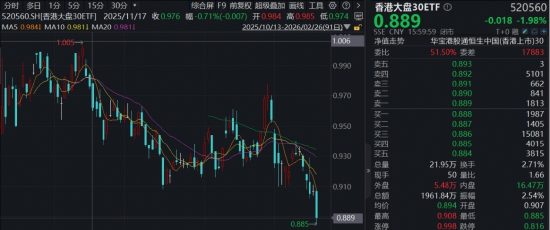
Market Overview - The Hong Kong stock market continued its recent downward trend, with the Hang Seng Index and Hang Seng Tech Index dropping by 1.44% and 2.87% respectively [1][9] - Major internet companies experienced significant declines, with Alibaba-W falling over 3%, Tencent Holdings and Meituan-W dropping over 2%, and Xiaomi Group-W decreasing by more than 1% [1][9] ETF Performance - The Hong Kong Large Cap 30 ETF (520560) closed down 1.98%, reaching a new low since its listing [1][10] - The ETF's underlying index, the Hang Seng China (Hong Kong Listed) 30 Index, has shown relative resilience, with a cumulative decline of 6.81%, which is less than the declines of the Hang Seng Tech Index (-10.65%) and the CSI Hong Kong Internet Index (-13.18%) during the same period [3][13] Investment Trends - Southbound capital has significantly increased its buying power since February, with net purchases exceeding 80 billion HKD, surpassing the total for January 2026 [3][12] - Notable increases in holdings were observed for Tencent Holdings and Alibaba-W, each gaining over 30 million shares, while Xiaomi Group-W and Meituan-W also saw substantial increases [3][12] Future Outlook - The long-term investment value in the technology and internet sectors is becoming more apparent following significant adjustments, supported by dividend assets [4][13] - According to Guangfa Securities, the ongoing decline in the Hong Kong market has released considerable emotional pressure, suggesting potential for recovery and capital inflow if positive catalysts emerge [4][13]
存储的超级周期被质疑了?
投中网· 2026-02-26 06:27
Core Viewpoint - The article discusses the impact of Citron Research's short-selling of SanDisk, highlighting concerns about the storage chip market and questioning the sustainability of the so-called "super cycle" driven by AI demand [5][8][27]. Group 1: Citron's Short-Selling and Market Reaction - Citron Research has established a short position against SanDisk, claiming that its valuation is misaligned and that there is a significant bubble [5]. - Following the announcement, SanDisk's stock price dropped over 8% at one point, ultimately closing down 4.2% [6]. - The A-share market reacted similarly, with several storage stocks experiencing a collective pullback, indicating a shift in market sentiment from enthusiasm to hesitation [7]. Group 2: Reasons for Citron's Bearish Stance - Citron presents three main arguments for its bearish outlook on SanDisk: 1. "Shareholder Exodus": Notably, Western Digital, a long-term investor in SanDisk, has significantly reduced its holdings at a price 25% lower than the current market price, which is often a strong signal of a market peak [13]. 2. "Illusory Supply and Demand": Citron argues that the NAND flash memory industry is cyclical, with current production capacity being double that of the 2018 peak, suggesting that perceived supply constraints may be misleading [14]. 3. "Threat from Samsung": Citron notes that Samsung is shifting its strategy to focus on higher-margin products, potentially threatening SanDisk's position in the high-end SSD market [16]. Group 3: Broader Market Implications - The article emphasizes that SanDisk is not representative of the entire storage market, as NAND flash memory does not encompass the full picture of the current storage cycle [21]. - The real driver of the current storage boom is DRAM, particularly HBM (High Bandwidth Memory), with major players like Samsung, SK Hynix, and Micron reallocating capacity towards higher-margin products [23]. - Despite concerns about competition, Samsung's stock has reached historical highs, with analysts projecting significant profit growth driven by resilient storage chip prices [26]. Group 4: Future Outlook for the Storage Cycle - The article argues that the storage super cycle is not over, with Nomura Securities predicting it will last at least until 2027, and meaningful supply increases are not expected until 2028 [29]. - Citigroup forecasts that average prices for DRAM and flash products will rise by 88% and 74% respectively by 2026, exceeding previous estimates [31]. - The article concludes that the storage super cycle remains intact and may last longer and be more robust than initially anticipated [32][44]. Group 5: Valuation Considerations - The article discusses the potential shift in valuation logic for storage companies, suggesting that the current market may start to view them as growth stocks rather than just cyclical commodities [37]. - Some institutions are already applying PE (Price-to-Earnings) ratios for valuation, indicating a growing belief in the sustainability of earnings growth driven by AI demand [39]. - The performance of storage companies in the coming years will significantly influence their valuation, with expectations for substantial earnings growth in 2026 and 2027 [42].

国信证券:首予敏实集团(00425)“优于大市”评级 品类持续迭代的全球汽配龙头
Zhi Tong Cai Jing· 2026-02-26 02:32
Core Viewpoint - Guosen Securities initiates coverage on Minth Group (00425) with an "outperform" rating, projecting rapid growth over the next five years, with net profit estimates of 2.8 billion, 3.3 billion, and 3.7 billion yuan for 2025-2027, representing growth rates of +20%, +16%, and +14% respectively, and an estimated reasonable valuation of 50-59 HKD per share [1] Group 1: Automotive Parts Sector - Minth Group is a leading global supplier of automotive exterior parts, benefiting from a diversified global customer base and product expansion [1] - The company has established itself as the largest supplier of battery boxes and body structure components, operating 77 factories and offices worldwide, serving over 80 automotive brands [1] - The company is leveraging the AI wave for industrial upgrades, focusing on robotics, liquid cooling, and low-altitude business to accelerate its second growth curve [1] Group 2: Financial Performance and R&D - The company has a stable cash flow from its exterior business, which supports the development of new products such as intelligent front-end modules and body sealing components [2] - In 2024, the company is expected to achieve a total revenue of 16.27 billion yuan from its exterior parts, reflecting a year-on-year growth of +6% [2] Group 3: Battery Box Business - Since exploring the battery box business in 2016, the company has become one of the largest aluminum battery box suppliers, with projected revenue of 5.3 billion yuan in 2024 [3] - The company aims to derive over 60% of its battery box revenue from Europe in 2024, capturing over 30% of the local market share [3] - The European battery box market is expected to grow from 17 billion yuan in 2025 to 33 billion yuan by 2029, with domestic market growth anticipated from 40 billion yuan to 60 billion yuan [3] Group 4: Expansion into New Markets - The company is expanding into new markets such as robotics, liquid cooling, and low-altitude sectors, leveraging its capabilities in aluminum and plastics [4] - In robotics, the company has strategic agreements with Zhiyuan and Siemens to develop wireless charging solutions [4] - In the low-altitude sector, the company has partnered with EHang to secure mass production orders for body and rotor system products [4] - The liquid cooling segment includes AI server liquid cooling cabinets and water distribution products, with orders already received and deliveries expected to begin in late 2025 [4]
