
Agentic AI

Search documents
OpenAI首个GPT-5找Bug智能体:全自动读代码找漏洞写修复
3 6 Ke· 2025-10-31 02:25
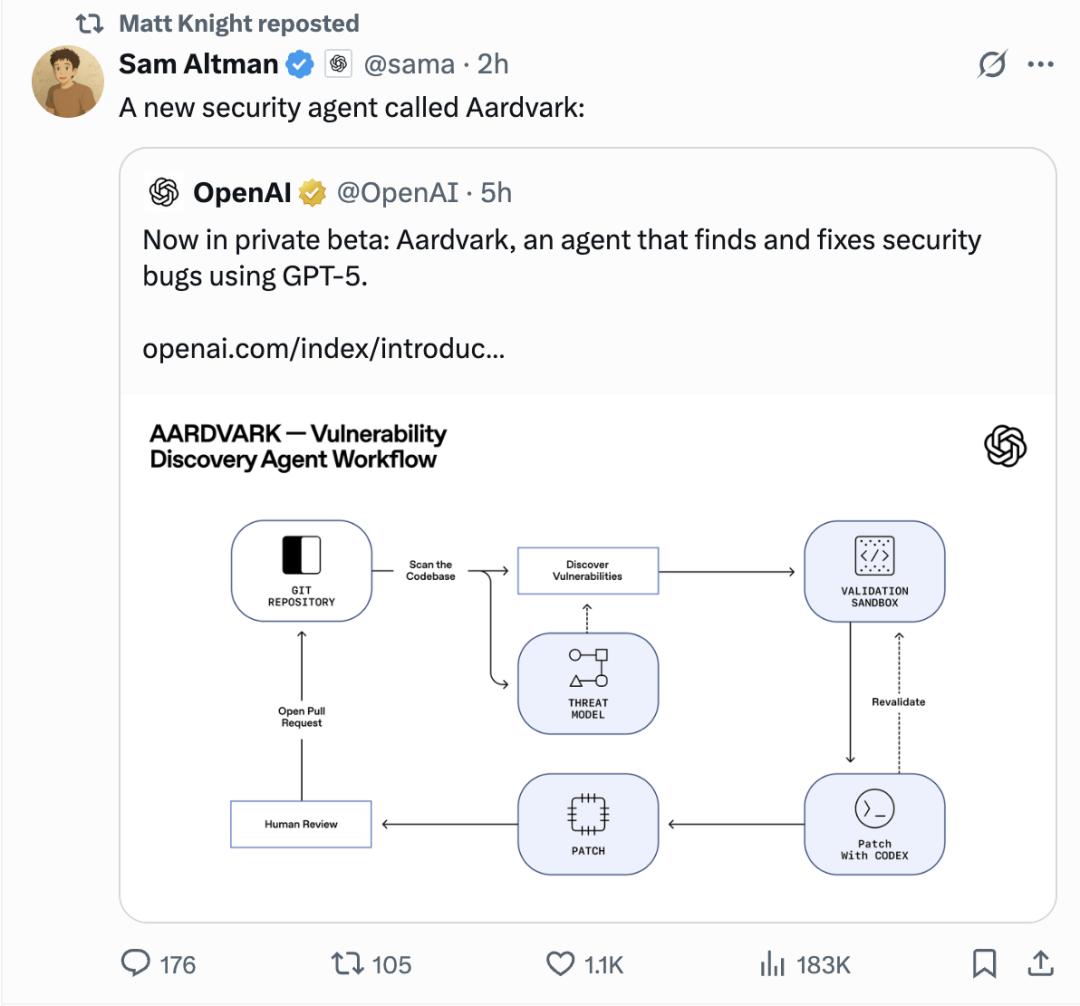
Core Insights - OpenAI has launched Aardvark, an AI-driven "white hat" agent designed to automatically identify and fix security vulnerabilities in large codebases [1][3] - Aardvark has demonstrated a 92% identification rate for known vulnerabilities and can locate issues that arise under complex conditions [3][12] - Other tech giants like Anthropic, Google, and Microsoft have also released similar AI security tools in October, indicating a growing trend in AI-driven code security solutions [14][19] Group 1: Aardvark's Functionality - Aardvark operates as an agentic security researcher, continuously analyzing source code repositories to identify vulnerabilities, assess exploitability, determine risk levels, and propose targeted fixes [4] - It utilizes a workflow that includes threat modeling, vulnerability discovery, sandbox validation, Codex patch generation, manual review, and pull request submission [5][10] - Aardvark integrates seamlessly with GitHub and existing development processes, providing actionable security insights without hindering development efficiency [10] Group 2: Performance and Testing - Internal testing has shown that Aardvark can identify not only security vulnerabilities but also logical flaws, incomplete fixes, and privacy risks [11] - Aardvark has been tested in various internal and partner projects, achieving a 92% identification rate in benchmark tests against "golden repositories" [12] - The tool has also been applied to multiple open-source projects, successfully identifying and disclosing numerous vulnerabilities, with 10 of them receiving CVE identifiers [12] Group 3: Industry Context - The recent surge in AI-driven security tools is a response to the increasing complexity and volume of vulnerabilities in enterprise-level codebases, which traditional debugging methods struggle to address [19] - The alignment in release timing among major tech companies suggests a collective recognition of the need for AI to enhance vulnerability discovery and remediation processes [14][19] - The growing reliance on AI for security tasks is seen as essential for ensuring software safety and mitigating enterprise risks in an era of escalating cyber threats [19]

GoDaddy(GDDY) - 2025 Q3 - Earnings Call Transcript
2025-10-30 22:00
Financial Data and Key Metrics Changes - GoDaddy achieved a total revenue growth of 10% year-over-year, reaching $1.3 billion, surpassing the high end of the guided range [17][18] - ANC (Annualized Net Customer) bookings grew by 14%, contributing to a total bookings increase of 9% to $1.4 billion [18][19] - Free cash flow increased by 21% to $440 million, reflecting strong operational performance [16][18] - The normalized EBITDA margin was maintained at 32%, with normalized EBITDA growing 11% to $409 million [18][21] Business Line Data and Key Metrics Changes - The high-margin ANC segment saw a revenue increase of 14% to $481 million, driven by solid adoption of subscription solutions [18] - The core platform segment delivered an 8% revenue growth to $784 million, supported by a 28% growth in aftermarket and a 7% growth in primary domains [18] - The $500+ customer cohort now represents approximately 10% of the customer base, contributing to a 10% increase in ARPU (Average Revenue Per User) to $237 [16][17] Market Data and Key Metrics Changes - International revenue grew by 14%, primarily driven by strength in both primary and secondary domain markets [17] - Retention rates remained stable at 85%, with total customers increasing sequentially to 20.4 million [17][18] Company Strategy and Development Direction - GoDaddy is focusing on the evolution of its Aero platform from generative AI to agentic AI, launching new agents to assist customers in various tasks [4][5] - The company is committed to creating an agentic open internet, enhancing customer experiences through AI-powered agents [4][10] - Strategic initiatives include pricing and bundling to provide greater value and choice to customers, and a seamless experience to improve conversion and renewal rates [12][13] Management's Comments on Operating Environment and Future Outlook - Management expressed optimism about the resilience of micro-business owners and their continued engagement with GoDaddy's services [81][82] - The company raised its full-year 2025 revenue guidance to approximately $4.93 to $4.95 billion, reflecting ongoing strength across the business [19][21] - Management highlighted the importance of AI in driving operational efficiencies and enhancing customer engagement [61][63] Other Important Information - GoDaddy has repurchased 9 million shares for a total of $1.4 billion year-to-date, demonstrating a commitment to shareholder returns [16] - The company is on track to exceed its investor day North Star commitment of a 20% CAGR (Compound Annual Growth Rate) [16] Q&A Session Summary Question: Impact of AI and agentic services on domains and websites - Management believes that AI and agentic AI will automate customer journeys, leading to an increase in the creation of websites and demand for domains [24][26] Question: Customer base growth and metrics - The total customer account showed slight sequential growth, with a focus on high-intent customers driving ARPU growth [30] Question: Rollout of Aero.ai and its integration - Aero.ai is built on the GoDaddy software platform, providing a seamless experience for existing customers and linking to the GoDaddy ecosystem [34][35] Question: Drivers of strengthening customer cohort dynamics - The high-intent customer cohort is attaching to more products at a higher rate, contributing to bookings and revenue growth [37][38] Question: AI investments and profitability - Investments in AI are being offset by efficiencies gained from internal use cases, with a focus on maintaining operational discipline [61][63] Question: Aftermarket performance - The company experienced strong performance in the aftermarket, particularly in high-value transactions [46] Question: International growth specifics - No specific markets were highlighted, but international growth mirrored domestic performance [79]

Grid Dynamics(GDYN) - 2025 Q3 - Earnings Call Transcript
2025-10-30 21:30
Financial Data and Key Metrics Changes - The company reported Q3 2025 revenue of $104.2 million, marking a 19.1% year-over-year growth and slightly exceeding the guidance range of $103 million to $105 million [30] - Non-GAAP EBITDA for the quarter was $12.7 million, within the higher end of the guidance range [30] - GAAP net income was $1.2 million, or $0.01 per share, down from $5.3 million in the previous quarter [38] Business Line Data and Key Metrics Changes - The retail vertical contributed $27.8 million, experiencing a sequential decline of 2.1% and a year-over-year decrease of 2.9% [31] - The technology, media, and telecommunications (TMT) vertical accounted for 27.4% of total revenues, growing 13.5% quarter-over-quarter and 18.2% year-over-year [32] - The finance vertical represented 24.6% of total revenues, with slight sequential growth and an 81% year-over-year increase [32] Market Data and Key Metrics Changes - The company added five times more billable engineers in Q3 compared to Q2, indicating strong demand for AI-driven solutions [7] - Partnership influence revenue exceeded 18% of total revenue, reflecting the growing importance of partnerships in driving growth [26] Company Strategy and Development Direction - The company is focused on becoming an AI-first organization, with initiatives aimed at enhancing profitability and margins by at least 300 basis points over the next twelve months [9] - The strategic framework includes three horizons: Efforts Delivery, Agenda Guide at Scale, and Physical AI, aimed at embedding AI into operations and service delivery [11] - The company is committed to disciplined capital allocation, including a $50 million share repurchase program, reflecting confidence in long-term business prospects [5] Management's Comments on Operating Environment and Future Outlook - Management expressed optimism about the demand recovery being structural rather than temporary, with clients shifting from risk management to growth strategies [20] - The company anticipates a materially higher billable run rate by the end of the year, positioning itself well for growth in 2026 [8] - Management noted that AI initiatives are expected to yield quicker ROI compared to traditional digital transformation programs, driving demand [22] Other Important Information - The company ended Q3 with a total headcount of 4,971, down from 5,013 in the previous quarter, while increasing billable headcount [35] - The company is rationalizing its overall headcount to align skill sets and geographies, aiming for greater efficiencies [8] Q&A Session Summary Question: Trends for 2026 growth rates - Management noted that the highest billable headcount in the company's history and longer-duration programs related to AI initiatives provide confidence for growth in 2026 [44] Question: Constraints limiting adoption of AgenTeq AI - Management highlighted that the technology continues to evolve, and they are expanding capabilities to solve a broader spectrum of business problems [48] Question: Contribution of managed services versus custom build activity - The majority of revenue is currently related to solving business cases, fueling overall growth [55] Question: Share repurchase program rationale - The program signals confidence in the company's growth trajectory and is seen as a good return on investment [74] Question: Margin expansion context - Management indicated that the 300 basis points expansion target includes both gross and EBITDA margins, driven by pricing increases and cost optimization [95][100]

GoDaddy(GDDY) - 2025 Q3 - Earnings Call Presentation
2025-10-30 21:00
Financial Performance - Total revenue grew by 10% to $1.265 billion in Q3 2025[39, 57] - Applications & Commerce (A&C) revenue increased by 14% to $0.5 billion[39, 57] - Core Platform revenue grew by 8% to $0.8 billion[39, 57] - NEBITDA margin reached 32%[9, 40] - Free cash flow increased by 21% to $440 million[35, 45, 57] Growth Drivers and Initiatives - A&C bookings growth contributed 20%[33] - Airo platform is evolving from Generative AI to Agentic AI[12, 15, 22, 27] - Airo customers are spending $500+ annually, representing ~10% of the customer base[36] - ARPU (Average Revenue Per User) grew by 10% in Q3[36] Future Outlook - The company raised full year revenue guide to 8% growth[35] - The company expects approximately $1.6 billion in free cash flow for the full year 2025[56]
Six AI capabilities advisors say they need — but don't have
Yahoo Finance· 2025-10-30 20:23
Core Insights - The wealth management industry is expected to undergo significant transformation due to artificial intelligence tools that enhance administrative efficiency and investment planning capabilities [1][2]. Group 1: AI Tools and Advisor Needs - Advisors are seeking AI solutions to streamline daily operations, particularly in areas like client onboarding, dictation, note-taking, and project management [3][6]. - There is a notable demand for agentic AI, which can autonomously handle complex tasks without human oversight, reflecting a shift in how companies perceive AI's role in the workplace [3][4]. Group 2: Understanding Agentic AI - The concept of agentic AI is gaining traction, with experts emphasizing the need for advisors to grasp its implications beyond superficial understanding [4][5]. - An agent is defined as an AI system capable of accessing tools and executing complex tasks in a loop, which is crucial for firms to leverage AI effectively [5]. Group 3: Portfolio Management and Analytics - Advisors express a strong interest in AI advancements in portfolio management and analytics, aiming to automate traditionally manual processes [6]. - Desired capabilities include the use of natural language processing for financial planning and analysis, as well as streamlined construction and management of custom portfolios through AI [6].
Coveo Reports Second Quarter Fiscal 2026 Financial Results
Prnewswire· 2025-10-30 20:01
Core Insights - Coveo reported SaaS Subscription Revenue of $35.9 million for Q2 FY2026, exceeding guidance with a growth of 15% compared to $31.2 million in Q2 FY2025 [3][4] - The Coveo core Platform saw a 17% increase in revenue, reaching $35.0 million, while total revenue for the quarter was $37.3 million, up 14% from $32.7 million [3][4] - Generative AI solutions contributed significantly, with customer and revenue growth of approximately 2.5 times year-over-year [4][8] Financial Performance - SaaS Subscription Revenue increased by 15% year-over-year, with the Coveo core Platform growing by 17% [3][4] - Total revenue for the first half of FY2026 was $72.9 million, a 12% increase from $65.0 million in the same period last year [3][4] - The company reported a net loss of $4.4 million, an improvement from a net loss of $5.4 million in the previous year [3][4] Business Developments - Commerce remains Coveo's fastest-growing use case, accounting for approximately 50% of new business bookings, driven by the partnership with SAP [4][8] - The company received the SAP Global Customer Experience Award for Partner Excellence 2025, highlighting the success of its collaboration with SAP [8] - New customer acquisitions included notable companies such as Halliburton and Deckers Outdoor Corp., indicating strong demand for Coveo's solutions [8] Future Outlook - Coveo revised the upper end of its revenue guidance for FY2026, reflecting solid market demand for its AI-powered platform [5][6] - Expected SaaS Subscription Revenue for Q3 FY2026 is projected to be between $35.7 million and $36.2 million, with total revenue guidance for the full year set between $147.5 million and $148.5 million [6][5] - The company anticipates achieving positive operating cash flows for the full fiscal year [6][5]

Elastic Brings LLM Observability to Azure AI Foundry to Optimize AI Agents
Businesswire· 2025-10-30 16:00
Core Insights - Elastic has announced a new integration with Azure AI Foundry, aimed at enhancing observability for agentic AI applications and large language models (LLMs) [1] - This integration provides site reliability engineers (SREs) and developers with real-time insights into LLMs, generative AI, and agentic AI workloads [1] - The goal is to enable the building, monitoring, and optimization of intelligent agents on Azure AI Foundry with improved reliability and efficiency [1]


4 Software Stocks Poised to Outshine Expectations This Earnings Season
ZACKS· 2025-10-30 13:11
Core Industry Trends - Software stocks are benefiting from the digitalization wave and strong adoption of AI, including generative AI and Agentic AI [1] - The proliferation of SaaS, migration to cloud platforms, and demand for hybrid work solutions are major tailwinds for software companies [1] - Increased customer-centric approaches and subscription-based models are driving recurring revenues and affordability for small and medium-sized businesses [5] Factors Supporting Software Stocks - The rise of AI-powered applications in various sectors, including voice recognition and telemedicine, is positively impacting software companies [2] - The adoption of cloud-based services, IoT, AR/VR devices, and 5G deployment is aiding software stock performance [3] - Rising cyber threats are prompting enterprises to invest more in cloud-based security solutions, shifting preference towards software-defined models [4] Company-Specific Insights - CoreWeave is expected to report revenues between $1.26 billion and $1.3 billion, with a year-over-year revenue increase of 207% and a backlog of $30.1 billion [8][9] - BILL Holdings anticipates first-quarter revenues of $390.6 million, reflecting a 9% year-over-year increase, while earnings are projected to decline by 19.1% [11] - Affirm Holdings expects first-quarter revenues of $885 million, indicating a 26.7% year-over-year growth, with earnings per share improving from a loss of 31 cents to a profit of 11 cents [14][15] - Unity Software forecasts revenues of $447.6 million for the third quarter, with a slight year-over-year growth of 0.2% and an expected earnings per share improvement from a loss of 31 cents [17] Strategic Developments - CoreWeave is capitalizing on the generative AI boom, focusing on scaling capacity and enhancing services to drive strong momentum [10] - BILL is leveraging AI to enhance its solutions for SMBs and is integrating generative AI to improve customer experience [12][13] - Affirm is expanding its partnerships and entering new markets, including the U.K. and Western Europe, to drive growth [16] - Unity Software is transitioning its product mix towards the AI-powered Unity Vector platform, which is expected to deliver long-term value despite short-term revenue friction [18][19]




后端架构新范式!阿里云专家亲揭:用RocketMQ彻底搞定多Agent异步协同难题
AI科技大本营· 2025-10-30 10:55
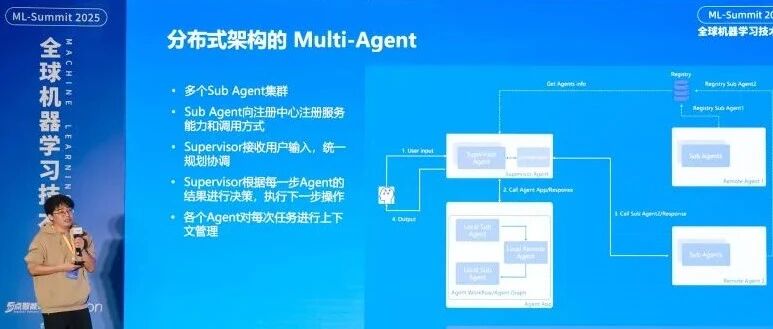
Core Insights - The article discusses the evolution of AI towards Agentic AI, emphasizing the shift from passive response to proactive decision-making and execution, leading to the development of Multi-Agent architectures [4][5] - It highlights the importance of agent capability discovery and task closure for efficient collaboration among agents, which is essential for achieving high reliability and effectiveness in task execution [5][6] Agent Capability Discovery - Agent capability discovery involves dynamic registration of agent abilities and allows a Supervisor Agent to query and select appropriate Sub Agents for task execution, enhancing autonomy and scalability [6] - This mechanism is compared to traditional microservices service discovery, focusing on semantic capability and intent-driven matching, which is crucial for intelligent division of labor [6] Task Collaboration - In a large model-driven multi-agent system, agents collaborate, compete, or divide tasks to complete complex objectives, with the Supervisor Agent coordinating the efforts of specialized agents [7] - Effective communication mechanisms are necessary for high-efficiency collaboration, with different communication modes offering various trade-offs in flexibility, scalability, control, and performance [7][8] Asynchronous Communication Mechanisms - The article examines asynchronous communication scenarios using a publish/subscribe model, where Sub Agents send results back to the Supervisor Agent, which requires a feedback mechanism to ensure task closure [8][9] - Various communication methods are discussed, including polling, point-to-point invocation, and the publish/subscribe model, each with its advantages and drawbacks [8][9] RocketMQ Features for Agentic AI - RocketMQ introduces new features such as semantic Topics and Lite-Topics to facilitate asynchronous communication and dynamic decision-making among agents [10][11] - The evolution of Topics from simple data channels to semantic carriers allows for intention-driven collaboration, enhancing the discoverability and expressiveness of agent capabilities [11][12] Lite-Topic Consumption Model - Lite-Topics are designed for lightweight message transmission and dynamic subscription relationships, supporting granular resource isolation and asynchronous result feedback [13][14] - The event-driven message distribution model, utilizing InterestSet and ReadySet, transforms traditional polling into precise wake-up calls, improving efficiency in personalized subscription scenarios [20][21] Building Asynchronous Multi-Agent Systems - The architecture enables asynchronous retrieval of Sub Agent results through dynamic subscription to Lite-Topics, ensuring task closure within the Supervisor Agent cluster [21][22] - The integration of semantic Topics for agent capability registration and discovery creates an efficient asynchronous collaboration framework, enhancing task orchestration and decision-making processes [24][25] Conclusion - The innovative architecture based on RocketMQ's publish/subscribe model effectively supports task orchestration, result feedback, and multi-round decision-making in Multi-Agent scenarios, providing a viable technical path for building reliable and controllable asynchronous intelligent agent collaboration systems [27]
Are You Buying the AI ETF That Will Dominate for Decades to Come?
Yahoo Finance· 2025-10-30 10:00
Group 1 - The Nvidia story exemplifies the potential for significant returns in AI investing, highlighted by its market value exceeding $5 trillion [1] - Semiconductors serve as essential components in the AI landscape, but selecting individual AI securities remains challenging; ETFs like the Global X Artificial Intelligence & Technology ETF (NASDAQ: AIQ) offer efficient access [2] - The Global X ETF, with a market capitalization of $6.68 billion, has consistently outperformed broader benchmarks since its inception on May 11, 2018, indicating its strong track record [4] Group 2 - The evolution of AI is still in its early stages, suggesting that the Global X ETF could be a long-term winner in the market [5] - Morgan Stanley estimates that full AI adoption by S&P 500 firms could generate annual financial benefits of $920 billion, potentially increasing the market capitalization of the index by $13 trillion to $16 trillion [7] - As of June, only 9.2% of businesses were utilizing AI, with projections indicating growth to 11.6% in the next six months, highlighting significant room for expansion [8] Group 3 - The growth of agentic AI, which allows autonomous systems to perform tasks with minimal human intervention, could further enhance the ETF's prospects; Morgan Stanley estimates that $490 billion of the projected $920 billion in annual benefits would stem from agentic AI [9]