Tariffs

Search documents
Gold Has Shone Through Tariffs, AI Fears, Global Risk. Why 2026 Looks Bright.
Barrons· 2025-12-23 11:46
Group 1 - Oracle's co-founder Larry Ellison has provided a guarantee for Paramount's bid for Warner Bros, indicating strong support for the acquisition [1] - The offshore wind industry faces challenges as former President Trump has dealt another blow to its growth prospects, impacting future investments [1] - FanDuel has launched a new prediction market, expanding its offerings in the sports betting sector and potentially increasing user engagement [1]


US stocks rose again in 2025 after overcoming turbulence from tariffs and Trump's fight with the Fed
Yahoo Finance· 2025-12-23 11:10
Market Performance - The S&P 500 index funds returned more than 18% in 2025 through December 11, marking a record high and the third consecutive year of significant returns [2] - The U.S. stock market experienced historic drops due to concerns over tariffs, interest rates, and potential bubbles in artificial intelligence technology [1] Tariff Impact - President Trump's announcement of severe tariffs on "Liberation Day" in April triggered fears of a recession and inflation, leading to a nearly 5% drop in the S&P 500 on April 3, followed by a 6% decline the next day due to China's retaliatory threats [3] - The tariffs affected not only the stock market but also led to a decline in the value of the U.S. dollar and created unease in the U.S. Treasury market [3] Federal Reserve Actions - Trump paused the tariffs on April 9 after observing instability in the U.S. bond market, which alleviated some investor concerns [4] - The Federal Reserve's three interest rate cuts during the year contributed to a positive market environment, alongside strong corporate profit reports and enthusiasm for artificial intelligence technology [5] - Trump's personal lobbying for lower interest rates marked a significant departure from the traditional independence of the Federal Reserve, which typically makes decisions without political influence [6]
The U.S. dollar had a rough year. What's next in 2026?
Yahoo Finance· 2025-12-23 10:00
Currency markets are not always sensitive to inflation itself. What they care about is what inflation signals — about growth, policy, credibility, governance, and perhaps most of all, predictability.By now, the mix is familiar — uneven goods inflation, tariffs doing their work in the background, stubbornly high rents and housing costs. Fed Chair Jerome Powell has repeatedly pointed to trade policy as a contributor to inflation overshoots, while emphasizing that officials need clearer evidence before conclud ...
X @The Wall Street Journal
The Wall Street Journal· 2025-12-22 21:26
Trade Policy - Tariffs are not a magic solution but a tool to enforce discipline [1] - Tariffs aim to incorporate the real cost of dependency into corporate planning [1] - Tariffs are used to counter predatory trade behavior [1]
X @The Wall Street Journal
The Wall Street Journal· 2025-12-22 20:00
Trade Policy Impact - Tariffs rose to the highest levels in centuries [1] - The U S lost tens of thousands of manufacturing jobs this year due to increased tariffs [1] Industry Focus - The report focuses on the manufacturing industry, specifically in Detroit [1] - The report aims to identify the winners of the new trade paradigm [1]
A chaotic 'up-crash' as markets and economic realities made for a turbulent 2025
Abc.Net.Au· 2025-12-22 19:10
Economic Overview - The year has been marked by significant economic shocks and surges, particularly due to changes in global trade dynamics and tariffs imposed by the US [1][6] - Despite these shocks, the global economy has shown resilience, with stock markets in various countries reaching record highs [6][10] Tariff Impacts - The US implemented a sweeping regime of tariffs that affected trade with allies and adversaries alike, with rates reaching as high as 145% for China and 10% for countries like Australia and the UK [11][12] - The chaotic nature of the tariffs, including those placed on uninhabited islands, exemplified the unpredictable environment created by the US administration [8][11] Market Reactions - Following the announcement of tariffs, global stock markets initially reacted with panic, with the S&P 500 index losing $7.5 trillion in value within two days [31] - However, the market sentiment shifted as fears of a trade war subsided, leading to a recovery in stock prices [19][31] AI Boom - The rise of artificial intelligence (AI) has been a significant driver of market performance, with substantial investments in technology and data centers propelling the "Magnificent Seven" tech companies [32][37] - Nvidia, a key player in the AI sector, saw its stock price increase by over 1,200%, making it the most valuable company globally, valued at over $4 trillion [33][36] Economic Growth and Projections - The capital expenditure related to AI is estimated to be close to $500 billion, contributing significantly to GDP growth in the US [37][38] - Economists have noted that while there are concerns about market bubbles, the current growth is supported by genuine earnings growth from leading tech companies [36][39]


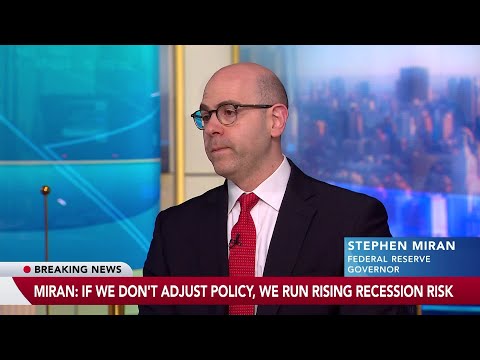
Fed's Miran Says Recession Risks Rise Without More Rate Cuts
Bloomberg Television· 2025-12-22 18:04
Coming to the economy. Investors are watching for signals from policymakers heading into a key year for the Federal Reserve, with a new chair expected to be announced soon. Cleveland Fed President Beth Hammack among those, preferring to hold rates higher for longer.Well, our next guest is taking the other side, voting for a 50 basis point cut at the Fed's last meeting. Joining us now is Federal Reserve Governor Stephen Myron. Very good morning to you, Stephen.Thank you so much for joining us. Good morning. ...
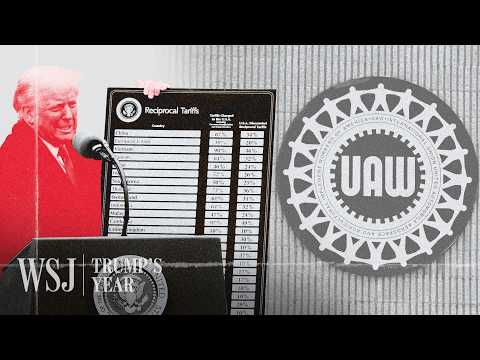
How Trump’s Tariffs Are Actually Hitting Detroit’s Auto Industry | WSJ
The Wall Street Journal· 2025-12-22 17:00
Automotive Industry Impact of Tariffs - AlphaUSA, an automotive fastener manufacturer, faces an existential threat due to tariffs, potentially leading to closure if costs cannot be passed on or relief is not obtained [2] - The US has lost tens of thousands of manufacturing jobs this year, despite Trump's promises of a manufacturing boom due to tariffs [4] - Tariffs have moved the needle and leveled the playing field, bringing some product back to the US [5] - The auto industry has lost just over 15,000 jobs this year through November [11] Company Financials & Operations - AlphaUSA has paid approximately $13 million (130万) in tariffs through November, with current monthly payments between $225,000 and $250,000 [9] - A part that used to cost a dime (10 cents) now costs 15 cents due to tariffs, representing a 50% increase [6] - Tariffs impact AlphaUSA's ability to expand its capital base and limits potential future growth [25] Union Perspective & Investment - UAW (United Auto Workers) has long advocated for auto tariffs, which they believe have led to new investments and job creation at facilities like the Stellantis Warren Truck Assembly Plant [16] - Stellantis reversed course after Trump's automotive tariff announcement, bringing back a shift of workers and expanding production [13][14] - New investments at Eric's plant are expected to generate a shift to production and create roughly 900 jobs [17] Policy & Implementation - Trump's tariffs are imposed under Section 232, allowing duties to protect national security, and the International Emergency Economic Powers Act (IEEPA) for national emergencies like the trade deficit [7][8] - Some of Trump's tariffs are at risk after the Supreme Court appeared skeptical of his authority to impose broad levies [24] - There is a desire to see all manufacturing brought back to the US, emphasizing the need to "build it here" if it's sold here [21]
How Trump's Tariffs Are Actually Hitting Detroit's Auto Industry | WSJ
Youtube· 2025-12-22 17:00
Core Viewpoint - The automotive industry is facing significant challenges due to tariffs imposed by the Trump administration, which are affecting small and medium-sized manufacturers like AlphaUSA, potentially threatening their existence without relief or the ability to pass costs on to consumers [2][3][11]. Group 1: Impact of Tariffs on Manufacturers - AlphaUSA, a manufacturer of automotive fasteners, reports that tariffs have increased costs significantly, with some parts seeing price increases from $0.10 to $0.15 due to a 50% tariff [6]. - The company has paid approximately $1.3 million in tariffs through November, with ongoing costs estimated at $225,000 to $250,000 per month [9]. - The auto industry has lost around 58,000 manufacturing jobs this year, with over 15,000 of those in the automotive sector specifically [11]. Group 2: Responses from the Automotive Sector - Some manufacturers are returning to the U.S. to avoid tariffs, but the overall job loss in manufacturing raises concerns about the effectiveness of these policies [4][23]. - Stellantis, a major automotive company, initially planned to cut jobs at its Warren assembly plant but reversed this decision following the announcement of automotive tariffs, indicating a potential positive impact on job retention and expansion [13][19]. - Union representatives express optimism about the tariffs leading to new investments and job creation, with expectations of 900 new jobs linked to upcoming production shifts [17][18]. Group 3: Future Outlook and Challenges - There is a belief among some industry stakeholders that the tariffs could lead to a resurgence in American manufacturing, although the actual outcomes remain uncertain [23]. - The Supreme Court's skepticism regarding the broad authority of tariffs may pose risks to some of Trump's tariff policies, but those under Section 232, affecting manufacturers like AlphaUSA, are not directly impacted by this case [24]. - Manufacturers emphasize the importance of keeping their workforce employed and the challenges they face in expanding their operations due to financial constraints caused by tariffs [25].


Opening Bell: December 22, 2025
Youtube· 2025-12-22 14:56
Group 1 - The launch of Titans leveraged and inverse ETFs is seen as a significant event, potentially marking one of the best-performing assets of 2025 [1] - The end-of-year market dynamics suggest that sellers are typically absent, allowing for upward price movement [2] - There is a consensus that the next two weeks could experience a "melt-up" in the market, unless disrupted by external factors such as tariff decisions [5] Group 2 - Concerns exist regarding the ability of many investors to beat benchmarks, particularly due to the dominance of major tech stocks, referred to as the "Mag 7" [3] - The market is on the verge of achieving a 20% growth year, a feat not accomplished three consecutive years since the late 1990s [6] - There is a notable trend of investors being hesitant to engage in individual stock picking, leading to a general market apprehension [7]