
粤港澳大湾区融合发展

Search documents
广州:十五运激活体育基因 千年商都焕发多彩活力
2 1 Shi Ji Jing Ji Bao Dao· 2025-11-04 10:57
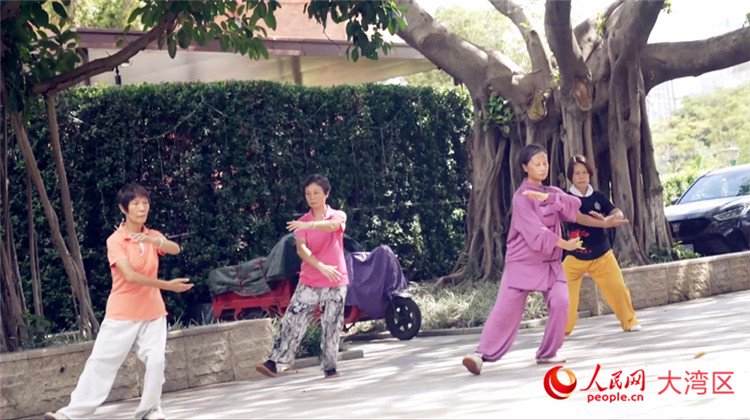
Core Viewpoint - Guangzhou is leveraging its rich sports culture and innovative spirit to showcase its unique charm as it prepares to host the 15th National Games in 2025, blending tradition and modernity in a vibrant urban landscape [1][17]. Sports Culture and Development - The city has a deep-rooted sports culture, with significant events like the 1987 Sixth National Games and the 2010 Asian Games serving as catalysts for urban development and infrastructure upgrades [4]. - Guangzhou has produced numerous sports talents, including Olympic champions, and has established a robust grassroots sports system, hosting 142 provincial-level events and nearly 200 large-scale public sports activities in 2024, with a total sports consumption of 63.125 billion yuan [5]. Integration of Tradition and Modernity - The city exemplifies a unique blend of traditional and modern elements, with cultural practices coexisting alongside contemporary lifestyles, such as morning exercises in historical areas and the fusion of traditional arts with modern entertainment [6][7]. - The preparation for the National Games reflects this integration, with the design of the event's medals incorporating diverse cultural symbols, showcasing the city's inclusive character [8]. Innovation in Sports Infrastructure - Guangzhou is committed to a "green, smart, and frugal" approach in its sports infrastructure, with all 30 competition venues undergoing upgrades to enhance sustainability, including a 45% reduction in carbon emissions at the Tianhe Sports Center [11][12]. - The use of advanced technologies such as AR navigation and smart security systems in event venues highlights the city's innovative capabilities and commitment to enhancing the spectator experience [12][14]. Economic and Regional Development - The hosting of the National Games is seen as an opportunity to accelerate the development of an international sports city and promote the integration of the Guangdong-Hong Kong-Macau Greater Bay Area, contributing to high-quality regional economic growth [15][17].

香港全运氛围渐浓
Xin Hua She· 2025-11-04 02:15
Group 1 - The atmosphere for the 15th National Games in Hong Kong is intensifying as the opening ceremony approaches, with various promotional activities and events taking place across the city [1][2] - The first competition, beach volleyball, commenced on October 31 at Victoria Park, featuring multiple standard courts and a free-to-play "Beach Volleyball Village" for citizens [1][2] - Community engagement is evident, with over 2,000 citizens participating in activities at West Sha Go Park, experiencing sports like pickleball and fencing [2][3] Group 2 - A significant volunteer program has been launched, attracting over 30,000 applications, resulting in a team of over 16,000 volunteers, the largest in Hong Kong's history [3] - The torch relay for the Games has fostered a strong sense of community pride, with citizens actively participating and expressing support for athletes [3][4] - The event symbolizes the integration of the Guangdong-Hong Kong-Macao Greater Bay Area, promoting sports cooperation and cultural unity among the regions [4][5]
十五运会香港赛区火炬传递途经多个著名地标
Xin Hua Wang· 2025-11-03 00:41
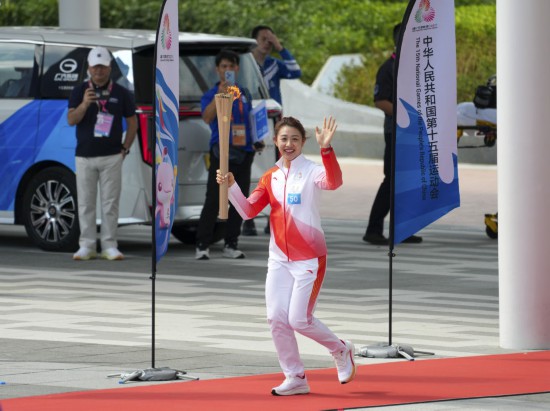
Core Points - The 15th National Games torch relay in Hong Kong took place on November 2, featuring 50 torchbearers and culminating with the lighting of the flame by fencer She Shan-yan at Kai Tak Sports Park [1][2] Group 1 - The torch relay was synchronized across four cities: Hong Kong, Macau, Guangzhou, and Shenzhen, marking the first cross-border torch relay in the history of the National Games [2] - The event showcased the unique advantages of the Guangdong-Hong Kong-Macao Greater Bay Area, emphasizing collaboration and integrated development among the three regions [2] - The relay route in Hong Kong spanned approximately 10 kilometers, including 3.8 kilometers of running, and passed several iconic landmarks such as Tamar Park and the Hong Kong Space Museum [4] Group 2 - The event attracted spontaneous gatherings of citizens and tourists, who cheered with national and regional flags, expressing unity and hope [5] - Following the relay, the flames from the four cities converged in Guangzhou for a ceremonial fire merging, preparing for the main torch lighting at the opening ceremony on November 9 [5]
全运会历史首次跨境火炬传递举行
Ren Min Ri Bao· 2025-11-02 22:21
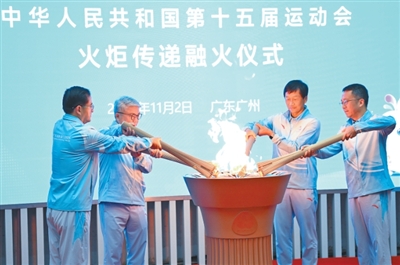
Core Points - The 15th National Games torch relay took place simultaneously in Hong Kong, Macau, Guangzhou, and Shenzhen, marking the first cross-border torch relay in the history of the National Games [2] - The relay featured 200 torchbearers showcasing the cultural and scenic beauty of the Guangdong-Hong Kong-Macau Greater Bay Area [2] - The torch was lit using a flame sourced from over 1,500 meters deep in the South China Sea, highlighting the integration of technology and sports [3] Group 1 - The torch relay started at Shenzhen's Lianhua Mountain Park, with the first torchbearer being Xue Qikun, an academician from the Chinese Academy of Sciences [2] - In Hong Kong, the torch was transported across Victoria Harbour on a ferry, with notable participation from Olympic medalist Li Jing [2] - In Macau, the first torchbearer, Li Yi, expressed excitement about the collaborative hosting of the National Games by the three regions [2] Group 2 - The relay included cultural performances in Guangzhou, featuring traditional Cantonese music and modern activities like skateboarding and street dance [2] - A humanoid robot named "Kua Fu" participated as the "0th" torchbearer, showcasing advancements in technology during the relay [3] - The torch relay culminated in a fire merging ceremony in Guangzhou, preparing for the main torch lighting at the opening ceremony on November 9 [3]
体育为媒 融合加速
Nan Fang Du Shi Bao· 2025-11-02 03:48
Core Points - The 15th National Games and the 12th National Paralympic Games will ignite the Olympic flame in Guangdong, showcasing the "One Country, Two Systems" principle in sports and enhancing regional collaborative development [1][2][3] Group 1: Event Coordination and Infrastructure - The Guangzhou Baiyun International Airport T3 terminal and the fifth runway have been officially put into operation, ensuring seamless transportation for the National Games [2] - A new model of joint hosting has been established, focusing on "hard connectivity" and "soft connectivity" to facilitate cross-border events [3] - Innovative customs clearance measures have allowed athletes to pass through three regions without interruption during the games, enhancing the efficiency of cross-border sports events [3][4] Group 2: Economic Impact and Industry Integration - The event has stimulated local economies through various sports-related activities, integrating sports with tourism and cultural experiences [5] - The introduction of high-tech solutions, such as drones and smart weather systems, has driven advancements in the sports industry [5][6] - The upcoming 2025 Guangdong-Hong Kong-Macao International Sports Goods Expo will showcase the latest developments in the sports industry, highlighting the economic potential of sports events [6] Group 3: Cultural Exchange and Community Engagement - Sports events have fostered cultural exchanges among youth from Guangdong, Hong Kong, and Macao, strengthening emotional ties and community bonds [7][8] - Various cultural activities and traditional performances have been integrated into the sports events, enhancing the cultural experience for participants and spectators [8]
香港特首李家超:“粤车南下”为大湾区融合发展注入更大动能
Zhong Guo Xin Wen Wang· 2025-10-31 13:47
Core Points - The implementation of "Yue Che Nan Xia" (粤车南下) is expected to inject greater momentum into the integration development of the Guangdong-Hong Kong-Macao Greater Bay Area [1] - The initiative will run parallel to "Hong Kong Cars Going North" (港车北上), facilitating two-way movement of residents and enhancing connectivity in terms of people and logistics [1] - The program aims to create new opportunities for Hong Kong's tourism, retail, and dining sectors by allowing mainland residents to visit Hong Kong [1] - The Hong Kong Airport Authority will launch an automated transfer parking facility on November 1, with official operations starting on November 15 [2] - The parking facility will offer an initial promotional rate of HKD 100 for the first three days, followed by HKD 50 per day, with pick-up and drop-off services charged at HKD 100 [1][2] - The facility, located within the Hong Kong-Zhuhai-Macao Bridge area, will provide 1,800 parking spaces and enhance multi-modal transport links between Hong Kong and other cities in the Greater Bay Area [2]
香港公布“粤车南下”政策 大湾区融合发展增添新动能
Xin Hua She· 2025-10-31 11:46
Core Points - The Hong Kong Special Administrative Region government announced the implementation of the "Yue Che Nan Xia" policy, facilitating easier travel for mainland residents driving to Hong Kong for business, employment, family visits, or tourism, thereby promoting the integration of the Guangdong-Hong Kong-Macao Greater Bay Area [1][2] - The policy allows approved Guangdong private cars to park at an automated parking facility on the Hong Kong port artificial island after crossing the Hong Kong-Zhuhai-Macao Bridge, enabling passengers to transfer to flights or local transportation without entering Hong Kong [1] - The first phase of the policy will initially open to four cities: Guangzhou, Zhuhai, Jiangmen, and Zhongshan, with plans to expand to other cities in Guangdong Province after six months [1] Implementation Timeline - The "transit parking lot" at the port will start accepting applications on November 1, 2023, and will be operational from November 15, 2023; the city entry portion will accept applications starting December 9, 2023, and will allow approved vehicles to enter Hong Kong from December 23, 2023 [2] - Hong Kong Chief Executive John Lee expressed gratitude for the support from the central and Guangdong provincial governments in promoting and implementing the "Yue Che Nan Xia" initiative, which will run parallel to the "Hong Kong Cars Northbound" policy [2] Economic and Social Integration - The ongoing collaboration between Guangdong and Hong Kong has led to the implementation of various cross-border vehicle policies, significantly contributing to the economic and social integration of the two regions [2] - The successful implementation of the "Hong Kong Cars Northbound" policy serves as a model for regulatory alignment and mechanism integration within the Greater Bay Area [2]
12月23日起,广东车辆可开进香港市区!
Di Yi Cai Jing· 2025-10-31 07:23
Core Points - The "Yue Car Southbound" initiative allows Guangdong vehicles to enter Hong Kong, with applications starting today and the first approved vehicles able to enter as early as December 23 [1][2] - The program is initially open to four cities in Guangdong: Guangzhou, Zhuhai, Zhongshan, and Jiangmen, with plans to expand to other cities in six months [1][3] - A daily cap of 100 vehicles will be implemented for entering Hong Kong, with each vehicle allowed to stay for a maximum of three days [3][4] Implementation Details - The application process requires drivers to have a valid Hong Kong driving license and to meet vehicle inspection and insurance requirements [3][4] - The automated "transit parking lot" at Hong Kong International Airport will provide approximately 1,800 parking spaces and will begin accepting applications on November 1 [2][4] - The "Yue Car Southbound" program is designed to complement the existing "Hong Kong Car Northbound" initiative, which has significantly increased cross-border travel and economic activity in the Greater Bay Area [4] Economic Impact - The "Yue Car Southbound" initiative is expected to enhance tourism, retail, and dining sectors in Hong Kong by facilitating easier access for mainland residents [4] - Recent data indicates a stabilization in local consumer sentiment, with retail sales showing a 3.8% year-on-year increase in August, suggesting a positive outlook for the retail sector [5]
智能机器人、低空飞行器将参与十五运会火炬传递
Ke Ji Ri Bao· 2025-10-27 23:55
Core Points - The 15th National Games torch relay will take place on November 2, simultaneously in four cities: Hong Kong, Macau, Guangzhou, and Shenzhen, with the torch named "Spirit of the Sea Flame" [1] - The relay will feature innovative organizational models, transmission methods, and route designs, showcasing the modernized Bay Area practices of China [1] - Technology will play a significant role in the relay, with the use of smart robots, autonomous vehicles, and low-altitude flying devices to highlight the Guangdong-Hong Kong-Macau Greater Bay Area as an international center for technological innovation [1] Route Design - The relay will utilize a point-to-point jumping transmission method to connect city landmarks, reflecting the historical culture and contemporary features of the cities involved [2] - Guangzhou's route will highlight its "thousand-year commercial capital" characteristics, linking both historical sites and new landmarks [2] - A special guarantee plan for the relay will be implemented, referencing the "seamless customs clearance" model for cross-border events, ensuring efficient transportation of the torch and related equipment [2]

简约不简单 十五运会火炬传递四城同传一天完成
Xin Hua She· 2025-10-27 09:06
Core Points - The torch relay for the 15th National Games will take place simultaneously in Hong Kong, Macau, Guangzhou, and Shenzhen on November 2, showcasing the integration of the Guangdong-Hong Kong-Macau Greater Bay Area [1][2] - A total of 200 torchbearers will participate, with each city having 50 torchbearers running 50 to 100 meters each [1] - The relay aims to highlight the historical and contemporary significance of each city, with Guangzhou emphasizing its "thousand-year commercial capital" identity and Shenzhen showcasing its "open city" characteristics [1] Group 1: Torch Relay Details - The relay will start at 9 AM in Shenzhen's Lianhua Mountain Park, with simultaneous starting ceremonies in Hong Kong, Macau, and Guangzhou at 9:30 AM [1] - After the relay, representatives from the four cities will bring the flame to Guangzhou for a merging ceremony at the Guangdong Olympic Sports Center at around 5 PM [1] Group 2: Representation and Symbolism - The torchbearers include outstanding representatives from various industries and community members such as sanitation workers, delivery riders, bus drivers, and nurses, reflecting the inclusive spirit of the Greater Bay Area [1] - The relay in Hong Kong will start at the Tamar Government Headquarters and end at the Kai Tak Sports Park, passing by several iconic landmarks, symbolizing Hong Kong's openness and diversity [2] - The Macau relay will take place in the Macau Peninsula, connecting various historical and cultural landmarks, showcasing Macau's unique blend of Eastern and Western cultures [2]