
无人驾驶汽车

Search documents
台湾短视频博主体验“100个大陆之最”
Xin Lang Cai Jing· 2026-02-09 22:25
Core Viewpoint - The article highlights the journey of Taiwanese short video creator Shen Xinkai, who is exploring unique cultural experiences across mainland China through a project titled "100 Mainland Firsts" [1][2]. Group 1: Project Overview - Shen Xinkai, a 41-year-old from Taipei, began his project in late 2023, focusing on discovering distinctive cultural aspects and experiences in mainland China [1]. - The project is driven by recommendations from netizens, allowing Shen to visit various locations such as universities, food streets, and museums [2]. Group 2: Engagement and Impact - Shen's videos have garnered significant viewer engagement, with netizens expressing gratitude for his assistance in various situations, such as helping a lost child [2]. - His content has sparked interest among his friends and family in Taiwan, leading some to visit mainland China and explore the areas he features [2]. Group 3: Future Plans - Shen plans to document a personal journey to Huzhou, Zhejiang, to reconnect with his 96-year-old grandmother, aiming to create a documentary of the experience [2]. - He expresses a desire to continue exploring mainland China and sharing diverse stories from a Taiwanese perspective, emphasizing the region's warmth and depth [2].
内蒙古两会观察:潮起来的内蒙古
Xin Lang Cai Jing· 2026-02-07 13:35
Group 1: Economic Development and Cultural Exchange - The Inner Mongolia Autonomous Region's government work report emphasizes emerging industries and cultural tourism, indicating a shift from traditional coal dominance to a more diversified economy [1][4] - The resumption of the Hohhot to Hong Kong flight route is expected to enhance cultural exchanges, with increased frequency of events planned for 2026 [1][3] - Concerts featuring popular artists have significantly raised Hohhot's profile, attracting more visitors and changing perceptions about the city [4] Group 2: Growth in Computing Power - The Inner Mongolia region is focusing on developing a leading green computing and data industry cluster, with Hohhot aiming to transition from "China's Cloud Valley" to "World's Computing Valley" [5] - A special fund of 128 million yuan is allocated annually to promote high-quality development in the green computing and AI sectors, with a clear roadmap for industry growth [5] - By the end of 2026, Ulanqab City plans to support the construction of a large-scale computing center, aiming for a computing capacity exceeding 200,000 P and revenue surpassing 8 billion yuan [6] Group 3: Advancements in Autonomous Vehicles - The introduction of autonomous vehicles in the Ordos City area has been successful, with no reported traffic accidents and a growing number of passengers enjoying the technology [7][9] - Since 2025, the region has deployed 80 autonomous vehicles across various applications, accumulating over 385,000 kilometers in test mileage and serving more than 520,000 passengers [9] - The development of smart logistics and autonomous heavy trucks is underway, with plans for extensive testing and operational deployment in the region [9]


特斯拉盈利前景恶化,目标股价却逆势走高
Xin Lang Cai Jing· 2026-01-27 13:17
Core Viewpoint - Wall Street is sending mixed signals regarding Tesla, with analysts increasingly skeptical about the company's profit potential for the year, yet raising the target price for Tesla stock [1][3]. Group 1: Analyst Expectations - Analysts have significantly downgraded their average net profit expectations for Tesla in 2026 by 56%, from $14.1 billion to $6.1 billion over the past 12 months [1][3]. - Despite the downgrade in profit expectations, the average target price for Tesla stock has risen from $337.99 to $409.49 during the same period, while the stock price has increased by 7%, closing at $435.20 [1][3]. Group 2: Valuation Metrics - Tesla's current dynamic price-to-earnings (P/E) ratio exceeds 195 times based on expected earnings for the next 12 months, significantly higher than the average P/E ratio of approximately 29 times for the "Tech Seven" group [2][7]. - Among S&P 500 constituents, Tesla's P/E ratio ranks second, only behind Warner Bros. Discovery, and is substantially higher than Palantir Technologies, which ranks third [2][7]. Group 3: Market Sentiment and Future Prospects - The high expectations embedded in Tesla's stock price have become a point of contention among investors, as the stock's performance is increasingly tied to CEO Elon Musk's visions for humanoid robots and autonomous vehicles rather than electric vehicle sales [3][8]. - Analysts are particularly interested in the company's progress in AI and robotics, as the importance of delivery volumes has diminished [3][8]. - RBC Capital Markets analysts believe that the growth opportunities in robotics, autonomous driving, and energy storage justify Tesla's current stock price [3][8].
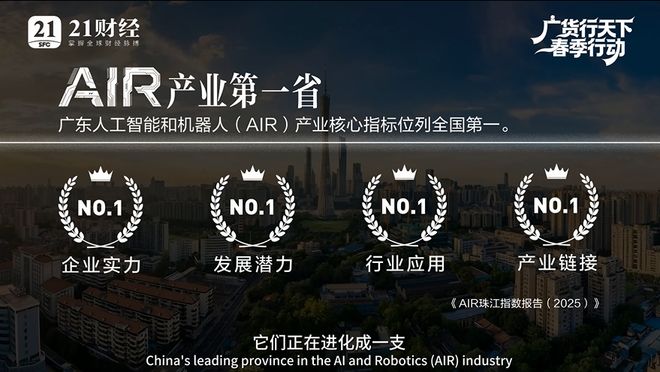
全国第一!广东凭什么拿下AIR产业“冠军”?
2 1 Shi Ji Jing Ji Bao Dao· 2026-01-16 23:14
Core Insights - The article highlights the rapid evolution of AI technology in Guangdong, showcasing the transformation of robots from isolated units to integrated teams capable of performing complex tasks [2][5][7] Group 1: Evolution of AI Technology - Robots in Guangdong have evolved from simple machines to sophisticated entities with intelligence and coordination, becoming popular products in the market [2] - The integration of domestic technologies, such as the open-source HarmonyOS, facilitates communication between different robotic devices, enhancing their capabilities [7] Group 2: Breaking Industry Barriers - AI applications are expanding beyond factories, with significant advancements in sectors like transportation, where autonomous vehicles are now operational in daily scenarios [9][11] - The use of drones has reached new heights, with record-breaking performances in various applications, including agricultural transport and entertainment [11] Group 3: Fusion of Technologies - AI technologies in Guangdong are being applied in diverse scenarios, from delivery drones to real-time translation services, demonstrating their adaptability and integration into everyday life [11][13] - The region's robust industrial ecosystem supports the development and deployment of AI solutions across multiple industries [13] Group 4: Guangdong's Competitive Advantages - Guangdong's AI industry benefits from a complete industrial chain, a large population supporting a vast market, and the fusion of various sectors creating unique applications [13][16] - The establishment of AI development agencies at both city and district levels positions Guangdong as a leader in AI and mechatronics integration [18] Group 5: Policy Support and Innovation - Since 2025, Guangdong has introduced numerous application scenarios to accelerate the integration of AI across various industries [16] - The region is recognized as a hub for both AI software and hardware innovation, with significant advancements in semiconductor technology supporting the AI ecosystem [20][18] Group 6: Scene-Based AI Development - The article emphasizes that the future of the AI industry in Guangdong will be shaped by innovative applications that integrate technology into daily life [22]
广州新书记上任后首次市委全会划出关键词:乘势而上
Nan Fang Du Shi Bao· 2026-01-09 14:53
Group 1 - The core focus of Guangzhou's economic strategy for 2026 includes supporting Nansha's development, establishing a manufacturing-based economy, and enhancing the modern industrial system under the "12218" framework [1][2] - The city aims to maintain its economic rebound momentum, targeting to align its growth rate with the provincial average by 2025 and striving for better results in 2026 [1][2] - Industrial output is identified as a key driver of economic recovery, with significant investments in manufacturing, including a 6.8% increase in automotive manufacturing investment and a 25.1% increase in auto parts manufacturing [2] Group 2 - Urban renewal investments in Guangzhou reached 190 billion, exceeding the target of 180 billion, providing strong support for economic recovery [3] - Despite a slight decline of 0.1% in real estate development investment from January to November 2025, the city is committed to high-quality urban renewal and improving housing conditions [3] - The city plans to achieve a target of 200 billion in urban renewal investments for the current year [3] Group 3 - Guangzhou's social retail sales exceeded 1 trillion, with a year-on-year growth of 4.2%, outperforming the national average [4][5] - The city is set to implement special actions to boost consumption and enhance market expectations, reinforcing its role as a major economic player [5] Group 4 - The new leadership under Feng Zhonghua emphasizes the importance of innovation and reform, particularly in the Nansha area, to strengthen its role as a strategic development platform [6][7] - Nansha has made significant progress in various sectors, including technology innovation and talent acquisition, and is expected to continue its development towards the 2035 goals outlined in the Nansha plan [7]

数智化趋势下如何以新供给创造新消费?
Xin Lang Cai Jing· 2025-12-27 04:15
Core Insights - The article discusses the profound changes in consumer behavior and supply-demand mismatches in the context of evolving economic conditions and technological advancements [1] Group 1: Changes in Consumer Behavior - The transition from self-sufficiency in agricultural civilization to large-scale production and centralized distribution during the industrial revolution has led to unprecedented changes in consumption patterns in the digital age [1] - There is a significant shift from product-centric consumption to a balanced focus on both goods and services, with service consumption, particularly in leisure and entertainment, growing at a faster rate than goods consumption [1] - The proportion of upgraded goods characterized by intelligence, greenness, and convenience is rapidly increasing, with China becoming the largest market for wearable wrist devices, accounting for 30% of global shipments [1] Group 2: Supply-Side Challenges - Despite the acceleration of new technologies and business models, the supply side still requires a systematic approach to meet the complex demands of changing consumer needs and technological iterations [1] - Addressing deep-seated technical, structural, and institutional challenges is crucial for expanding effective consumer demand [1] Group 3: Technological Empowerment - The development of new information technologies is redefining product forms and content presentation, enabling customized and personalized supply based on consumer profiles [2] - Companies are encouraged to leverage cutting-edge technologies such as AI, quantum technology, and biotechnology to create tailored products and services [2] Group 4: Multi-Industry Integration - Promoting multi-industry integration can break down industry boundaries and create one-stop, composite consumption scenarios that integrate functional services and experiential value [3] - Upgrading consumption supply facilities and developing local cultural and ecological resources into distinctive tourism products can enhance consumer experiences [3] Group 5: Rural Market Development - The growth rate of consumption in rural areas has surpassed that in urban areas, presenting a "blue ocean" market opportunity [4] - There is a need to enhance the infrastructure and supply structure in rural markets to meet diverse consumer demands effectively [4] Group 6: Optimizing Consumption Environment - The consumption environment, encompassing both hardware and software aspects, is critical for market stability and consumer confidence [5] - Strengthening market regulation and improving quality standards and consumer rights protection are essential for enhancing the overall consumption experience [5][6]
从千亿到 25 万亿,具身市场迈入新量级
具身智能之心· 2025-12-25 09:30
Core Insights - The core viewpoint of the article is that the global market for embodied intelligence is projected to reach $25 trillion by 2050, representing a growth of 250 times from approximately $100 billion in 2025 [1][2]. Market Projections - The market for humanoid robots is expected to reach $7.5 trillion by 2050 - The market for autonomous vehicles is projected to be $5.6 trillion - Service robots are anticipated to reach $5 trillion - The market for flying drones is estimated at $4.7 trillion - Non-humanoid robots in other scenarios are expected to be around $2.2 trillion [2]. Community Engagement - The community is actively planning research reports and encourages participation from individuals interested in entering or advancing in the field of embodied intelligence [2]. - The community has established a platform for sharing technical routes, live broadcasts, Q&A sessions, job opportunities, and competitions, creating a closed loop for industry, academia, and career exchanges [2][4]. Educational Resources - The community has organized a comprehensive technical stack and learning routes for beginners in the field [6]. - Various roundtable forums and live broadcasts are being prepared to discuss the current developments and unresolved issues in the embodied intelligence industry [4]. Job Opportunities and Networking - The community has established a job referral mechanism with several companies in the embodied intelligence sector, facilitating connections between job seekers and employers [12]. - Members can engage with industry leaders and receive guidance on career-related questions [19]. Knowledge Sharing - The community has compiled a wealth of resources, including open-source projects, datasets, and technical learning routes, to support both newcomers and advanced practitioners in the field [14][20][25].

知名投资者看衰特斯拉:问题不少,2026年将是“清算年”
Sou Hu Cai Jing· 2025-12-15 00:32
Core Viewpoint - Tesla's future is seen as increasingly uncertain, with 2026 identified as a critical year for the company to demonstrate substantial progress in its ambitious goals, particularly in autonomous driving technology [1][2]. Group 1: Concerns About Autonomous Driving - The primary concern for Tesla is its autonomous driving technology, which if it fails to meet market expectations, could undermine the bullish investment logic surrounding the company [1]. - Ross Gerber, a long-time investor, has shifted from being a supporter to a critic, emphasizing that 2026 will be a year where Tesla must show tangible results in its plans [2][9]. - Gerber attributes Tesla's struggles in the autonomous driving sector to its refusal to adopt lidar technology, which has allowed competitors like Waymo to gain a significant market advantage [7][10]. Group 2: Competitive Landscape - Waymo is currently leading the autonomous driving market, having established a strong presence in major U.S. cities, while Tesla is just beginning to deploy its autonomous taxi service [10]. - Gerber believes that Alphabet, Waymo's parent company, is a better investment choice due to its resources and established market position, which puts Tesla at a disadvantage [10]. Group 3: Leadership and Public Perception - Gerber has criticized Elon Musk for being distracted by other ventures, which he believes has negatively impacted Tesla's stock performance and operational focus [5][6]. - The public perception of Musk has also become a concern, as his political involvement has polarized consumer opinions, potentially affecting Tesla's market appeal even if it catches up technologically [10].


大摩闭门会:机器人、金融、保险行业更新行业更新 _AI 纪要
2025-12-11 02:16
Summary of Key Points from Conference Call Records Industry Overview Embodied Intelligence Market - The global embodied intelligence market is projected to reach $25 trillion by 2050, growing from approximately $100 billion in 2025, indicating a 250-fold increase over 25 years [3][1] - Key segments include humanoid robots ($7.5 trillion), autonomous vehicles ($5.6 trillion), service robots ($5 trillion), aircraft and drones ($4.7 trillion), and non-humanoid robots ($2.2 trillion) [3][1] Humanoid Robots in China - The humanoid robot market in China is expected to double by 2026, with potential sales reaching 50 million units by 2050, accounting for 30%-40% of global demand [1][7] - Current testing willingness among enterprises is high, with 62% expected to test humanoid robots by 2027 [1][8] - Price sensitivity is significant, with most enterprises preferring prices below 200,000 RMB, and 50% wanting prices under 100,000 RMB [1][9] Autonomous Driving - China is leading in the autonomous driving sector, with L4/L5 vehicles expected to exceed 165 million units by 2050, representing about 25% of the global market [1][10] - The focus in 2026 will shift to the profitability of autonomous ride-hailing services [1][11] Low-altitude Economy - China is making strides in the eVTOL (electric Vertical Take-Off and Landing) sector, expected to be the first country to achieve large-scale commercial operations by 2030, supplying over 60% of global demand [1][12] Company Insights Ping An Insurance - Ping An is benefiting from the growth in resident wealth, increasing demand for retirement and healthcare services, with a projected compound annual growth rate (CAGR) of 8% from 2024 to 2030 [4][15] - The asset management sector is gradually recovering from losses, with expectations of profitability by 2027 [4][15] - The company is reducing real estate exposure and optimizing asset structure to mitigate risks associated with declining property prices [4][15] Public Fund Industry - The public fund industry is facing transformation pressures, with expected management scale growth of 10%-11% in the coming years, driven by increasing resident financial assets [4][21] - The industry has seen a decline in income by 28% despite a 28% increase in management scale from 2021 to 2024 [4][19] - The sales channel income is shifting from being heavily reliant on sales volume to being more performance-based [4][20] Key Components and Growth Projections Core Components for Embodied Intelligence - Significant growth is anticipated in key components: visual cameras (95x), radar and lidar (300x), motors (260x), bearings (200x), and batteries (1,400x) [5][1] Market Dynamics - The public fund industry is expected to see a rebound in equity allocation, with a projected recovery in the proportion of actively managed equity products [4][26] - The shift towards mixed products is anticipated, with a focus on fixed income to meet the demand for stable returns among domestic investors [4][28] Conclusion - The embodied intelligence and autonomous driving sectors present substantial growth opportunities, particularly in China, while Ping An Insurance is well-positioned to capitalize on demographic trends and market demands. The public fund industry is undergoing significant changes, with a focus on performance-based income and a shift in investment strategies.


推动更多应用场景转变为“科创胜景”
Zhong Guo Jing Ji Wang· 2025-11-22 00:34
Core Insights - The Chinese government has issued an implementation opinion to accelerate the cultivation and large-scale application of new scenarios, leveraging the country's vast market and rich application scenarios to transform them into "scientific and technological innovation landscapes" [1][2] Group 1: Market and Technological Landscape - China's market, with over 1.4 billion people, and its leading number of R&D personnel are key drivers for innovation, enabling applications like autonomous vehicles, drone deliveries, and medical robots [1] - Despite existing advantages in AI, 5G, and quantum computing, many innovations remain in the "laboratory" stage and need effective market transformation [1][2] Group 2: Innovation and Industry Upgrading - Scenario innovation addresses real challenges in manufacturing costs and logistics efficiency, acting as a lever for industrial upgrades, exemplified by the "smart mine" scenario that can drive innovation across the entire supply chain [1] - Successful scenarios represent a systemic reconstruction of technology, industry, and production factors, creating a bidirectional cycle of demand and supply [2] Group 3: Collaborative Ecosystem - The collaboration between large enterprises and small to medium-sized enterprises fosters a synergistic ecosystem that enhances the coupling of innovation chains, industry chains, capital chains, and talent chains [2] - A smart connected vehicle scenario exemplifies the integration of multiple technologies, promoting cross-fusion and integrated innovation [2] Group 4: Implementation Strategies - Realizing the vision requires coordinated efforts from government, market, and society, including driving independent innovation in critical areas like chips and industrial software through demand [2] - Establishing foundational systems for data rights, circulation, and governance is essential for maximizing the potential of data as a production factor [2] - Promoting inclusive regulatory models like "sandbox regulation" will provide space for new developments and accelerate the establishment of corresponding standards and norms [2][3]