量化私募

Search documents
百亿元级私募机构增至101家
Zheng Quan Ri Bao· 2025-10-26 16:16
Group 1 - The number of private equity firms with over 10 billion yuan in assets has reached 101 as of October 26, 2023, an increase of 5 from 96 at the end of September [1] - Among the 101 firms, quantitative private equity firms dominate with 47 firms, accounting for approximately 46.53%, while subjective private equity firms follow closely with 44 firms, making up about 43.56% [1] - In October, the new entrants included 2 subjective strategy firms, 2 quantitative strategy firms, and 1 mixed strategy firm [1] Group 2 - Stock strategies remain the primary focus, with 77 firms employing this strategy, representing a high proportion of 76.24% [2] - The new entrants in October included 3 firms focusing on stock strategies, while the remaining 2 firms adopted multi-asset and combination fund strategies [2] - The increase in the number of private equity firms is attributed to the stabilization and recovery of the A-share market, which has enhanced the performance of equity assets [2] Group 3 - In the first three quarters of the year, the average return of products from 62 recorded private equity firms reached 28.80%, showcasing strong market adaptability [2] - Notable firms with outstanding performance include Shanghai Fusheng Asset Management, Ningbo Lingjun Investment Management, and Shanghai Kaishi Private Fund Management [2]
私募“百亿俱乐部”成员再破百,这次有啥不一样?
Zhong Guo Ji Jin Bao· 2025-10-26 10:53
Core Insights - The number of private equity firms managing over 10 billion yuan has surpassed 100, indicating a new phase of growth in the industry driven by market conditions and structural changes [1][2][3] - The shift from subjective to quantitative strategies marks a significant evolution in the private equity landscape, with quantitative firms now outnumbering subjective ones [4][5][6] Industry Growth - As of October 2023, the number of billion-yuan private equity firms reached 101, up from 96 at the end of September, with notable new entrants and returning firms [2] - The average return for billion-yuan private equity firms in the first three quarters of 2023 was nearly 30%, with over 98% of firms reporting positive returns [2][3] Performance Comparison - Quantitative private equity firms achieved an average return of 66.8% from September 2024 to October 2025, significantly outperforming subjective strategies, which returned 41.98% [5] - The average return for all private equity funds in the market was 25%, outperforming the Shanghai and Shenzhen 300 Index [3] Strategy Evolution - The current market environment has led to a preference for stable and reliable investment strategies, with investors increasingly favoring established firms with robust risk management and operational compliance [3][9] - The integration of quantitative methods into traditional subjective strategies is becoming common, as firms seek to enhance their investment capabilities and adapt to market changes [11] Investor Behavior - Investors are shifting from self-directed investments to allocating funds to private equity products, reflecting a growing trust in established firms [3][9] - There is a notable change in investor preferences, with a focus on stable returns and risk-adjusted performance rather than solely on high excess returns [10]
私募“百亿俱乐部”成员再破百,这次有啥不一样?
中国基金报· 2025-10-26 10:52
Core Insights - The number of private equity firms managing over 10 billion yuan has surpassed 100, indicating a new phase of growth in the industry driven by market conditions and structural changes [2][4][17] - The shift from a focus on high returns to a preference for stable and reliable investment strategies is evident among investors, particularly high-net-worth individuals and institutions [13][15][16] Industry Expansion - As of October 2025, the number of billion-yuan private equity firms reached 101, up from 96 in September, with notable new entrants and returning firms [4] - The average return for billion-yuan private equity firms in the first three quarters of the year was nearly 30%, with over 98% of firms reporting positive returns [5][6] - The growth of quantitative private equity firms has outpaced that of subjective strategy firms, with 47 quantitative firms compared to 44 subjective firms in the billion-yuan category [8] Performance Metrics - Quantitative strategies have shown superior performance, with an average return of 66.8% compared to 41.98% for subjective strategies from September 2024 to October 2025 [8] - The average return for all private equity funds in the market was 25%, significantly outperforming the Shanghai and Shenzhen 300 Index [5] Strategy Evolution - The industry is witnessing a transition from quantity to quality, with a focus on stable operations and risk management capabilities [6][17] - The integration of quantitative tools into subjective strategies is becoming common, leading to a more blended approach in investment management [9][16] Investor Behavior - Investors are increasingly favoring products that offer stable returns and diversified strategies, moving away from the pursuit of high-risk, high-reward options [13][15] - The demand for index-enhanced products has surged, as they provide a combination of market exposure and quantitative alpha, appealing to investors who prefer not to select individual stocks [15] Future Outlook - The private equity industry is expected to continue evolving, with firms focusing on sustainable value creation rather than short-term gains, marking a significant shift in the "new hundred club" era [17]


私募业重回“双百”时代!百亿阵营格局大变,行业头部化加速
券商中国· 2025-10-24 23:32
Core Insights - The private equity fund industry is experiencing a resurgence, with the number of private equity funds exceeding 100 for the first time in over a year, reaching 101 as of October 22, 2025, driven by a strong A-share market and rising investor confidence in top-performing funds [1][5][4] Group 1: Market Dynamics - The number of private equity funds with over 10 billion yuan in assets has increased from 91 in late August to 101 by October, indicating a significant recovery in the market [1][5] - The rise of quantitative private equity funds is notable, with their numbers increasing to 47, making up 46.53% of the "billion club," surpassing subjective funds [6][8] - The private equity industry is witnessing a trend of consolidation, with resources increasingly flowing towards high-performing funds, leading to accelerated competition and a "survival of the fittest" scenario [11][8] Group 2: Historical Context - The private equity sector entered a "double hundred" era in late 2021 when the number of funds exceeding 10 billion yuan first surpassed 100, but faced a decline in 2024 due to a prolonged market downturn [3][2] - The number of billion-yuan private equity funds dropped to 80 in August 2024, highlighting the industry's volatility and the challenges faced by many funds [3] Group 3: Performance and Strategy - The recent market rally has allowed subjective strategy funds to regain traction, with 6 out of the 10 newly added funds in October being subjective strategy funds, indicating a shift in investor preferences [6][5] - The total assets under management for quantitative private equity funds have seen a significant increase, with the total estimated at 1.3 trillion yuan, reflecting a growth of over 200 billion yuan from the previous quarter [10][9]

百亿私募格局悄然生变 量化私募数量升至47家
Zheng Quan Shi Bao Wang· 2025-10-23 23:04
人民财讯10月24日电,近两个月,在上证指数创出十年新高的背景下,私募基金迎来新一轮规模扩张的 机遇,又一批私募加入"百亿俱乐部"。 私募排排网数据显示,截至10月22日,百亿私募数量突破至101家,较8月底的91家新增10家。其中,正 瀛资产、开思私募、太保致远(上海)私募、大道投资为新晋百亿私募,有6家私募为再次回归百亿阵 营。 值得注意的是,百亿私募的格局悄然生变,量化私募数量升至47家,成为"百亿俱乐部"主力军,将主观 策略私募甩在身后;同时,行业头部效应进一步强化,优胜劣汰加速。 ...
百亿私募再破百家:这次有何不同?
2 1 Shi Ji Jing Ji Bao Dao· 2025-10-23 15:05
Core Insights - The private equity fund industry in China is experiencing robust growth, with the number of billion-yuan private equity firms exceeding 100 as of October 22, 2025, marking an increase from 96 in September 2025 [1] - The recovery of the A-share market and improved returns on equity assets are driving the performance and scale of private equity products [1][6] - Quantitative private equity firms are becoming the dominant force within the billion-yuan private equity sector, with 46 firms representing 46% of the total [8] Group 1: Growth of Billion-Yuan Private Equity Firms - The number of billion-yuan private equity firms has reached 100, with 4 new additions in October 2025 and a total of 9 since September 2025 [5] - Among the new entrants, subjective strategy private equity firms dominate, with 6 out of 9 being subjective strategy firms [5] - The core strategy of the majority of these firms remains equity-focused, with 76 firms (76%) employing stock strategies [5] Group 2: Performance of Quantitative Private Equity - Quantitative private equity firms have shown significant performance advantages, with an average return of 31.90% for 38 firms compared to 24.56% for 19 subjective strategy firms [2] - The competitive edge of quantitative firms is attributed to continuous strategy iteration and enhanced risk control systems [2] - The leading quantitative firms, referred to as the "Four Kings of Quant," have collectively surpassed 70 billion yuan in scale as of Q3 2025 [8] Group 3: Market Dynamics and Future Outlook - The increase in billion-yuan private equity firms is driven by the stabilization of the A-share market and a growing recognition of top private equity firms by investors [6] - The market is expected to continue favoring low-valuation sectors in the fourth quarter, as historical trends suggest defensive strategies will prevail [10] - The ongoing investment in artificial intelligence and deep learning by quantitative private equity firms is aimed at maintaining their strategic advantages [9]

再增5家!百亿私募数量突破100大关!
私募排排网· 2025-10-23 03:33
Core Insights - The number of billion-dollar private equity firms has surpassed 101 as of October 22, 2025, with an increase of 5 firms from September [1] - The growth in the number of billion-dollar private equity firms is attributed to the stabilization and recovery of the A-share market, leading to improved performance and scale of private equity products [6][7] - The majority of the new entrants in the billion-dollar category are subjective private equity firms, reflecting their flexibility in adapting to market conditions [7] Summary by Categories Number of Billion-Dollar Private Equity Firms - As of October 22, 2025, there are 101 billion-dollar private equity firms, up from 96 in September, with notable returns of familiar firms and one new entrant [1] - The new entrants include Shanghai New Equation, Wangzheng Asset, Jing'an Investment, and Hefei Investment, with Dadao Investment being a first-time entrant [1] Investment Strategy Distribution - Among the 101 billion-dollar private equity firms, quantitative firms lead with 47 firms (46.53%), followed closely by subjective firms with 44 firms (43.56%), and mixed strategy firms with 8 firms (7.92%) [2] - In the new entrants, subjective and quantitative strategies each account for 2 firms, while mixed strategy accounts for 1 firm [2] Core Strategy Analysis - The dominant core strategy among the billion-dollar private equity firms is stock strategy, with 77 firms (76.24%), followed by multi-asset strategy (13 firms, 12.87%) and bond strategy (6 firms, 5.94%) [5] - Among the new entrants, 3 firms focus on stock strategy, while 1 firm each focuses on multi-asset and combination fund strategies [5] Market Trends and Investor Behavior - The increase in billion-dollar private equity firms is driven by investor confidence in top firms, leading to a concentration of funds towards those with stable performance and mature strategies [6] - The "head effect" in the industry is strengthening, with resources increasingly directed towards high-quality private equity firms, accelerating the process of industry selection [6] Flexibility of Subjective Private Equity Firms - Subjective private equity firms are favored in the current complex market environment due to their ability to adjust positions and sector allocations in response to macroeconomic conditions and policy changes [7] - Experienced fund managers in subjective firms are better positioned to identify quality stocks, leading to superior performance and attracting continued capital inflow [7]

百亿私募数量突破100家 量化私募和主观私募占据绝大多数份额
Zhong Guo Ji Jin Bao· 2025-10-22 10:16
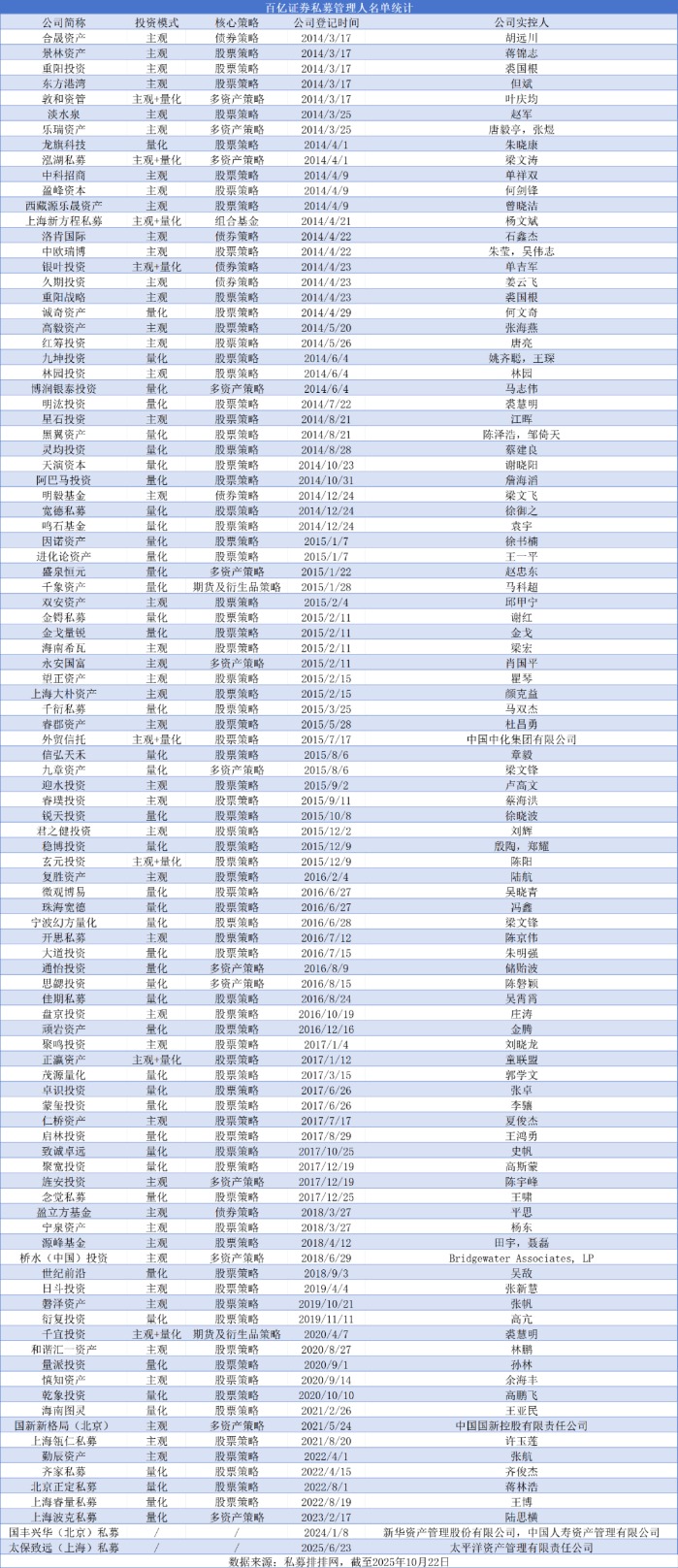
Core Insights - The number of private equity funds with over 10 billion yuan in assets has reached 100, marking a significant milestone in the industry as it reflects the recovery of the market and the growth of fund performance and scale [2][3]. Group 1: Growth of Private Equity Funds - As of October 22, 2025, the number of private equity funds exceeding 10 billion yuan has increased by 4 from the end of September, with notable new entrants including Dadao Investment and the return of Shanghai New Equation and Wangzheng Asset [2]. - The current distribution of the 100 funds shows that quantitative funds lead with 46, followed closely by subjective funds at 44, while mixed strategy funds account for 8 [2][3]. Group 2: Market Dynamics - The increase in the number of large private equity funds is attributed to the stabilization of the A-share market, which has improved returns on equity assets, leading to a rise in both fund performance and scale [3]. - There is a growing recognition of leading private equity firms, resulting in a concentration of funds towards those with stable performance and mature strategies, reinforcing the "head effect" in the industry [3]. Group 3: Investment Strategies - Stock strategies dominate the core strategies of the funds, with 76 out of 100 funds focusing on this area, reflecting the current market's favorable conditions for stock selection [4]. - The rise in multi-asset strategies indicates an increasing demand for risk diversification, as these strategies can mitigate the volatility of single assets and provide more stable returns [5].
百亿私募,突破100家!
Zhong Guo Ji Jin Bao· 2025-10-22 09:40
Core Insights - The number of private equity firms with over 10 billion yuan in assets has surpassed 100, marking a significant milestone in the industry, with a total of 100 firms as of October 22, 2025, an increase of 4 from the end of September [2][3] - Quantitative and subjective private equity firms dominate the market, collectively accounting for 90% of the total, indicating a solidified "dual giant" structure in the industry [2][3] Group 1: Market Trends - The increase in the number of billion-yuan private equity firms is attributed to the stabilization and recovery of the A-share market, which has improved the performance of equity assets [3] - Investors are increasingly recognizing leading private equity firms, leading to a concentration of funds towards those with stable performance and mature strategies [3] - The current market environment's complexity has favored subjective strategies, allowing for flexible adjustments based on macroeconomic conditions and policy changes [3] Group 2: Investment Strategies - Among the 100 billion-yuan private equity firms, 46 are quantitative, 44 are subjective, and 8 employ mixed strategies, with 2 firms not disclosing their investment models [2] - Stock strategies remain the dominant core strategy, utilized by 76 firms, while multi-asset strategies account for 13, and bond strategies for 6 [4][5] - The rise in multi-asset strategies reflects an increasing demand for risk diversification in a market characterized by rapid style rotation and heightened volatility [5]
百亿私募,突破100家!
中国基金报· 2025-10-22 09:39
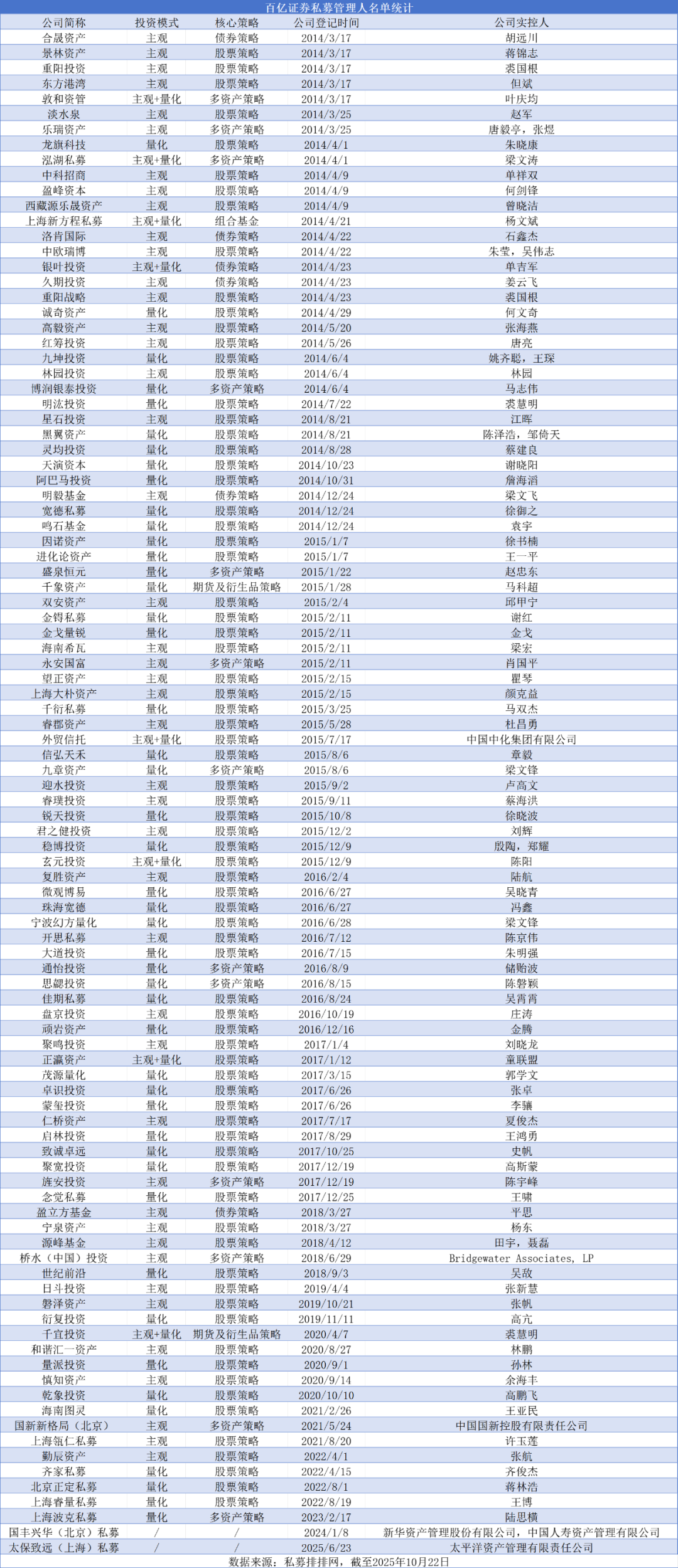
Core Insights - The number of private equity firms with over 10 billion yuan in assets has surpassed 100, marking a significant milestone in the industry, with a total of 100 firms as of October 22, 2025, an increase of 4 from the end of September [4][5] - Quantitative and subjective private equity firms dominate the market, collectively accounting for 90% of the total, indicating a solidified "dual giant" structure in the industry [5][6] Private Equity Growth - The increase in the number of billion-yuan private equity firms is attributed to the stabilization of the A-share market, which has led to improved performance and scale of private equity products [6] - Investors are increasingly recognizing leading private equity firms, resulting in a concentration of funds towards those with stable performance and mature strategies [6] Investment Strategy Distribution - Among the 100 billion-yuan private equity firms, 46 are quantitative, 44 are subjective, 8 employ mixed strategies, and 2 have undisclosed investment models [5] - Stock strategies remain the dominant core strategy, with 76 firms (76%) focusing on this approach, while multi-asset strategies account for 13 firms and bond strategies for 6 [8][9] Market Dynamics - The current market environment favors subjective strategies due to their flexibility in adjusting positions based on macroeconomic conditions and policy changes, which is crucial for navigating market volatility [6] - The rise in multi-asset strategies reflects an increasing demand for risk diversification, as institutions seek balanced returns amid rapid market style rotations [9]