
Agentic AI

Search documents
腾讯云邱跃鹏:模型产业重心已向推理转变
第一财经· 2025-09-16 02:52
Core Viewpoint - The focus of the model industry is shifting towards inference, with a predicted inflection point in 2025 when inference demand will surpass training demand [1] Group 1 - Tencent's MAU (Monthly Active Users) for its IMA has increased 80 times in six months [1] - The "Yuanbao" service has answered high school entrance exam questions 150 million times [1] - By 2028, it is expected that 33% of enterprise software will include Agentic AI [1] Group 2 - The domestic enterprise-level Agent (intelligent agent) market is projected to exceed $27 billion [1]



腾讯云邱跃鹏:模型产业重心已向推理转变
Di Yi Cai Jing· 2025-09-16 02:28
Core Insights - Tencent's IMA (Intelligent Model Assistant) has seen a significant increase in monthly active users, growing 80 times within six months [1] - The focus of the model industry is shifting towards inference, with expectations that by 2025, the demand for inference will surpass that for training [1] - The IMA has answered high school entrance exam questions 150 million times, indicating its widespread usage and utility [1] - By 2028, it is projected that 33% of enterprise software will incorporate Agentic AI, with the domestic enterprise-level Agent market expected to exceed $27 billion [1]
Amazon bolsters AI agent push with new executive hires, according to internal memos
Business Insider· 2025-09-15 20:49
Core Insights - Amazon is intensifying its focus on agentic AI by hiring two senior executives to enhance its developer tools and infrastructure for intelligent agents [1][2] - The company's cloud computing division, AWS, aims to establish itself as a leader in the agentic AI market, where intelligent software agents manage complex applications for users [2] Executive Hires - David Richardson has returned to AWS as Vice President of AgentCore, overseeing foundational agent infrastructure and related projects like Strands SDK and Agent Builder within Bedrock [3][4] - Joe Hellerstein has joined AWS as Vice President and Distinguished Scientist, focusing on advancing Kiro, AWS's agentic integrated development environment (IDE), which has attracted over 100,000 users in its first week [5][9] Strategic Initiatives - Richardson is expected to initiate new projects under the AgentCore umbrella, enhancing AWS's capabilities in agentic AI [4] - Hellerstein will integrate principles from his Hydro project into Kiro to improve the platform's reliability and appeal to developers [9][10] - The collaboration between Hydro and Kiro is anticipated to help customers build robust, high-performance distributed systems [10]


Ericsson Powers NetCloud With Agentic AI to Drive Enterprise 5G Growth
ZACKS· 2025-09-15 15:01
Core Insights - Ericsson has advanced the enterprise 5G networking landscape by integrating agentic AI into its NetCloud platform, which is expected to transform how enterprises deploy, optimize, and manage private 5G and Wireless WAN solutions [1] Group 1: AI Integration and Features - The AI-powered assistant ANA has evolved from a user-prompt-driven tool to a strategic partner, capable of executing complex workflows and assisting in decision-making while reducing administrative workload [2] - ANA's architecture includes orchestrators and functional AI agents, with the first troubleshooting agent set to launch in Q4 2025, aiming to automate workflows and improve efficiency [3] - The AI-powered troubleshooting orchestrator is projected to reduce downtime and support cases by 20% by addressing recurring issues such as offline devices and degraded signal quality [4] Group 2: Analytics and Insights - ANA can generate dynamic graphs and visualizations to highlight trends and anomalies, making analytics more actionable and efficient [5] - NetCloud AIOps capabilities will expand to cover various anomalies for Wireless WAN and NetCloud SASE, providing service health analytics and enabling early issue identification [6] Group 3: Integration and Benefits - Ericsson is integrating Private 5G into the NetCloud platform, which is expected to enhance agility, lifecycle management, and administrator control for enterprise 5G customers [7] - This integration aims to address key adoption challenges and enable industrial enterprises to fully leverage 5G for mission-critical IT and OT operations [7] Group 4: Market Position and Strategy - Ericsson is leveraging strong 5G momentum and a competitive product portfolio to strengthen its position in mobile infrastructure and enterprise markets, supported by strategic acquisitions and increased R&D [10] - The company remains a leading choice for operators seeking expanded coverage and faster networks, focusing on technology leadership and automation to drive growth [11] Group 5: Challenges and Competition - Despite its advancements, Ericsson faces challenges from geopolitical risks, supply chain issues, and competition from Huawei and Nokia, with declining revenue in certain regions [12]

‘Fastest-Growing Market in Software’: Morgan Stanley Suggests 2 Cybersecurity Stocks to Buy
Yahoo Finance· 2025-09-13 10:10
Company Overview - Okta is a $16 billion company focused on identity security, providing solutions for both human and non-human identity verifications, including secure processes for agentic AI [2] - The company has developed Okta AI, which integrates into its workforce and customer identity clouds, enhancing security and productivity while improving user experience [6] Financial Performance - Okta's fiscal 2Q26 report showed a revenue of $728 million, exceeding estimates by $16 million and growing 13% from fiscal 2Q25 [7] - The company predicts revenue for fiscal 3Q26 to be between $728 million and $730 million, above the Wall Street expectation of $723.1 million [7] Market Potential - The cybersecurity market is valued at approximately $270 billion and is expected to grow at a 12% CAGR from 2025 to 2028, with cybersecurity spending projected to grow 50% faster than overall software spending [4] - Okta's expansion into Identity Governance (OIG) and Privileged Access Management (PAM) presents significant upsell opportunities, with OIG already being a >$100 million ACV business [8] Analyst Insights - Morgan Stanley analyst Keith Weiss rates Okta shares as Overweight (Buy) with a price target of $123, indicating a 34% upside potential over the next 12 months [9] - The consensus rating for Okta shares is a Moderate Buy, with 19 Buy, 11 Hold, and 2 Sell recommendations [9] Competitive Landscape - Zscaler, another key player in cybersecurity, has grown into a ~$44 billion company, handling over 500 billion daily transactions and preventing over 9 billion daily incidents [12] - Zscaler's recent acquisition of Red Canary enhances its capabilities in exposure management and agentic AI threat management [13] Zscaler Financials - Zscaler's fiscal 4Q25 revenue reached $719.2 million, growing 21% year-over-year and exceeding forecasts by over $12 million [14] - The company's annual recurring revenue (ARR) increased by 22% year-over-year to $3.02 billion [14] Analyst Ratings for Zscaler - Weiss rates Zscaler as Overweight (Buy) with a price target of $320, suggesting a 12% upside potential [15] - The consensus rating for Zscaler is Strong Buy, with 30 Buy and 5 Hold recommendations [16]


Prediction: This Artificial Intelligence (AI) Player Could Be the Next Palantir in the 2030s
The Motley Fool· 2025-09-12 23:45
Core Insights - The article discusses the challenges and strategies for companies aiming to replicate Palantir's success in the enterprise AI sector, emphasizing the importance of becoming a core platform for AI applications and effectively managing client relationships [1][4][15] Company Performance - Palantir's Q2 fiscal 2025 revenues grew 48% year over year to over $1 billion, with U.S. commercial and government revenues increasing by 93% and 53% respectively, and a total contract value of $2.3 billion [4] - Innodata's Q2 fiscal 2025 revenues increased by 79% year over year to $58.4 million, with adjusted EBITDA rising 375% to $13.2 million, and management raised full-year organic growth guidance to 45% or more [5][11] Business Strategy - Palantir focuses on leveraging AI capabilities to solve real-world problems rather than large language models, utilizing a framework that connects real and digital assets [6] - Innodata is transitioning to provide "smart data" for AI models, enhancing accuracy and performance, and is working closely with major tech clients to improve model performance [7][9] Vendor Neutrality - Palantir's platforms can operate on any cloud and integrate with various large language models, preventing vendor lock-in and building trust among clients [8] - Innodata's vendor-neutral approach is becoming a competitive advantage, as it allows for collaboration without conflicts of interest, attracting new opportunities [9] Scaling Efforts - Palantir closed 157 deals worth $1 million or more in Q2, indicating strong traction with high-value clients [10] - Innodata is expanding revenues significantly, with a notable increase from a major client expected to reach $10 million in the second half of 2025 [11] AI Development - Palantir is investing in agentic AI capabilities to autonomously execute complex tasks, enhancing efficiency for clients [12] - Innodata is also advancing in agentic AI, focusing on providing simulation training data and safety monitoring for autonomous systems [13] Valuation - Innodata's shares have increased by over 315% in the last year, but it is still valued as a data services company rather than an AI platform, trading at nearly 8.2 times sales [14] - Palantir's stock trades at approximately 114 times sales, reflecting its status as a category leader in the enterprise AI market [14]



SoundHound AI Acquires Interactions to Cement Its Lead in Agentic AI
Yahoo Finance· 2025-09-12 21:29
Core Insights - SoundHound AI, Inc. has announced the acquisition of Interactions, enhancing its position in Agentic AI and customer service market penetration [1][3] - The acquisition will introduce major global brands to SoundHound's customer portfolio, including Fortune 100 companies across various industries [2] - The merged entity will possess approximately 400 patents and over $270 million in cash, with no outstanding debt, and is expected to improve operating profitability immediately [3] Company Strategy - The integration of Interactions' AI-powered voice assistants aims to enhance customer engagement and productivity, thereby expanding SoundHound's enterprise business [3] - SoundHound's CEO emphasizes the vision of advancing towards a future where voice and conversational AI are essential for high-quality customer service, positioning the company as a leader in the AI era [4] Financial Position - The acquisition is expected to provide immediate accretion to operating profitability, indicating a positive financial outlook post-transaction [3]

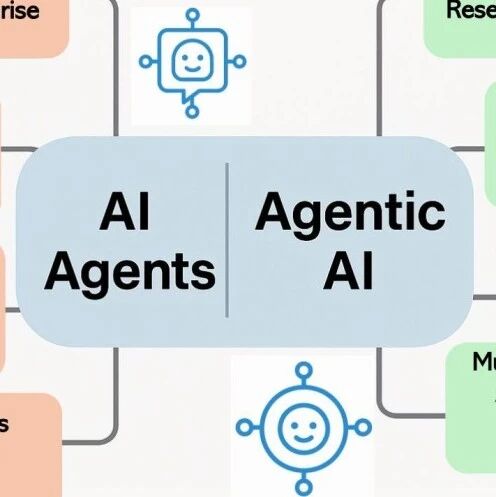
AI Agents与Agentic AI的范式之争?
自动驾驶之心· 2025-09-12 16:03
Core Viewpoint - The article discusses the evolution and differentiation between AI Agents and Agentic AI, highlighting their respective roles in automating tasks and collaborating on complex objectives, with a focus on the advancements since the introduction of ChatGPT in November 2022 [2][10][57]. Group 1: Evolution of AI Technology - The development of AI technology has progressed from early expert systems like MYCIN to modern AI Agents and Agentic AI, marking a significant paradigm shift in capabilities [10][11]. - ChatGPT's release in November 2022 is identified as a pivotal moment that catalyzed the evolution of AI Agents, transitioning from passive responders to more autonomous systems capable of executing multi-step tasks [12][24]. - The introduction of frameworks like AutoGPT and BabyAGI in 2023 signifies the formal establishment of AI Agents, which integrate LLMs with external tools to perform complex tasks [12][24]. Group 2: Characteristics of AI Agents - AI Agents are defined as modular systems driven by LLMs and LIMs, designed for task automation, filling the gap where generative AI lacks execution capabilities [13][16]. - Three core features distinguish AI Agents from traditional automation scripts: autonomy, task-specificity, and reactivity [16][17]. - The integration of tools allows AI Agents to overcome limitations of static knowledge and hallucination issues, enabling them to perform real-time data retrieval and processing [19][20]. Group 3: Agentic AI and Multi-Agent Collaboration - Agentic AI represents a shift towards multi-agent collaboration, where multiple AI Agents work together to achieve complex goals, enhancing system-level intelligence [24][27]. - The architecture of Agentic AI includes dynamic task decomposition and shared memory, facilitating efficient collaboration among specialized agents [33][36]. - Real-world applications of Agentic AI demonstrate its advantages in various fields, such as healthcare and agriculture, where multiple agents coordinate to optimize processes [37][38]. Group 4: Challenges and Future Directions - Both AI Agents and Agentic AI face challenges, including causal reasoning deficits and coordination issues among multiple agents [48][50]. - Proposed solutions include enhancing retrieval-augmented generation (RAG), implementing causal modeling, and establishing shared memory architectures to improve collaboration and decision-making [49][53]. - The future roadmap emphasizes the need for deeper causal reasoning, transparency in decision-making, and ethical governance to ensure the responsible deployment of AI technologies [56][59].
HCHB forms alliance with Element5 to enhance healthcare efficiency
Yahoo Finance· 2025-09-12 11:01
Core Insights - Homecare Homebase (HCHB) has partnered with Element5 to enhance operational efficiency for healthcare providers by integrating Element5's Agentic AI platform with HCHB's EHR system [1][4] - The collaboration aims to address challenges in post-acute care, such as Medicare Advantage growth, staffing shortages, slim margins, and regulatory burdens [2][4] - The integration of intelligent agents from Element5 allows for the automation of complex processes, leading to reduced operational costs and improved workflows [3][4] Group 1 - The partnership combines HCHB's workflow knowledge with Element5's AI capabilities to empower healthcare providers [4][5] - Element5's Agentic AI transforms workflow efficiency by integrating business rules, intelligence, tools, and advanced orchestration [2][3] - The collaboration sets benchmarks for operational excellence, enabling agencies to navigate current challenges and expand in the healthcare sector [5]
Can Agentic DevOps unlock the dream of frictionless digital transformation?
Yahoo Finance· 2025-09-12 08:57
Core Insights - DevOps is a significant challenge for CIOs, as the transition from automated processes in development to full operational status often conflicts with executive directives that overlook the complexities of IT modernization [1] - A well-functioning DevOps can lead to substantial cost reductions, increased productivity, and streamlined workflows through new automation processes [2] Industry Challenges - Despite advancements in intelligent process automation (IPA), enterprises face difficulties in defining, creating, and managing the modernization of IT infrastructure and applications [3] - Business transformations remain costly, slow, and labor-intensive due to issues such as lack of executive support, internal expertise, and access to qualified consultants [4] - Maintaining legacy IT systems is becoming increasingly expensive and poses regulatory and operational risks, making modernization essential [5] Technological Advancements - AI agents are seen as a promising technology for enterprise developers, enhancing the capabilities of intelligent process automation [5] - IPA focuses on automating repetitive, rule-based processes, while AI agents are designed for goal-driven applications that can adapt and reason autonomously [6] - The adoption of Generative AI (GenAI) by application platform providers has made machine learning and natural language processing more accessible, facilitating the development of agentic AI [6] - Customization of GenAI-injected code and integration with development environments like GitHub enhances intelligent workflows through autonomous capabilities [7] - Agentic AI aims to automate complex tasks and improve business processes with minimal human input, learning to become more effective over time [7]