模型推理

Search documents
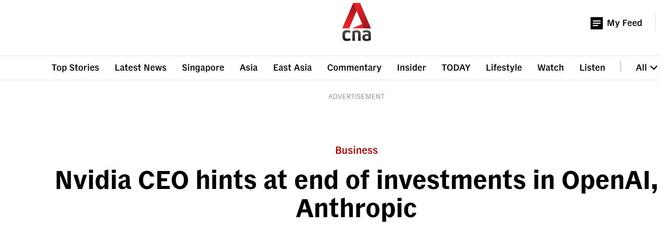
黄仁勋暗示:英伟达将终止对OpenAI和Anthropico的投资
Huan Qiu Wang Zi Xun· 2026-03-05 08:59
Group 1 - Nvidia's CEO Jensen Huang stated that the recent $30 billion investment in OpenAI may be the last, indicating a significant shift in their previously announced $100 billion infrastructure partnership due to OpenAI's preparations for an IPO [1][2] - The ambitious $100 billion investment plan is now deemed "highly unlikely" to be realized, as OpenAI's upcoming IPO will fundamentally change its capital structure and financing strategy, making it difficult for Nvidia to continue large-scale investments as a private equity investor [2] - The confirmed $30 billion investment is part of OpenAI's total $110 billion financing plan, which also includes $50 billion from Amazon and $30 billion from SoftBank, providing OpenAI with dedicated inference and training capabilities to support its growing AI data center needs [2] Group 2 - Nvidia's investment in another AI giant, Anthropic, amounting to $10 billion, is also likely to be the last, as Anthropic plans to go public in 2026, although the IPO decision has not been officially confirmed [3] - Huang expressed that this may be Nvidia's last opportunity to invest in such significant companies, as leading AI startups move towards the public market, redefining Nvidia's dual role as a chip supplier and strategic investor [3] - The AI industry is experiencing a profound shift in demand from model training to inference, which requires new chip efficiency and latency standards, prompting Nvidia to develop new chips optimized for inference tasks [4]


吴恩达年度AI总结来了!附带一份软件开发学习小tips
量子位· 2025-12-30 06:33
Core Insights - The article summarizes the key AI trends anticipated for 2025, as outlined by AI expert Andrew Ng, highlighting significant developments in AI capabilities and industry dynamics [1][3]. Group 1: AI Model Capabilities - The ability of models to reason is becoming a standard feature, moving beyond being a unique trait of a few models [5][8]. - The evolution of reasoning capabilities in models can be traced back to the paper "Large Language Models are Zero-Shot Reasoners," which introduced the prompt "let's think step by step" to enhance output quality [9]. - The introduction of models like OpenAI's o1 and DeepSeek-R1 has marked a paradigm shift, embedding multi-step reasoning workflows directly into model architectures [12][13]. Group 2: AI Talent Competition - The AI talent competition, ignited by Meta, has led to salaries for top AI professionals reaching levels comparable to professional sports stars, fundamentally reshaping the tech industry's talent pricing [18][19]. - Meta's establishment of the "Meta Super Intelligence Lab" and aggressive recruitment strategies have intensified the competition for AI talent [20][21]. - This talent war is seen as a strategic necessity for companies aiming to compete in the AGI race, with the potential for salary structures to evolve beyond mere price competition by 2026 [23][24]. Group 3: Data Center Investments - The surge in data center investments signifies the onset of a new industrial era, with AI companies' plans for data center construction rivaling national infrastructure projects [25][26]. - Major investments include OpenAI's $500 billion "Stargate" project, Meta's $72 billion infrastructure investment, and Amazon's projected $125 billion expenditure by 2025 [28]. - The AI industry's capital expenditure has exceeded $300 billion this year, with projections suggesting total investments could reach $5.2 trillion by 2030 to meet AI training and reasoning demands [29][30]. Group 4: Automated Programming - AI-driven automated programming is transforming software development processes, with coding agents achieving completion rates over 80% for similar tasks [34][35]. - These agents have evolved from simple "auto-complete" tools to comprehensive "digital engineers" capable of planning tasks and managing entire codebases [36][37]. - The integration of reasoning capabilities into these agents has significantly reduced overall computational costs by allowing them to think through tasks before execution [37][40]. Group 5: Software Development Learning Tips - Continuous learning is emphasized as essential for entering the AI field, with recommendations to participate in AI courses, build AI systems, and read technical papers [42][45]. - Practical experience is deemed crucial, as theoretical knowledge alone is insufficient for proficiency in software development [49][51]. - Reading research papers, while not mandatory, is encouraged for those seeking to enhance their understanding of AI [52][53].

英伟达史上最大的一次收购,也可能是最招骂的一次
3 6 Ke· 2025-12-30 01:45
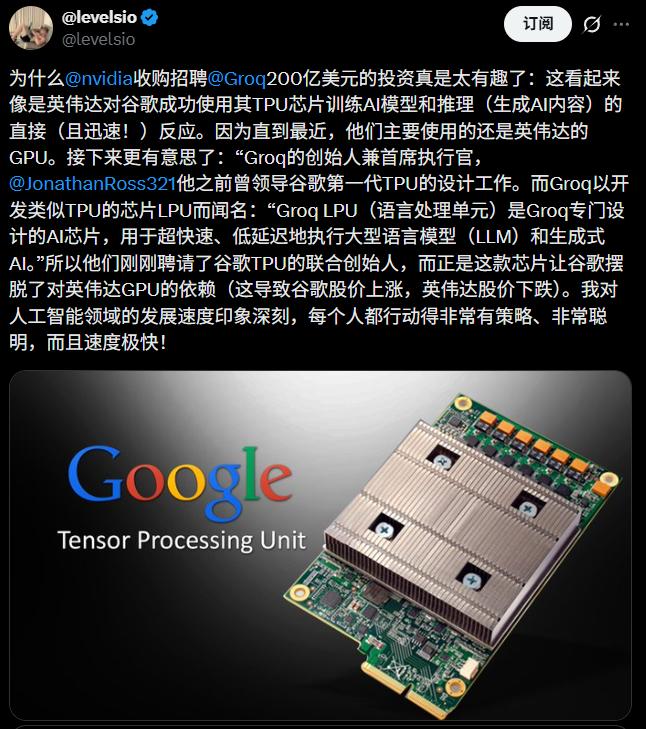
Core Viewpoint - NVIDIA has made a significant acquisition of Groq, a chip manufacturer with a different technological approach, for $20 billion, which has sparked discussions about market monopolization and competitive dynamics in the AI chip sector [1][19]. Group 1: Acquisition Details - NVIDIA's acquisition of Groq is its largest to date, aimed at eliminating a potential competitor in the AI chip market [1]. - Groq, founded in 2016, has a valuation exceeding $7 billion and was co-founded by Jonathan Ross, a designer of Google's first-generation TPU [3]. - The acquisition is structured as a "shell acquisition," where NVIDIA has not fully acquired Groq but has signed a non-exclusive licensing agreement to use Groq's inference technology [22]. Group 2: Technology Insights - Groq's core product is the Language Processing Unit (LPU), designed specifically for accelerating AI computations, similar to Google's TPU but without the use of high-bandwidth memory (HBM) [5][12]. - The LPU utilizes SRAM for storage, allowing for faster data access compared to traditional GPU architectures, achieving data retrieval speeds over 20 times faster than GPUs [12][24]. - Groq's LPU has demonstrated a model inference speed that is reportedly 10 times faster than NVIDIA's GPUs, indicating its potential to disrupt the market [14]. Group 3: Market Implications - The acquisition reflects a broader trend in the AI industry where the demand for model inference is expected to surpass that for model training, as indicated by a Bloomberg report projecting a decrease in training costs from 60% to around 20% of data center expenditures by 2032 [25]. - NVIDIA's move to acquire Groq's technology suggests a strategic effort to enhance its capabilities in both model training and inference, ensuring it remains a dominant player in the AI computing landscape [24][25].
商汤分拆的AI芯片公司,为何全盘押注模型推理市场?
Nan Fang Du Shi Bao· 2025-11-25 06:45
Core Viewpoint - Domestic AI chip companies like Sunrise are focusing on the inference chip market, differentiating themselves from competitors like Nvidia by targeting specific market segments rather than attempting to cover both training and inference simultaneously [2][4]. Company Overview - Sunrise, spun off from SenseTime's chip division, aims to establish itself in the inference chip market, having completed its first round of external financing by the end of 2024 and raised nearly 1 billion yuan in July 2023 [2][3]. - The company is led by Xu Bing, co-founder of SenseTime, and has a management team with backgrounds from Baidu [2]. Product Development - Sunrise has launched three generations of inference chips: - The first-generation S1 chip, launched in 2020, focuses on visual inference and has sold over 20,000 units [3]. - The second-generation S2 chip, set to begin production in September 2024, claims to achieve performance close to 80% of Nvidia's A100 [3]. - The third-generation S3 chip is expected to be officially launched in May 2025, optimized for large model inference and supporting low-precision data formats [3]. Market Trends - The demand for inference computing power is rising due to the accelerated adoption of AI applications, prompting Sunrise to focus on this segment [4]. - The industry is witnessing a shift towards high-performance inference chips, as the market for high-performance training chips is perceived to be limited [4]. Strategic Partnerships - To reduce customer migration costs, Sunrise has chosen to be compatible with Nvidia's CUDA parallel computing framework, facilitating easier adoption for developers [5]. - The company has established partnerships with various industry players, including SANY Group, Fourth Paradigm, Midea Group, and others, ensuring customer engagement from the design phase [5]. Design Considerations - Achieving a balance between computing power and memory bandwidth is crucial for optimizing the cost-performance ratio of inference chips [5]. - Sunrise emphasizes the importance of aligning chip design with target computing tasks to avoid inefficiencies that could lower the chip's value proposition [5].

腾讯云邱跃鹏:模型产业重心已向推理转变
第一财经· 2025-09-16 02:52
Core Viewpoint - The focus of the model industry is shifting towards inference, with a predicted inflection point in 2025 when inference demand will surpass training demand [1] Group 1 - Tencent's MAU (Monthly Active Users) for its IMA has increased 80 times in six months [1] - The "Yuanbao" service has answered high school entrance exam questions 150 million times [1] - By 2028, it is expected that 33% of enterprise software will include Agentic AI [1] Group 2 - The domestic enterprise-level Agent (intelligent agent) market is projected to exceed $27 billion [1]


腾讯云邱跃鹏:模型产业重心已向推理转变
Di Yi Cai Jing· 2025-09-16 02:28
Core Insights - Tencent's IMA (Intelligent Model Assistant) has seen a significant increase in monthly active users, growing 80 times within six months [1] - The focus of the model industry is shifting towards inference, with expectations that by 2025, the demand for inference will surpass that for training [1] - The IMA has answered high school entrance exam questions 150 million times, indicating its widespread usage and utility [1] - By 2028, it is projected that 33% of enterprise software will incorporate Agentic AI, with the domestic enterprise-level Agent market expected to exceed $27 billion [1]
联想申请一种模型推理方法及电子设备专利,可基于第三向量和目标向量确定推理结果
Jin Rong Jie· 2025-08-06 12:32
Group 1 - Lenovo (Beijing) Co., Ltd. has applied for a patent titled "A Model Inference Method and Electronic Device," with publication number CN120430411A, and the application date is April 2025 [1] - The patent abstract reveals a method for model inference that includes determining first and second vectors based on the acquired text, processing the first vector to determine a third vector with a smaller dimension and a greater head count than the first vector [1] - The company was established in 1992 and is primarily engaged in the manufacturing of computers, communications, and other electronic devices, with a registered capital of 565 million Hong Kong dollars [1] Group 2 - Lenovo (Beijing) Co., Ltd. has made investments in 107 companies and participated in 5,000 bidding projects [1] - The company holds 1,751 trademark records and 5,000 patent records, along with 238 administrative licenses [1]

周鸿祎:360最近都采购华为芯片,国产性价比高
Nan Fang Du Shi Bao· 2025-07-23 14:03
Group 1 - The gap between domestic chips and Nvidia is acknowledged, but the necessity to use domestic products is emphasized for improvement [1] - 360 Group has recently procured Huawei's chip products, indicating a shift towards domestic technology [1] - Nvidia's H20 chip has been approved for sale to China, which is more suitable for model inference, providing opportunities for domestic AI chips [2] Group 2 - DeepSeek has contributed significantly to the popularity of inference models, although it recently experienced a decline in monthly active users [2] - The decline in DeepSeek's application traffic is not solely negative, as many cloud vendors still rely on DeepSeek's model services [2] - The performance enhancement of open-source models has laid the foundation for the booming AI agents this year, which are seen as key to AI implementation [3] Group 3 - AI coding has emerged as a hot vertical direction for AI agents, with a focus on engineering capabilities like context and prompt engineering [3] - The development of specialized AI agents tailored to different industries is recommended to create unique technical barriers [3] - The potential disruptive future of AI agents has led to significant changes in operational strategies within companies, with a push for efficiency through AI utilization [3]
AI算力需求涌向模型推理,国产芯片站上竞技台了
Di Yi Cai Jing· 2025-05-28 07:22
Core Insights - The Chinese data center accelerator card market is experiencing a significant shift, with domestic computing power expected to exceed 40% in the first half of 2024, up from approximately 30% last year [1][2] - NVIDIA's CEO highlighted the ongoing AI investment trend, indicating that the demand for AI computing power is evolving, particularly with the rise of inference chips [1][8] - The introduction of DeepSeek has led to a notable increase in the demand for inference chips, which are expected to constitute over 57.6% of the market by 2024 [8][11] Market Dynamics - The construction of data centers is accelerating, with a projected 97.3% year-on-year growth in China's accelerated computing server market in 2024 [4] - The number of successful bids for intelligent computing centers in China has increased significantly, indicating a robust demand for computing resources [4] - Universities and enterprises are increasingly seeking computing power, with many opting for cloud solutions or purchasing their own computing cards [5][6] Technological Shifts - The demand for inference capabilities is reshaping the chip composition in the market, allowing domestic chips to gain traction as they are suitable for inference tasks [11][12] - The performance requirements for inference chips are lower, enabling a broader range of domestic chips to compete effectively against NVIDIA [10][11] - Companies like Tencent are adapting to the changing landscape by increasing their focus on inference needs, indicating a shift in AI application strategies [9][13] Competitive Landscape - NVIDIA's market share in China's data center accelerator card market has decreased from 95% to around 65.2%, while domestic chip manufacturers are gaining ground [11][13] - The introduction of export controls on NVIDIA's chips has prompted the company to consider launching a new AI chip tailored for the Chinese market [13] - Domestic AI chip manufacturers, such as Cambricon, are beginning to report profitability, reflecting a positive trend in the domestic chip market [12]