抗日民族统一战线

Search documents
从九一八到七七事变:抗战的初始与全面爆发
Hai Nan Ri Bao· 2025-06-23 03:38
Core Viewpoint - The article discusses the historical context and significance of the September 18 Incident and the July 7 Incident, marking the beginning and escalation of the Chinese resistance against Japanese aggression, leading to a unified national effort in the Anti-Japanese War [10][18]. Group 1: Historical Background - The September 18 Incident in 1931 initiated Japan's aggressive expansion into China, which was the first step in its broader imperial ambitions [10]. - The period following the September 18 Incident is characterized as "localized resistance," where anti-Japanese activities were not yet widespread across the nation [10][11]. - The July 7 Incident in 1937 marked the transition from localized resistance to a full-scale national war against Japan, uniting various political factions under a common cause [10][18]. Group 2: Political Dynamics - During the early phase of the Anti-Japanese War, the Nationalist government under Chiang Kai-shek exhibited a passive attitude towards anti-Japanese activities, fearing the rise of local warlords [12][13]. - Local warlords often prioritized their own power struggles over national unity, leading to fragmented resistance efforts [12][13]. - The Chinese Communist Party (CCP) initially struggled to establish a united front against Japan due to its weakened position after the 1927 anti-communist purge [13][14]. Group 3: Rise of Anti-Japanese Sentiment - Despite the challenges, the anti-Japanese sentiment grew, particularly in response to Japan's increasing aggression, leading to the formation of various resistance groups [15][16]. - The establishment of the Anti-Japanese National United Front was a significant development, with the CCP advocating for a unified resistance against Japanese forces [19]. - The July 7 Incident catalyzed a nationwide call for comprehensive resistance, with Chiang Kai-shek's rhetoric emphasizing collective responsibility for defense [18][19]. Group 4: Regional Impact - The events in Hainan, while geographically distant, were influenced by the national anti-Japanese sentiment, leading to local organizations advocating for resistance [20]. - The CCP in Hainan adapted to the changing political landscape, forming alliances with local Nationalist forces to establish a united front against Japanese invaders [20]. - The formation of the Hainan Anti-Japanese National United Front marked a significant local response to the broader national movement [20].

同袍赴国难 浴血护山河(山河显影)
Ren Min Ri Bao· 2025-06-11 22:11
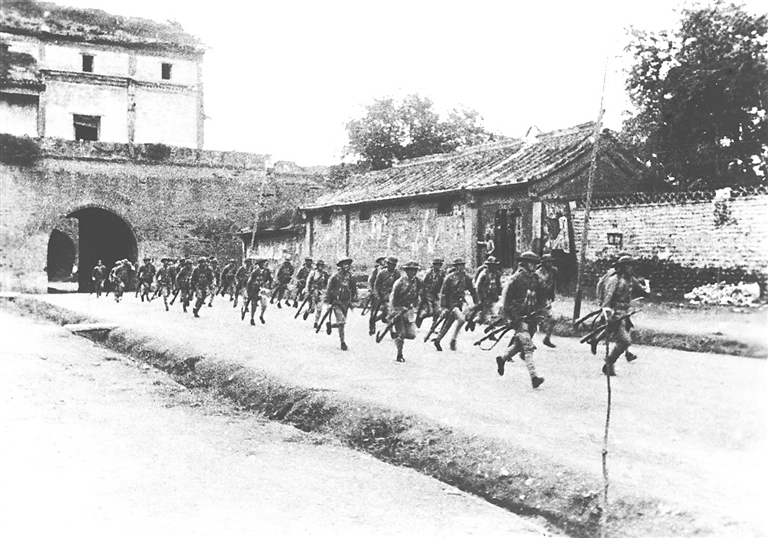
Core Viewpoint - The July 7 Incident marked the beginning of the nationwide resistance against Japanese aggression, initiated by the attack on Chinese troops at the Lugou Bridge [2][4]. Group 1: Events Leading to the Incident - On the night of July 7, 1937, Japanese troops conducted provocative military exercises near the Lugou Bridge, claiming a soldier was missing and demanding to search the area, which was refused by Chinese forces [2]. - Following the refusal, Japanese forces attacked the Chinese garrison, leading to a counterattack by the 29th Army, thus igniting the national resistance [2]. Group 2: Response from Chinese Society - The incident sparked widespread outrage across various sectors of society, with calls for resistance against Japanese invasion rising nationwide [4]. - On July 8, the Chinese Communist Party issued a call for a united national resistance, emphasizing the need for a cohesive front against the aggressors [4]. - The Second United Front between the Chinese Nationalist Party and the Communist Party was established, fostering a broad coalition of various social groups and patriotic forces to participate in the anti-Japanese struggle [4].
中国共产党是全民族抗战的中流砥柱
Jing Ji Ri Bao· 2025-05-28 01:00
Core Viewpoint - The Chinese Communist Party (CCP) has been the backbone of the national resistance against Japanese aggression, leading the anti-Japanese war through political, organizational, strategic, and military efforts since its establishment [1][12]. Group 1: Historical Context and Actions - The CCP was the first to raise the banner of armed resistance against Japan, calling for mobilization of the masses to respond to Japanese imperialism as early as 1931 [2]. - The CCP directly led the armed struggle in Northeast China, significantly strengthening anti-Japanese forces during a period when other movements were declining [3]. - The CCP played a crucial role in the peaceful resolution of the Xi'an Incident in 1936, which laid the groundwork for the second cooperation between the CCP and the Kuomintang (KMT) [3][4]. Group 2: Unity and Strategy - The CCP recognized the necessity of a united front against Japanese imperialism, advocating for the establishment of an anti-Japanese national united front as a political guarantee for victory [5]. - The CCP's strategy included both cooperation and struggle against the KMT, emphasizing the importance of maintaining unity while opposing internal divisions [6][7]. - The CCP articulated a comprehensive strategy for a prolonged war, emphasizing the mobilization of the entire population for a successful resistance [8][9]. Group 3: Military Developments - The CCP's leadership in guerrilla warfare became increasingly significant as the KMT's conventional forces faced setbacks, with the CCP's forces growing to approximately 1.32 million by the end of the war [10][11]. - The establishment of anti-Japanese bases under CCP leadership created a strategic advantage, disrupting Japanese operations and contributing to the overall war effort [11][12]. Group 4: Legacy and Future Goals - The victory in the anti-Japanese war marked a historical turning point for the Chinese nation, leading towards national rejuvenation [12]. - The CCP remains committed to its foundational mission of leading the Chinese people towards national strength and revival [12].
新四军第七师有多富裕?可养活20个甲级师,每年上交20万两黄金
Sou Hu Cai Jing· 2025-05-25 13:23
Core Viewpoint - The article highlights the economic achievements of the New Fourth Army's Seventh Division during the Second Sino-Japanese War, showcasing how strategic leadership and innovative economic measures led to significant growth despite challenging circumstances [1][19]. Group 1: Historical Context - The Anti-Japanese National United Front was established in the 1930s to resist Japanese invaders, leading to a 14-year struggle that ultimately expelled the invaders from China [1]. - The war severely hindered domestic economic development, with the Communist Party's bases facing significant challenges such as territory loss, troop reductions, and supply shortages [1][3]. Group 2: Economic Transformation - The New Fourth Army's Seventh Division, particularly in the central Anhui region, sought to innovate wartime economics to overcome difficulties and build strength for a prolonged conflict [3]. - By 1945, the Seventh Division had grown from an initial force of fewer than 2,000 to nearly 200,000 troops, controlling over 22,500 square kilometers and serving a population exceeding 3 million [11]. Group 3: Key Figures - Zeng Xisheng and Cai Hui played pivotal roles in creating an economic miracle for the Seventh Division after May 1941, with Zeng serving as the political commissar and Cai overseeing financial matters [5][12]. - Their collaboration was instrumental in transforming the division's economic situation, allowing it to thrive despite initial hardships [5][12]. Group 4: Economic Strategies - Faced with severe financial constraints, Cai Hui implemented measures such as food blockades to monopolize grain trade and proposed public salt industries to stimulate local economies [16]. - By autumn 1944, the financial revenue of the central Anhui base had more than doubled compared to 1942, surpassing 60 million yuan [16]. - The Seventh Division contributed 53 million yuan (equivalent to 26.5 million taels of gold) to support other units, demonstrating its economic strength [17].