公司治理

Search documents
惠云钛业调整组织架构,不再设置监事会
Xin Lang Cai Jing· 2025-09-18 14:56
Group 1 - The company Huayun Titanium Industry announced on September 19, 2025, that it held the 14th meeting of the 5th Board of Directors on September 17, where it approved the adjustment of the organizational structure and the revision of the Articles of Association [1] - The company will no longer have a supervisory board; instead, the Audit Committee of the Board will exercise the powers of the supervisory board as stipulated by the Company Law of the People's Republic of China [1] - The adjustments to the organizational structure aim to enhance management levels and operational efficiency, clarify responsibilities, and provide organizational support for sustainable development [1]
快意电梯修订公司章程,多项条款调整完善公司治理
Xin Lang Cai Jing· 2025-09-18 14:52
Group 1 - The core viewpoint of the article is that Kuaiji Elevator Co., Ltd. has revised certain provisions of its Articles of Association to enhance corporate governance and operational standards in compliance with relevant laws and regulations [1][3]. Group 2 - The main contents of the revision include adjustments to terminology, such as standardizing the term "shareholders' meeting" to "shareholders' assembly" [2]. - New and modified clauses have been added to clarify the protection of employees' legal rights, adjust the company's address and postal code, detail the responsibilities of the legal representative, and specify conditions and limits for financial assistance [2]. - The meeting-related revisions involve changes to the procedures and responsibilities for convening and voting in shareholders' meetings, board meetings, and supervisory meetings, including adjustments to the circumstances for calling temporary shareholders' meetings [2]. - The provisions regarding directors and specialized committees have been improved, including qualifications for directors, duties of loyalty and diligence, and the process for appointing employee directors [2]. - Other areas revised include profit distribution policies, internal audit systems, and procedures for company mergers, divisions, and capital reductions, with specific guidelines for the order of using reserves to cover losses [2]. Group 3 - The revised Articles of Association will require approval from the shareholders' meeting before they can be officially implemented, with the final content subject to approval by the Market Supervision Administration of Dongguan City, Guangdong Province [3]. - This revision is seen as a significant step for the company to adapt to legal requirements and optimize internal governance, potentially laying a stronger foundation for long-term development [3].
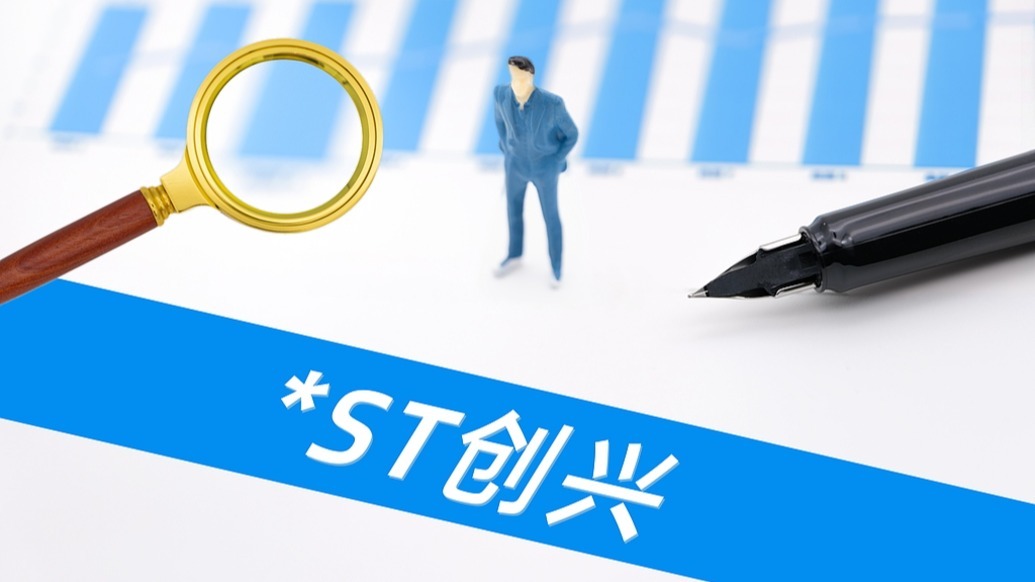
*ST创兴董事长刘鹏被采取强制措施,公司原实控人去年因涉嫌集资诈骗被立案
Feng Huang Wang· 2025-09-18 14:22
Core Viewpoint - The company *ST Chuangxing announced that its chairman Liu Peng is under investigation by the police, and during his absence, Yang Zhe will act as the chairman and legal representative of the company [2][3]. Group 1: Management Changes - Liu Peng, the chairman of *ST Chuangxing, is currently cooperating with an investigation by the Hangzhou Public Security Bureau, which is unrelated to the company [2]. - Yang Zhe, who has been with *ST Chuangxing for less than a year, will assume the responsibilities of chairman and legal representative until Liu Peng resumes his duties or a new chairman is elected [2]. - Yang Zhe faced opposition when appointed as the company president last December due to concerns about his lack of experience in listed companies [3]. Group 2: Shareholder and Control Changes - The company's former controlling shareholder, Zhejiang Huqiao Industrial Co., Ltd., is under investigation for suspected fundraising fraud, leading to the freezing of its shares [3]. - Following a judicial auction, Huqiao Industrial's shareholding in *ST Chuangxing decreased from 23.90% to 8.15% [4]. - The new controlling shareholder is Wang Xiangrong, who indirectly controls 9.88% of the company through other entities [5]. Group 3: Financial Performance - For the first half of the year, *ST Chuangxing reported a revenue of approximately 374,000 yuan, a 99% decrease year-on-year, and a net loss attributable to shareholders of 13.71 million yuan, with losses expanding compared to the previous year [6]. - As of September 18, the stock price of *ST Chuangxing was 4.28 yuan per share, reflecting a decline of 2.28% [6].


Is $5.20 Per Share Buyout Proposal Fair to WideOpenWest, Inc. (NYSE: WOW) Investors? Kaskela Law LLC Encourages WOW Shareholders to Contact the Firm to Discuss Their Legal Rights and Options
Globenewswire· 2025-09-18 10:00
Core Viewpoint - Kaskela Law LLC is investigating the proposed buyout of WideOpenWest, Inc. to assess the fairness of the transaction for shareholders and whether it provides adequate compensation for their shares [1][2]. Group 1: Transaction Details - On August 11, 2025, WideOpenWest announced an agreement to be acquired by DigitalBridge Investments and Crestview Partners at a price of $5.20 per share [2]. - Following the transaction, WOW shareholders will be cashed out and will not benefit from any future growth of the company [2]. Group 2: Investigation Findings - The investigation has revealed potential conflicts of interest in the transaction, suggesting that the sales process and compensation may be unfair to shareholders [3]. - At the time of the announcement, at least one stock analyst had a price target of $6.50 per share for WideOpenWest, indicating a discrepancy between market expectations and the buyout offer [3].


香飘飘拟调整经营范围并修订多项制度,提升公司治理水平
Xin Lang Cai Jing· 2025-09-18 09:51
Core Viewpoint - Xiangpiaopiao (603711) is adjusting its business scope and revising its articles of association to enhance corporate governance and operational efficiency, with significant implications for its future development [1][4]. Group 1: Business Scope Adjustment - The company plans to adjust its business scope due to actual operational needs and will revise relevant clauses in its articles of association [2]. - The proposal requires authorization from the shareholders' meeting for the board to handle the registration of changes [2]. Group 2: Corporate Governance Revisions - The board has approved the revision of several corporate governance systems, including the management system for preventing the occupation of company funds by controlling shareholders and related parties, decision-making systems for related transactions, external investments, guarantees, authorization management, and cumulative voting implementation details [3]. - These revisions also need to be submitted for approval at the 2025 second extraordinary shareholders' meeting [3]. Group 3: Shareholders' Meeting - The board has scheduled the 2025 second extraordinary shareholders' meeting for October 10, 2025, to discuss the proposed adjustments and governance revisions [4]. - The outcomes of the shareholders' meeting regarding these proposals are expected to be closely monitored by the market [4].

雀巢动荡未止!CEO才因办公室恋情被解雇,董事会主席也被迫“闪辞”
Guan Cha Zhe Wang· 2025-09-18 01:42
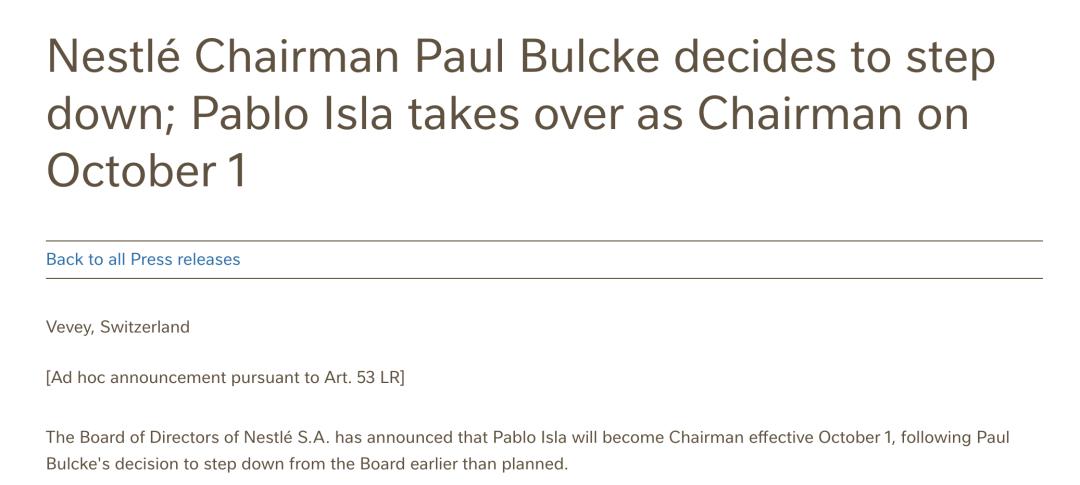
Core Viewpoint - Nestlé is experiencing a governance crisis marked by the abrupt resignation of Chairman Paul Bulcke, who will be succeeded by Pablo Isla on October 1, 2023, following a series of leadership changes and declining performance [2][4][11]. Group 1: Leadership Changes - Paul Bulcke's resignation was unexpected as he was originally set to retire in April 2026, and it follows the recent dismissal of former CEO Laurent Freixe due to a scandal [4][8]. - Bulcke is the first chairman in nearly 20 years to resign under pressure from investors, reflecting a loss of confidence in the company's governance [5][7]. - The rapid succession of leadership, including two CEO changes within a year, has raised concerns about the company's stability and performance [8][10]. Group 2: Financial Performance - Nestlé's sales have been struggling, with a reported sales figure of 44.23 billion Swiss francs for the first half of 2025, a decline of 1.8% year-on-year, and a net profit of 5.06 billion Swiss francs, down 10.3% [10]. - The company's stock price has dropped over 40% since 2022, indicating significant market challenges and pressure on profit margins [10][12]. Group 3: New Leadership Expectations - Pablo Isla, the new chairman, is the first external appointee in Nestlé's history, previously leading Inditex and known for his strong leadership [11][12]. - Isla's immediate challenge will be to restore investor confidence and address the internal governance issues that have arisen from recent leadership turmoil [12][13]. - Analysts suggest that Isla must focus on strategic repositioning and operational efficiency to navigate the current market challenges and enhance Nestlé's competitive edge [12][13].


友邦保险20250917
2025-09-17 14:59
Summary of AIA Group's Conference Call Company Overview - **Company**: AIA Group - **Industry**: Insurance Services Key Points and Arguments Financial Performance - AIA Group reported a 19% growth in insurance service performance for the first half of 2025, driven by stable release and increased operational variances, despite a negative investment performance of -7% due to high equity allocation in participating accounts [2][3] - The annualized shareholder return reached 3.7%, with a target for compound annual growth rate (CAGR) of after-tax operating profit per share set at 9%-11% from 2023 to 2026 [3][2] New Business Value (NBV) - Strong growth in new business value (NBV) was noted, with a 30% increase in 2023 and a 14% increase in the first half of 2025 (at constant exchange rates), with 13 out of 18 markets showing growth [2][6] - The NBV margin increased by 3.4 percentage points to 57.7%, with new single premium growth of 8% [6][2] Shareholder Returns and Capital Management - AIA has consistently increased its dividend since its listing, with a dividend payout ratio exceeding 35%. The company plans to allocate 75% of new retained earnings for share buybacks and dividends [2][5] - Expected shareholder returns are projected at 4.6% for 2025, with 4% for 2026 and 2027 [5][2] Regional Performance - AIA Hong Kong contributed 35% to the group, with a 2 percentage point increase year-on-year. The NBV from mainland visitors purchasing insurance grew by 24% [4][13] - AIA China saw a 10% increase in NBV in the first half of 2025, with a 15% increase in Q2, despite facing pressure in the agent channel [11][2] Strategic Initiatives - AIA is focusing on expanding its agent channel, which remains the primary sales channel, and aims for a 40% compound annual growth rate in new business value from newly opened regions [11][12] - The company is enhancing its governance structure with a high proportion of independent directors and local empowerment management frameworks [4][9] Market Insights - The Singapore market experienced a 16% increase in NBV in the first half of 2025, while Malaysia is in a recovery phase with a 13% decline in MV due to poor agent channel performance [16][17] - Thailand's market showed a remarkable 35% increase in NBV, with a market share of 44% [18][17] Product Structure and Risk Management - AIA's product structure varies significantly across regions, with a focus on participating products in Hong Kong and floating yield products in mainland China [19][20] - The company has a global asset allocation strategy that diversifies risks and capitalizes on high-yield overseas markets [20][21] Valuation and Future Outlook - AIA's current price-to-value (PV) ratio is 1.36 times, which is considered low compared to a more reasonable estimate of 1.5 times [22][21] - The company anticipates strong long-term growth in premiums, particularly in Hong Kong, Singapore, Malaysia, and Thailand, with a projected double-digit growth in MVV [21][22] Additional Important Insights - The agent strategy has shown significant results, with an increase in active agents and productivity [10][4] - AIA's governance measures include a high number of independent directors and local management empowerment, which enhances operational efficiency [9][4]
雀巢董事会主席被迫提前辞职
第一财经· 2025-09-17 10:13
Core Viewpoint - Nestlé Group's board chairman Paul Bulcke will resign earlier than planned due to investor pressure following the departure of two CEOs within a year, raising concerns about corporate governance and decision-making [3][4]. Group 1: Leadership Changes - Paul Bulcke was originally set to resign in April 2026 but will step down on October 1, 2025, to restore the company's credibility [3][4]. - Philipp Navratil was appointed as the new CEO on September 1, 2025, following the dismissal of Laurent Freixe due to a violation of the company's code of conduct [3][4]. - Pablo Isla, the incoming chairman, previously served as the CEO of Inditex, the parent company of Zara, and is not a product of Nestlé's internal system [4]. Group 2: Financial Performance - In the first half of 2025, Nestlé's sales amounted to 44.228 billion Swiss francs, a year-on-year decrease of 1.8%, while net profit fell by 10.3% to 5.065 billion Swiss francs [4]. - The Greater China region's sales were 2.47 billion Swiss francs, reflecting a decline of 6.4% year-on-year [4]. Group 3: Strategic Adjustments - In 2022, Nestlé restructured its market divisions, elevating Greater China to a standalone region, which was later merged back into the Asia, Oceania, and Africa (AOA) region in 2024 [5]. - In March 2025, Nestlé completed the acquisition of the remaining 40% stake in the food brand Xu Fu Ji, achieving full ownership after initially acquiring 60% in 2011 [5][6].
董事长身陷囹圄,高管集体套现 亚钾国际将驶向何方?
Jing Ji Guan Cha Wang· 2025-09-17 09:11
Core Viewpoint - The collective share reduction by senior executives of Yaqi International, despite the company achieving record-high performance, raises questions about the motivations behind the move, whether it is a normal cash-out or a warning signal of potential risks [1][10]. Company Performance - Yaqi International reported a remarkable 48.54% year-on-year increase in revenue and a 216.64% increase in net profit attributable to shareholders for the first half of 2025 [1]. - The company's operating cash flow increased by 218.66%, and basic earnings per share rose by 220.70% compared to the previous year [1]. Executive Share Reduction - Five executives, including the arrested chairman Guo Baichun, plan to reduce a total of 540,000 shares, representing 0.0591% of the company's total share capital [4]. - Guo Baichun intends to sell 270,000 shares, which is 25% of his total holdings, while the other four executives plan to sell 72,000 or 54,000 shares, also around 25% of their holdings [4][5]. Governance Issues - Guo Baichun was formally arrested on charges of embezzlement and abuse of power, which has raised significant concerns about the company's governance and stability [2][7]. - The inability of Guo Baichun to sign the half-year report due to his arrest highlights potential deficiencies in internal controls [7]. Market Reaction - Following the announcement of the share reduction, Yaqi International's stock price fell by 3.91% to 37.14 yuan on September 17 [3]. Legal and Compliance Risks - The company faces legal risks related to an international arbitration case with Mitsui & Co., which has led to a provision of 1.1751 million yuan and a cumulative expected compensation of 67.2157 million yuan [8]. - Additionally, operational challenges have arisen from a water inflow incident at the potassium salt mine in Laos, resulting in repair costs of 50.9637 million yuan [8]. Industry Outlook - Despite governance challenges, Yaqi International remains a competitive player in the potassium fertilizer market, with significant resources in Laos and a growing demand for potassium globally [9]. - The company holds potassium salt mining rights over 263.3 square kilometers, with an estimated resource reserve of 1 billion tons [9]. - The global demand for potassium fertilizer is projected to reach 74.3 million tons in 2025, with Asia and Latin America being key markets [9]. Conclusion on Governance - The situation at Yaqi International serves as a case study on the importance of corporate governance, where executive actions can signal systemic risks beyond mere financial performance [10]. - The absence of a stable leadership figure like the chairman can lead to trust crises that may have more severe implications than short-term financial fluctuations [10].

突发,高层震荡,雀巢董事长辞职,外部“空降兵”将于10月1日接任
3 6 Ke· 2025-09-17 05:12
Core Viewpoint - Nestlé's chairman Paul Bulcke has decided to step down earlier than planned, with Pablo Isla set to take over the role on October 1, marking a significant leadership transition for the company [1][3]. Leadership Transition - Paul Bulcke has served as chairman since 2017, and his early departure is seen as a move to facilitate a smoother transition to new leadership [1][3]. - Pablo Isla, the new chairman, has a strong background as the former CEO of Inditex, and his appointment is expected to bring fresh perspectives to Nestlé [11][13]. Recent Management Changes - The company has experienced significant management upheaval, including the recent dismissal of CEO Laurent Freixe due to inappropriate conduct, which has raised concerns about stability within the organization [7][10]. - Dick Boer has been appointed as the lead independent director and vice chairman, alongside Marie-Gabrielle Ineichen-Fleisch, indicating a shift towards a more diverse and independent board structure [7][13]. Performance Challenges - Nestlé has faced declining sales growth and a significant drop in stock price, with a reported decline of over 40% since 2022, leading to increased pressure from investors [7][9]. - Bulcke's support from shareholders has decreased, with only 84.8% backing at the recent annual meeting, down from nearly 96% in 2017, reflecting growing concerns about leadership effectiveness [9]. Strategic Focus - The new leadership team is expected to prioritize organic growth and operational efficiency while addressing the company's complex business structure and performance issues [13][14]. - The recent changes in leadership are viewed as a critical opportunity for Nestlé to revitalize its strategy and improve its market position amid ongoing challenges [14][15].