
人民币汇率

Search documents
人民币汇率升至年内新高后小幅回调
Jin Rong Shi Bao· 2025-10-22 02:38
Core Insights - The interbank foreign exchange market in China showed a mixed performance in September, with the US employment data falling short of expectations and the Federal Reserve lowering interest rates by 25 basis points, leading to a rebound in the US dollar index [1][6] - The Chinese yuan reached a new high for the year in September, but experienced slight fluctuations towards the end of the month [2][3] - The offshore yuan weakened against the onshore yuan, resulting in a shift from a positive to a negative exchange rate differential [3] Exchange Rate Performance - The yuan appreciated to a high of 7.1019 against the US dollar in early September, driven by a weaker dollar index and positive sentiment from US-China trade talks [2] - By the end of September, the yuan was trading at 7.1186, reflecting a monthly appreciation of 0.17% [2] - The CFETS index for the yuan against a basket of currencies rose by 0.21% to 96.77 [2] Exchange Rate Differential - The exchange rate differential between onshore and offshore yuan shifted from positive to negative, with the average differential for the month being -4 basis points [3] - The maximum differential recorded was -97 basis points on September 26 [3] Foreign Exchange Options Market - The trading volume for yuan foreign exchange options was stable, with an average daily transaction of 63.18 billion USD, up 8.37% month-on-month [4] - Implied volatility for yuan options continued to decline, with the 1-month ATM implied volatility dropping to 2.3%, the lowest since August 2024 [4] Swap Market Activity - The yuan foreign exchange swap market saw active trading, with an average daily volume of 931.95 billion USD, an increase of 8.90% month-on-month [5] - Short to medium-term transactions dominated, accounting for nearly 70% of the trading volume [5] Interest Rate Differentials - The interest rate differential between Chinese and US bonds fluctuated, with the 10-year US Treasury yield dropping to a year-low of 4.01% before rebounding to around 4.2% [6] - The 10-year US-China bond yield spread ended the month at -230 basis points, an increase of 9 basis points from the previous month [6] - The 1-year swap points rose significantly, reaching -1322 basis points, the highest in nearly two and a half years [6]
人民币市场汇价(10月22日)
Xin Hua Wang· 2025-10-22 02:30
Core Points - The People's Bank of China announced the exchange rates of the Renminbi against various currencies on October 22, 2023, indicating the current market value of the Renminbi [1] Group 1: Exchange Rates - The exchange rate for 100 US dollars is 709.54 Renminbi [1] - The exchange rate for 100 euros is 824.5 Renminbi [1] - The exchange rate for 100 Japanese yen is 4.6816 Renminbi [1] - The exchange rate for 100 Hong Kong dollars is 91.303 Renminbi [1] - The exchange rate for 100 British pounds is 950.46 Renminbi [1] - The exchange rate for 100 Australian dollars is 461.63 Renminbi [1] - The exchange rate for 100 New Zealand dollars is 408.56 Renminbi [1] - The exchange rate for 100 Singapore dollars is 547.48 Renminbi [1] - The exchange rate for 100 Swiss francs is 892.49 Renminbi [1] - The exchange rate for 100 Canadian dollars is 507.21 Renminbi [1] - The exchange rate for 100 Renminbi is 112.87 Macanese patacas [1] - The exchange rate for 100 Renminbi is 59.484 Malaysian ringgits [1] - The exchange rate for 100 Renminbi is 1142.78 Russian rubles [1] - The exchange rate for 100 Renminbi is 244.77 South African rand [1] - The exchange rate for 100 Renminbi is 20113 South Korean won [1] - The exchange rate for 100 Renminbi is 51.659 UAE dirhams [1] - The exchange rate for 100 Renminbi is 52.751 Saudi riyals [1] - The exchange rate for 100 Renminbi is 4720.03 Hungarian forints [1] - The exchange rate for 100 Renminbi is 51.403 Polish zlotys [1] - The exchange rate for 100 Renminbi is 90.57 Danish krone [1] - The exchange rate for 100 Renminbi is 132.58 Swedish krona [1] - The exchange rate for 100 Renminbi is 141.49 Norwegian krone [1] - The exchange rate for 100 Renminbi is 590.415 Turkish lira [1] - The exchange rate for 100 Renminbi is 259.54 Mexican pesos [1] - The exchange rate for 100 Renminbi is 461.44 Thai baht [1]
10月22日人民币对美元中间价报7.0954元 下调24个基点
Zhong Guo Xin Wen Wang· 2025-10-22 01:47
Core Points - The central bank of China announced that the RMB to USD exchange rate midpoint is set at 7.0954, reflecting a decrease of 24 basis points [1] Group 1 - The People's Bank of China authorized the China Foreign Exchange Trade System to publish the exchange rate [1] - The reported exchange rate indicates a downward adjustment in the value of the RMB against the USD [1]

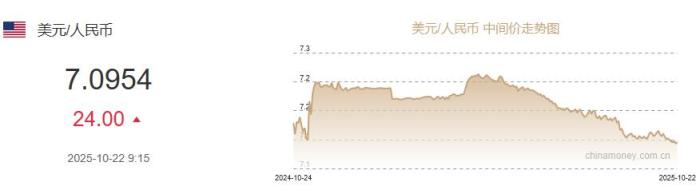
人民币对美元中间价报7.0954 调贬24个基点
Zhong Guo Jing Ji Wang· 2025-10-22 01:34
中国经济网北京10月22日讯 来自中国外汇交易中心的数据显示,今日人民币对美元汇率中间价报 7.0954,较前一交易日调贬24个基点。 (责任编辑:华青剑) 中国人民银行授权中国外汇交易中心公布,2025年10月22日银行间外汇市场人民币汇率中间价为: 1美元对人民币7.0954元,1欧元对人民币8.2450元,100日元对人民币4.6816元,1港元对人民币0.91303 元,1英镑对人民币9.5046元,1澳大利亚元对人民币4.6163元,1新西兰元对人民币4.0856元,1新加坡 元对人民币5.4748元,1瑞士法郎对人民币8.9249元,1加拿大元对人民币5.0721元,人民币1元对1.1287 澳门元,人民币1元对0.59484马来西亚林吉特,人民币1元对11.4278俄罗斯卢布,人民币1元对2.4477南 非兰特,人民币1元对201.13韩元,人民币1元对0.51659阿联酋迪拉姆,人民币1元对0.52751沙特里亚 尔,人民币1元对47.2003匈牙利福林,人民币1元对0.51403波兰兹罗提,人民币1元对0.9057丹麦克朗, 人民币1元对1.3258瑞典克朗,人民币1元对1.4149挪威克朗 ...
人民币汇率将保持稳中偏强
Sou Hu Cai Jing· 2025-10-21 20:03
Core Viewpoint - The recent appreciation of the Renminbi (RMB) against the US dollar is attributed to both internal and external factors, with the RMB middle rate reaching a new high since late October 2024, indicating a strong performance in October 2023 [1][2][4]. Group 1: RMB Exchange Rate Performance - As of October 20, 2023, the RMB middle rate against the US dollar was reported at 7.0930, marking a significant increase and breaking the 7.10 threshold for five consecutive trading days [1][2]. - The RMB middle rate has appreciated over 900 basis points throughout the year, with fluctuations around the 7.17 level in early 2025 and a low of 7.2133 earlier in the year [2]. Group 2: Factors Supporting RMB Appreciation - External factors include the increasing risk of a US economic recession and a cooling labor market, which may lead the Federal Reserve to initiate a rate cut, thereby putting downward pressure on the US dollar index [4]. - Internally, China's economy is showing signs of moderate recovery, with a stable economic foundation and increased attractiveness of the domestic securities market to foreign capital, contributing to the demand for RMB [4]. Group 3: Long-term Outlook for RMB Stability - Analysts suggest that the recent appreciation may indicate the beginning of a long-term appreciation cycle for the RMB, supported by a solid economic foundation and policy space [5]. - The People's Bank of China emphasizes the importance of maintaining a stable RMB exchange rate at a reasonable level, with ongoing monitoring of market dynamics [6].
2025年10月21日银行间外汇市场人民币汇率中间价
Jin Tou Wang· 2025-10-21 02:31
Group 1 - The People's Bank of China conducted a 1,595 billion yuan reverse repurchase operation today, with a bid amount of 1,595 billion yuan and a winning amount of 1,595 billion yuan, maintaining an operation interest rate of 1.40%, unchanged from previous levels [1] Group 2 - As of October 21, 2025, the central parity rates of the Chinese yuan against various currencies showed a depreciation against the US dollar by 43 points to 7.0930, and against the euro by 162 points to 8.2734, while the Australian dollar saw an appreciation of 72 points to 4.6309 [2]
人民币市场汇价(10月21日)
Xin Hua Wang· 2025-10-21 02:18
Core Points - The People's Bank of China authorized the release of the market exchange rates for the Chinese Yuan against various currencies on October 21 [1] Exchange Rates Summary - The exchange rate for 100 US dollars is 709.3 Chinese Yuan [2] - The exchange rate for 100 Euros is 827.34 Chinese Yuan [2] - The exchange rate for 100 Japanese Yen is 4.7163 Chinese Yuan [2] - The exchange rate for 100 Hong Kong dollars is 91.296 Chinese Yuan [2] - The exchange rate for 100 British pounds is 952.41 Chinese Yuan [2] - The exchange rate for 100 Australian dollars is 463.09 Chinese Yuan [2] - The exchange rate for 100 New Zealand dollars is 408.51 Chinese Yuan [2] - The exchange rate for 100 Singapore dollars is 549.34 Chinese Yuan [2] - The exchange rate for 100 Swiss Francs is 896.59 Chinese Yuan [2] - The exchange rate for 100 Canadian dollars is 506.33 Chinese Yuan [2] - The exchange rate for 100 Macau Patacas is 112.88 Chinese Yuan [2] - The exchange rate for 100 Malaysian Ringgits is 59.411 Chinese Yuan [2] - The exchange rate for 100 Russian Rubles is 1136.01 Chinese Yuan [2] - The exchange rate for 100 South African Rand is 242.41 Chinese Yuan [2] - The exchange rate for 100 South Korean Won is 19970 Chinese Yuan [2] - The exchange rate for 100 UAE Dirhams is 51.683 Chinese Yuan [2] - The exchange rate for 100 Saudi Riyals is 52.779 Chinese Yuan [2] - The exchange rate for 100 Hungarian Forints is 4699.88 Chinese Yuan [2] - The exchange rate for 100 Polish Zlotys is 51.18 Chinese Yuan [2] - The exchange rate for 100 Danish Krone is 90.28 Chinese Yuan [2] - The exchange rate for 100 Swedish Krona is 132.53 Chinese Yuan [2] - The exchange rate for 100 Norwegian Krone is 141.39 Chinese Yuan [2] - The exchange rate for 100 Turkish Lira is 590.014 Chinese Yuan [2] - The exchange rate for 100 Mexican Pesos is 259.07 Chinese Yuan [2] - The exchange rate for 100 Thai Baht is 457.61 Chinese Yuan [2]
10月21日人民币对美元中间价报7.0930元 上调43个基点
Zhong Guo Xin Wen Wang· 2025-10-21 01:40
Core Point - The central bank of China has adjusted the RMB to USD exchange rate, setting it at 7.0930, an increase of 43 basis points [1]. Exchange Rate Adjustment - On October 21, 2025, the People's Bank of China authorized the China Foreign Exchange Trade System to announce the interbank foreign exchange market's RMB exchange rate midpoint [1]. - The adjustment reflects a strengthening of the RMB against the USD, indicating potential shifts in market dynamics [1].
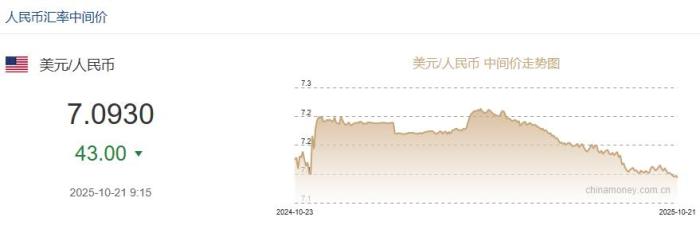
人民币对美元中间价报7.0973 调贬24个基点
Zhong Guo Jing Ji Wang· 2025-10-20 03:45
(责任编辑:蔡情) 中国经济网北京10月20日讯 今日,人民币对美元汇率中间价报7.0973,较前一交易日调贬24个基 点。 中国人民银行授权中国外汇交易中心公布,2025年10月20日银行间外汇市场人民币汇率中间价为: 1美元对人民币7.0973元,1欧元对人民币8.2896元,100日元对人民币4.7157元,1港元对人民币0.91362 元,1英镑对人民币9.5497元,1澳大利亚元对人民币4.6237元,1新西兰元对人民币4.0792元,1新加坡 元对人民币5.4891元,1瑞士法郎对人民币8.9605元,1加拿大元对人民币5.0758元,人民币1元对1.1279 澳门元,人民币1元对0.59432马来西亚林吉特,人民币1元对11.3949俄罗斯卢布,人民币1元对2.4448南 非兰特,人民币1元对199.79韩元,人民币1元对0.51642阿联酋迪拉姆,人民币1元对0.52728沙特里亚 尔,人民币1元对46.9719匈牙利福林,人民币1元对0.51200波兰兹罗提,人民币1元对0.9010丹麦克朗, 人民币1元对1.3254瑞典克朗,人民币1元对1.4146挪威克朗,人民币1元对5.89539土耳 ...
人民币市场汇价(10月20日)
Xin Hua Wang· 2025-10-20 02:23
新华社北京10月20日电 中国外汇交易中心10月20日受权公布人民币对美元、欧元、日元、港元、 英镑、澳元、新西兰元、新加坡元、瑞士法郎、加元、澳门元、林吉特、卢布、兰特、韩元、迪拉姆、 里亚尔、福林、兹罗提、丹麦克朗、瑞典克朗、挪威克朗、里拉、墨西哥比索及泰铢的市场汇价。 100美元 709.73人民币 100欧元 828.96人民币 100日元 4.7157人民币 100港元 91.362人民币 100英镑 954.97人民币 100澳元 462.37人民币 100新西兰元 407.92人民币 100新加坡元 548.91人民币 100瑞士法郎 896.05人民币 100加元 507.58人民币 100人民币112.79澳门元 100人民币59.432马来西亚林吉特 100人民币1139.49俄罗斯卢布 100人民币244.48南非兰特 100人民币19979韩元 100人民币51.642阿联酋迪拉姆 100人民币52.728沙特里亚尔 100人民币4697.19匈牙利福林 100人民币51.2波兰兹罗提 100人民币90.1丹麦克朗 100人民币132.54瑞典克朗 100人民币141.46挪威克朗 1 ...