《开罗宣言》

Search documents
台湾地位已被“七重锁定”!是哪七重?一图读懂
Zhong Guo Xin Wen Wang· 2025-12-09 13:36
Core Viewpoint - The meeting between Wang Yi, a member of the Political Bureau of the Central Committee and Foreign Minister, and German Foreign Minister Baerbock in Beijing on December 8, 2025, provided a comprehensive explanation of the historical facts and legal context regarding the Taiwan issue [1][11]. Historical Context - The Potsdam Declaration, signed by China, the United States, and the United Kingdom in July 1945, with later participation from the Soviet Union, stipulated that the conditions of the Cairo Declaration must be implemented [4][14]. - Following Japan's defeat on August 15, 1945, the Japanese Emperor pledged to faithfully implement the provisions of the Potsdam Declaration and surrender unconditionally. On October 25, 1945, the Chinese government announced the restoration of sovereignty over Taiwan and held a surrender ceremony in Taipei [5][15]. - In 1949, the Central People's Government of the People's Republic of China replaced the government of the Republic of China as the sole legal representative of all of China, thereby exercising sovereignty over all territories, including Taiwan [6][16]. - In 1971, the 26th UN General Assembly passed Resolution 2758, restoring all rights of the People's Republic of China in the United Nations and expelling the representatives of the Taiwan authorities. The official legal opinion of the UN confirmed that Taiwan is a province of China [7][19]. - The 1972 Sino-Japanese Joint Statement established that the Japanese government recognizes the People's Republic of China as the sole legitimate government representing all of China and understands and respects the Chinese government's position that Taiwan is an inseparable part of Chinese territory, committing to adhere to the provisions of the eighth article of the Potsdam Declaration [8][20].


日方信函充斥错误观点和虚伪谎言
Ren Min Ri Bao· 2025-12-02 22:33
Core Viewpoint - The Chinese government strongly criticizes Japan's recent letter to the UN Secretary-General, labeling it as filled with erroneous views and hypocritical lies, and urges Japan to reflect on its actions as a defeated nation and fulfill its commitments to China and the international community [1] Group 1: Japan's Position on Taiwan - Japan's Prime Minister, Fumio Kishida, has made statements regarding Taiwan that challenge the outcomes of World War II and the post-war international order, which China views as a serious violation of the UN Charter [1] - The Chinese government questions Japan's vague stance on Taiwan, demanding a clear and accurate response regarding Japan's "consistent position" as outlined in the four political documents between China and Japan [1] Group 2: Military and Defense Issues - Japan's claims of adhering to a "defensive posture" are contradicted by its Prime Minister's comments linking Japan's survival crisis to Taiwan, implying a potential military threat against China [1] - The Chinese government highlights Japan's increasing military expenditures and its moves to reinterpret its self-defense policies, which it sees as a violation of its post-war commitments and a challenge to the international order established after World War II [1] Group 3: China's Response - In light of Japan's actions, China has reiterated its position through its permanent mission to the UN, emphasizing the need for Japan to reflect on its past and adhere to its obligations as a defeated nation [1] - The year marks the 80th anniversary of China's victory in the War of Resistance against Japan, reinforcing China's stance against Japan's attempts to challenge the post-war international order and revive militarism [1]
中方敦促日方:老老实实收回错误言论
中国基金报· 2025-12-01 08:32
Group 1 - The article discusses Japan's ambiguous stance on Taiwan's legal status, referencing the San Francisco Peace Treaty and the 1972 Sino-Japanese Joint Statement as key documents [2][3] - It highlights China's assertion of sovereignty over Taiwan based on international legal documents such as the Cairo Declaration, which is considered a significant outcome of the anti-fascist war [3] - The article criticizes Japan for not addressing its historical responsibilities and for attempting to revise its pacifist constitution while increasing defense budgets, indicating a resurgence of militarism [3][4] Group 2 - The article emphasizes the importance of historical reflection and urges Japan to retract its erroneous statements and demonstrate its political commitments through actions [4]
外交部:再次敦促日方切实反思纠错 立即收回错误言论
Yang Shi Xin Wen· 2025-11-27 07:48
Core Viewpoint - The spokesperson of the Ministry of Foreign Affairs, Guo Jia Kun, emphasized that Taiwan's return to China is a significant outcome of World War II and an essential part of the post-war international order, supported by various international legal documents [1][2]. Group 1 - The status of Taiwan was resolved in 1945 with the victory of the Chinese people in the Anti-Japanese War, and the establishment of the People's Republic of China (PRC) on October 1, 1949, reaffirmed China's sovereignty over Taiwan [1]. - The PRC is recognized as the sole legitimate government of China, as stated in the 1972 Sino-Japanese Joint Statement, which Japan acknowledges and respects [1]. - Guo criticized the San Francisco Peace Treaty for being illegal and ineffective regarding Taiwan's sovereignty, as it was made without the participation of key WWII parties and violated international agreements [2]. Group 2 - Guo highlighted that the current Japanese Prime Minister's focus on the San Francisco Peace Treaty, while ignoring the Cairo Declaration and Potsdam Proclamation, undermines the political foundation of Sino-Japanese relations and challenges the post-war international order [2]. - The Chinese government urges Japan to reflect on its statements and take corrective actions to fulfill its obligations as a UN member state [2].
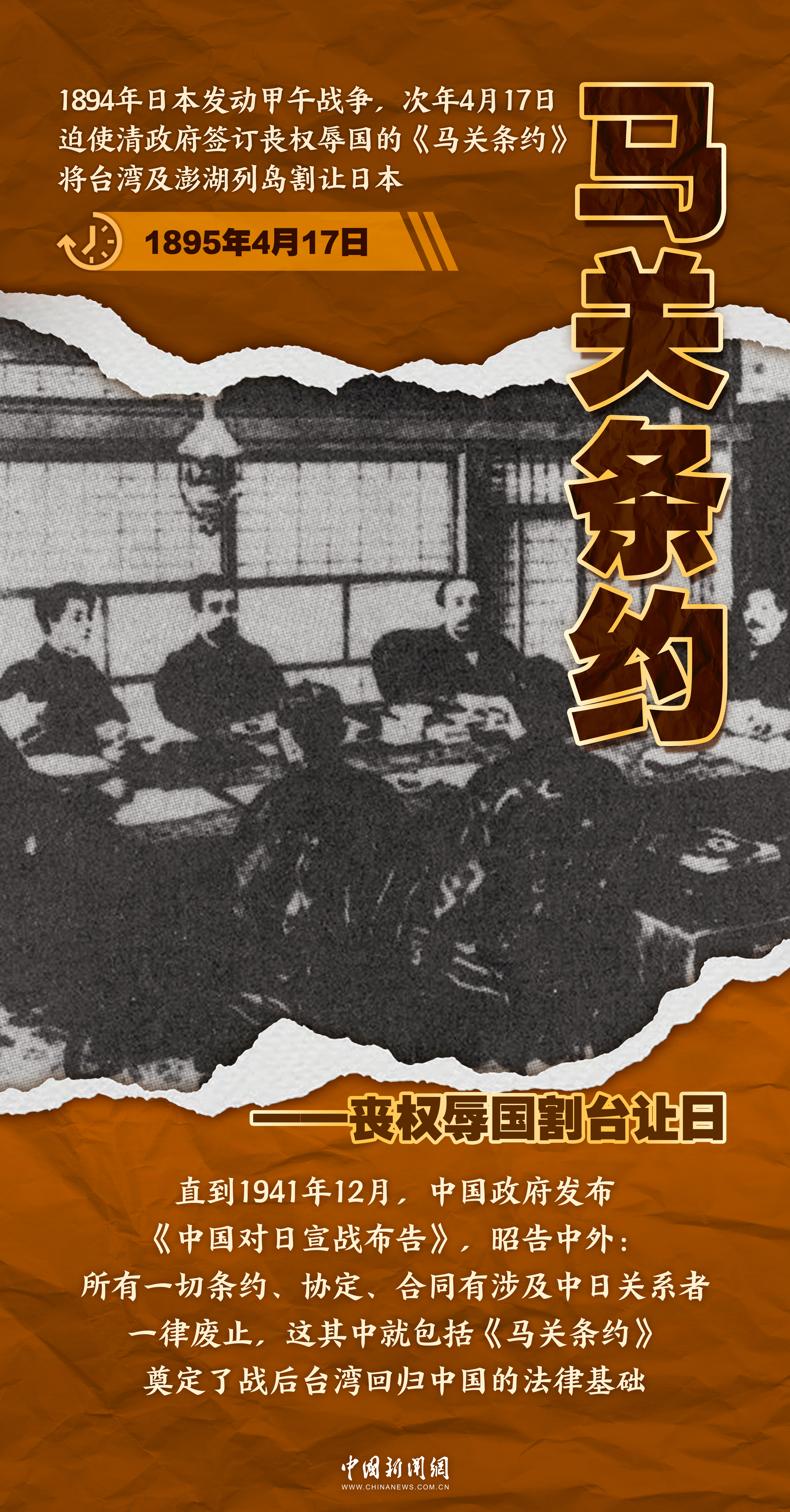
【图说抗战】铭记历史,从屈辱割台到台湾光复
Zhong Guo Xin Wen Wang· 2025-08-07 14:59
Group 1 - The year 2025 marks the 80th anniversary of the victory in the Chinese People's War of Resistance Against Japanese Aggression and the World Anti-Fascist War, as well as the 80th anniversary of Taiwan's recovery [1] - Taiwan's return to the motherland is based on the legal principles established by the Cairo Declaration and the Potsdam Proclamation, following the humiliating cession of Taiwan in the Treaty of Shimonoseki and the Wushe Incident [1]