
一个东风战略

Search documents
东风汽车:2026,迈入高质量发展跃迁年!
Zhong Guo Qi Che Bao Wang· 2026-02-02 02:20
Core Insights - Dongfeng Motor is committed to a strategic transformation under the "One Dongfeng" initiative, aiming to enhance collaboration across its various business segments and achieve significant growth in the automotive market [1][29]. Group 1: Strategic Goals and Achievements - In 2025, Dongfeng's new energy vehicle sales reached 1.05 million units, marking a 21% year-on-year increase, while total sales of self-owned brands exceeded 1.5 million units, accounting for over 60% of total sales [4]. - The company aims to achieve overall sales of 3.25 million units in 2026, with specific targets of 1.7 million for new energy vehicles and 600,000 for exports [10][11]. Group 2: Technological Advancements - Dongfeng has significantly enhanced its core technology capabilities, with R&D investment intensity reaching 7.9%. The company has successfully mass-produced the DF30 automotive-grade MCU chip, achieving full-stack domestic control [7]. - The Mahle hybrid engine has achieved a thermal efficiency of over 48%, setting a new industry record, and the company has established a 16,000-ton integrated die-casting production line to improve vehicle manufacturing efficiency [7]. Group 3: Brand Development and Market Positioning - Dongfeng's brand strategy includes the launch of the "Yijing" brand in collaboration with Huawei, focusing on high-end intelligent vehicles, while the Dongfeng Warrior and Dongfeng Lantu brands aim to lead the luxury electric off-road and high-end markets, respectively [10][11]. - The company is exploring a new model characterized by "Chinese customers, Chinese standards, Chinese components, and Chinese speed," fostering a strategic community for co-creating value [10]. Group 4: Future Outlook and Reforms - In 2026, Dongfeng plans to implement deeper reforms to enhance market responsiveness by granting greater autonomy to frontline business units, enabling quicker decision-making and actions [24]. - The company emphasizes that its future growth will be driven by technological innovation, collaborative development, and internal reforms, positioning itself to lead in the evolving automotive industry [29].


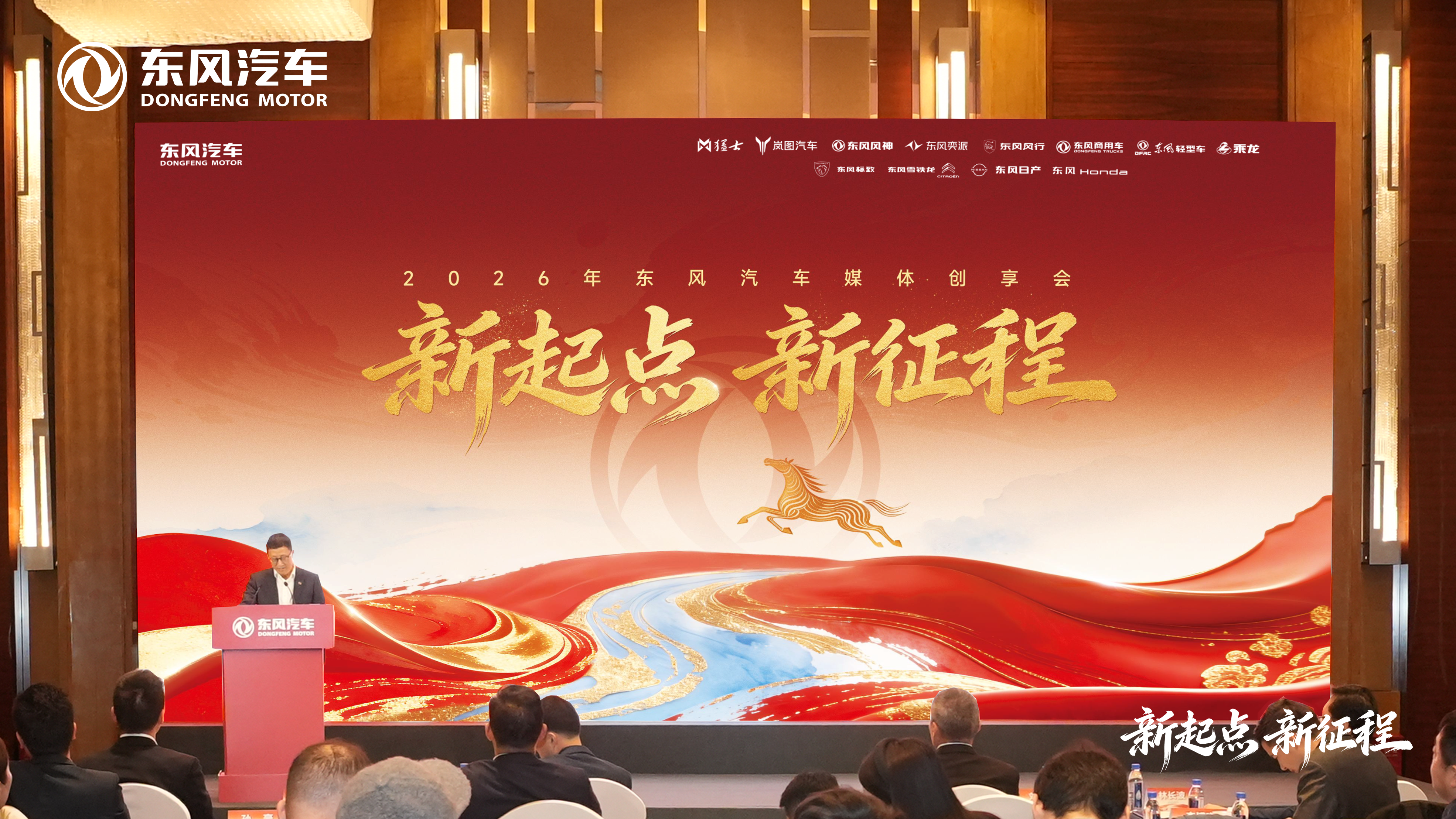
东风汽车定下325万辆年销量目标
Xin Jing Bao· 2026-02-01 10:37
Core Insights - Dongfeng Motor aims for an overall annual sales target of 3.25 million vehicles in 2023, with specific targets of 1.7 million for new energy vehicles and 600,000 for exports [1][2] Group 1: Sales Targets and Growth - In 2025, Dongfeng's new energy vehicle sales are projected to reach 1.05 million units, representing a year-on-year growth of 21%, with total self-owned brand sales exceeding 1.5 million units, accounting for over 60% of total sales [1] - The company plans to deepen its "One Dongfeng" strategy and enhance technology implementation [1] Group 2: Technological Advancements - New generation Mahle power systems and high-performance DF30 chips are set to be scaled up for vehicle integration this year [1] - The "Tianyuan Intelligent" system will accelerate deployment, with the T200 intelligent driving system being widely adopted and the T500 entering mass production [1] Group 3: Product Launches - The new brand jointly created with Huawei, "Yijing," will make its global debut this year [1] - Dongfeng will introduce several new models, including the U series of Dongfeng Warriors, and various models under the Lantu brand such as Lantu Taishan Ultra and Lantu X8 [1] - Dongfeng Yipai will launch a new full-size six-seat SUV, a spacious SUV, and a high-performance coupe, while Dongfeng Fengshen will introduce the Fengshen L9 [1] - Dongfeng Fengxing will unveil a new strategic model, the Xinghai V6, and Dongfeng Commercial Vehicles will launch its first new energy model, the Dongfeng Tianlong KH tractor [1] Group 4: Strategic Management - The event featured leaders from Dongfeng Motor Group and its subsidiaries, who discussed the development paths of various business segments under the "One Dongfeng" strategy [2] - Dongfeng Motor emphasizes granting greater autonomy to frontline business units to enhance operational effectiveness [2]