
融合化

Search documents
固本强基,做实做强实体经济
Xin Lang Cai Jing· 2026-02-27 23:36
Core Viewpoint - The emphasis on strengthening the real economy as the foundation for a strong nation is highlighted, with a focus on technological and industrial innovation to enhance competitiveness and sustainability [2][5][10]. Group 1: Real Economy Development - The importance of the real economy as the foundation of a major country is reiterated, with a call to focus on its development [1][2]. - In 2025, the contribution rate of industrial added value to economic growth reached 35%, with manufacturing added value maintaining the world's highest position for 16 consecutive years [5]. - The revenue of Luoyang Bearing Group exceeded 6 billion yuan in 2025, with products widely used in various sectors including new energy vehicles [4][5]. Group 2: Technological and Industrial Innovation - The integration of technological innovation and industrial innovation is emphasized as crucial for enhancing the real economy [7][8]. - The launch of the "land aircraft" by Guangdong Huitian Aerospace Technology Company represents a significant step in low-altitude economic development [6][7]. - The establishment of a comprehensive support system for the transformation of scientific research achievements into market products is underway, addressing challenges in the innovation chain [8]. Group 3: Smart, Green, and Integrated Development - The shift towards smart, green, and integrated development is identified as essential for the modernization of the industrial system [9][10]. - The production precision and stability at Benxi Steel's cold-rolled plant have significantly improved due to digital transformation, with automotive steel sales increasing by 49.2% year-on-year [9][11]. - Hydrogen metallurgy projects in Hebei are expected to reduce carbon emissions by over 50% compared to traditional methods, showcasing the integration of environmental sustainability in industrial practices [11].
习近平总书记关切事·两会看落实丨固本强基,做实做强实体经济
Xin Hua Wang· 2026-02-27 07:05
Group 1 - The core message emphasizes the importance of the real economy as the foundation of a major country, with a focus on developing the real economy through technological and industrial innovation [3] - In 2025, the industrial added value contributed 35% to economic growth, with the manufacturing sector maintaining its position as the world's largest for 16 consecutive years, and the service sector's contribution to GDP rising to nearly 60% [8] - The development of the real economy is illustrated by the achievements of Luoyang Bearing Group, which reported revenues exceeding 6 billion yuan and expanded its product applications in various sectors, including new energy vehicles [8][7] Group 2 - The launch of the world's largest radial bearing for a 120-meter radio telescope by Luoyang Bearing Group marks a significant technological breakthrough in the domestic market [4] - The company is actively pursuing partnerships with leading domestic new energy vehicle manufacturers, particularly with its third-generation products that have high integration and assembly precision [7] - The emphasis on smart, green, and integrated development is highlighted as a key direction for the real economy, with various projects in hydrogen metallurgy and artificial intelligence applications contributing to reduced carbon emissions and enhanced productivity [20][19] Group 3 - The integration of technology and industry is crucial for enhancing the real economy, as demonstrated by the establishment of a technology transfer center in Guangdong aimed at accelerating the conversion of research outcomes into market products [13][14] - The production of a new type of flying car by Guangdong Huitian Aerospace Technology Company showcases the innovative potential within the low-altitude economy sector [9][12] - The ongoing digital transformation in manufacturing, as seen in the steel industry, has led to significant improvements in production stability and product quality, with sales of high-end automotive products increasing substantially [18]


2026年中国铁路连接器行业产业链、需求规模、竞争格局分析:随着铁路网络的扩展和电气化程度的提升,铁路连接器市场需求持续增长,国产化率提升[图]
Chan Ye Xin Xi Wang· 2026-02-27 01:26
Core Viewpoint - The railway connector industry is experiencing growth driven by national policies promoting modern railway infrastructure, with significant investments expected to enhance the market demand and scale by 2025 [1][3]. Industry Definition and Classification - Railway connectors are essential components used to link completed railway trains or vehicles, ensuring synchronized operation for smooth train movement. They are classified into passenger car connectors and locomotive connectors, with further subdivisions into electrical, communication, and control connectors for passenger cars, and circular and rectangular connectors for locomotives [2][4]. Industry Development Status - The national railway fixed asset investment is projected to reach 901.5 billion yuan by 2025, a 6% increase year-on-year. This investment will support the construction of new railway lines, with total railway operating mileage expected to reach 165,000 kilometers, including over 50,000 kilometers of high-speed rail, accounting for 30.55% of the total [3][4]. Market Demand and Scale - The demand for railway connectors in China is expected to reach approximately 2.369 million sets by 2025, reflecting a year-on-year growth of 3.99%. The market size is projected to be around 4.49 billion yuan, with a growth of 4.66% [1][4]. Industry Chain - The upstream of the railway connector industry includes raw materials like copper, aluminum, and cables. The midstream involves the manufacturing of railway connectors, while the downstream applications are primarily in the manufacturing and maintenance of rail transport vehicles [4][5]. Competitive Landscape - The railway connector market is becoming increasingly competitive, with domestic companies rapidly rising in the market, particularly in the passenger car connector segment. Major domestic players include Sichuan Huafeng Technology Co., Ltd., Zhejiang Yonggui Electric Co., Ltd., and Nanjing Kanni Electromechanical Co., Ltd. [7][8]. Key Enterprises - Yonggui Electric focuses on the research, manufacturing, and sales of electrical connectors and components, reporting a revenue of 1.027 billion yuan in the first half of 2025, with 43.14% from the rail transport and industrial sector [8]. - Kanni Electromechanical emphasizes a diversified industrial structure, with rail transport products contributing 72.94% to its revenue of 1.282 billion yuan in the first half of 2025 [8][9]. Industry Development Trends - The railway connector industry is poised for growth due to the ongoing expansion of the national railway network and the shift towards intelligent and green transportation solutions. Despite some slowdowns in urban rail construction, the demand for maintenance and upgrades of existing infrastructure presents significant opportunities for the railway connector market [9].


经济高质量发展里的“心”与“新”|能源保供,立足长远
Zhong Guo Xin Wen Wang· 2026-02-26 08:15
Group 1 - The core viewpoint of the article emphasizes the enhancement of energy supply security in China by 2025, with record high production of coal, oil, gas, and electricity, ensuring stable power supply [2] - National People's Congress representative, Yuan Hongwei, highlights the need to transform resource advantages into economic advantages by focusing on circular symbiosis and green development, with efforts in intelligence, greening, and integration [2] - Shanxi Development and Reform Commission Director, Chen Lei, states that Shanxi is committed to the national mission of coal supply security, with coal delivery of 400 million tons to stabilize supply for 23 provinces, alongside the delivery of 10 billion kilowatt-hours of green electricity [2]
21社论丨用好优势抓住机遇,促进广东制造业与服务业协同发展
2 1 Shi Ji Jing Ji Bao Dao· 2026-02-24 23:09
Group 1 - The core theme of the Guangdong conference is the collaborative development of manufacturing and service industries to explore new paths for high-quality development [1] - Guangdong's manufacturing sector accounts for 1/8 of the national manufacturing value added and approximately 1/3 of the province's GDP, establishing it as a global manufacturing hub [1] - The manufacturing industry in Guangdong is transitioning towards intelligent, green, and integrated development, aiming to move from low-value assembly to high-value design and sales [1] Group 2 - The historical evolution of developed economies shows that manufacturing and service industries have always evolved dynamically and collaboratively, leading to deeper industrial division and tighter integration [2] - The rapid development of information technology since the 1990s has empowered manufacturing through service-oriented manufacturing and the integration of the digital economy with the real economy [2] - The current technological revolution and industrial transformation necessitate a strong collaboration between manufacturing and services, leveraging advancements in AI, biomanufacturing, and quantum communication [2] Group 3 - Guangdong has unique advantages in the global technological revolution, with the Guangdong-Hong Kong-Macao Greater Bay Area being the only region with both mechanical and AI technologies [3] - The manufacturing sector in Guangdong includes leading industries such as home appliances, mobile phones, and automobiles, which need to collaborate with intelligent technologies to enhance their competitive edge [3] - A supportive market environment is essential for the collaborative innovation of manufacturing and services, requiring regulatory frameworks that facilitate new products, business models, and technological innovations [3]
四中全会精神在基层丨河北迁安:钢铁企业有“三变”
Xin Hua Wang· 2026-02-11 12:35
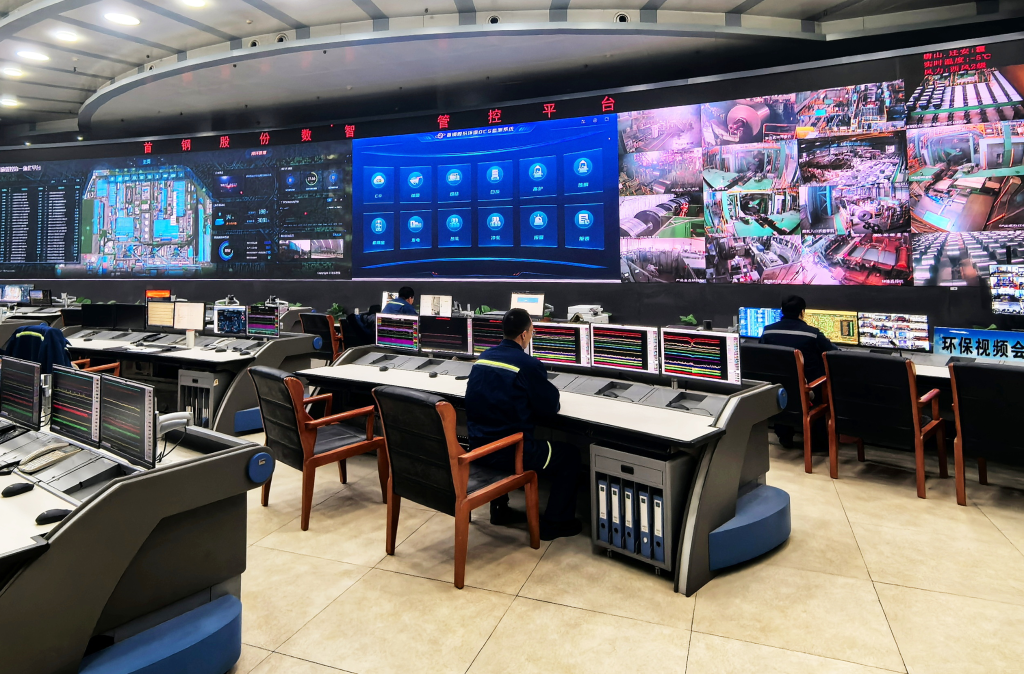
Group 1: Digital Transformation - The Shougang Group's steel company in Qian'an has implemented digital control for iron water transportation, utilizing data management systems [1] - The company has integrated artificial intelligence models into over 20 processes, resulting in annual cost savings of 70 million yuan and a reduction of 40,200 tons of carbon dioxide emissions [3][4] - Qian'an's steel enterprises have achieved AI demonstration applications in 45 scenarios across 12 processes, with plans to enhance collaboration with leading AI companies [4] Group 2: Green Transformation - Qian'an's steel companies are pursuing green transformation, achieving A-level environmental performance across all long-process steel enterprises [4] - The local steel and coking enterprises have a total coking capacity of 10.8 million tons, with the potential to produce 200,000 tons of hydrogen from coke oven gas [5] - The Hebei Yanshan Steel Group has deployed 643 hydrogen-powered heavy trucks, emphasizing the integration of hydrogen energy and steel production [6]
中国制造要“四化”丨专栏记者开讲了 · 展望2026
Xin Lang Cai Jing· 2026-02-11 08:24
Core Viewpoint - China's manufacturing sector is expected to maintain its position as the world's largest for 16 consecutive years, showcasing its remarkable achievements and underlying strengths [1] Group 1: Future Directions - The future of China's manufacturing lies in four key transformations: high-end, intelligent, green, and integrated [1]
福建:巩固提升制造业支柱产业,培育光电信息、集成电路、新能源等战略性新兴产业集群
Xin Lang Cai Jing· 2026-02-08 00:58
Core Viewpoint - The Fujian Provincial Government has issued implementation opinions to promote high-quality urban development, emphasizing tailored strategies to enhance urban development momentum [1] Group 1: Urban Development Strategies - The government advocates for city-specific policies to boost urban development [1] - There is a focus on enhancing urban industrial parks through intelligent, green, and integrated development [1] Group 2: Industry Focus - The strategy aims to consolidate and elevate the manufacturing sector while fostering strategic emerging industry clusters such as optoelectronics, integrated circuits, and new energy [1] - Future industries will be developed based on local conditions to cultivate new productive forces [1] Group 3: Construction and Modernization - The plan includes the development of intelligent construction and the cultivation of a modern architectural industry chain to accelerate the transformation and upgrading of the construction sector [1] Group 4: Economic Diversification - The government is promoting the development of various economic sectors, including first-release, silver economy, low-altitude, cultural tourism, and marine economies, to create new consumption scenarios and business formats [1] - Support is provided for Xiamen to pilot the construction of an international consumption environment [1] Group 5: Cultural and Tourism Development - The initiative aims to accelerate the creation of distinctive cultural districts, nighttime cultural and tourism consumption clusters, leisure tourism streets, and intangible cultural heritage districts [1]
东风汽车:2026年加速迈向智能化、绿色化、融合化
Zheng Quan Ri Bao Wang· 2026-02-06 07:15
Group 1 - Dongfeng Motor's new energy vehicle sales reached 1.05 million units in 2025, a year-on-year increase of 21%, with self-owned brand sales exceeding 1.5 million units, accounting for over 60% of total sales, marking a transition from the "investment phase" to the "harvest phase" [1] - The company's R&D investment intensity reached 7.9%, with the number of invention patents granted ranking first among Chinese independent vehicle manufacturers for four consecutive years; the DF30 automotive-grade high-end MCU chip has entered mass production, achieving full-stack domestic control [1] - Dongfeng's Mahle hybrid engine has achieved a thermal efficiency of over 48%, setting a new industry record, and the largest 16,000-ton integrated die-casting production line has been completed and put into operation [1] Group 2 - Dongfeng Motor aims to achieve overall annual sales of 3.25 million units, 1.7 million new energy vehicles, and 600,000 exports by 2026, focusing on "intelligent, green, and integrated" transformation [2] - The company plans to transition from "technical realization" to "value resonance," with the new generation Mahle power system and high-performance DF30 chip set for large-scale deployment [2] - The "Yijing" brand, co-created with Huawei, will make its global debut in March 2026, while various new models across different segments are set to launch, including the Dongfeng Mengshi U series and Dongfeng Lantu's high-end offerings [3]
光伏告别出口退税后怎么办?王勃华:倒逼企业转向高质量高附加值竞争
Xin Lang Cai Jing· 2026-02-05 05:52
Core Insights - The Chinese photovoltaic industry will enter a new market-driven phase focused on technology, cost, and brand starting April 1, 2026, as it phases out the value-added tax export rebate [1][2][3] - This transition will compel companies to shift from low-price competition to high-quality, high-value competition, aiming to build sustainable global competitiveness [1][2] Industry Transformation - A significant transformation in development philosophy and logic is anticipated, moving from scale and price competition to value competition [3] - Two key areas for this transformation include: - Policy level: Implementing a combination of policies to promote industry upgrades and create a healthy development environment [3] - Corporate level: Companies need to explore second growth curves by building technological moats and fostering collaborative industry ecosystems [3] Manufacturing Development - The manufacturing sector should focus on three key directions: intelligent, green, and integrated development, which are interrelated and mutually reinforcing [2][3] - Intelligent development encompasses smart R&D, production, and operation of power plants, as well as contributing to societal smart transformation [2][3] - Green development involves promoting green energy use within the photovoltaic industry and advancing energy-saving and carbon-reducing technologies [2][3] - Integrated development includes deep integration with other industries and active participation in the electricity market [2][3]