
一二三产业深度融合

Search documents
珍珠产业串起发展路 河南鲁山特色养殖助振兴
Xin Lang Cai Jing· 2026-02-11 08:24
Group 1 - The project, named "Happiness City Pearl Ecological Breeding Base," is a collaboration between Zhejiang Yunsan Jewelry Co., Ltd. and Lushan Happiness City Real Estate Co., Ltd., with a planned investment of 230 million yuan, covering 1,000 acres of breeding water area and a 50-acre full industry chain park [1] - The breeding area is divided into 500 acres for finished pearl breeding, 300 acres for pearl seedling breeding, and 200 acres for a popular experience base, aiming to increase income for over 1,000 local households [1] - The project implements ecological, green, and intelligent breeding standards, establishing a comprehensive technical control system from seedling selection to water management, ensuring high-quality "Lushan Pearls" in the market [1] Group 2 - Future plans include collaboration with research institutions to enhance pearl breeding technology and product development, such as exploring mixed breeding of clams and fish, and establishing a pearl museum with immersive educational experiences [2] - The initiative aims to integrate research, ecological breeding, tourism, processing, sales, cultural creativity, and educational research into a comprehensive industrial cluster, significantly promoting high-quality economic and social development in the region [2]
一颗核桃的“变形记”
Xin Lang Cai Jing· 2026-01-02 18:29
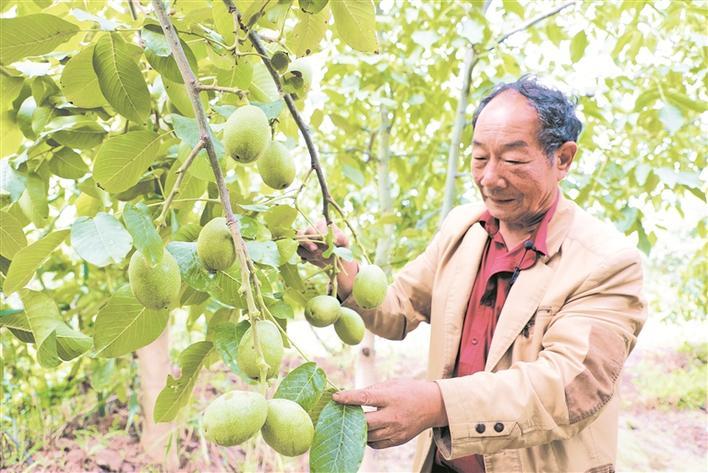
Core Viewpoint - The walnut industry in the Sanqun Ganquan Town has transformed from a struggling agricultural sector into a thriving economic powerhouse, significantly contributing to local ecological protection and economic development [5][9][15]. Industry Overview - The walnut planting area in Sanqun Ganquan Town has reached 80,000 acres, with an annual production of 36,000 tons and an annual output value exceeding 650 million yuan [8][12]. - The town has established itself as a national-level walnut demonstration base, receiving various accolades for its quality and innovation in walnut production [12]. Technological Advancements - A technology team has been providing hands-on training for walnut tree cultivation, focusing on pruning techniques and pest control, which has led to increased yields and improved nut quality [10][11]. - The introduction of a "six unifications and three transformations" development model has streamlined production processes, enhancing quality and efficiency [10]. Economic Impact - The walnut industry has become a significant source of income for local farmers, with some reporting earnings of over 200,000 yuan in good years [6]. - The establishment of cooperative models and partnerships with enterprises has strengthened the economic framework, leading to the formation of 49 walnut cooperatives and attracting investment from companies like Zhejiang Zhejiang Fruit Industry Co., Ltd. [11][14]. Market Expansion - The marketing strategy includes both online and offline sales channels, with a focus on e-commerce platforms and local partnerships to enhance product reach [14]. - The integration of tourism with walnut production has created new revenue streams, attracting visitors and promoting local culture through events like the walnut cultural festival [14]. Environmental Benefits - The walnut forests serve as a natural barrier against desertification, improving local climate conditions and water conservation [9][15]. - The successful cultivation of walnuts in previously unproductive sandy land demonstrates the potential for ecological restoration through agricultural practices [6][9].

打造万亩生态方塘!三角生鱼产业迈向集约化新阶段
Nan Fang Nong Cun Bao· 2025-12-26 00:31
Core Viewpoint - The project aims to establish a large-scale ecological fishery industry demonstration zone in Sanjiao Town, focusing on modernizing fish farming practices and addressing environmental challenges [2][12]. Group 1: Project Overview - The "Fish Village" ecological fishery industry demonstration zone covers a total area of 1,048.48 hectares, with a planned total investment of 70 million yuan, and is expected to be completed by December 2027 [5][6]. - Since the project commenced in June this year, approximately 376.3 hectares of ecological protection and restoration have been completed, with an investment of 23.3673 million yuan [3][4]. Group 2: Industry Context - Sanjiao Town is renowned as the "Fish Village," producing an annual output of 108,500 tons of fish and over 3.5 billion fish fry, with a total industry chain output value exceeding 1.9 billion yuan [10][11]. - The industry faces challenges such as fragmented fish pond layouts and pressure on tailwater treatment, which the demonstration zone aims to address through systematic upgrades [11][12]. Group 3: Project Components - The core components of the project include the consolidation of scattered fish ponds, comprehensive treatment of tailwater covering approximately 5,600 acres, and the establishment of modern processing bases, cold chain logistics areas, and a "fish culture" tourism belt [13][15]. - Tailwater treatment is expected to protect the environment, improve water quality, reduce fish diseases, and enhance product quality [16][18]. Group 4: Future Plans - Future efforts will focus on the continued dredging of remaining fish ponds, strengthening pond foundations, and accelerating the construction of tailwater treatment facilities, alongside improving drainage and road infrastructure [18][19]. - The initiative aims to create a benchmark for high-quality fishery development in Guangdong Province and further enhance the reputation of Sanjiao Town as the "Fish Village" [24].

老北京水果有了示范基地,打造“农业+文化+旅游”发展模式
Xin Jing Bao· 2025-11-14 06:13
Core Insights - The construction of the Tongzhou Old Beijing Fruit Demonstration Base has been completed, showcasing a modern fruit orchard that integrates planting, sightseeing, and education, providing a new model for urban agriculture development in Beijing [1][2] Group 1: Project Overview - The project is implemented by Jinguo Tiandi (Beijing) Ecological Technology Co., Ltd. and Beijing Zhengjia Ecological Agriculture Co., Ltd., focusing on the introduction of new varieties, technologies, and models [1] - The base aims to protect and utilize the rich fruit resources of Beijing, particularly the local Old Beijing fruit varieties, through a systematic approach [1] Group 2: Technological Integration - The base features a digital information system for the orchard, which includes modules for environmental monitoring, intelligent water and fertilizer integration, and smart production management, enabling precise management and decision-making [2] - Advanced technologies such as drones for pest control and various detection instruments for soil and fruit quality are employed to ensure a comprehensive quality control system from soil to fruit [2] Group 3: Economic and Ecological Benefits - The demonstration base emphasizes the multi-functional aspects of agriculture, combining agricultural production with tourism and cultural experiences, thus achieving both economic and ecological benefits [3] - The "Agriculture + Culture + Tourism" model reflects Beijing's efforts to promote the deep integration of primary, secondary, and tertiary industries [3]