
生鱼

Search documents
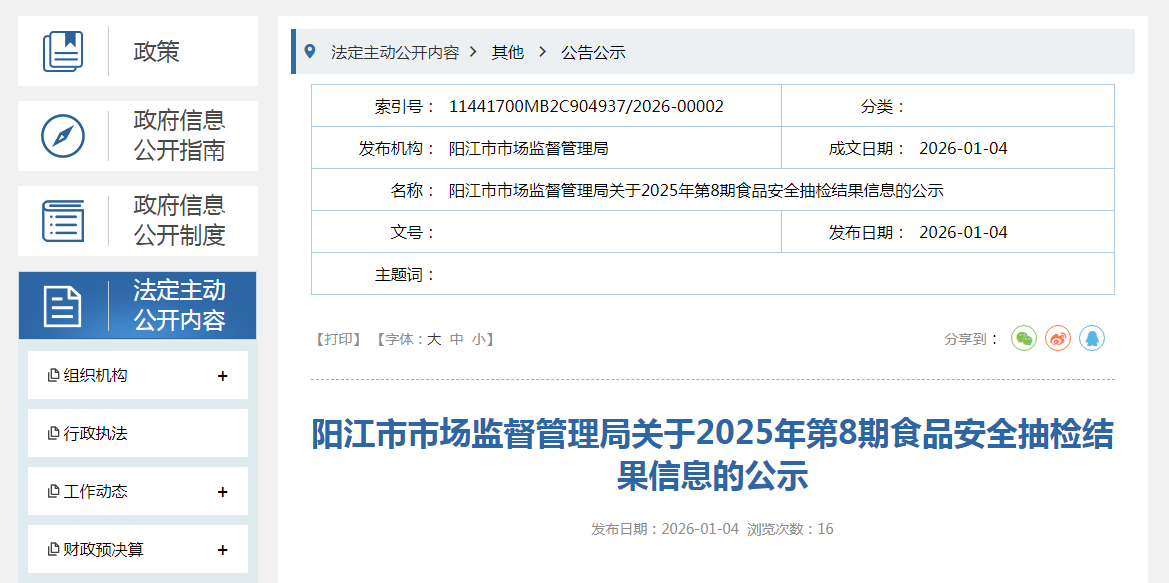
广东省阳江市市场监督管理局关于2025年第8期食品安全抽检结果信息的公示
Zhong Guo Zhi Liang Xin Wen Wang· 2026-01-22 08:25
Core Viewpoint - The Yangjiang Market Supervision Administration conducted a food safety inspection, revealing a non-compliance rate of 2.41% from 1452 samples tested, with 35 batches found to be unqualified [1]. Group 1: Inspection Results - A total of 1452 samples were collected from food business units in Yangjiang [1]. - 35 batches of products were identified as non-compliant, resulting in a non-compliance rate of 2.41% [1]. - The details of the unqualified products are documented in an attached summary table [1]. Group 2: Regulatory Actions - The Yangjiang Market Supervision Administration mandated local regulatory bodies to investigate and address the non-compliant products and their producers [1]. - Legal actions will be taken against any violations in production and operation, with the results recorded in the food safety credit archives of the businesses involved [1]. - The investigation outcomes will be publicly disclosed by the respective local market supervision departments [1].

广东省中山市市场监督管理局食品监督抽检信息通告(2026年第4期)
Zhong Guo Zhi Liang Xin Wen Wang· 2026-01-12 08:32
Core Viewpoint - The Zhongshan Market Supervision Administration conducted a food safety inspection, testing 220 batches of food across four categories, with 212 passing and 8 failing the safety standards [2]. Group 1: Inspection Results - A total of 220 food samples were tested, including catering food, condiments, convenience foods, and edible agricultural products [2]. - Out of the 220 samples, 212 were found to be compliant, resulting in a compliance rate of approximately 96.36% [2]. - The inspection was conducted according to the "Implementation Rules for Food Safety Supervision and Sampling Inspection in Guangdong Province" [2]. Group 2: Non-compliance Details - Eight samples were identified as non-compliant, with specific issues including the presence of harmful substances such as sodium dodecylbenzenesulfonate and excessive levels of coliform bacteria [2]. - For instance, one sample of cold beef was found to have 310 CFU/g of coliform bacteria, exceeding the acceptable limit of 100 CFU/g [2]. - Another sample of soy sauce contained 0.34g/100mL of amino acid nitrogen, which is above the standard limit of 0.40g/100mL [2]. Group 3: Consumer Engagement - The administration encourages consumers to participate in food safety supervision and report any harmful food products or illegal activities by calling the complaint hotline [2].

打造万亩生态方塘!三角生鱼产业迈向集约化新阶段
Nan Fang Nong Cun Bao· 2025-12-26 00:31
Core Viewpoint - The project aims to establish a large-scale ecological fishery industry demonstration zone in Sanjiao Town, focusing on modernizing fish farming practices and addressing environmental challenges [2][12]. Group 1: Project Overview - The "Fish Village" ecological fishery industry demonstration zone covers a total area of 1,048.48 hectares, with a planned total investment of 70 million yuan, and is expected to be completed by December 2027 [5][6]. - Since the project commenced in June this year, approximately 376.3 hectares of ecological protection and restoration have been completed, with an investment of 23.3673 million yuan [3][4]. Group 2: Industry Context - Sanjiao Town is renowned as the "Fish Village," producing an annual output of 108,500 tons of fish and over 3.5 billion fish fry, with a total industry chain output value exceeding 1.9 billion yuan [10][11]. - The industry faces challenges such as fragmented fish pond layouts and pressure on tailwater treatment, which the demonstration zone aims to address through systematic upgrades [11][12]. Group 3: Project Components - The core components of the project include the consolidation of scattered fish ponds, comprehensive treatment of tailwater covering approximately 5,600 acres, and the establishment of modern processing bases, cold chain logistics areas, and a "fish culture" tourism belt [13][15]. - Tailwater treatment is expected to protect the environment, improve water quality, reduce fish diseases, and enhance product quality [16][18]. Group 4: Future Plans - Future efforts will focus on the continued dredging of remaining fish ponds, strengthening pond foundations, and accelerating the construction of tailwater treatment facilities, alongside improving drainage and road infrastructure [18][19]. - The initiative aims to create a benchmark for high-quality fishery development in Guangdong Province and further enhance the reputation of Sanjiao Town as the "Fish Village" [24].

中山农业科技特派员下沉一线,为水产养殖注入绿色动能
Nan Fang Nong Cun Bao· 2025-09-17 09:03
Core Viewpoint - The article emphasizes the efforts of Zhongshan Agricultural Technology Special Commissioners (light cavalry) in promoting green and healthy aquaculture practices to ensure food safety and support the sustainable development of the aquaculture industry [2][4][20]. Group 1: Promotion of New Technologies - The special commissioners focus on introducing new varieties and technologies, enhancing quality control, and protecting the ecological environment as key areas of development [2][3]. - They conduct comprehensive demonstrations and promotions of green aquaculture technologies to facilitate the industry's transformation [3][4]. Group 2: Technical Support and Guidance - The agricultural technology special commissioners systematically outline key management practices, disease prevention, product transportation, and safety production to provide technical services for aquaculture [6][8]. - They distribute technical guidelines, lists of banned veterinary drugs, and common drug detection lists to ensure farmers have clear instructions and responses [7][8]. Group 3: On-Site Demonstration and Project Implementation - The initiative includes leading projects such as smart aquaculture and upgrading breeding ponds, as well as exploring new service technologies for specific fish species [11][12]. - The special commissioners provide on-site guidance for project design and implementation, promoting smart aquaculture production technologies and equipment [13][14]. Group 4: One-on-One Support and Emergency Response - The special commissioners engage in one-on-one guidance in key breeding areas, checking records and assisting in production documentation [15][16]. - They offer emergency plans for unexpected situations, ensuring effective implementation of technical solutions [17]. Group 5: Future Directions - Zhongshan plans to continue enhancing the work mechanism of agricultural technology special commissioners, focusing on technical tracking and service promotion to drive the aquaculture industry towards greener, higher quality, and more efficient development [19][20].