万有理论

Search documents
我们应当如何理解杨振宁先生的成就
3 6 Ke· 2025-10-20 02:47
Core Points - The article discusses the significance of the work of physicist Yang Zhenning, emphasizing the importance of his contributions to theoretical physics and their impact on human understanding of the universe [2][11][43] - It highlights two major achievements: the proposal of "parity non-conservation" with Li Zhengdao and the development of the "Yang-Mills theory" [22][24][27] Group 1: Importance of Physics - Physics is described as a fundamental science with the mission to explore the essence of the world [5][30] - The article uses analogies to illustrate how advancements in physics provide a better understanding of the universe, comparing historical and modern tools [4][8] Group 2: Yang Zhenning's Contributions - Yang Zhenning and Li Zhengdao's 1956 paper challenged the established notion of "parity conservation," leading to their Nobel Prize win [18][22] - The "Yang-Mills theory" is recognized as a significant theoretical framework that attempts to unify the four fundamental forces of nature [26][27] Group 3: Impact on Chinese Science - Yang Zhenning's return to China in 1971 is noted as a pivotal moment for the development of theoretical physics in the country, helping to elevate its status to a world-class level [29][34] - His contributions are credited with fostering the growth of numerous academicians and enhancing research facilities in Chinese universities [34][37] Group 4: Future Implications - The article stresses the necessity of foundational research in physics for future technological advancements, particularly in areas like controlled nuclear fusion and high-temperature superconductors [40][41] - It concludes that Yang Zhenning's work is essential for addressing deeper scientific questions that transcend national boundaries, serving humanity as a whole [43][45]

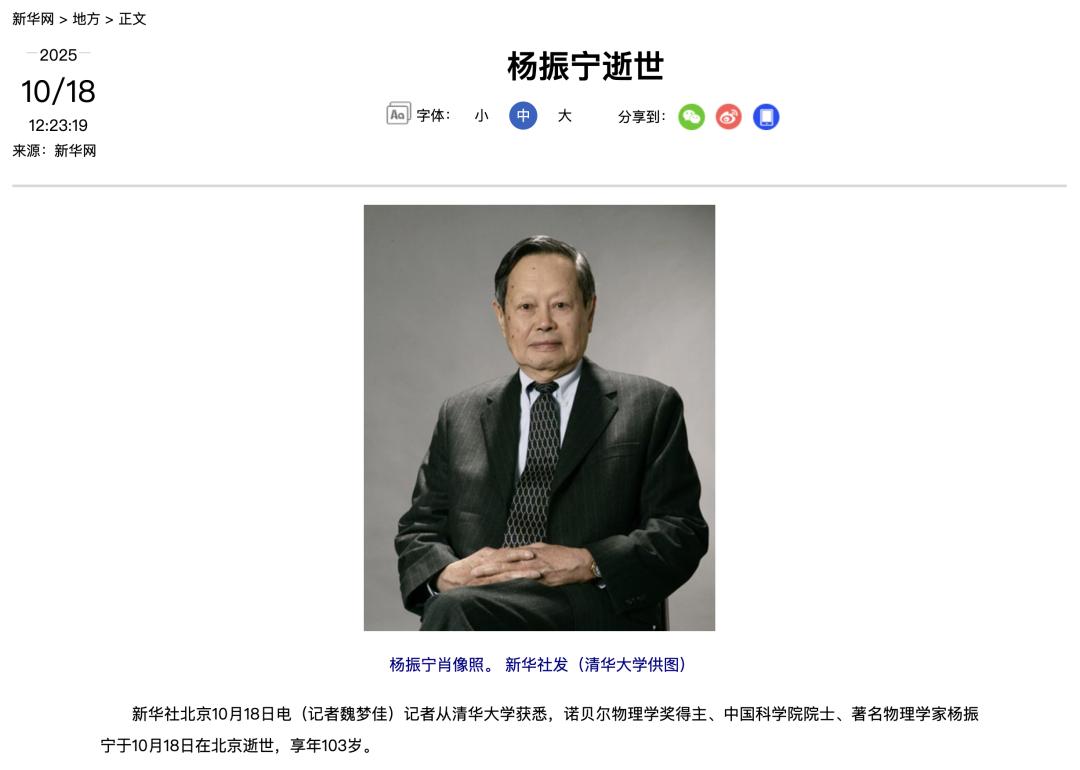
改变国人“自觉不如人”心理,杨振宁已在星河恒久闪耀
第一财经· 2025-10-19 14:33
Core Viewpoint - The article commemorates the life and contributions of Yang Zhenning, a prominent physicist and Nobel laureate, who passed away at the age of 103, highlighting his impact on Chinese science and the global scientific community [3][6]. Group 1: Personal Background and Education - Yang Zhenning was born in 1922 in Anhui and graduated from Southwest Associated University in 1942. He pursued further studies in the United States, where he was mentored by notable physicists such as Edward Teller and Enrico Fermi [6][7]. - He completed his PhD at the University of Chicago in 1948 and later worked at the Institute for Advanced Study in Princeton, where he interacted with renowned physicists like Albert Einstein [7][8]. Group 2: Scientific Contributions - Yang Zhenning, along with Li Zhengdao, was awarded the Nobel Prize in Physics in 1957 for the theory of "parity violation," which was experimentally confirmed [8]. - He is recognized as one of the most influential theoretical physicists of the mid-20th century, with contributions that extend beyond the Nobel Prize, including the Yang-Mills theory, a cornerstone of particle physics [9][12]. Group 3: Influence on Chinese Science - After returning to China in 2003, Yang dedicated himself to advancing basic scientific research and nurturing young talent at Tsinghua University, where he founded the Institute for Advanced Study [12][14]. - His efforts significantly contributed to the development of quantum information science in China, encouraging many scientists to return and engage in research [14][15]. Group 4: Legacy and Recognition - Yang Zhenning's passing has been met with widespread mourning in the scientific community, with tributes highlighting his role as a mentor and his influence on generations of scientists [14][15]. - His thoughts on education emphasized the importance of allowing young students to explore their interests freely and the need for collaboration among academic institutions [15][16].
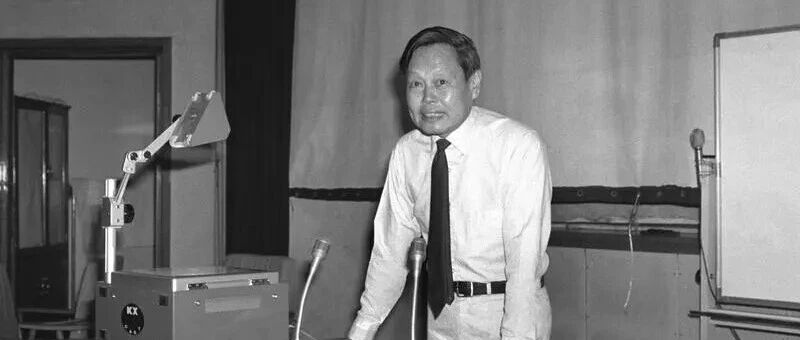
改变国人“自觉不如人”心理,杨振宁已在星河恒久闪耀
Di Yi Cai Jing· 2025-10-19 13:48
Core Insights - The passing of Yang Zhenning, a prominent physicist and Nobel laureate, on October 18 at the age of 103, has deeply impacted the scientific community both domestically and internationally [1][3][11] - Yang Zhenning dedicated his later years to advancing basic scientific research in China, nurturing young talent, and establishing top-tier research institutions [1][10] Group 1: Contributions to Physics - Yang Zhenning was recognized for his groundbreaking work in theoretical physics, particularly for the "parity violation" theory, which earned him the Nobel Prize in Physics in 1957 alongside fellow scientist Li Zhengdao [4][5] - He co-developed the "Yang-Mills theory," a fundamental framework in particle physics, which is considered a cornerstone of the standard model and has influenced numerous fields in mathematics and physics [5][10] Group 2: Influence on Chinese Science - Yang Zhenning played a crucial role in promoting the development of physics in China, especially after his return in 2003, where he contributed significantly to Tsinghua University's research initiatives [10][12] - He encouraged young scientists, including notable figures like Pan Jianwei, to return to China and focus on quantum information science, thereby fostering a new generation of researchers [9][10] Group 3: Legacy and Recognition - His death prompted tributes from various academic institutions, highlighting his profound influence on generations of scientists and the broader scientific community [11][12] - Yang Zhenning's insights into the nature of scientific research emphasized the importance of foundational studies and the need for collaboration among academic institutions [12]