
不动产金融

Search documents
洞见 | 申万宏源杨成长:推动不动产金融向动产金融转变
申万宏源证券上海北京西路营业部· 2025-12-02 02:21
Core Viewpoint - The article emphasizes the need for China's financial system to transition from real estate finance to movable asset finance, driven by the shift in economic development from traditional factor-driven models to innovation-driven models during the "14th Five-Year Plan" and "15th Five-Year Plan" periods [2][3]. Group 1: Economic Transition and Financial System Challenges - During the "14th Five-Year Plan," the financial system explored ways to improve the market-oriented allocation of factors and promote the development of innovative factors, but it still faces challenges in serving new asset types [2][4]. - The transition to an innovation-driven economy will require financial institutions to adapt their service models to support new asset structures, focusing on technology, data, and green resources [5][6]. Group 2: New Asset Characteristics and Financial Service Requirements - New factors and assets are characterized by intangibility, high liquidity, and value increment, which pose challenges for traditional financial service models based on collateral and stable cash flows [7][8]. - The financial system must develop new service models that cater to movable asset characteristics, addressing the difficulties in rights confirmation, valuation, pricing, and investment [8][9]. Group 3: Current Challenges in Financial Services for New Factors - The financial system faces three main challenges: difficulty in incorporating new factors into financial statements, challenges in valuation due to lack of stable cash flows, and investment difficulties stemming from differing investor logic [8][9][10]. - New factors struggle with rights confirmation and accounting, as existing frameworks do not adequately address the unique characteristics of technology and data assets [9][10]. Group 4: Strategies for Financial Service Improvement - Financial institutions should enhance their capabilities in confirming rights and integrating new assets into financial statements, developing modern accounting systems that reflect the changes brought by technological and green transformations [16][17]. - A multi-dimensional evaluation framework should be established to improve the valuation and pricing capabilities for new factors and assets, involving industry experts and investment institutions [18][19]. - The construction of a unified national market for movable assets should be prioritized to facilitate the trading and circulation of new factors, enhancing market efficiency [20][21]. Group 5: Investment Tools and Financial Product Innovation - There is a need to diversify investment tools for movable assets, encouraging the development of patient capital and innovative financial products that align with the risk-return characteristics of new factors [23][24]. - Financial institutions should innovate their service models to better support the development of new factors, focusing on long-term investment strategies and enhancing risk management capabilities [25].

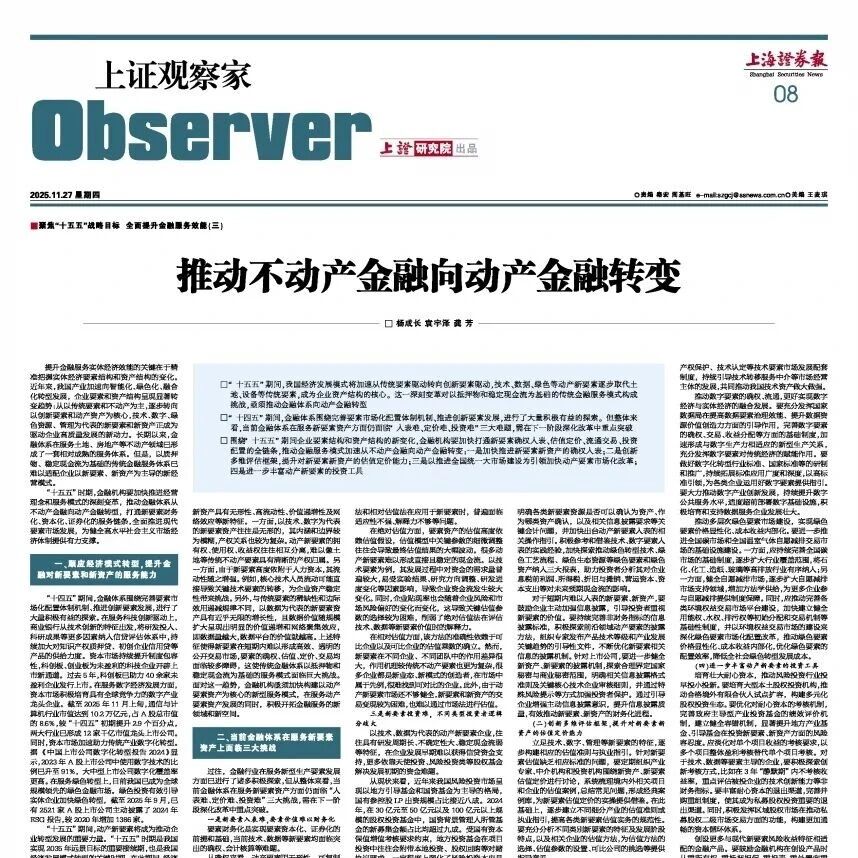
推动不动产金融向动产金融转变
申万宏源研究· 2025-11-27 06:29
Core Viewpoint - The article emphasizes the need for China's financial system to transition from real estate finance to movable asset finance, driven by the shift towards innovation-driven economic development during the 14th and 15th Five-Year Plans [6][7][8]. Group 1: Economic Transition and Financial System Challenges - During the 14th Five-Year Plan, the financial system explored ways to enhance the market-oriented allocation of factors and promote the development of innovative elements, but it still faces challenges in serving new asset types [8][12]. - The transition from traditional asset-driven models to innovation-driven models is crucial, with technology, digital, and green resources becoming core elements of enterprise asset structures [9][10]. - The financial system's traditional reliance on collateral and stable cash flows is increasingly incompatible with the new operational models of enterprises that focus on new elements and assets [11][12]. Group 2: New Elements and Assets - The rapid development of movable new elements will reshape enterprise asset structures, with intangible assets like patents and data becoming significant components [10][11]. - New elements are characterized by intangibility, high liquidity, and value increment, posing challenges for traditional financial services that rely on clear ownership and stable cash flows [11][12]. Group 3: Financial System's Three Major Challenges - The financial system faces three main challenges in serving new asset types: difficulties in asset recognition, valuation, and investment [13][14]. - The lack of clear standards for recognizing and accounting for new elements, such as data and green assets, complicates their financialization [14][15]. - Valuation of new elements is challenging due to their dependence on unstable cash flows and the absence of comparable market standards [16][17]. Group 4: Recommendations for Financial System Reform - Financial institutions should enhance their service capabilities for new elements by improving the recognition and valuation processes, and by facilitating the circulation and investment of these assets [20][21]. - Establishing a modern financial system that accurately reflects the changes in asset structures due to technological, digital, and green transformations is essential [21][22]. - Developing a multi-dimensional evaluation framework to improve the valuation and pricing capabilities for new elements and assets is necessary [23][24]. Group 5: Market Development and Investment Tools - Accelerating the construction of markets for technology, data, and green elements is vital for facilitating the trading and circulation of new assets [25][26]. - There is a need to create more investment tools that align with the risk-return characteristics of modern new elements, encouraging financial institutions to innovate their service models [28][29]. - Promoting the development of a multi-layered green element market will help internalize costs and benefits, enhancing the efficiency of green resource allocation [27].
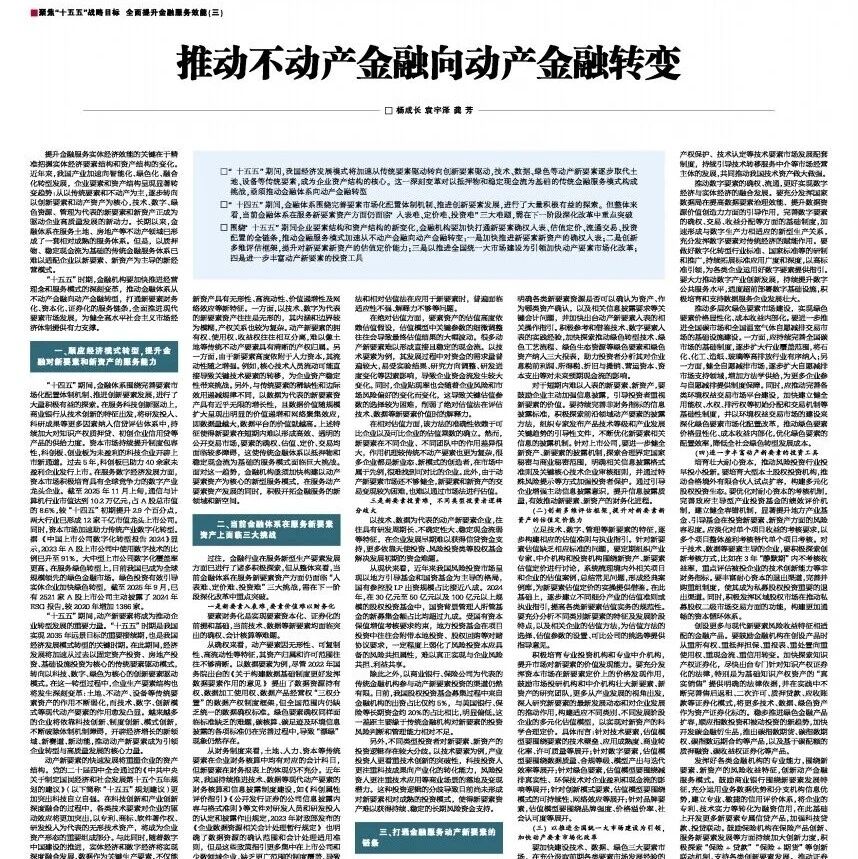
聚焦“十五五”战略目标全面提升金融服务效能(三) | 推动不动产金融向动产金融转变
Shang Hai Zheng Quan Bao· 2025-11-26 18:40
Core Viewpoint - The article emphasizes the need for China's financial system to transition from real estate finance to movable asset finance, driven by the shift towards innovation-driven economic development during the 14th and 15th Five-Year Plans [1][2]. Group 1: Economic Transition and Financial System Challenges - During the 14th Five-Year Plan, the financial system explored ways to enhance the market-oriented allocation of factors and promote the development of innovative elements, but it still faces challenges in serving new asset types [1][3]. - The financial system must address three main challenges: difficulties in asset recognition, pricing, and investment for new elements and assets [7][8]. Group 2: New Elements and Assets - The transition to movable new elements will reshape corporate asset structures, with technology, digital resources, and green assets becoming core components driving high-quality development [4][5]. - The rapid development of new elements and assets necessitates a new financial service model that can accommodate their unique characteristics, such as intangibility and high liquidity [6][10]. Group 3: Financial Service Model Transformation - Financial institutions are urged to innovate their service models to facilitate the financialization, capitalization, and securitization of new elements, thereby supporting the development of a modern factor market [2][14]. - The article outlines the need for a comprehensive approach to integrate new elements into financial statements, improve valuation frameworks, and enhance market mechanisms for movable assets [15][17][19]. Group 4: Investment Challenges - New elements often face investment difficulties due to their long R&D cycles, high uncertainty, and weak cash flow, leading to reliance on venture capital rather than traditional financing [12][13]. - There is a significant divergence in investment logic among different types of investors, complicating the establishment of a mature investment model for new elements [13]. Group 5: Recommendations for Financial Institutions - Financial institutions should develop new financial products that align with the risk-return characteristics of modern new elements, moving away from traditional collateral-based models [24][25]. - Encouraging the growth of patient capital and diversifying investment tools will be crucial for supporting the development of new elements and assets [23][22].
推动不动产金融向动产金融转变
Shang Hai Zheng Quan Bao· 2025-11-26 18:26
Core Viewpoint - The article emphasizes the need for China's financial system to transition from real estate finance to movable asset finance during the "15th Five-Year Plan" period, driven by the shift towards innovation-driven economic development and the increasing importance of new factors such as technology, data, and green resources [1][2]. Group 1: Economic Transition and Financial Service Adaptation - The economic development model in China is shifting from traditional factor-driven growth to innovation-driven growth, necessitating a transformation in financial services to accommodate new asset structures [1][4]. - The financial system has faced challenges in serving new asset types, particularly in terms of recognition, pricing, and investment, which need to be addressed in the next reform phase [1][7]. - Financial institutions must enhance their capabilities to recognize, value, and trade new factors and assets, moving towards a service model that supports movable asset finance [2][14]. Group 2: Challenges in Serving New Factors and Assets - The current financial system encounters three main challenges in serving new factors: difficulties in asset recognition, valuation, and investment [7][8]. - New factors like technology and data face significant hurdles in terms of clear ownership and accounting standards, complicating their financial recognition [8][9]. - Valuation of new factors is complicated due to their lack of stable cash flows and market comparables, making traditional valuation methods less effective [10][11]. Group 3: Strategies for Financial Service Improvement - Financial institutions are encouraged to develop a modern financial system that accurately reflects the changes in asset structures due to technological, digital, and green transformations [15][16]. - A multi-dimensional evaluation framework should be established to enhance the valuation and pricing capabilities for new factors and assets [17][18]. - The construction of a unified market for new factors is essential to facilitate the trading and circulation of technology, data, and green assets [19][20]. Group 4: Investment Tools and Financial Products - There is a need to diversify investment tools for movable new factors, encouraging the growth of patient capital and innovative financial products that align with the characteristics of new assets [22][23]. - Financial institutions should innovate their service models to better support the development of new factors, focusing on credit evaluation systems that leverage business data and branch information [24].