专项债管理

Search documents
18地明年Q1地方债将发1.37万亿,四川居首
21世纪经济报道· 2025-12-25 23:34
Core Viewpoint - The article discusses the anticipated issuance of local government bonds in the first quarter of 2026, highlighting a significant increase in planned issuance compared to previous years, indicating strong demand for funding across various regions [1][3][4]. Group 1: Issuance Plans and Trends - As of December 25, 2025, 18 regions have announced a total planned issuance of local government bonds amounting to 1.37 trillion yuan for Q1 2026 [1][3]. - The issuance schedule shows a peak expected in late January and early March 2026, with over 300 billion yuan planned for these periods, indicating a concentrated supply in the primary market [1][3]. - The planned issuance for January is approximately 597.8 billion yuan, a notable increase from 557.6 billion yuan in January 2025, reflecting a faster issuance pace and strong funding demand [4]. Group 2: Regional Issuance Breakdown - The top three regions for planned bond issuance in Q1 2026 are Sichuan (188.7 billion yuan), Jiangxi (128.5 billion yuan), and Guangxi (111.3 billion yuan), with Sichuan leading in planned issuance [3][4]. Group 3: Bond Types and Uses - The planned issuance includes a larger scale of new special bonds and refinancing general bonds compared to Q1 2025, indicating a pressing need for financing new projects and refinancing existing debts [4][6]. - The shift in management of special bonds from a "positive list" to a "negative list" allows for a broader range of projects to be financed, enhancing local governments' decision-making autonomy [6]. Group 4: Market Dynamics and Investment Outlook - Despite concerns about the capacity of banks and insurance companies to absorb long-term bonds, the market remains optimistic about the potential for profit, with local bonds seen as increasingly attractive [7]. - The overall supply of government bonds is expected to increase, providing financial institutions with more quality assets, as the central government continues to implement a proactive fiscal policy [8]. - The yield spread between local bonds and national bonds is projected to remain stable, which may enhance the attractiveness of local bonds for investment [9].


2025年上半年地方债发行分析:再融资专项债集中发行,区域分化问题显著
Yuan Dong Zi Xin· 2025-08-15 09:13
Group 1: Report Industry Investment Rating - No relevant content found Group 2: Core Viewpoints of the Report - In the first half of 2025, local government bond issuance was fast - paced, with a focus on resolving implicit local government debts through concentrated issuance of refinancing special bonds, which squeezed the issuance window for special bonds to some extent [2][45] - New special bonds will take over from refinancing special bonds, with an expected issuance scale of nearly 2 trillion yuan in the third quarter. Their investment directions show many highlights, such as diversification, covering payment arrears, and investing in government investment funds for the first time [2][46] - The issuance of local bonds shows significant regional differentiation. Five key debt - resolution provinces have higher issuance costs, while some economically developed provinces have lower issuance spreads. "Self - review and self - issuance" pilot areas are the main issuers, and key provinces mainly issue refinancing special bonds [3][46] - The expansion of local bond scale intensifies the repayment pressure in some regions, and the flexibility and autonomy of special bond issuance and use increase the management difficulty. Future management should strengthen the whole - life cycle management of special bond projects and leverage the role of special bond funds [4][47] Group 3: Summary According to the Directory 1. Local Bond Issuance in the First Half of 2025 - Overall, local government bonds issued about 5.49 trillion yuan in the first half of 2025, a 57.18% increase year - on - year, reaching a record high. Net financing was about 4.41 trillion yuan, a 135.69% increase year - on - year [6] - In terms of bond types, refinancing special bonds and new special bonds were the main types. Refinancing special bonds issued 2.15 trillion yuan, accounting for 39.16% of the total. New special bonds issued 2.16 trillion yuan, accounting for 39.35% of the total, with a slow overall issuance progress in the first half of the year and an expected peak in the third quarter [7] - New special bonds are mainly invested in traditional infrastructure, but also show many highlights, including diversified investment, covering payment arrears, and investing in government investment funds for the first time [2][11] - Special refinancing bonds issued 1.80 trillion yuan, completing 90% of the annual quota, with issuance expected to slow down in the second half of the year. Special new special bonds issued 4647.80 billion yuan, accounting for 8.47% of the total, with large issuance potential [2][15] 2. Regional Differentiation in Local Bond Issuance - In terms of overall issuance, Jiangsu Province issued the most local bonds, 5500.6 billion yuan, mainly refinancing special bonds. Shandong, Guangdong, and Sichuan issued over 300 billion yuan [25] - In terms of issuance spreads, five key debt - resolution provinces have spreads mostly above 20BP, while some economically developed provinces have spreads compressed to within 10BP [3][27] - "Self - review and self - issuance" pilot areas (excluding Hebei Xiongan New Area) issued 2.95 trillion yuan in the first half of the year, accounting for 53.73% of the total. They are expected to speed up the issuance of new special bonds in the future [31] - Twelve key provinces issued 2.15 trillion yuan in the first half of the year, mainly refinancing special bonds. Many provinces are accelerating their exit from the list of high - risk debt areas, and those that exit are expected to increase the quota of new special bonds [34][37] 3. Problems and Prospects of Local Bonds - Problems include the increased repayment pressure in some regions due to the large - scale growth of local bonds and weakening fiscal revenue, and the increased management difficulty of special bonds due to enhanced flexibility and autonomy [38] - In terms of repayment pressure, the balance of local government debts has risen rapidly, and although the average term has been extended and the average interest rate has decreased, the weak fiscal revenue may intensify the interest - payment pressure [38][39] - In terms of special bond management, there are problems such as illegal investment, false reporting, misappropriation, and idle funds. Future management should focus on strengthening investment area management, full - process management, and expanding the proportion of special bonds used as project capital [43][44] 4. Summary - In the first half of 2025, local government bond issuance was fast - paced, with a focus on resolving implicit debts. New special bonds will take over, and special new special bonds have large issuance potential [45][46] - Regional differentiation is significant, and "self - review and self - issuance" pilot areas will play an important role. Key provinces mainly issue refinancing special bonds, and provinces exiting high - risk debt areas may increase new special bond quotas [46] - The expansion of local bond scale and weak fiscal revenue increase repayment pressure, and special bond management needs to be strengthened. In the future, new special bonds will be issued and used more quickly, and investment areas may be further expanded [47]
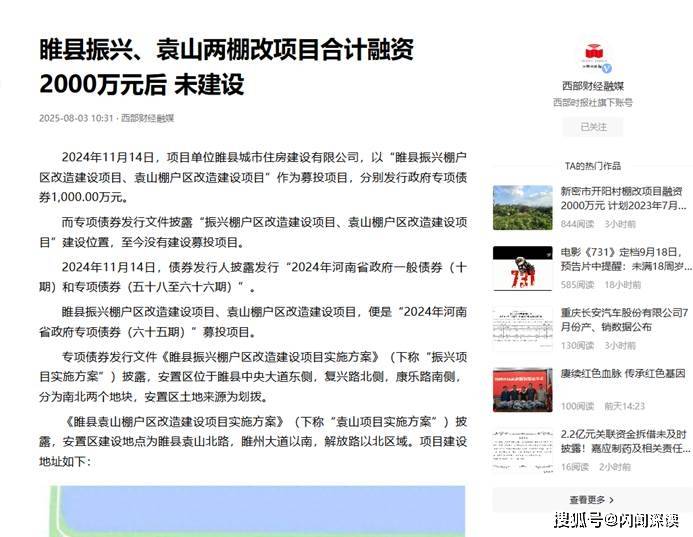
快评丨睢县专项债项目 "开天窗":民生工程岂可沦为数字游戏?
Sou Hu Cai Jing· 2025-08-04 09:30
Core Viewpoint - The issuance of 20 million yuan in special bonds for urban renewal projects in Suixian has not led to any actual construction progress, highlighting deep-seated issues in local government management of special bonds [1][4]. Group 1: Special Bond Management Issues - The special bond funds must be spent within 10 months of issuance, yet the funds from the November 2024 issuance remain idle after over 9 months, violating the monthly expenditure progress requirements set by Henan Province [4]. - The lack of progress in these projects indicates a failure in the preliminary preparation, particularly regarding land acquisition, which often involves complex negotiations [4][5]. - The idle 20 million yuan not only wastes financial resources but may also lead to a reduction in future bond allocations, exacerbating the already tight fiscal situation in Suixian [4]. Group 2: Recommendations for Improvement - There is an urgent need to establish a regulatory framework that integrates funding, projects, and accountability, ensuring that special bond funds are managed and utilized properly [5]. - A thorough review of the preliminary procedures for the projects is necessary, focusing on the completeness of land allocation and environmental assessments [5]. - Immediate special audits should be initiated to uncover the real reasons behind the project stagnation, and accountability measures should be enforced against those responsible for any violations [6].