世界哲学

Search documents
中国马克思主义哲学何以成为世界的?
Xin Lang Cai Jing· 2026-01-18 04:04
Core Viewpoint - The article emphasizes the significance of Chinese Marxist philosophy as a world philosophy that transcends Western-centric views, highlighting its role in addressing global issues and contributing to human civilization [1][2]. Group 1: Theoretical Foundations - Chinese Marxist philosophy integrates Marxist principles with over 5,000 years of Chinese civilization, creating a unique philosophical framework that embodies both "soul" and "root" [2]. - It challenges the notion that philosophy is synonymous with Western philosophy, establishing a new paradigm for non-Western philosophical discourse [1][2]. Group 2: Practical Contributions - The philosophy addresses both "China's questions" and "world's questions," contributing to public wisdom and global discourse on development, governance, and social issues [1][2]. - It has evolved to provide a framework for understanding human progress and global unity, emphasizing the interconnectedness of national and global concerns [1][2]. Group 3: Innovations in Philosophy - The article outlines three main areas of innovation in Chinese Marxist philosophy: 1. **Ontology**: A shift from traditional materialist ontology to a "practice-relationship" ontology, focusing on human existence and well-being [3][4]. 2. **Methodology**: The development of a distinctive cognitive paradigm that integrates dialectical materialism with traditional Chinese thought, creating a "practice-knowledge-repractice" model [5]. 3. **Value Theory**: A transformation of value assessment from capital logic to human-centered logic, establishing a framework for social justice and common human values [6]. Group 4: Global Impact - Chinese Marxist philosophy not only guides China's modernization but also engages in global practices such as the Belt and Road Initiative, promoting a shared human destiny [7]. - It aims to build a global consensus on values, addressing the needs of humanity and fostering dialogue among diverse cultures [7].
展现“当代世界的哲学”的恢弘气象
Xin Lang Cai Jing· 2026-01-11 21:21
Core Viewpoint - The article emphasizes the significance of Chinese Marxist philosophy in breaking the dominance of Western philosophy and establishing a unique philosophical framework that integrates traditional Chinese culture with Marxist principles, thereby contributing to global philosophical discourse [1][2]. Group 1: Theoretical Foundations - Chinese Marxist philosophy has successfully dismantled the perception that philosophy is synonymous with Western philosophy, achieving a systematic critique and creative transformation of Western philosophical thought [1]. - The philosophy addresses both "China's questions" and "world's questions," contributing to public wisdom and positioning itself as a global philosophical entity [1][2]. Group 2: Innovations in Philosophy - The philosophy introduces an innovative ontological paradigm that focuses on "practice-relationship" frameworks, emphasizing human existence and well-being, and promoting the concept of a community of shared human destiny [3]. - A restructured methodology is established, integrating dialectical materialism with traditional Chinese thought, leading to a "practice-knowledge-repractice" model and a dynamic balance approach to contradiction analysis [4]. - The value theory is transformed to prioritize human-centered principles, establishing a dialectical unity between "people's happiness" and "human progress," thus expanding the Marxist value framework [5]. Group 3: Global Implications - Chinese Marxist philosophy not only guides China's modernization but also engages in global practices such as the Belt and Road Initiative, aiming to create a shared global value consensus [6]. - The philosophy embodies the essence of contemporary Chinese culture while contributing to the broader narrative of human civilization, showcasing its relevance in addressing global challenges [6].
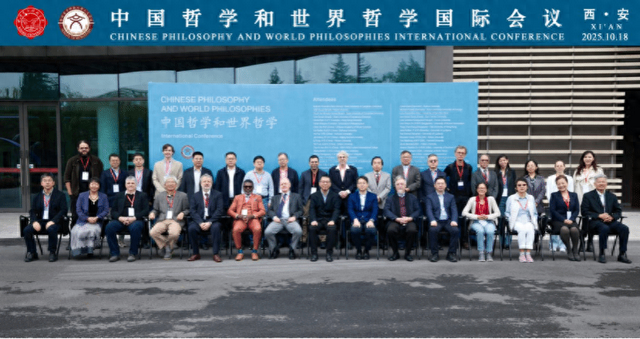
西安电子科技大学成功举办“中国哲学与世界哲学”国际学术研讨会
Huan Qiu Wang· 2025-10-24 09:34
Core Perspective - The international academic seminar "Chinese Philosophy and World Philosophy" aims to promote cultural exchange and respond to the initiative of building a community with a shared future for mankind, held from October 18 to 19 at Xi'an University of Electronic Science and Technology [1] Group 1: Event Overview - The seminar was attended by nearly 40 scholars from 12 countries, highlighting its international significance [1] - The opening ceremony featured speeches from key figures, including Vice President Zhu Wenkai, who emphasized the importance of humanities in fostering moral values and critical thinking in a technology-focused university [3] Group 2: Discussion Themes - Scholars engaged in discussions on breaking the Western-centric philosophical paradigm and exploring the value of non-Western philosophies, particularly Chinese philosophy [4] - Notable participants included prominent philosophers and academics from various universities, who presented keynote speeches and participated in parallel forums [4] Group 3: Philosophical Insights - There is a consensus among scholars that the existing Western-centric philosophical narratives need to be revised, advocating for greater representation of Chinese philosophy [5] - The core concepts of Confucianism, such as "Ren" and "Li," are seen as beneficial for alleviating international tensions, while Daoist ideas emphasize harmony with nature to address environmental crises [5] Group 4: Future Directions - The seminar has enhanced the influence of the Philosophy Department at Xi'an University of Electronic Science and Technology within the global philosophical community [6] - The Humanities College plans to continue promoting international academic exchanges to contribute to the prosperity of Chinese philosophy and social sciences [6]