世界级港口群

Search documents
5年后长三角会是啥样?全在这里了
Xin Lang Cai Jing· 2026-01-20 00:25
Core Viewpoint - The article discusses the development strategies and economic goals of the Yangtze River Delta (YRD) region during the 14th and 15th Five-Year Plans, highlighting the collaborative efforts of Shanghai, Jiangsu, Zhejiang, and Anhui to achieve high-quality growth and integration [3][5][6]. Economic Performance - Shanghai's economic total ranks among the top five global cities, with a projected GDP nearing 7 trillion yuan by 2025 [3][6]. - Jiangsu aims to exceed 14 trillion yuan by 2025, showcasing significant growth potential [3]. - Zhejiang's GDP is expected to surpass 9 trillion yuan, with per capita GDP projected to exceed 140,000 yuan [3]. - Anhui has reached a new milestone of 5 trillion yuan, indicating its emerging role in the YRD [3]. Long-term Economic Goals - By 2035, Shanghai aims to double its per capita GDP compared to 2020 levels [6]. - Jiangsu targets higher per capita GDP and income levels by 2035 [6]. - Zhejiang plans to reach per capita GDP levels comparable to developed economies by 2035 [6]. - Anhui's goal is to align its per capita GDP with the national average by 2035 [6]. Key Development Areas - The integration of technology and industry innovation is emphasized as a critical focus for the YRD [8][10]. - The construction of world-class airport and port clusters is highlighted as essential for regional connectivity and economic growth [16][19]. - The YRD aims to establish itself as a global leader in high-end industrial clusters, particularly in the aviation sector [21]. Collaborative Efforts - The article underscores the importance of collaboration among the four regions to enhance their competitive advantages and achieve common goals [9][11]. - The concept of "urban agglomeration" is frequently mentioned, indicating a focus on developing interconnected metropolitan areas [13][15]. - The YRD is recognized as a world-class urban cluster, with plans for further integration and development of urban spaces [14]. Infrastructure Development - The YRD is advancing its transportation infrastructure, including high-speed rail and airport facilities, to improve regional connectivity [16][17]. - The construction of the "North Along the Yangtze River High-Speed Railway" is a significant project aimed at enhancing travel efficiency within the region [17]. Innovation and Technology - The establishment of an international technology innovation center in the YRD is a priority, with Shanghai leading the initiative [9][10]. - Jiangsu and Zhejiang are also committed to fostering technological advancements and industrial innovation [10][11].


河北:“十五五”期间基本建成高效协同的津冀世界级港口群
Zhong Guo Xin Wen Wang· 2026-01-13 09:26
Group 1 - The core focus of Hebei's "14th Five-Year Plan" is to enhance the modern comprehensive transportation system, aiming to develop a highly efficient and collaborative port cluster in the Tianjin and Hebei region, with a port throughput capacity reaching 1.35 billion tons [1] - Hebei plans to optimize the highway network layout in the Xiong'an New Area, completing projects such as the second phase of the Rongwu Expressway and the second phase of the Jingde Expressway, to achieve efficient connectivity of the road network [1] - The province aims to integrate deeply into the world-class airport cluster in the Beijing-Tianjin-Hebei region, with passenger and cargo throughput capacities projected to reach 29.8 million and 249,000 tons respectively [2] Group 2 - Hebei will strengthen the optimization of the transportation airport layout, constructing a convenient air service network, including the expansion of Shijiazhuang Zhengding International Airport, to establish a world-class airport cluster [2] - An investment of 123 billion RMB is planned for 2026 to enhance the construction of highways, ports, and railways, focusing on improving the comprehensive transportation network [2]
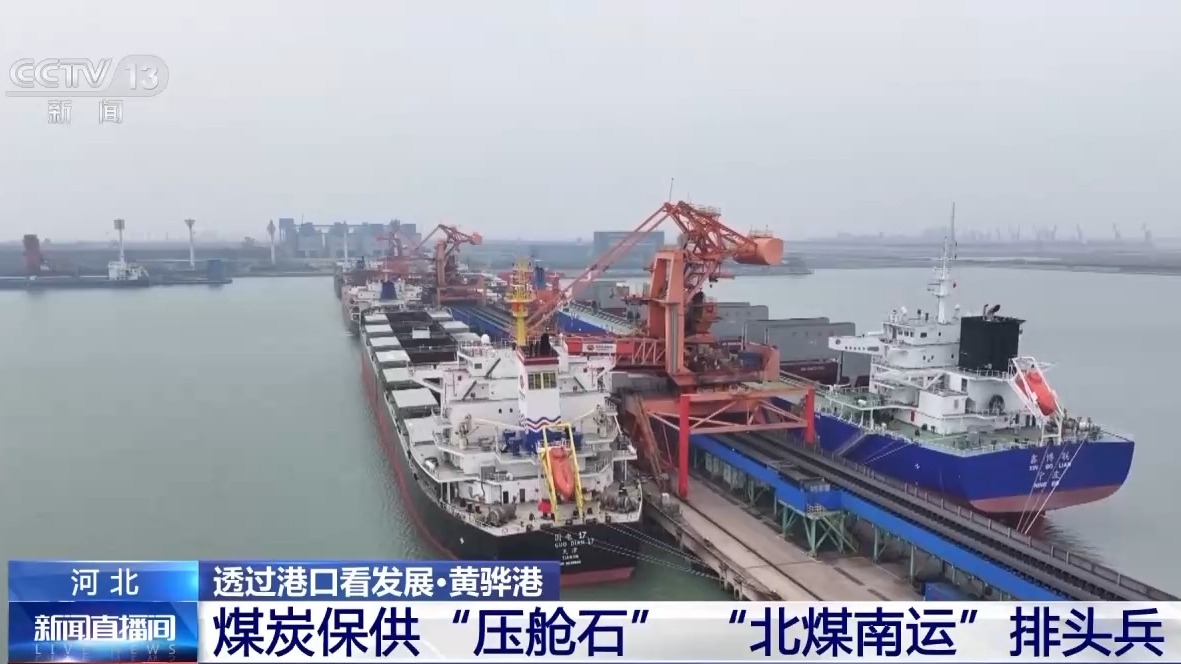
传统港→智慧绿色港 河北如何打造世界级港口群?
Yang Shi Xin Wen Ke Hu Duan· 2025-06-17 06:17
Core Viewpoint - Hebei province is enhancing its port capabilities, particularly at Huanghua Port, to adapt to international trade fluctuations and improve service efficiency in the economy [1][19]. Port Operations and Innovations - Huanghua Port features an automated coal unloading system that can process four carriages in 20 seconds without worker intervention, showcasing advancements in operational efficiency [3][5]. - The port has achieved a coal throughput of 88.2 million tons in the first five months of this year, establishing itself as a critical hub in China's energy supply chain [5][19]. - The ongoing Phase V expansion project will add 18 coal storage silos and four 70,000-ton bulk cargo berths, increasing annual coal transport capacity by 53.1 million tons [7][9]. Transition to a Comprehensive Port - Huanghua Port is transitioning from a coal-centric port to a comprehensive port, aiming to enhance its operational capabilities and embrace smart, green port technologies [10][12]. - The port currently has 47 operational berths, including those for bulk, liquid, and container cargo, positioning it as a modern logistics center for the region [12][20]. Regional Port Development - Hebei province aims to develop a world-class port cluster, with Qinhuangdao, Tangshan, and Huanghua ports each focusing on different functional roles and resource integration [20][22]. - Tangshan Port is projected to handle over 860 million tons of cargo by 2024, while Huanghua Port is enhancing its coal and crude oil handling capabilities [22][24]. - The province has established 118 inland ports and 47 sea-rail intermodal routes, creating a multi-modal transport network that connects inland regions to the ports [24]. Technological Advancements - The implementation of smart production systems at Huanghua Port has reduced process preparation time by 23%, facilitating faster cargo movement [17][19]. - The port's operational model has shifted from human-controlled to autonomous management, enhancing overall efficiency [16].