
中医体质分类与判定

Search documents
四分钟读懂你的“体质密码”
Xin Lang Cai Jing· 2026-02-25 17:54
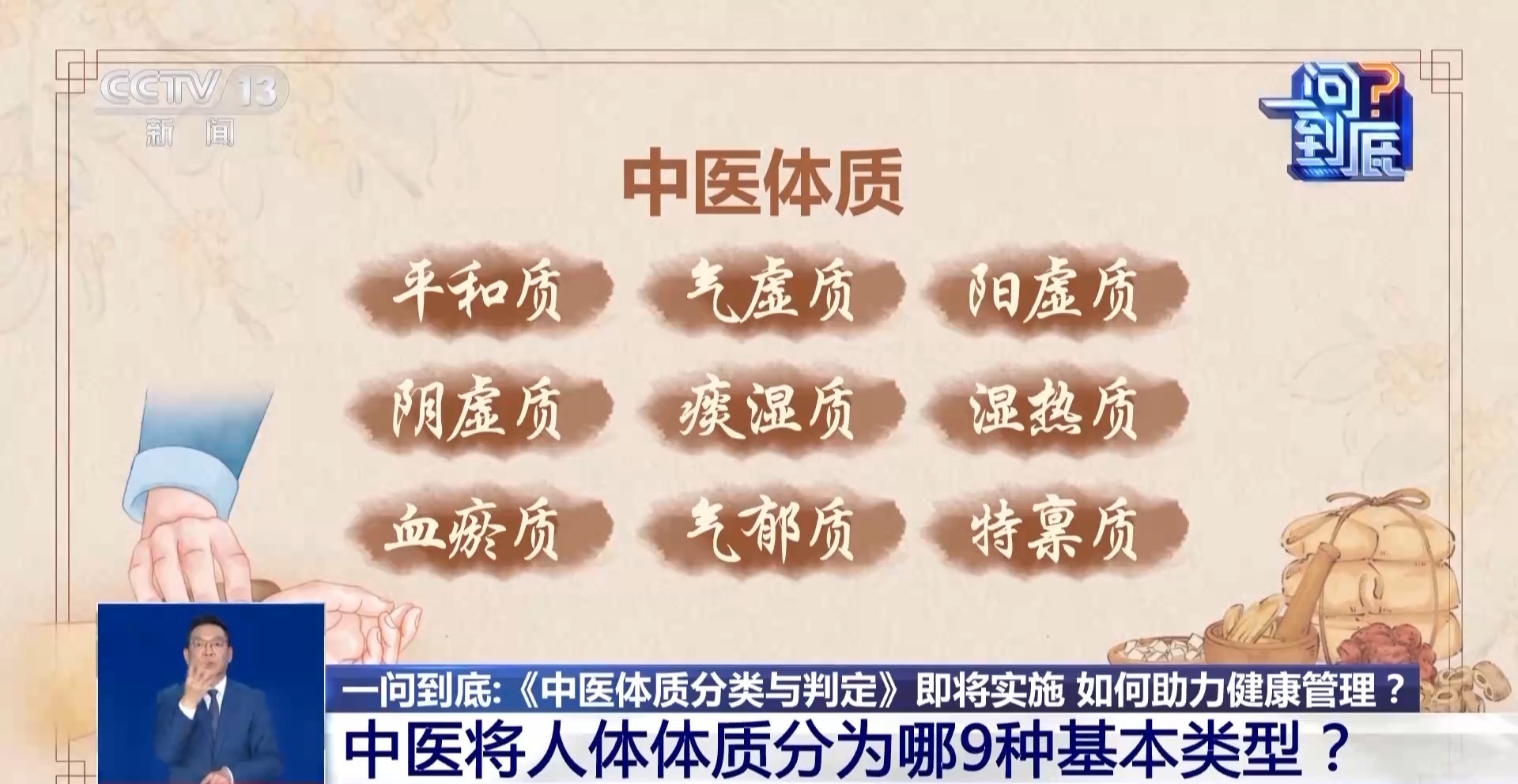
Core Viewpoint - The newly approved national standard for Traditional Chinese Medicine (TCM) body constitution classification aims to enhance health management by identifying individual health risks and promoting personalized health strategies [1][6]. Group 1: Body Constitution Classification - TCM categorizes body constitution into nine basic types, each with distinct characteristics, such as "平和质" (Balanced Constitution), "气虚质" (Qi Deficiency), and "湿热质" (Damp-Heat Constitution) [2][3]. - The classification is based on principles like genetic predisposition, life stage variations, and environmental influences, indicating that body constitution is not static and can change over time [3][4]. Group 2: Standardization and Efficiency - The new national standard introduces a standardized questionnaire for body constitution identification, significantly improving the efficiency of the process, with an average completion time of 4.23 minutes [4][5]. - The questionnaire consists of 27 items covering lifestyle, exercise habits, and medical history, allowing for a more systematic approach to body constitution assessment [4]. Group 3: Health Management Implications - The classification system supports a shift in health management from "treating existing diseases" to "preventing diseases," facilitating early detection and personalized health recommendations [6][7]. - It serves as a tool for community health screening, enabling targeted health education and early prevention strategies for specific body constitution types [7]. - The body constitution identification is integrated into national health strategies, contributing to public health planning and potentially reducing healthcare costs through early intervention [7].
一问到底丨《中医体质分类与判定》即将实施 如何助力健康管理?
Yang Shi Wang· 2026-02-05 22:19
Core Viewpoint - The newly approved national standard "Classification and Judgment of Traditional Chinese Medicine Constitution" aims to enhance health management by categorizing individuals into nine basic constitution types, which can help tailor health and wellness strategies for better personal health outcomes [1][12]. Group 1: Classification of Body Constitutions - Traditional Chinese Medicine categorizes human constitution into nine types: 1. Harmonious constitution: Energetic and healthy 2. Qi deficiency constitution: Poor immunity, prone to fatigue 3. Yang deficiency constitution: Cold extremities, intolerance to cold 4. Yin deficiency constitution: Lack of moisture, heat in palms and soles 5. Phlegm-damp constitution: Overweight, oily skin 6. Damp-heat constitution: Prone to acne, bad breath 7. Blood stasis constitution: Thick blood, forgetfulness 8. Qi stagnation constitution: Fragile, often depressed 9. Special constitution: Prone to allergies [3][5]. Group 2: Implementation of the New Standard - The new standard, effective from April 1, aims to provide a standardized method for identifying body constitution across various sectors, including healthcare and public health [6][12]. - The identification method has been streamlined from 60 questions to 27, reducing the average completion time from 11.6 minutes to 4.23 minutes, thus improving efficiency [8][10]. Group 3: Research Basis and Validation - The new standard is based on extensive epidemiological studies, with nearly 400,000 cases analyzed, enhancing the clarity of the relationship between body constitution and certain diseases [11]. - The improved algorithm and reduced identification time signify a significant advancement over the previous 2009 standard [11]. Group 4: Impact on Public Health - The implementation of this standard is expected to shift health management from general recommendations to precise, tailored health solutions, making personalized wellness plans a new trend in health consumption [12][13]. - The standardization of body constitution classification is anticipated to elevate public health literacy and optimize health service models, contributing to the national strategy of disease prevention [13].

去年刑事案件为本世纪以来最低 上月各线城市商品房售价总体下降
Xin Lang Cai Jing· 2026-01-26 06:30
Group 1: Criminal Justice and Public Safety - The number of criminal cases nationwide decreased by 12.8% year-on-year, marking the lowest level since the beginning of the century [1] - The national sense of security among the public is projected to reach 98.23% by 2025, maintaining above 98% for six consecutive years [1] - Significant achievements in combating telecom and internet fraud, with 57,000 criminals repatriated and the head of a gambling fraud group apprehended [1] - Drug-related crimes saw a historic decline, with the number of drug users down by 63% since the end of 2020 [1] Group 2: Judicial System and Credit Repair - In 2025, over 37 million judicial execution cases were accepted, with a year-on-year increase of over 10% [1] - The number of criminal cases and defendants in first-instance criminal cases decreased, while civil and commercial cases increased by over 11% [1] - The number of credit repairs exceeded the number of new entries into the dishonesty list for seven consecutive quarters, aiding many businesses in resuming normal operations [1] Group 3: Environmental and Industrial Policy - Five departments issued guidelines for the construction of zero-carbon factories, emphasizing technological innovation and management optimization to reduce CO2 emissions [4] - The initiative will prioritize industries with urgent decarbonization needs and gradually expand to sectors with higher carbon intensity by 2030 [4] Group 4: Economic Indicators - In 2025, China's GDP reached 14,018.79 billion yuan, growing by 5.0% year-on-year [8] - The first, second, and third industries saw respective growth rates of 3.9%, 4.5%, and 5.4% [8] - The per capita disposable income for residents was 43,377 yuan, also reflecting a nominal growth of 5.0% [8] Group 5: Real Estate Market - In December 2025, new residential sales prices in first-tier cities fell by 0.3% month-on-month, while second and third-tier cities saw declines of 0.4% [8] - Year-on-year, new residential prices in first-tier cities decreased by 1.7%, with second and third-tier cities experiencing declines of 2.5% and 3.7% respectively [8] - Second-hand residential prices in first-tier cities dropped by 7.0% year-on-year, with notable declines in major cities like Beijing and Shanghai [8]

中医体质分类与判定国家标准首次制定发布
Yang Shi Xin Wen· 2026-01-19 03:08
Core Viewpoint - The approval and implementation of the national standard "Classification and Determination of Traditional Chinese Medicine (TCM) Constitution" marks a new phase of standardization and normalization in TCM constitution studies, providing strong support for enhancing public health literacy and optimizing health service models [1][2]. Group 1: Standard Features - The standard defines the characteristics of nine basic types of TCM constitution and the criteria for classification, which includes a comprehensive coverage of application scenarios across medical, public health, research, education, and health industries [2]. - The classification is based on the latest research results from 2009 to 2024, reflecting the most recent findings in TCM constitution studies, particularly for types such as平和质 (Balanced Constitution), 气虚质 (Qi Deficiency Constitution), 阳虚质 (Yang Deficiency Constitution), and others [2]. - A standardized identification method is established, simplifying the complex classification process by selecting typical symptoms associated with different constitutions and matching them with a scoring algorithm, thus promoting the identification and application of TCM constitution [2].