中国式养老事业

Search documents
经济日报财经早餐【1月9日星期五】
Jing Ji Ri Bao· 2026-01-08 23:25
Group 1 - The Ministry of Commerce reported that since the implementation of the old-for-new consumption policy in 2024, related product sales have reached 3.92 trillion yuan, benefiting 494 million people [2] - The Ministry of Natural Resources announced new progress in mineral resource exploration, with breakthroughs in chrome ore and unconventional oil and gas exploration [2] - The China Futures Association reported that the cumulative trading volume of the national futures market in 2025 reached 9.074 billion contracts, with a cumulative transaction value of 76.625 trillion yuan, representing year-on-year increases of 17.4% and 23.74% respectively [2] Group 2 - The National Development Bank plans to invest nearly 20 billion yuan in 2025 to support the development of China's elderly care industry and the silver economy [3] - The State Medical Insurance Administration issued a notice to promote convenient payment systems, aiming to establish a comprehensive medical insurance payment system within three years [3] - The National Health Commission and 13 other departments released a plan to address five key issues affecting children and adolescents, including obesity and mental health, with specific targets and responsibilities outlined [3]
货币市场日报:1月8日
Xin Lang Cai Jing· 2026-01-08 12:49
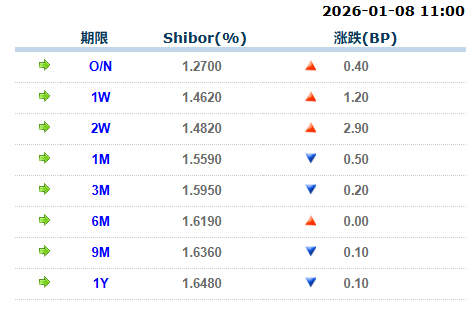
Group 1: Monetary Policy and Market Operations - The People's Bank of China conducted a 99 billion yuan reverse repurchase operation with a rate of 1.40%, maintaining the previous level, resulting in a net injection of 99 billion yuan into the market as there were no reverse repos maturing on that day [1] - The Shanghai Interbank Offered Rate (Shibor) for short-term instruments saw a slight increase, with overnight Shibor rising by 0.40 basis points to 1.2700%, 7-day Shibor up by 1.20 basis points to 1.4620%, and 14-day Shibor increasing by 2.90 basis points to 1.4820% [1] Group 2: Interbank Repo Market - In the interbank pledged repo market, short-term funding rates continued to fluctuate within a narrow range, with overnight rates increasing in both volume and price. The weighted average rates for DR001 and R001 rose by 0.2 basis points and 0.6 basis points, respectively, to 1.2695% and 1.3424%, with transaction volumes increasing by 3,121 billion yuan and 1,455 billion yuan [4] - The weighted average rates for DR007 and R007 showed mixed movements, with DR007 rising by 1.2 basis points to 1.474% while R007 fell by 0.6 basis points to 1.5261%, with transaction volumes decreasing by 176 billion yuan and 648 billion yuan, respectively [4] Group 3: Market Sentiment and Trading Activity - Overall, the funding environment on January 8 was balanced, with major banks lending out funds and non-bank overnight transactions occurring at rates around 1.45%. The market maintained stability post-open market operations, with overnight rates fluctuating between 1.30% and 1.42% [9] - In the secondary market for negotiable certificates of deposit, trading sentiment was generally moderate, with 1-month, 3-month, and 6-month maturities experiencing active trading. The 1-month national bank rate closed at approximately 1.54%, unchanged from the previous day, while the 3-month rate decreased by about 1 basis point to 1.60% [10]

“十五五”时期养老金融的机遇与对策|财富与资管
清华金融评论· 2025-12-29 10:39
Group 1 - The article emphasizes the need to accelerate structural transformation in the pension finance sector to provide social security for people's livelihoods, aligning with the national strategy to enhance the multi-tiered pension insurance system [2][3][4] - The aging population and declining birth rates pose significant challenges to the economy, necessitating a comprehensive and systematic approach to reform and innovation in pension finance to address these issues [3][5][6] - The article highlights that pension finance is crucial for promoting common prosperity and should be integrated with various social resources to enhance services in education, healthcare, and social security [5][6][7] Group 2 - The article discusses the importance of innovation in pension finance services to optimize the livelihood sector and provide new momentum for economic structural transformation [7][8] - It points out that the inadequacy of the social security system is a major factor hindering the release of consumer potential, with China's consumption rate remaining around 40%, significantly lower than that of developed economies [9] - The article suggests that improving the social security system is essential for transitioning to a consumption-driven economy, with pension finance playing a foundational role in this process [9]

养老金融助力中国式养老事业和银发经济发展 | 财富与资管
清华金融评论· 2025-05-28 10:14
Core Viewpoint - The silver economy is a necessary response to population aging and an important aspect of cultivating new economic momentum, emphasizing the need for high-quality development in pension finance to support China's unique pension system and silver economy [1][2]. Group 1: Importance of Pension Finance - Pension finance is defined as a series of financial activities that support the development of the silver economy, which is crucial for promoting a virtuous cycle of high-quality development in China's financial and pension sectors [2]. - The development of pension finance can enhance the wealth accumulation and consumption capacity of the elderly, provide financing and credit support to enterprises, and promote supply-demand balance through innovative pension service and product models [2]. Group 2: Challenges in the Silver Economy - The supply of pension products and services is inadequate, with a significant gap between the growing demand due to rapid population aging and the current supply capabilities [5]. - The quality of pension products and services needs improvement, as the diverse and layered demands of the elderly are not being met by the relatively uniform supply [5][6]. Group 3: Supply-Side Issues - The reasons for the lag in the development of the pension product and service supply system include the short time and rapid pace of entering an aging society, insufficient recognition of elderly needs by supply entities, and high entry barriers for market participants [6]. Group 4: Demand-Side Issues - There is a significant gap between the actual demand for pension services and the effective demand of the elderly, primarily due to income and consumption level limitations [7][8]. - The overall wealth accumulation of the elderly is insufficient, with a high dependency on pension income and an imbalance in the pension insurance system, leading to limited financial resources available for pension services [8].