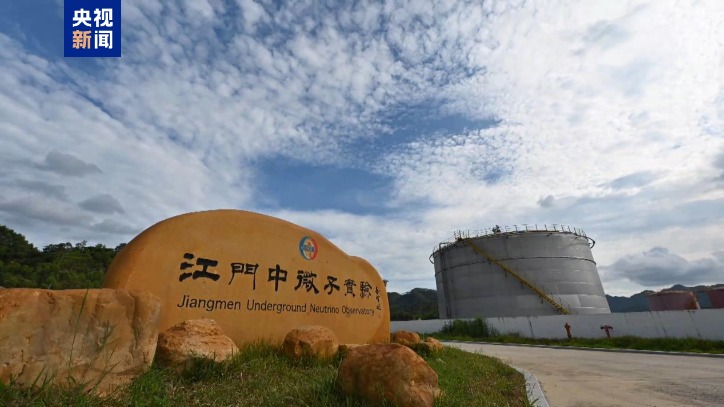
中微子质量顺序

Search documents
于泽源:潜心科研,提升中微子振荡参数测量精度
Ren Min Ri Bao· 2026-01-07 06:39
Core Insights - The article emphasizes the importance of foundational research, advocating for strategic, forward-looking, and systematic investments in this area to enhance long-term support [1] Group 1: Neutrino Research Significance - The Jiangmen Neutrino Experiment, which began over a decade ago, aims to measure neutrino oscillation with unprecedented precision, addressing the mystery of neutrino mass ordering [2][4] - The experiment is a collaborative international project involving over 700 researchers from 17 countries, highlighting the global nature of scientific inquiry [3][6] Group 2: Technological Innovations - A novel method was developed to measure liquid levels in the experiment, improving accuracy by approximately 100 times compared to traditional techniques, which significantly boosted team confidence [3] - The experiment's first physical results, released in November 2025, demonstrated a 1.5 to 1.8 times improvement in the measurement precision of neutrino oscillation parameters, confirming the detector's performance met design expectations [3][6] Group 3: Future Directions and Applications - The Jiangmen Neutrino Experiment is designed for a lifespan of 30 years, with plans to continue exploring neutrino properties and their implications for understanding fundamental cosmic laws [4][6] - Research on neutrinos is expected to yield insights into various fields, including geoscience and astrophysics, potentially leading to groundbreaking discoveries [4][5]
江门中微子实验发布首个科研成果
Xin Hua She· 2025-11-19 06:25
Core Insights - The Jiangmen Underground Neutrino Observatory (JUNO) has achieved its first physical results, measuring two parameters related to neutrino oscillation with an accuracy improved by 1.5 to 1.8 times compared to previous experiments [2][3] - The JUNO project, proposed by the Chinese Academy of Sciences in 2008, officially commenced operations on August 26, 2023, and is recognized as the world's first large-scale, high-precision neutrino experiment [2] - The project involves over 700 researchers from 75 institutions across 17 countries and regions, showcasing China's commitment to international scientific collaboration [2] Project Details - The JUNO collaboration has successfully analyzed data from August 26 to November 2, 2023, leading to the high-precision measurement of solar neutrino oscillation parameters [3] - The performance of the JUNO detector has met or exceeded design expectations, allowing for rapid determination of neutrino mass ordering and testing of the three types of neutrino oscillation frameworks [3] - The success of JUNO is seen as a significant milestone reflecting the dedication and creativity of the international team involved in the project [3]

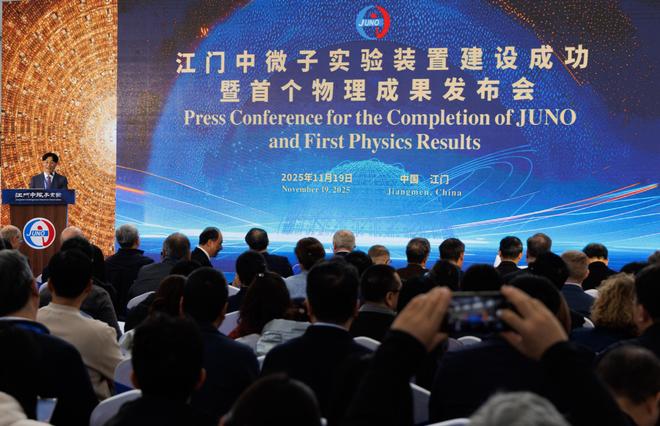
“幽灵粒子”探测精度世界第一!江门中微子实验重大成果发布
Nan Fang Du Shi Bao· 2025-11-19 04:40
Core Insights - The Jiangmen Underground Neutrino Observatory (JUNO) has successfully completed its construction and announced its first scientific results, measuring solar neutrino oscillation parameters with an accuracy improved by 1.5 to 1.8 times compared to previous experiments [1][4][6]. Group 1: Project Overview - JUNO is the first large-scale, high-precision neutrino experiment of its kind, designed to detect elusive neutrinos, often referred to as "ghost particles" [1][3]. - The project is a significant international collaboration involving over 700 researchers from 75 institutions across 17 countries and regions [8][11]. - The observatory is set to officially begin data collection on August 26, 2025, after a series of construction and installation phases that began in 2008 [11]. Group 2: Scientific Achievements - The first physical results from JUNO were derived from data collected over 59 days, confirming the solar neutrino oscillation parameters and addressing the previously noted "solar neutrino anomaly" [6][9]. - The experiment's design allows for simultaneous measurement of both solar and reactor neutrinos, which could provide insights into new physics beyond the current particle physics framework [6][11]. - The core detector, with an effective mass of 20,000 tons, is designed to achieve unprecedented sensitivity in neutrino detection, focusing on neutrino mass ordering and oscillation parameters [11]. Group 3: Future Prospects - JUNO is expected to produce significant scientific results over the next few decades and contribute to the training of a new generation of physicists [11]. - The facility has a design lifespan of 30 years and can be upgraded to become the world's most sensitive experiment for neutrinoless double beta decay, potentially probing the absolute mass of neutrinos [11].
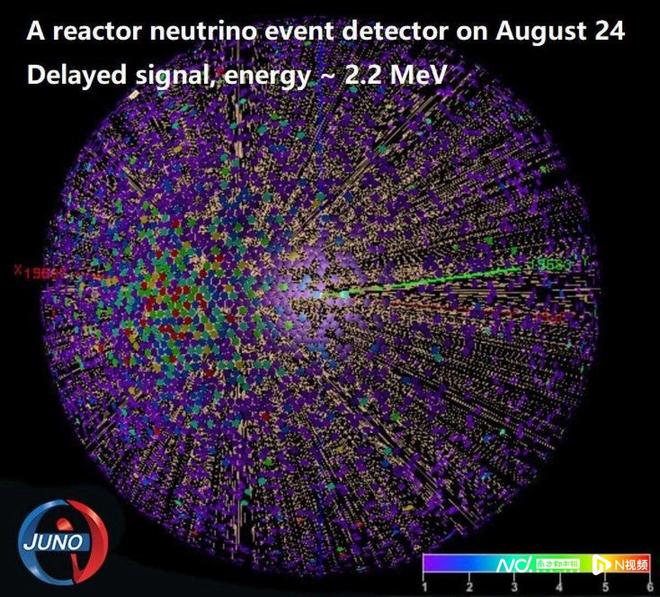
新华鲜报|捕捉“幽灵粒子” 江门中微子实验测量精度创新高
Xin Hua She· 2025-11-19 03:10
Core Insights - The Jiangmen Neutrino Experiment has successfully measured two parameters describing neutrino oscillation with a precision 1.5-1.8 times better than previous experiments, marking a significant advancement in neutrino research [1][2] - The experiment's performance has met or exceeded design expectations, bringing humanity closer to determining the mass hierarchy of neutrinos [1] Group 1: Experiment Overview - The Jiangmen Neutrino Experiment is designed to capture "ghost particles" known as neutrinos, utilizing a detector that contains 20,000 tons of liquid scintillator housed in the world's largest organic glass sphere, increasing the volume by 20 times compared to existing facilities [2] - The experiment has been operational for two months, analyzing data from August 26 to November 2, totaling 59 days of effective data collection [1] Group 2: Scientific Significance - Neutrinos are fundamental particles that play a crucial role in understanding the evolution of the universe, yet they are extremely difficult to detect due to their minuscule mass and weak interaction with matter [1] - The project team aims to collaborate closely with global scientists to produce original scientific results with significant impact [3]
大国重器传来好消息!江门中微子实验首个重大成果发布
Yang Shi Xin Wen· 2025-11-19 03:02
Core Insights - The Jiangmen Neutrino Experiment has officially commenced operations, marking a significant milestone in scientific research [1] - The experiment confirmed the existence of the solar neutrino anomaly, achieving a measurement precision improvement of 1.5 to 1.8 times compared to previous international experiments [3][5] - The primary scientific goal is to resolve a major issue in particle physics: the mass ordering of neutrinos, which could open new avenues for exploring the unknown physical world [5] Experiment Overview - The Jiangmen Neutrino Experiment was proposed by the Institute of High Energy Physics, Chinese Academy of Sciences in 2008, with construction starting in 2015 and completion in December 2021 [8] - The core detector has an effective mass of 20,000 tons and is located 44 meters underground, featuring a stainless steel shell and various key components for detecting neutrino interactions [8] Future Prospects - As the world's first large-scale, high-precision neutrino facility, the Jiangmen Neutrino Experiment is expected to facilitate cutting-edge research on neutrinos from various cosmic sources [11] - The facility has a design lifespan of 30 years and can be upgraded to become the most sensitive experiment for neutrinoless double beta decay, potentially addressing critical questions in particle physics, astrophysics, and cosmology [11]