中心化金融

Search documents
“币圈历史最大惨案”:币安宕机 稳定币USDe脱锚与惨烈的“铁索连舟”
Hua Er Jie Jian Wen· 2025-10-13 00:38
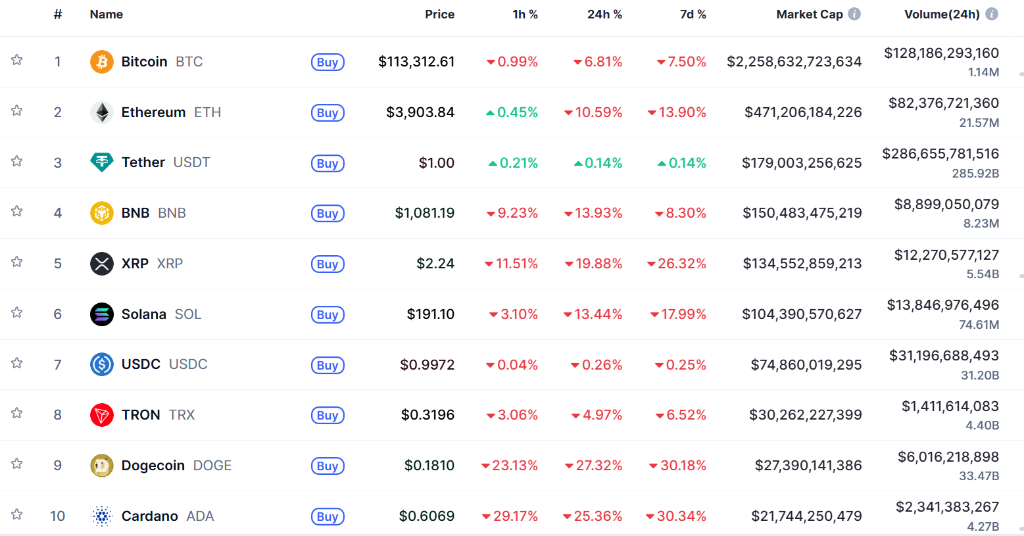
Core Insights - The recent tweet by President Trump regarding tariff threats triggered a significant sell-off in the cryptocurrency market, leading to a loss of nearly $800 billion in market capitalization and marking one of the largest liquidation events in crypto history [1][2][3] Market Reaction - Bitcoin's price fell from over $126,000 to below $110,000, experiencing a drop of 13.5% in one day, while Ethereum dropped over 17% and other altcoins like Ripple and Dogecoin saw declines exceeding 30% [1][2] - Over $20 billion in leveraged positions were liquidated, with more than $5.5 billion disappearing in just a few minutes [1][7] Centralized Exchange Issues - During the market turmoil, several centralized exchanges (CEX), including Binance, faced severe system delays and outages, preventing users from executing orders or managing positions, which exacerbated losses [1][8][13] - Users expressed anger on social media, accusing Binance of failing to provide necessary liquidity and stability during critical moments [2][13] Market Structure and Risks - The cryptocurrency market was characterized by high leverage and a significant amount of open contracts, creating a precarious environment that was susceptible to external shocks like Trump's tweet [3][5] - The cascading effect of forced liquidations led to a "waterfall effect," where one liquidation triggered another, further driving down prices [9] Decentralized Finance (DeFi) Performance - In contrast to centralized exchanges, decentralized finance (DeFi) platforms like Uniswap and Aave managed to operate smoothly during the crisis, handling significant volumes without technical issues [10] - Aave processed $180 million in liquidations without human intervention, highlighting the resilience of DeFi compared to centralized platforms [10] Allegations of Market Manipulation - There are theories suggesting that the crash was not merely a market reaction but a coordinated attack exploiting vulnerabilities in Binance's unified margin system, which allowed for the mixing of various assets as collateral [11][13] - The global third-largest stablecoin, USDe, experienced severe de-pegging on Binance, dropping to $0.65 while maintaining a price of $0.90 on other platforms, raising concerns about potential market manipulation [11][13] Regulatory Implications - The incident has reignited discussions about the risks associated with centralized versus decentralized financial systems, with calls for regulatory scrutiny of centralized exchanges like Binance [15][17] - Binance acknowledged the issues caused by "extreme market activity" and assured users that their funds were safe, but the trust in centralized platforms remains shaken [15][17]

一个帖子引发的“币圈历史最大惨案”:币安宕机,“第三大稳定币”脱锚与惨烈的“铁索连舟”
美股IPO· 2025-10-12 16:38
Core Viewpoint - The article discusses the recent turmoil in the cryptocurrency market, highlighting the failures of centralized exchanges like Binance during a critical liquidity crisis, which led to significant market losses and raised questions about the reliability of centralized versus decentralized finance systems [1][4][16]. Group 1: Market Reaction and Impact - On a recent Friday, a tweet from former President Trump regarding tariff threats triggered a severe sell-off in the cryptocurrency market, causing Bitcoin to drop from over $126,000 to below $110,000, with a daily decline of 13.5% [3][7]. - The total market capitalization of cryptocurrencies evaporated by nearly $800 billion within hours, with over $20 billion in leveraged positions liquidated, marking one of the largest liquidation events in cryptocurrency history [3][12]. Group 2: Centralized Exchange Failures - During the market crash, several centralized exchanges, including Binance, experienced significant system delays and outages, preventing users from executing trades or managing positions, which exacerbated their losses [1][13][22]. - Users expressed outrage on social media, accusing Binance of failing to provide necessary liquidity and stability during a critical time, leading to a trust crisis for centralized exchanges [4][21]. Group 3: The Nature of the Crash - The article suggests that the crash was not merely a market reaction but potentially a targeted attack exploiting vulnerabilities in Binance's unified margin system, which allowed for the mixing of various assets as collateral [5][17]. - The cascading effect of forced liquidations was described as a "waterfall effect," where the decline in asset prices triggered further liquidations, leading to a rapid downward spiral in the market [11][9]. Group 4: Comparison with Decentralized Finance - In contrast to the failures of centralized exchanges, decentralized finance (DeFi) platforms like Uniswap and Aave managed to operate smoothly during the market turmoil, processing significant volumes without technical issues [16]. - This performance disparity has reignited discussions about the risk management capabilities of centralized versus decentralized financial systems [27]. Group 5: Regulatory and Community Response - Following the incident, there were calls for regulatory investigations into Binance's operations, as this was not the first time the exchange faced criticism for similar issues [24][26]. - Despite Binance's assurances that user funds were safe and that their systems had been restored, community dissatisfaction remains high, with many users demanding accountability [23][24].

币圈遭历史最大爆仓
Bei Jing Shang Bao· 2025-10-12 15:13
Market Overview - The cryptocurrency market experienced a significant liquidation event over the past weekend, with Bitcoin dropping to $109,992, a nearly 3% decline within 24 hours, while Ethereum fell over 3% to $3,719 [1] - Other cryptocurrencies faced even larger declines, with XRP down 4.83%, Solana down 7.32%, Dogecoin down over 8%, and Cardano down 6.58% [1] Causes of the Market Crash - Analysts attribute the recent cryptocurrency turmoil to U.S. President Trump's latest tariff comments, which heightened global market risk aversion, prompting investors to sell off risk assets [2] - Bitcoin plummeted from $122,000 to $103,900, a nearly 15% drop, while other cryptocurrencies like Ethereum, XRP, and Dogecoin saw declines exceeding 20% [2] Liquidation Statistics - The total liquidation across the cryptocurrency market reached $19.141 billion, marking the largest forced liquidation wave since early April, affecting over 1.6 million traders [2] - The largest single liquidation occurred on the Hyperliquid platform, involving an ETH-USDT contract worth $203 million [2] USDe Stablecoin Incident - The USDe stablecoin, the third-largest globally with a market cap exceeding $12 billion, experienced a significant de-pegging event, dropping to as low as $0.65 [3] - This incident coincided with a broader market crash, leading to a simultaneous decline in various wrapped tokens [3] Exchange Performance and Criticism - Centralized exchanges like Binance faced technical issues during the peak of the liquidation, leading to delays and trading interruptions, which exacerbated user losses [3] - The situation has reignited debates about the risk management capabilities of centralized versus decentralized finance (DeFi) platforms [3] Market Sentiment and Predictions - A trader known for accurately predicting the 2022 cryptocurrency crash warned that the recent downturn may be a precursor to a new "black swan" event, indicating ongoing market uncertainty [4] - The trader noted that while altcoins have experienced significant declines, major cryptocurrencies have not yet completed their deep corrections [4] Future Outlook - The sustainability of Bitcoin's price increase is heavily dependent on macroeconomic conditions and developments in trade [5] - Deutsche Bank predicts that by 2030, Bitcoin and gold may become significant components of central bank reserve assets, as the share of U.S. dollar reserves declines [5]
一个帖子引发的“币圈历史最大惨案”:币安宕机,“第三大稳定币”脱锚与惨烈的“铁索连舟”
Hua Er Jie Jian Wen· 2025-10-12 09:46
Core Insights - The recent tweet by President Trump regarding tariff threats triggered a significant sell-off in the cryptocurrency market, leading to a loss of nearly $800 billion in market capitalization within hours [1][2] - Major cryptocurrencies like Bitcoin and Ethereum experienced drastic price drops, with Bitcoin falling 13.5% and Ethereum dropping over 17% [1] - The event is described as one of the largest liquidation events in cryptocurrency history, with over $20 billion in leveraged positions being liquidated [1][7] Market Reaction - The cryptocurrency market was already in a precarious state, characterized by high leverage and a significant amount of low-quality tokens, which diluted liquidity [3][5] - The sell-off was exacerbated by automated liquidation mechanisms triggered when prices fell below critical support levels, leading to a cascading effect of forced liquidations [5][9] Exchange Performance - Centralized exchanges (CEX) like Binance faced severe technical issues during the market turmoil, including system delays and order execution failures, which further amplified user losses [8][14] - In contrast, decentralized finance (DeFi) platforms like Uniswap and Aave managed to operate smoothly without technical disruptions, highlighting a stark difference in performance under stress [10] Allegations and Theories - There are allegations that the market crash was not merely a result of market behavior but rather a coordinated attack exploiting vulnerabilities in Binance's unified margin system [2][11] - The global third-largest stablecoin, USDe, experienced significant de-pegging, dropping to $0.65 on Binance while maintaining a higher value on other platforms, suggesting potential market manipulation [11][14] User Sentiment - User dissatisfaction with Binance has surged, with many reporting account freezes and failed stop-loss orders during the crash, leading to accusations of market manipulation [14][16] - Binance acknowledged the issues caused by "extreme market activity" but assured users that their funds were safe, although this did not quell the community's anger [16][19]