主权智能

Search documents
怕失业的你,在AI狂飙的时代该这么想
虎嗅APP· 2025-11-29 13:20
Core Viewpoint - The article emphasizes the importance of optimism and long-term thinking in the face of uncertainty, using the construction of the Sagrada Familia as a metaphor for enduring projects that transcend individual lifetimes [4][6][7]. Group 1: Historical Context of Sagrada Familia - The Sagrada Familia's construction began in 1882, and architect Antoni Gaudí took over in 1883, dedicating his life to its design, which aimed to create a dialogue between nature and faith [5][6]. - Gaudí's vision included modular design and a self-sustaining funding model through ticket sales and donations, allowing the project to progress at its own pace without reliance on government funding [6][8]. - Despite Gaudí's death in 1926, which left the project in crisis, subsequent generations of architects and craftsmen continued the work, utilizing advancements in technology such as 3D modeling and drone surveying [6][7]. Group 2: Optimism in Uncertain Times - The article argues that true creativity often stems from optimism, suggesting that most significant human achievements are made by those who maintain a hopeful outlook [7][10]. - It highlights the need for flexible thinking and the ability to imagine multiple future scenarios, especially in rapidly changing environments like AI technology [10][11]. - The discussion includes the potential for collaboration between the U.S. and China in AI, challenging the prevailing narrative of inevitable conflict and emphasizing the importance of global cooperation on shared challenges [12][13]. Group 3: AI and Creativity - The article posits that AI is not merely a tool but a partner that can enhance human creativity by freeing individuals from mundane tasks, allowing them to focus on imaginative endeavors [16][20]. - It discusses the evolution of AI from general-purpose tools to specialized assistants that can cater to specific industry needs, thereby enhancing creativity across various fields [17][18]. - The potential for AI to create a new era of creativity is emphasized, where individuals can explore interests and hobbies, leading to innovative outcomes [20][21]. Group 4: Challenges and Considerations - The article acknowledges the limitations of AI, emphasizing the need for human guidance in AI training and the importance of integrating human experience with AI capabilities [21][22]. - It raises concerns about the gap between theoretical knowledge and practical application in AI, suggesting that human insight is crucial for effective collaboration [22][23]. - The need for AI to develop continuous learning capabilities and the distinction between human responsibility and machine execution are highlighted as critical issues for future development [23].

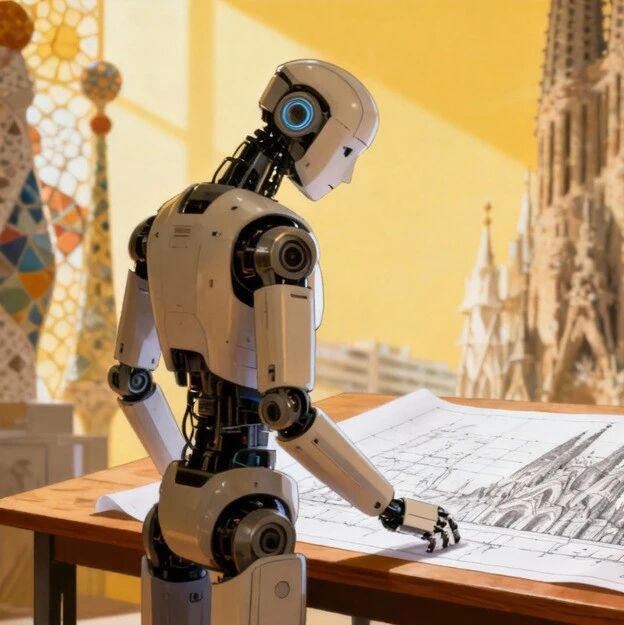
怕失业的你,在AI狂飙的时代该这么想
Xin Lang Cai Jing· 2025-11-26 21:27
Core Insights - The construction of the Sagrada Familia, initiated in 1882, represents a long-term vision that transcends individual lifetimes, embodying optimism and the spirit of perseverance [2][3][19] - The project has evolved through various technological advancements, from modular design to modern techniques like 3D modeling and drone surveying, allowing it to progress steadily despite historical setbacks [3][8] - The completion of the Sagrada Familia is projected for 2026, marking a significant milestone in a 144-year journey, symbolizing the enduring nature of ambitious projects [3][19] Group 1: Historical Context - The Sagrada Familia was designed by architect Antoni Gaudí, who dedicated his life to the project, emphasizing a dialogue between nature and faith through innovative architectural elements [2][3] - After Gaudí's death in 1926, the project faced challenges due to the destruction of plans during the Spanish Civil War, leading to a halt in construction [2][3] Group 2: Technological Evolution - The project adopted modular design principles, allowing for independent progress on various sections and accommodating future technological advancements [3][8] - Recent advancements, including 3D printing and drone technology, have significantly accelerated the construction process, with a goal to complete the project by Gaudí's centenary [3][8] Group 3: Philosophical Implications - The Sagrada Familia serves as a testament to long-termism, illustrating how ambitious projects can inspire future generations and foster a culture of optimism [3][19] - The discussion around the Sagrada Familia reflects broader themes of creativity and innovation, particularly in the context of AI and its potential to enhance human capabilities [9][10][19] Group 4: Societal Impact - The Sagrada Familia has transformed into a major tourist attraction, generating over €100 million in annual ticket revenue, which has implications for local housing and tourism dynamics in Barcelona [18][19] - The changing societal context, including a decline in religious affiliation, has altered the perception and purpose of the Sagrada Familia from a spiritual center to a cultural landmark [18][19]

怕失业的你,在AI狂飙的时代该这么想
经济观察报· 2025-11-26 15:16
Core Insights - The article emphasizes the importance of optimism and long-term thinking in the age of AI, using the construction of the Sagrada Familia as a metaphor for enduring creativity and collaboration across generations [2][3][4][5]. Group 1: Historical Context and Long-term Vision - The Sagrada Familia, designed by Antoni Gaudí, represents a long-term vision that transcends individual lifetimes, showcasing the spirit of optimism and creativity [2][3]. - Gaudí's modular design approach allowed for independent progress on different parts of the church, ensuring that the project could adapt to future technologies and funding sources [3]. - The completion of the Sagrada Familia is projected for 2026, marking a significant milestone in a project that has spanned over 144 years [3]. Group 2: Optimism in Uncertain Times - The article argues that maintaining optimism is crucial in uncertain times, as most significant human achievements have been made by optimists [4][6]. - It highlights the need for a flexible mindset to envision multiple possibilities for the future, especially in the context of AI and global challenges [8][9]. Group 3: AI and Creativity - AI is positioned as a partner that enhances human creativity rather than replacing it, enabling individuals to focus on imaginative and meaningful tasks [12][16]. - The evolution of AI is expected to lead to a surge in creativity, as it frees up time for individuals to explore interests and engage in non-utilitarian pursuits [16][17]. Group 4: Challenges and Collaboration with AI - The article discusses the limitations of AI, emphasizing the need for human guidance in training AI models to ensure they align with real-world complexities [17][18]. - It points out the gap between theoretical knowledge and practical application in AI, suggesting that human experience is essential for effective collaboration [18][19]. Group 5: Future Implications - The potential for AI to reshape work dynamics is explored, with the possibility of reduced working hours as AI takes over routine tasks [16]. - The article concludes by stressing the importance of understanding change and embracing unexpected possibilities brought about by AI advancements [23].