
亚洲水塔

Search documents
“铁打”的人,在“第三极”干最“硬核”的事
Xin Lang Cai Jing· 2026-01-15 14:19
Core Insights - The second comprehensive scientific expedition to the Tibetan Plateau, initiated in 2017, has significantly advanced China's research capabilities, transitioning from a "follower" to a "leader" in this field [2][3] - The expedition has involved over 3,000 research teams and more than 7,000 researchers, focusing on ecological protection and sustainable development [2][3] - The expedition has produced groundbreaking results, including the longest mountain ice core record of 324 meters, and has established new benchmarks for scientific research in extreme environments [5][9] Group 1: Expedition Overview - The second Tibetan Plateau scientific expedition began in August 2017, led by the Chinese Academy of Sciences, and has involved collaboration among 222 research institutions and universities [3] - Over eight years, the expedition has organized more than 3,000 teams and over 30,000 personnel, achieving multiple historical records [4] - Significant achievements include the establishment of the highest automatic weather station on Mount Everest and the first high-resolution measurements of snow and ice thickness at the summit [4] Group 2: Key Findings and Innovations - The expedition has confirmed that the water storage capacity of the Asian water tower is dynamically increasing, equivalent to the total runoff of the Yellow River over 200 years [9] - More than 3,000 new species have been discovered, including rare and previously thought extinct species, filling gaps in microbial research [9] - The expedition has developed a fully domestically controlled technology system for scientific research, exemplified by the "Extreme Eye" tethered balloon, which set a world record for atmospheric observation at 9,050 meters [8] Group 3: Applications and Policy Impact - The expedition has supported the legislative process for the "Tibetan Plateau Ecological Protection Law" and has guided the construction of national parks [10] - It has provided critical data for disaster prevention and resource exploration, identifying 33 target areas for mineral exploration and 110 potential lithium brine sites [10] - The research has established a comprehensive observation and early warning platform for glacier collapse and other natural disasters [10] Group 4: Future Directions - The second expedition is viewed as a new starting point, with ongoing research needed to address the challenges posed by climate change and human activity on the Tibetan Plateau [12] - The region is experiencing significant warming, with a rate of 0.37 degrees Celsius per decade, which is double the global average [12] - Future research will focus on balancing the opportunities and risks associated with the changing environment, aiming for sustainable development in the region [13]

第二次青藏科考新成果发布
Ren Min Wang· 2025-11-20 01:22
Core Insights - The second comprehensive integration of the Qinghai-Tibet scientific expedition has released ten major application results, focusing on ecological protection, disaster prevention, resource energy investigation, and carbon balance accounting [1][2] Group 1: Key Achievements - The establishment of a comprehensive Earth system observation and early warning platform, which includes monitoring and early warning systems for various disaster scenarios [1] - Successful implementation of six early warnings through the established disaster monitoring systems [1] - Development of a fault distribution map along the Sichuan-Tibet transportation corridor and a meteorological disaster monitoring system, optimizing over 400 kilometers of corridor routes [1] Group 2: New Recognitions - The Qinghai-Tibet Plateau is experiencing warming, increased humidity, greening, and darkening trends, which have persisted for decades and are expected to continue into the mid-21st century [2] - Significant enhancement of the Asian water tower's water supply capacity, with projected runoff increases of up to 49% by the end of the century in major river basins [2] - Identification of a tripling risk of ice collapse and glacial lake outburst floods in the future [2] Group 3: Environmental Transformations - The Qinghai-Tibet Plateau has undergone three significant environmental transformations driven by various climatic and geological factors [2] - The new environmental transformations present opportunities for sustainable development, including enhanced water supply capacity and biodiversity services [2] - However, these transformations also pose risks such as imbalances in the Asian water tower and ecological fragmentation [2]
【新华社】探秘第三极!第二次青藏科考新成果发布
Xin Hua She· 2025-11-20 01:21
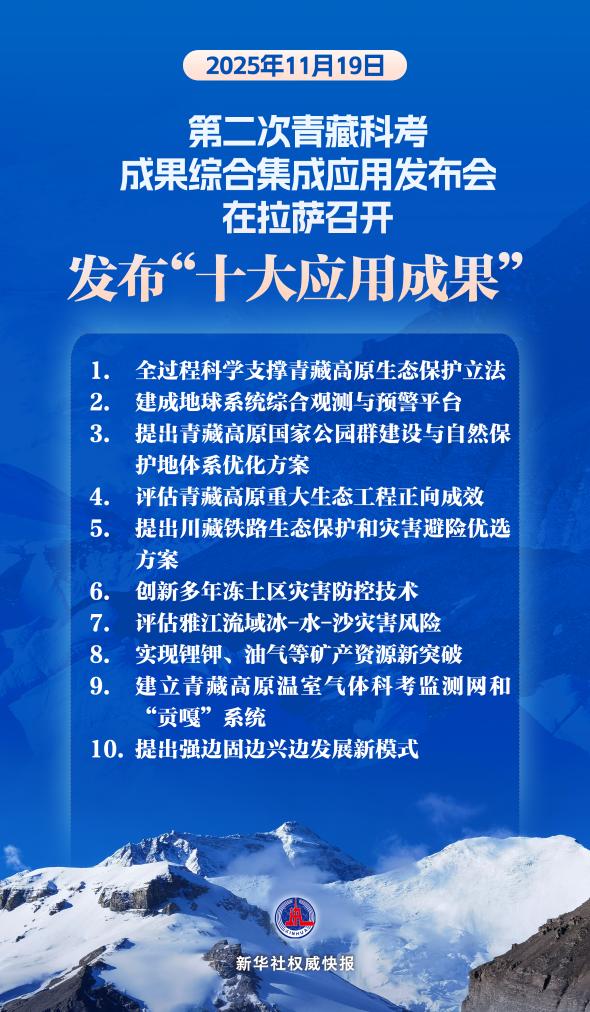
Core Insights - The second comprehensive scientific expedition to the Qinghai-Tibet Plateau has released "Ten Application Achievements," showcasing significant advancements in ecological protection, disaster prevention, resource investigation, and carbon accounting [1][4][6]. Group 1: Application Achievements - The expedition has established a comprehensive observation and early warning platform for the Earth system [4]. - A proposal for optimizing the national park system and natural protection areas in the Qinghai-Tibet Plateau has been put forward [4]. - Innovative disaster prevention technologies for permafrost regions have been developed [4]. - The assessment of major ecological projects in the Qinghai-Tibet Plateau has shown positive results [4]. - A monitoring network for greenhouse gas research has been established [1][4]. Group 2: Environmental Changes and Risks - The expedition identified significant environmental changes in the Qinghai-Tibet Plateau, including warming, increased humidity, and enhanced water supply capabilities [6][7]. - The water supply capacity of the Asian water tower has notably increased, with projected runoff increases of up to 49% by the end of the century [6]. - The expedition revealed a tripling of risks associated with ice avalanches and glacial lake outburst floods in the future [6]. Group 3: Biodiversity Discoveries - New discoveries in biodiversity include the identification of a new group of echo-locating mammals, the pig-tailed mouse, challenging previous beliefs about echo-location in mammals [8][9]. - The study found that bird migration routes can be passed down through genetic memory, providing insights into the relationship between biological behavior and geological changes [9]. - Numerous new species and records were discovered, including previously thought extinct plants and rare animals, highlighting the Qinghai-Tibet Plateau's unique biodiversity [9].
新华鲜报|探秘第三极!第二次青藏科考新成果发布
Xin Hua She· 2025-11-19 14:27
Core Insights - The second comprehensive scientific expedition to the Qinghai-Tibet Plateau has yielded significant findings, showcasing China's advancements in ecological protection, disaster prevention, and resource management [2][4]. Group 1: Key Achievements - The expedition involved over 30,000 participants and 3,000 scientific teams since its initiation in August 2017, focusing on various critical areas such as ecological protection and disaster prevention [2]. - Ten major application results were announced, including the establishment of a comprehensive observation and early warning platform for the Earth system and innovative disaster prevention technologies for permafrost areas [2][4]. - A monitoring system for meteorological disasters along the Sichuan-Tibet transportation corridor was developed, successfully avoiding over 97% of mountain disasters and optimizing over 400 kilometers of transportation routes [3]. Group 2: Environmental Changes - The expedition revealed significant environmental changes in the Qinghai-Tibet Plateau, including warming, increased humidity, and enhanced water supply capabilities, with potential runoff increases of up to 49% by the end of the century [4][5]. - Three major environmental transitions were identified, driven by various geological and climatic factors, impacting the region's ecological balance [4]. Group 3: Biodiversity Discoveries - The expedition made notable discoveries in biodiversity, including the identification of a new group of echo-locating mammals, the pig-tailed mouse, and insights into bird migration patterns influenced by genetic memory [7]. - Several previously thought extinct species, such as the Motuo lily and the Gonge green velvet, were rediscovered, highlighting the plateau's unique biodiversity [7].
“亚洲水塔”本世纪末外流区径流量增幅最高可达49%
Xin Hua She· 2025-11-19 13:56
Core Insights - The second Qinghai-Tibet scientific expedition has revealed a significant enhancement in the water supply capacity of the Qinghai-Tibet Plateau, with an estimated increase in runoff in the outflow areas of up to 49% by the end of this century [1] Group 1: Water Supply and Climate Change - The warming and humidification of the climate has led to an imbalance in the "Asian Water Tower," characterized by a rapid decrease in solid water bodies such as glaciers and snow, alongside a widespread increase in liquid water bodies like lakes and rivers [1] - Over the past 40 years, there has been a continuous increase in runoff in major river basins such as the source of the Yangtze River and the Lancang River [1] Group 2: Future Water Resource Management - Despite the projected increase in water volume from the "Asian Water Tower," the rapid population growth in most countries in South Asia and Central Asia means that the increased upstream water supply will not meet the growing water demand [1] - There is a need for regional strategies and international coordination to manage water resources effectively, including the establishment of scientific early warning systems for disasters such as ice avalanches and glacial lake outburst floods [1] - The sharing of China's successful water resource management experiences and the implementation of more effective sustainable water management measures are essential for building a water resource community in the "Asian Water Tower" [1]