
交易行为数据

Search documents
强一股份上市:业绩高增背后的交易启示
Sou Hu Cai Jing· 2026-01-02 00:16
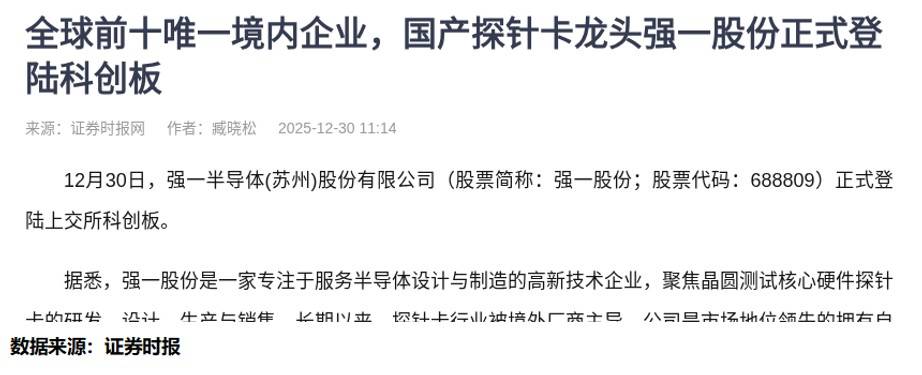
Group 1 - The core point of the article highlights the significant growth of Qiangyi Co., a semiconductor probe card manufacturer, which has entered the global top six in its industry, previously dominated by foreign companies. The company's revenue is projected to grow from 254 million to 641 million from 2022 to 2024, with an expected revenue of 950 to 1,050 million in 2025 and a net profit increase of over 50% [1] Group 2 - The article emphasizes the importance of understanding market behavior rather than solely relying on price charts (K-line) to predict stock movements. It suggests that the true driving force behind stock trends is the actual trading behavior of funds [3][5] - It introduces the concept of "transaction behavior data," which focuses on the real intentions of funds rather than just inflow and outflow metrics. Key indicators include dominant momentum colors representing different trading actions and the activity level of institutional inventory [5][7] Group 3 - For Qiangyi Co., while its fundamentals are strong, the article stresses the necessity of monitoring trading behavior to determine stock price movements. If the stock experiences adjustments, the analysis of fund intentions becomes crucial [9] - The article concludes by advising against merely guessing stock trends based on price charts, advocating for a focus on trading behavior data to make more informed investment decisions [9][10]

锡华科技上市 无锡A股再上台阶
Sou Hu Cai Jing· 2025-12-24 16:56
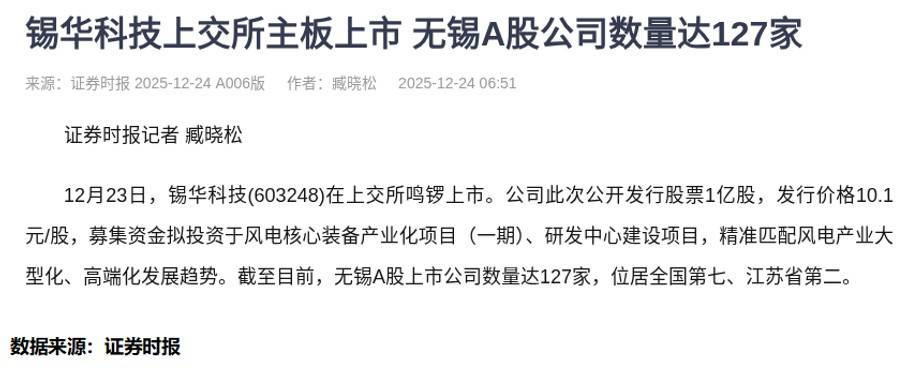
Core Insights - Wuxi's capital market welcomed a new player, Xihua Technology, which specializes in wind power core equipment components, marking the city's A-share listed companies at 127, ranking seventh nationwide and second in Jiangsu [1] Group 1: Market Performance - The recent bull market from April to October 2025 saw the index rise nearly 1000 points, with a growth rate exceeding 20%, yet less than 40% of individual stocks outperformed the index, indicating that the majority of investors earned less than the market average [3] - An example illustrates that an investor with a principal of 100,000 yuan earning 15% would make 15,000 yuan, but with the market average at 20%, their profit would diminish significantly during market corrections [3] Group 2: Trading Behavior - Many investors rely on intuition, often selling at perceived highs and buying at perceived lows, leading to missed opportunities as sold stocks continue to rise and bought stocks continue to fall [4] - A friend's experience with a telecommunications stock demonstrates how selling at various points led to missed gains, highlighting the pitfalls of relying solely on technical analysis [4] Group 3: Institutional Participation - Understanding whether institutional investors are actively participating in trading is more valuable than merely analyzing stock trends; consistent institutional inventory indicates ongoing interest and potential for sustained price movements [17] - Xihua Technology's successful listing is attributed to its 20% global market share in wind power gearbox components, showcasing the importance of "hard power" in attracting institutional investment [18]
牛市两大错觉,90%股民都中招!
Sou Hu Cai Jing· 2025-10-27 12:46
Core Insights - The average return rate of billion-level private equity firms reached 28.8% in the first three quarters, indicating a competitive market environment that attracts retail investors [2] - The emergence of five new firms, with a balanced representation of quantitative and subjective strategies, suggests that there are no eternal strategies in the market, only ongoing competition [2] - The market is characterized by information asymmetry, where the behavior of funds is more telling than price movements, highlighting the importance of understanding institutional actions [14] Group 1 - The current market resembles a humid and stagnant environment, where institutions are playing a "time for space" game, making it difficult for retail investors to interpret market movements accurately [6] - The concept of "institutional inventory" reveals that just because funds are present does not mean they are actively engaged, similar to gym-goers who check in but do not work out [10] - The reliance on traditional technical analysis is becoming less effective in a market dominated by algorithms and strategies, necessitating a shift in how market observations are made [14][15] Group 2 - The two major illusions affecting investors are the belief that "my stock will definitely rise" and that "adjustments are opportunities," which can lead to significant losses during market fluctuations [5] - The market's nature is such that it does not distribute gains evenly, as evidenced by stocks like Guangju Energy, which lost 60% of its gains during a bullish phase [2] - The behavior of institutional investors, such as the significant holdings by Central Huijin and China Securities Finance in Moutai, did not prevent the stock price from declining, illustrating the unpredictability of market reactions [10]
