仓位择时

Search documents
PB-ROE模型仓位择时与交易策略
HUAXI Securities· 2026-03-04 05:08
Group 1: Core Insights - The report introduces the PB-ROE model, which establishes a linear relationship between the logarithm of price-to-book (PB) ratio and return on equity (ROE) under the assumption of no dividends and clean surplus [6][8] - The model is effective in explaining current stock pricing and predicting future return differences, indicating that abnormal ROE will converge to the required return rate over the long term [9][11] - The empirical analysis of the A-share market shows that the PB-ROE model has a strong explanatory power, with an adjusted R-squared value exceeding 0.80, indicating that PB is primarily driven by earnings, real interest rates, and inflation [20][21] Group 2: Trading Strategies - The report outlines a position timing strategy based on the PB-ROE valuation deviation, categorizing market conditions into four states: very high, relatively high, relatively low, and very low valuation deviations [41][43] - The backtesting results from January 3, 2014, to February 27, 2026, show that the timing strategy significantly reduces drawdowns, with cumulative returns of 283.45% compared to a benchmark of 122.61% [47][48] - The report emphasizes the importance of adjusting positions based on valuation states to optimize trading outcomes [41][43] Group 3: Key Trading Signals - The report provides statistical analysis of trading signals based on valuation deviations, indicating that high valuation deviation areas yield high win rates and odds for long positions, while mid-high valuation areas are more favorable for short positions [57][59] - The performance of trading signals varies significantly across different valuation deviation regions, with specific thresholds identified for optimal trading strategies [56][60] - The analysis suggests that when valuation deviations exceed certain thresholds, the probability of successful trades increases, highlighting the model's utility in identifying trading opportunities [59][61] Group 4: Industry Rotation - The report applies the PB-ROE model to industry analysis, revealing that different industries exhibit distinct valuation deviation characteristics and their correlation with future returns [67][68] - A long-short industry portfolio strategy is proposed, where positions are adjusted based on the valuation deviation of each industry, leading to significant outperformance of the long portfolio compared to a benchmark [71][76] - The findings indicate that industries with positive correlation coefficients should have increasing positions as valuation deviations rise, while those with negative coefficients should see decreasing positions [68][69]
2026年Q1可转债投资策略:淡化仓位择时,深挖板块个券
Shenwan Hongyuan Securities· 2026-01-09 08:48
Group 1 - The report indicates a shift in the convertible bond market from a positioning mindset to a trading mindset since Q4 2025, with pricing anchors transitioning from derivative pricing to "underlying stock" pricing, leading to increased demand for convertible bonds [4][41] - The outlook for Q1 2026 suggests that the divergence in positions has ended, and investors should focus on deepening their analysis of sectors and individual bonds rather than timing their positions [4][41] - The report emphasizes the need for a solid allocation strategy, recommending a mix of low-priced and high-priced convertible bonds to enhance returns, with expected returns of 4%-8% for low-priced bonds and around 17% for high-priced bonds [4][41] Group 2 - The report highlights that since Q4 2025, the performance of convertible bonds has been relatively stable compared to underlying stocks, with a noted lower risk of decline [8][39] - It is observed that the convertible bond market has experienced a bull market positioning, with high-priced and small-cap convertible bonds showing significant excess returns, although this trend has diminished post-September 2025 [11][39] - The report identifies specific convertible bonds for different strategies, including low volatility, stable, and flexible combinations, indicating a diverse approach to investment in the convertible bond market [4][39] Group 3 - The report notes that the convertible bond market is currently facing high redemption risks, particularly for equity-type convertible bonds, which are trading at historically low valuations [33][39] - It discusses the performance of convertible bonds based on their remaining duration, indicating that bonds with less than two years remaining typically perform poorly, while new and recently issued bonds have shown better performance [20][39] - The report also mentions that the market is experiencing a significant outflow of funds from convertible bond ETFs, while public funds are increasing their holdings, indicating a shift in investment strategies [38][39]
华夏基金吴凡:低利率时代,低波固收+或许是更适合普通人的理财替代
Sou Hu Cai Jing· 2025-08-01 01:35
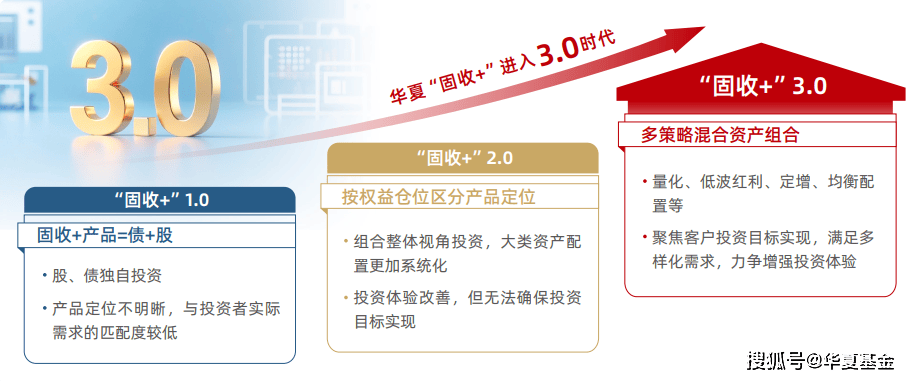
Core Viewpoint - The growth of the "Fixed Income+" product category has been significant, with a total scale increase of over 250 billion in the first half of the year, indicating a shift towards more diversified investment strategies in a low-interest-rate environment [2][3]. Group 1: Market Trends - The "Fixed Income+" category has evolved through different phases, moving from a simple stock-bond mix to a more complex, multi-strategy approach to meet investor demands for flexibility and diverse asset allocation [3]. - The current market environment, characterized by low interest rates, has led to a consensus that "Fixed Income+" products can balance risk and return effectively [3]. Group 2: Fund Manager Insights - Fund manager Wu Fan emphasizes a top-down investment framework, focusing on market timing while also considering individual securities, and avoids high-valuation assets [7][9]. - Wu Fan's investment philosophy includes a strong macroeconomic perspective, which is crucial for understanding the bond market's dynamics and making informed investment decisions [9][10]. Group 3: Investment Strategy - The strategy involves dynamic asset allocation based on market conditions, with a focus on maintaining a balance between equity and fixed income to control volatility and drawdown [10][11]. - The approach to managing "Fixed Income+" products includes a dual-manager system, where one manager focuses on equity and the other on pure bonds, ensuring a unified return and risk assessment [11][12]. Group 4: Performance Metrics - The performance of the "Fixed Income+" products has been strong, with specific funds achieving a maximum drawdown of less than 1% while yielding a return of 6.34% [26]. - The success in performance is attributed to both equity and bond segments contributing to overall returns, with strategic timing and allocation playing a critical role [26][27]. Group 5: Future Outlook - The market is currently in a phase of stabilization, with macroeconomic fundamentals showing signs of improvement, although a strong recovery is yet to be confirmed [29][30]. - The focus on dividend-paying assets is expected to grow, particularly in a low-interest-rate environment, with specific sectors like consumer goods and financials being highlighted for potential investment [31].