
低波固收+

Search documents
长债暴跌!盘几只稳稳的“固收+”~
Sou Hu Cai Jing· 2025-12-06 09:22
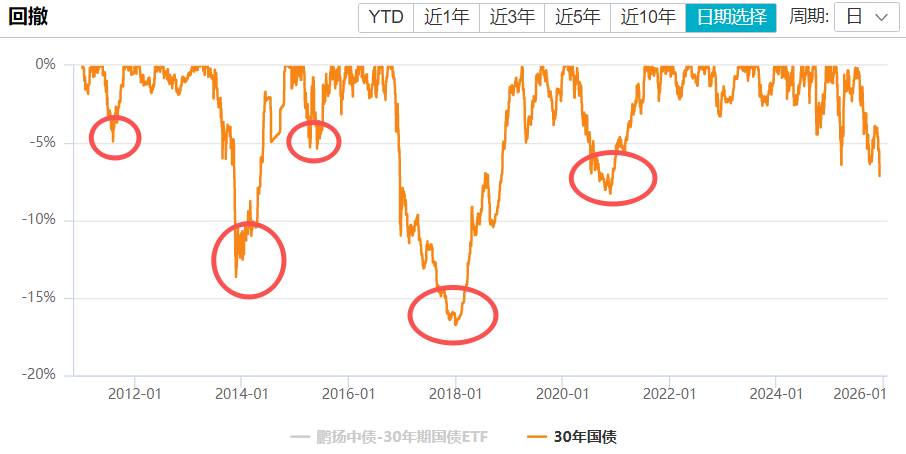
Group 1 - The 30-year Treasury ETF experienced a significant drop of 1.32% on Thursday, reaching a new low since the adjustment began, and has declined 5.86% year-to-date with a maximum drawdown of 8.2% [1][2] - Compared to previous market corrections, the current adjustment is less severe than the maximum drawdowns of 16.75% in 2017 and 13.64% in 2013, indicating a relatively milder market reaction [2] - The volatility of the 30-year Treasury ETF reflects the behavior of risk-seeking funds, which were actively buying during the downturn from July to September and continued to flow into the market during the October rebound [4] Group 2 - Starting from November 20, there has been a continuous outflow of funds, leading to a rapid decline in the bond market, which is perceived differently by large investors compared to previous downturns [5] - The decline in the bond market is attributed to several factors, including insufficient monetary policy easing as indicated by the central bank's net bond purchases of only 50 billion yuan in November, which fell short of market expectations [7] - Concerns over liquidity have increased due to the central bank's operations, including a net withdrawal of 1,756 billion yuan on the same day, alongside upcoming 1 trillion yuan reverse repos maturing in December [7] Group 3 - Market sentiment has been impacted by credit risk events, notably related to Vanke bonds, which have affected investor confidence [8] - The yield curve has been adjusting as expectations for economic recovery have shifted, leading to a gradual restoration of the yield spread between long-term and short-term bonds since July [8] - Institutional selling has been observed, with the 30-year Treasury ETF experiencing net redemptions, attributed to various factors such as fund redemptions and regulatory constraints on banks [10] Group 4 - For ordinary investors, traditional bond funds have shown a maximum drawdown of no more than 3% over the past decade, making them a more suitable option compared to the high volatility of the 30-year Treasury ETF [12] - The "fixed income plus" strategy, particularly low-volatility options, is gaining traction as both stock and bond markets face challenges, with many investors opting for professional fund managers to navigate these conditions [14] - The secondary bond fund index has increased by 13.19% since 2021, with a maximum drawdown of 6.93%, indicating a favorable performance for this investment category [14]

公募FOF业务及产品布局2026年展望:在多元资产的时代乘风破浪
Shenwan Hongyuan Securities· 2025-12-05 13:15
Report Title - In the Era of Multi - asset Investments, Riding the Waves: Outlook for the Public Offering FOF Business and Product Layout in 2026 [1] 1. Report Industry Investment Rating - Not provided in the content 2. Core Viewpoints of the Report - Since Q4 2024, the overall scale of public offering FOFs has rebounded, reaching a new high since Q4 2022, mainly due to China Merchants Bank's "Long - term Prosperity Plan" and the increasing market recognition of multi - asset allocation for achieving fixed - income plus returns after the rapid decline in interest rates [10]. - Multi - asset low - volatility FOFs face issues such as potential overcrowding, reliance on the performance of gold and US stocks, and the need to build competitiveness through further asset diversification, strategy specialization, and product differentiation [49][54]. - High - volatility FOFs have a natural advantage in the personal pension Y - share market, and in the new regulatory environment, they can evolve in directions such as building low - volatility products under the same benchmark and making style - based asset allocations [103][114] 3. Summary by Directory 3.1 Public Offering FOF Industry Status - **Scale and Product Trends**: After years of overall decline, the scale of public offering FOFs started to rebound in Q4 2024, with positive net inflows for three consecutive quarters. The "Long - term Prosperity Plan" of China Merchants Bank brought about a scale of approximately 60 billion yuan, driving the development of the FOF industry. Most FOFs with large scale growth and initial issuance in 2025 belong to the "Long - term Prosperity Plan", mainly bond FOFs or fixed - income plus FOFs [10][12]. - **Asset Allocation**: Multi - asset allocation has become a common choice for FOFs. In Q3 2025, leading fund managers generally increased their allocation to QDII, mutual - recognition funds, and commodities while maintaining their allocation to active equity, fixed - income plus, and pure - bond funds [17]. - **Personal Pension Y - share**: In Q3, the scale of personal pension funds reached 12.817 billion yuan, a significant increase from Q2 2025. Pension target - date funds are more popular, and high - equity - position products in personal pension accounts are more favored. The scale of equity - type and 2050 - series FOFs increased significantly [28][32] 3.2 Next Evolution Direction of Multi - asset Investments - **Asset - side**: To overcome the "reliance on gold and US stocks", multi - asset FOFs should further diversify and increase sources of returns. Public REITs can be considered as a substitute for bonds, and commodity - type funds such as non - ferrous metal futures, chemical futures, and soybean meal futures can enhance the diversification effect of FOFs [56][64]. - **Strategy - side**: The ability to be familiar with alternative assets can be a competitive barrier for multi - asset investment. Multi - asset allocation frameworks can be labeled, transparent, and tool - based. The deployment of various assets under a stable allocation framework tests the tactical ability of fund managers, and the deployment models can be macro - driven, risk - driven, or value - driven [69][82] - **Multi - asset + Multi - strategy**: If bond yields remain low in the long term, multi - asset low - volatility FOFs can reduce bond allocation and adopt a multi - asset + multi - strategy model. By strategizing single assets and combining them with a risk - parity weighting, a quasi - absolute - return strategy can be formed [92] 3.3 Future of High - volatility FOFs - **Natural Battlefield - Personal Pension Y - share**: High - volatility FOFs are more popular in the personal pension Y - share market. The "search for lower points" model can be adopted in the Y - share business to promote the development of the third pillar of pensions [103]. - **Friendly Environment from High - quality Public Offering Development**: The high - quality development of the public offering industry provides a more favorable environment for FOFs. Due to their low - volatility characteristics, FOFs can offer better returns to investors [109]. - **Evolution Direction in the New Regulatory Environment**: In the new regulatory era with clear performance benchmarks, high - volatility FOFs can build low - volatility products under the same benchmark, improve the holding experience, and make style - based asset allocations to adapt to different market conditions [114][117]
股债细分领域精耕细作 华安沣泰债券基金11月11日起发行
Shang Hai Zheng Quan Bao· 2025-11-03 06:39
Core Viewpoint - The Huazhong Fengtai Bond Fund is set to launch on November 11, focusing on stable asset allocation for investors in a low-interest-rate environment, aiming for steady value growth [1] Group 1: Fund Characteristics - The fund is positioned as a "low volatility fixed income+" product, utilizing a unique macro research framework to make precise asset allocation decisions based on economic cycles, policies, and liquidity [1] - It will invest at least 80% of its assets in bonds, with 5%-20% allocated to equity and convertible bonds, and a minimum of 5% in domestic stocks [2] - The fund manager, Wu Wenming, has nearly 16 years of financial experience and emphasizes a meticulous approach to bond pricing and trading, aiming for stable long-term performance [2] Group 2: Investment Strategy - The fund will focus on high-rated bonds to build a solid base return while maintaining a balanced style in equity investments to control risks [1][2] - The investment strategy includes a dual-market approach, leveraging opportunities in both A-shares and Hong Kong stocks, with a 10% allocation for additional investment flexibility [1] - The fund aims to capitalize on structural investment opportunities, particularly in the context of artificial intelligence's potential to enhance profit growth [3] Group 3: Market Outlook - The market is expected to remain in a volatile state with limited chances for significant adjustments in bond yields, presenting ongoing investment opportunities [3] - The strategy includes wave operations in interest rate bonds and selective participation in credit bonds that have not fully adjusted to previous interest rate increases [3]
华夏基金吴凡:低利率时代,低波固收+或许是更适合普通人的理财替代
Sou Hu Cai Jing· 2025-08-01 01:35
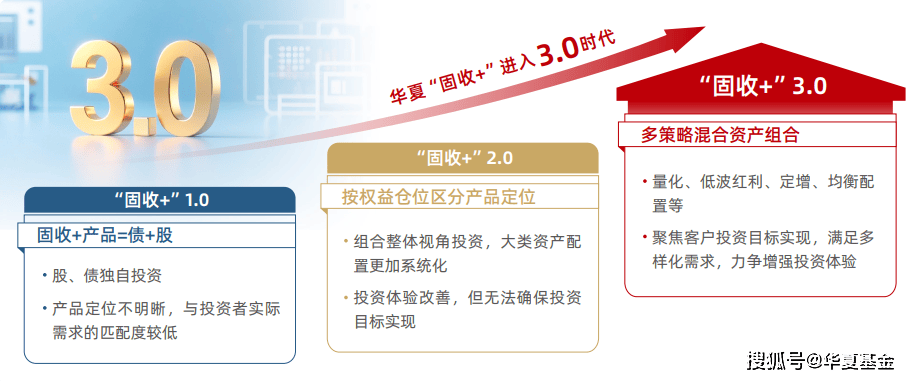
Core Viewpoint - The growth of the "Fixed Income+" product category has been significant, with a total scale increase of over 250 billion in the first half of the year, indicating a shift towards more diversified investment strategies in a low-interest-rate environment [2][3]. Group 1: Market Trends - The "Fixed Income+" category has evolved through different phases, moving from a simple stock-bond mix to a more complex, multi-strategy approach to meet investor demands for flexibility and diverse asset allocation [3]. - The current market environment, characterized by low interest rates, has led to a consensus that "Fixed Income+" products can balance risk and return effectively [3]. Group 2: Fund Manager Insights - Fund manager Wu Fan emphasizes a top-down investment framework, focusing on market timing while also considering individual securities, and avoids high-valuation assets [7][9]. - Wu Fan's investment philosophy includes a strong macroeconomic perspective, which is crucial for understanding the bond market's dynamics and making informed investment decisions [9][10]. Group 3: Investment Strategy - The strategy involves dynamic asset allocation based on market conditions, with a focus on maintaining a balance between equity and fixed income to control volatility and drawdown [10][11]. - The approach to managing "Fixed Income+" products includes a dual-manager system, where one manager focuses on equity and the other on pure bonds, ensuring a unified return and risk assessment [11][12]. Group 4: Performance Metrics - The performance of the "Fixed Income+" products has been strong, with specific funds achieving a maximum drawdown of less than 1% while yielding a return of 6.34% [26]. - The success in performance is attributed to both equity and bond segments contributing to overall returns, with strategic timing and allocation playing a critical role [26][27]. Group 5: Future Outlook - The market is currently in a phase of stabilization, with macroeconomic fundamentals showing signs of improvement, although a strong recovery is yet to be confirmed [29][30]. - The focus on dividend-paying assets is expected to grow, particularly in a low-interest-rate environment, with specific sectors like consumer goods and financials being highlighted for potential investment [31].
博时低波"固收+"产品如何成为震荡市中的配置优选
Jing Ji Guan Cha Wang· 2025-05-21 04:54
Core Viewpoint - The article emphasizes the growing popularity of "low-volatility fixed income plus" products as a stable investment choice amid a challenging market environment characterized by tightening yields in traditional bank wealth management and pure bond funds, alongside increased volatility in equity markets [1][8]. Market Environment - The traditional bank wealth management and pure bond fund yields are under continuous pressure due to the transition to net value management and the scarcity of high-yield assets [1]. - The bond market is expected to perform well in 2024, coupled with structural opportunities in the equity market, creating a favorable environment for "fixed income plus" strategies [1]. - In Q1 2025, the average drawdown of "fixed income plus" products was only 1.38%, showcasing strong risk resistance capabilities [1]. Product Strategy - Bosera Fund has developed a comprehensive "fixed income plus" product matrix to cater to different risk preferences, filling the gap between pure bonds and equities through flexible asset allocation [2]. - The "low-volatility" prefix in "fixed income plus" products clarifies the product strategy, aiming to maintain low volatility while responding flexibly to market fluctuations [2]. Management Approach - The management of "fixed income plus" products requires a combination of macro asset allocation and in-depth research on specific assets, which Bosera Fund has effectively integrated [3]. - Bosera has established a systematic asset evaluation process that includes weekly, monthly, and quarterly assessments to ensure timely and professional investment decisions [4]. Performance Metrics - Bosera's "low-volatility fixed income plus" products have demonstrated strong long-term returns, with the Bosera Stable Return Fund achieving a cumulative return of 97.88% since its inception in 2011, significantly outperforming its benchmark [6]. - The Bosera Stable Value Fund has also shown impressive performance, with a cumulative return of 173.23% since its establishment in 2007, far exceeding its benchmark [6]. Team Expertise - The investment team behind Bosera's "low-volatility fixed income plus" products consists of experienced professionals, many with over 10 years in the securities industry, ensuring a robust investment philosophy and operational style [7][8]. - The dual-manager decision-making structure for these products combines the strengths of fixed income and equity managers, enhancing the ability to capture investment opportunities while maintaining low volatility [5].
绩优低波“固收+”再受关注,中泰双鑫6个月持有债券基金重磅发行
Zhong Zheng Wang· 2025-05-12 02:20
Core Viewpoint - The recent recovery in equity markets has led to increased interest in "fixed income +" products, particularly low-volatility variants that offer stable returns with lower drawdowns [1][2] Group 1: Product Overview - The Zhongtai Shuangxin 6-Month Bond Fund (Class A: 023214, Class C: 023215) was launched on May 14, focusing on high-quality bonds as underlying assets, with a maximum of 20% allocated to equity assets [1] - The fund aims to achieve long-term returns exceeding the average fixed income yield while controlling drawdowns through hedging tools [1][3] - A 6-month holding period is set to stabilize fund size and reduce the impact of daily redemptions, allowing for a more strategic long-term investment approach [1] Group 2: Management Team - Fund managers Cheng Bing and Shang Yuanbo have over ten years of experience in securities research and investment, previously managing the Zhongtai Shuangli Bond Fund, which has shown strong performance [2][4] - The Zhongtai Shuangli Bond Fund's Class A net value growth rate reached 9.97% as of March 31, 2025, outperforming its benchmark by 4.04% [2] Group 3: Risk Management and Strategy - The focus of low-volatility "fixed income +" products is on risk-return characteristics rather than just yield, aiming for drawdown control similar to pure bond funds while achieving slightly better long-term returns [3] - Over 80% of the fund's capital will be invested in high-grade credit bonds and interest rate bonds, with equity investments limited to 20% in well-governed industry leaders [3] Group 4: Performance Metrics - The Zhongtai Shuangli Bond Fund has demonstrated superior drawdown management, with a maximum drawdown of only 0.66%, significantly better than the mixed bond index (4.25%) and pure bond index (1.31%) [2][4]