
以人民为中心的发展理念

Search documents
民生“含金量”托稳群众幸福感
Xin Lang Cai Jing· 2026-02-24 20:22
Core Viewpoint - The focus of the news is on the commitment of Inner Mongolia to enhance the well-being of its citizens through various initiatives and policies aimed at improving living standards and ensuring that the benefits of development are felt by all [1][2][4]. Group 1: Achievements in People's Livelihood - Inner Mongolia has made significant progress in improving people's livelihoods, with 1.06 million new urban jobs created and per capita disposable income exceeding 40,000 yuan [1]. - Key educational metrics such as preschool enrollment, nine-year compulsory education retention, and high school enrollment rates are all above the national average [1]. - The implementation of centralized medical insurance procurement has reduced costs for citizens by 23.7 billion yuan, ensuring that basic livelihood guarantees meet or exceed national averages [1]. Group 2: Future Plans and Policies - The government has outlined "Ten Major Livelihood Projects" aimed at addressing the most pressing needs of the population, including income stability, education quality, and healthcare services [2]. - The focus is on creating a robust social safety net and improving public services in education, healthcare, and elderly care, reflecting a people-centered development philosophy [2][3]. - Specific targets include maintaining a basic pension and medical insurance coverage rate of over 95%, providing vocational training for 400,000 people, and establishing 500 local employment service stations [3]. Group 3: Implementation and Accountability - The success of these initiatives relies on precise execution and measurable outcomes, with a commitment to transparency and public oversight [3]. - The government aims to ensure that the projects not only provide immediate benefits but also lay a foundation for long-term development and prosperity [3]. - By focusing on both visible and long-term impacts, the initiatives are designed to enhance the overall quality of life and contribute to sustainable development [3].
2025年“读懂中国”国际会议在广州举办 李书磊出席开幕式并作主旨演讲
Xin Hua She· 2025-12-01 12:14
Core Points - The "Understanding China" International Conference is being held in Guangzhou from November 30 to December 2, 2025, focusing on "New Layout, New Development, New Choices - Chinese Modernization and the New Global Governance Pattern" [1] - The conference has become one of the most influential platforms for the world to understand China after years of development [1] - Chinese President Xi Jinping emphasized that understanding China requires understanding Chinese modernization, which has been successfully advanced and expanded since the 18th National Congress of the Communist Party of China [1] Group 1 - The conference is attended by over 800 guests from political, strategic, business, academic, and relevant think tank sectors [2] - The 20th Central Committee's Fourth Plenary Session has outlined a blueprint for the next five years of Chinese modernization, which is significant for sharing development opportunities with countries worldwide [1] - Chinese modernization aims to develop itself while benefiting the world, focusing on high-quality development and new productive forces [1] Group 2 - China is committed to high-level opening up and quality cooperation in the Belt and Road Initiative, promoting mutual connectivity and achievements with other countries [1] - The development philosophy centers on people, ensuring that development outcomes are more equitable and beneficial to all citizens [1]
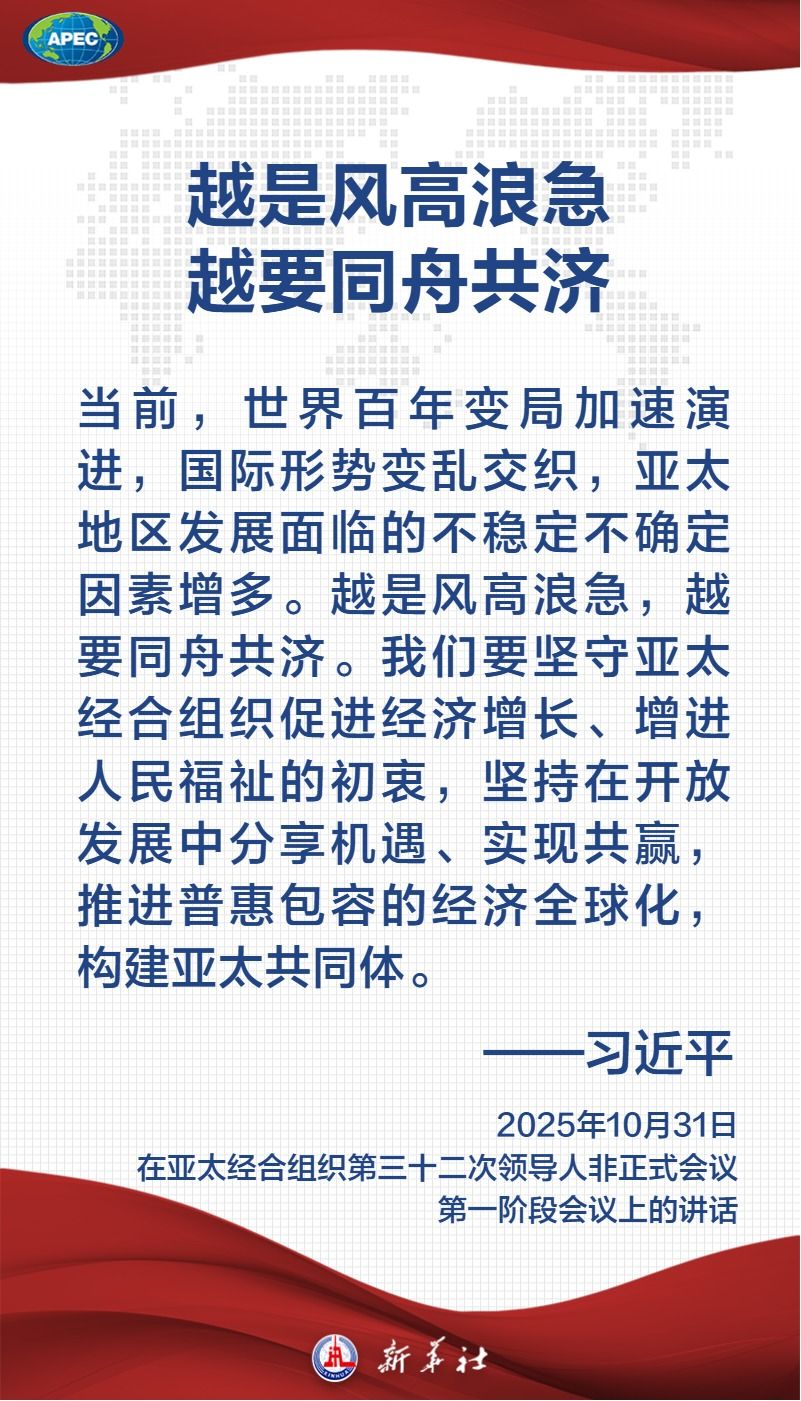
金句海报|共建普惠包容的开放型亚太经济 习近平主席这样论述
Xin Hua She· 2025-10-31 13:01
Core Points - President Xi Jinping emphasized the importance of building an inclusive and open Asia-Pacific economy during the APEC informal leaders' meeting [1][2] Group 1: Multilateral Trade System - The need to practice true multilateralism and enhance the authority and effectiveness of the multilateral trading system centered around the World Trade Organization (WTO) was highlighted [3] - Commitment to reforming the WTO while maintaining fundamental principles such as most-favored-nation treatment and non-discrimination was reiterated [3][4] Group 2: Regional Economic Integration - Continuous promotion of trade and investment liberalization and facilitation, along with deepening financial cooperation, was stressed to advance regional economic integration [8] - The importance of high-quality implementation of trade agreements, such as the Comprehensive and Progressive Agreement for Trans-Pacific Partnership, was mentioned as a means to foster connectivity and integration [9] Group 3: Supply Chain Stability - The focus on stabilizing and ensuring smooth supply chains was emphasized, advocating for collaboration to find more points of mutual interest [12][13] - The 10th anniversary of the APEC Connectivity Blueprint was noted as an opportunity to strengthen hard, soft, and emotional connectivity in the region [13] Group 4: Digital and Green Trade - The role of digital technology in promoting cross-border trade, including initiatives like paperless trade and smart customs, was highlighted [14] - Efforts to eliminate green barriers and expand cooperation in green industries, clean energy, and green minerals were discussed [14] Group 5: Inclusive Development - A people-centered development approach was advocated to address imbalances in development and promote more inclusive and sustainable economic globalization [16] - China's commitment to providing zero-tariff treatment on 100% of products to least developed countries was reiterated, along with plans to implement similar measures for African countries [19][20] Group 6: Trade and Investment Statistics - Over the past five years, China has ranked first and second globally in goods and services trade, attracting over $700 billion in foreign investment [22]

中国式现代化是实干出来的现代化(国际论坛)
Ren Min Ri Bao· 2025-10-23 22:01
Group 1 - The core viewpoint emphasizes the importance of practical action and strategic planning in China's modernization efforts, particularly during the "14th Five-Year Plan" period, which has allowed for stable development amidst complex international challenges [1] - The "Five-Year Plan" serves as both a policy framework and a governance mechanism that integrates top-level design, institutional execution, and social mobilization, ensuring continuity and predictability in China's modernization [1] - The focus on improving public services such as education, healthcare, and elderly care during the "14th Five-Year Plan" period reflects a people-centered development approach, aiming to enhance the quality of life for all citizens [1] Group 2 - In the context of a sluggish global economic recovery and geopolitical tensions, China is advancing structural optimization and industrial upgrading through innovation, green transformation, and open cooperation, with emerging industries like AI and new energy vehicles driving economic growth [2] - The integration of innovation with public welfare is highlighted, as the digital economy enables ordinary citizens to benefit from technological advancements, thereby promoting social equity and high-quality economic development [2] - China's commitment to high-level opening up during the "14th Five-Year Plan" includes initiatives like the Hainan Free Trade Port and improvements in the business environment, which aim to combine domestic market potential with global opportunities [2] Group 3 - The development of new productive forces in China, particularly in sectors like renewable energy and AI, not only reshapes its industrial structure but also offers growth opportunities for neighboring countries [3] - Infrastructure projects like the China-Laos Railway and the Thai-Chinese Rayong Industrial Park exemplify successful cooperation between China and partner countries, showcasing both hard and soft power in areas such as green development and financial collaboration [3] - The concept of "Chinese-style modernization" is presented as a model for global opportunities, emphasizing that true modernization is achieved through practical efforts and cooperative development rather than exploitative growth [3]