
经济全球化

Search documents
东兴证券晨报-20260325
Dongxing Securities· 2026-03-25 07:46
Core Insights - The report highlights a strong growth trend in China's high-tech industries, with sales revenue increasing by 16.1% year-on-year in the first two months of the year, particularly driven by high-tech services and manufacturing sectors [2] - The report emphasizes the importance of economic globalization and China's role in providing certainty in a volatile global environment, as stated by the Ministry of Commerce [2] - The smart glasses market in China is projected to see significant growth, with an expected shipment volume of 2.46 million units in 2025, reflecting an 87.1% year-on-year increase [2] - The report outlines a strategic plan for the AI server industry in Shenzhen, aiming for substantial growth in production capacity and market share by 2028 [2] - The machine tool industry in China is showing signs of recovery, with a reported revenue of 288.7 billion yuan in 2025, marking a 10.3% year-on-year increase [5] Industry Summaries High-Tech Industry - High-tech service revenue grew by 17.2%, with significant increases in technology intermediary services and natural scientific research [2] - High-tech manufacturing revenue increased by 14.5%, driven by sectors such as aerospace and consumer electronics [2] Smart Glasses Market - The smart glasses market is expected to reach 2.46 million units shipped by 2025, with a growth rate of 87.1% [2] - The report notes that while the market is expanding rapidly, there are still challenges in realizing user value and effective market penetration [2] AI Server Industry - The Shenzhen action plan aims for a leap in AI server production and shipment by 2028, focusing on key components like core chips and storage [2] Machine Tool Industry - The machine tool sector is recovering, with a total revenue of 288.7 billion yuan and a 10.3% increase in 2025 [5] - The report indicates a positive trend in exports, which grew by 17.9% to reach 9.68 billion USD [5] Express Delivery Industry - In February 2026, the express delivery sector saw a business volume of approximately 12.11 billion packages, a year-on-year decline of 10.9%, but a 7.1% increase when considering January and February together [7][8] - The report notes that the industry is shifting focus from quantity to quality, with significant price increases observed in the express delivery sector [9]
博鳌亚洲论坛迎来25岁 亚洲合作纽带凝聚发展共识
证券时报· 2026-03-24 00:00
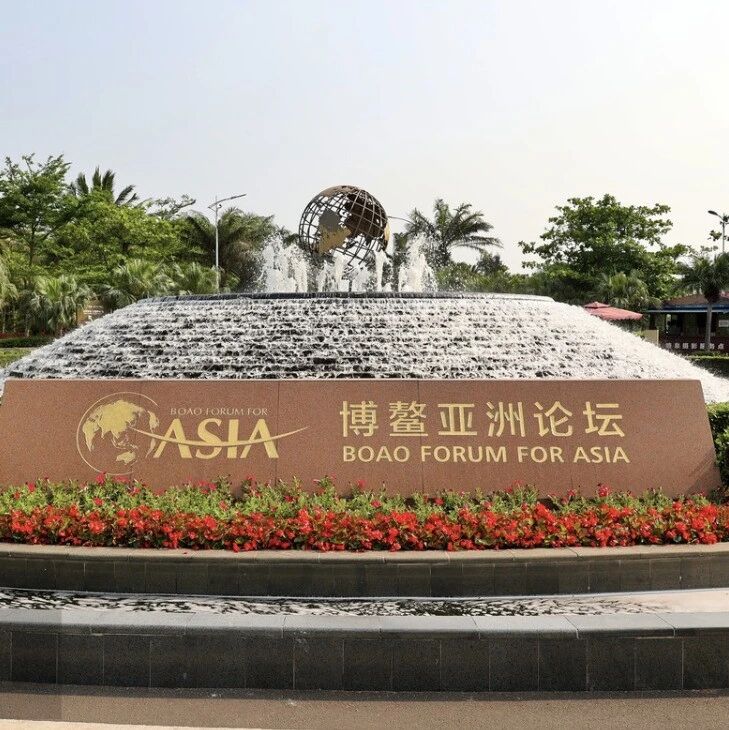
Core Viewpoint - The Boao Forum for Asia 2026 Annual Conference is set to take place from March 24 to 27, focusing on the theme "Shaping a Shared Future: New Situations, New Opportunities, New Cooperation" to address global development issues and foster collaboration [1][2]. Group 1: Conference Overview - The 2026 Annual Conference marks the 25th anniversary of the Boao Forum and is the first annual meeting held after the full closure of the Hainan Free Trade Port [1]. - The forum will feature nearly 50 sub-forums, roundtable discussions, and dialogues, concentrating on topics such as global economic governance, green transformation, technological innovation, and regional integration [1]. Group 2: Global Context - The world is at a critical crossroads, facing challenges such as unilateralism, protectionism, geopolitical tensions, and climate crises, which have severely impacted global order and multilateral systems [2]. - Open regionalism in Asia is effectively countering protectionism, with economic integration and regional cooperation advancing despite global challenges [2]. Group 3: Economic Insights - Economic globalization is an irreversible trend, and principles of fairness, openness, and cooperation are essential for providing stability in a turbulent world [3]. - China's economy is progressing steadily, and the country is committed to sharing development opportunities with Asia and the world, further opening its doors to global collaboration [3].

信息量很大!中美关系、伊朗局势、中俄关系、四问日本……王毅答中外记者问,划重点!
券商中国· 2026-03-08 04:30
Core Viewpoint - The article emphasizes China's growing international influence amidst a rapidly changing global landscape, highlighting its commitment to peace, stability, and cooperation with other nations [2][3]. Group 1: China’s Global Role - China is positioned as a significant force for peace, stability, and justice in the world, expressing confidence in humanity's future and a willingness to collaborate with like-minded countries to build a community with a shared future for mankind [3]. - The global South's rise is noted as a key driver of world multipolarity, with its economic share increasing from 24% to over 40% in the past 40 years, indicating a shift in global power dynamics [13]. Group 2: China-U.S. Relations - The relationship between China and the U.S. is characterized by mutual respect and the need for cooperation, with high-level exchanges providing strategic support for stability in bilateral relations [4]. - This year is described as a "big year" for China-U.S. relations, with an agenda for high-level interactions already set [4]. Group 3: Regional Relations - The China-Russia relationship is described as stable and resilient, unaffected by external pressures, emphasizing mutual respect for core interests and strategic collaboration [5][7]. - In discussing the Iran situation, China calls for an immediate cessation of military actions to prevent escalation, advocating for peace in the Middle East [6][8]. Group 4: Global Governance and Multilateralism - China's global governance initiative has received support from over 150 countries and international organizations, addressing the challenges of governance deficits and the need for multilateralism [9][10]. - The article stresses the importance of revitalizing the United Nations and enhancing its role in global governance [10]. Group 5: Economic Relations - China plans to implement zero tariffs on 100% of products from Africa starting May 1, aiming to enhance trade opportunities and economic cooperation [20]. - The article warns against the dangers of decoupling and trade barriers, asserting that such actions will ultimately harm those who pursue them [21]. Group 6: Taiwan and Japan Relations - Taiwan is reaffirmed as an inseparable part of China, with the article emphasizing that any attempts to create a "two Chinas" scenario will fail [24][25]. - Concerns are raised regarding Japan's involvement in Taiwan affairs, questioning its right to intervene in China's internal matters [23].
9 以更开放的姿态为全球发展带来广阔机遇
Xin Lang Cai Jing· 2026-02-24 22:23
Group 1: Core Insights - China's commitment to high-level opening up is a strategic choice to meet development needs and promote global economic cooperation [1] - The "14th Five-Year Plan" is expected to provide significant certainty and strong momentum for the global economy [1] - By 2025, China's import scale is projected to reach 18.48 trillion yuan, maintaining a 10% share of global imports [1] Group 2: Market Opportunities - China will implement zero-tariff treatment for 100% of products from least developed countries with diplomatic relations, covering approximately 1.9 billion people [1] - Imports from these economies are expected to exceed 140 billion USD by 2025, contributing to local economic growth [1] - China aims to expand imports of high-quality goods and services, leveraging both domestic and international markets [1] Group 3: Supply Chain Stability - China is reducing the negative list for foreign investment and has achieved a "zero" list in the manufacturing sector [2] - By 2025, over 70,000 new foreign-invested enterprises are expected to be established, with a 19.1% year-on-year growth [2] - High-tech industries will account for 32.3% of foreign investment, indicating strong returns for foreign enterprises [2] Group 4: Economic Globalization - China is actively promoting institutional opening and aligning with international high-standard trade rules [3] - The number of free trade agreements has expanded, with trade with free trade partners expected to exceed 20 trillion yuan by 2025 [3] - 22 pilot free trade zones have promoted 485 institutional innovation achievements [3] Group 5: Belt and Road Initiative - The Belt and Road Initiative has become the largest international economic cooperation platform globally, with over 150 countries involved [4] - Significant infrastructure projects and trade routes have been established, enhancing connectivity with participating countries [4] - Future efforts will focus on both major projects and smaller community-based initiatives to ensure sustainable development [4]
关税政策大调整:美国终止 IEEPA 关税,全球贸易再迎变数
Sou Hu Cai Jing· 2026-02-24 07:45
Core Viewpoint - The U.S. Customs and Border Protection (CBP) announced the termination of additional tariffs imposed under the International Emergency Economic Powers Act (IEEPA), marking a significant shift in U.S. trade policy following a Supreme Court ruling that deemed these tariffs legally unfounded [1][2]. Group 1: Tariff Termination Details - The termination affects seven presidential executive orders, including tariffs aimed at illegal drug imports, synthetic opioids from China, punitive tariffs on Venezuelan oil, and tariffs designed to address the U.S. trade deficit [2]. - The CBP will update its Automated Commercial Environment (ACE) system, rendering all HTSUS numbers applicable to IEEPA tariffs ineffective from February 24, 2026 [2]. - The adjustment only pertains to IEEPA measures and does not alter other core U.S. trade protection policies, such as Section 232 and Section 301 tariffs [2]. Group 2: New Tariff Measures - Following the Supreme Court ruling, the Trump administration quickly introduced a temporary 10% import tariff on all goods from all countries, which was later raised to 15% [3]. - This new tariff will apply to all trade partners, including those with existing bilateral agreements, disrupting previous trade negotiation frameworks [3]. - The administration aims to offset the revenue loss from the IEEPA tariff termination and maintain overall tariff income for 2026 [3]. Group 3: Impact on U.S. Economy and Trade - The termination of IEEPA tariffs is expected to alleviate cost pressures on U.S. businesses, potentially enhancing profit margins and leading to a temporary rise in stock market indices [4]. - However, the new 15% global tariff raises concerns for industries reliant on global supply chains, leading to increased costs [4]. - The issue of refunding over $130 billion in previously paid IEEPA tariffs has emerged, with many companies seeking reimbursement, which could lead to prolonged legal disputes [4]. Group 4: Implications for U.S.-China Trade - The termination of certain tariffs signals a potential easing of trade tensions between the U.S. and China, allowing for increased trade volumes in specific sectors [5]. - Despite this, the Section 301 tariffs on Chinese goods remain unchanged, limiting the scope for improvement in U.S.-China trade relations [5]. Group 5: Global Trade System Effects - The termination of IEEPA tariffs may lower trade barriers in some sectors, benefiting global trade flows, particularly in energy and chemicals [6]. - However, the introduction of new tariffs creates uncertainty, prompting other nations to consider retaliatory measures, which could disrupt global trade recovery [6]. - The adjustment reflects broader domestic political dynamics and the ongoing struggle between protectionism and globalization [6]. Group 6: Long-term Trade Outlook - The recent changes in U.S. tariff policy introduce both opportunities and challenges for global trade, necessitating enhanced bilateral and multilateral cooperation to mitigate the impacts of unilateral trade actions [7]. - The emphasis on economic globalization and adherence to global trade rules is crucial for sustainable trade development [7].
关税刚被判定违法,特朗普就代表美国,对全球打响第一枪
Sou Hu Cai Jing· 2026-02-23 02:43
Group 1 - The U.S. Supreme Court ruled that the Trump administration's use of the International Emergency Economic Powers Act to impose global tariffs was unconstitutional, requiring congressional authorization for tax policies [1][3] - This ruling undermines Trump's previous hardline stance on tariffs, which he used as a tool for diplomatic leverage against countries like China, Mexico, and Canada [1][3] - Trump's immediate response was to sign a new tariff law, challenging the Supreme Court's decision and indicating a political struggle, while also criticizing the conservative justices who overturned his policies [3][5] Group 2 - The new tariff policy is expected to lead to economic shocks, including rising global commodity prices and increased production costs for businesses, which could severely impact consumer purchasing power [5] - The long-term implications of Trump's tariff policy may negatively affect the U.S.'s leadership position in global trade, as the ability to impose tariffs as a negotiation tool is diminished [5][7] - The current global economic landscape emphasizes cooperation and dialogue over unilateral actions, suggesting that Trump's approach may be misaligned with future economic development strategies [7][8]
商务部:我国提交首份全面系统阐述世贸组织改革立场政策文件
Di Yi Cai Jing· 2026-02-19 07:04
Core Viewpoint - China is a staunch supporter and active contributor to the multilateral trading system, advocating for the WTO to play a greater role in global economic governance [1][2] Summary by Sections Overall Position - The position paper outlines China's understanding of the WTO and its basic attitude towards WTO reform, emphasizing that the WTO provides an open, non-discriminatory, stable, and predictable institutional guarantee for economic globalization [4] - The multilateral trading system faces challenges from unilateral tariff measures, but WTO rules remain a crucial barrier against trade turbulence [4] Emphasis on Economic Globalization - The position paper stresses that economic globalization is an unstoppable historical trend, and WTO reform should aim to strengthen multilateral trade governance [6] - The WTO has facilitated a fivefold increase in global goods and services trade from 1995 to 2024, with developing economies accounting for 47% of global goods exports and 33% of services exports by 2024 [6] Work Recommendations - The position paper suggests that members should develop a gradual, structured reform work plan at the 14th WTO Ministerial Conference, focusing on decision-making mechanisms, development, and fair competition [7] - It advocates for flexible decision-making while respecting the principle of consensus and encourages developing members to seize opportunities in digital transformation and green transition [7] Dispute Resolution Mechanism - The position paper calls for the restoration of a fully operational dispute resolution mechanism accessible to all members, reflecting China's commitment to multilateralism and addressing the concerns of other members [8] Focus on Development and Future - The position paper emphasizes placing development at the center of the reform agenda, helping developing members leverage opportunities in emerging industries [9] - It highlights the need to discuss government measures that distort international trade and to seek consensus on fair competition, respecting different economic systems and development stages [9]
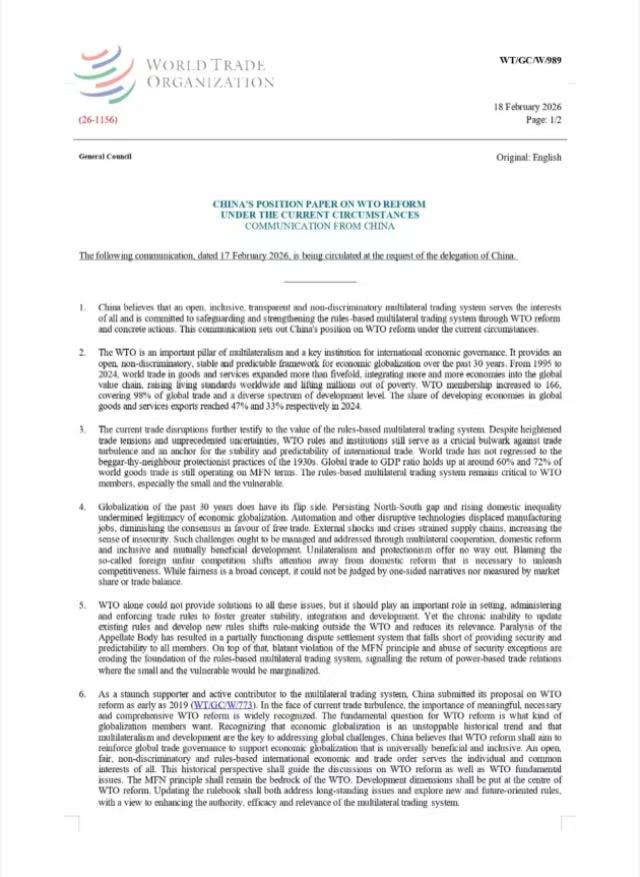
中国提交关于当前形势下世贸组织改革的立场文件
Xin Lang Cai Jing· 2026-02-19 03:30
Group 1 - The core viewpoint of the news is China's submission of a position paper to the WTO, emphasizing the need to center development in the reform agenda to help developing members seize opportunities in digital economy, green transition, and artificial intelligence [1][2] - The position paper is the first comprehensive policy document submitted by China to the WTO since the initiation of the reform process, outlining China's supportive stance towards inclusive economic globalization and the multilateral trading system [1] - The document suggests implementing special and differential treatment provisions in a more precise and effective manner, encouraging developing members to capitalize on future industries and trade opportunities [1] Group 2 - The WTO initiated a necessary reform process in June 2022, achieving some progress in areas such as mechanism operation, in response to unilateral tariff measures and decision-making abuses by certain members [2] - The WTO members plan to start deep reform consultations in the second half of 2025, aiming to address urgent issues like operational inefficiencies and rule deficits based on previous work [2]
展现推动历史前行的大国之姿
Xin Lang Cai Jing· 2026-02-14 21:57
Core Viewpoint - The article emphasizes the importance of major powers taking responsibility in shaping a fair and just international order, advocating for cooperation, equality, and respect for the sovereignty of all nations [1][2][3]. Group 1: China's Role in Global Governance - China promotes a multilateral approach to international relations, advocating for a more equitable and just global order while opposing unilateralism and protectionism [3][4]. - The country actively participates in multilateral mechanisms such as the G20, Shanghai Cooperation Organization, and BRICS, aiming to enhance cooperation and dialogue among nations [3][4]. - China's commitment to international law and the principles of the UN Charter is highlighted as essential for maintaining global stability and peace [1][3]. Group 2: Economic and Development Initiatives - China continues to expand its high-level openness, hosting international exhibitions and implementing zero tariffs for least developed countries, thereby sharing development benefits [4][5]. - The country is taking significant steps in global climate governance, announcing new contributions to the Paris Agreement and promoting green and low-carbon development [4]. - In the face of technological barriers, China is making breakthroughs in advanced fields and fostering international tech cooperation to bridge the digital divide [4]. Group 3: Diplomatic Engagements - In the new year, China has engaged in active diplomatic efforts, welcoming leaders from various countries, which reflects a global willingness to collaborate in addressing challenges [5]. - The global governance initiative proposed by China has garnered support from over 150 countries and international organizations, indicating its relevance to current global issues [5].
今日财经要闻TOP10|2026年2月14日
Xin Lang Cai Jing· 2026-02-14 11:54
Group 1 - The U.S. military is preparing for potential military action against Iran, which could last for several weeks if ordered by President Trump, raising the risk of unprecedented conflict between the two nations [1] - The ongoing military planning is more complex, with potential strikes on Iran's nuclear infrastructure and national security facilities anticipated, alongside expected retaliatory actions from Iran [1] Group 2 - Following the release of U.S. CPI data, market expectations for a Federal Reserve interest rate cut have increased, leading to a decline in the U.S. dollar index and boosting the attractiveness of precious metals [2] - Gold prices rose by 2.41% to $5042.81 per ounce, while silver prices increased by 2.81% to $77.34 per ounce, prompting domestic gold jewelry prices to rise, with brands like Chow Sang Sang and Lao Miao adjusting their prices to 1551 CNY and 1565 CNY per gram respectively [2][2] Group 3 - Bridgewater Associates disclosed a significant increase in holdings of Nvidia, Amazon, and Micron Technology stocks, as well as Newmont Corporation, a major gold producer, in its latest 13F filing for Q4 [3] - The total market value of Bridgewater's holdings reached $27.4 billion, up from $25.5 billion in the previous quarter, with the top ten holdings accounting for 36.33% of the total [3] Group 4 - The State Administration for Market Regulation of China has held discussions with major platform companies, including Alibaba and Tencent, emphasizing compliance with various laws and the need to eliminate "involutionary" competition to foster a fair market environment [4] Group 5 - China plans to implement zero-tariff measures for 53 African countries starting May 1, 2026, while also promoting the signing of economic partnership agreements to enhance trade [6] Group 6 - A new policy from multiple Chinese regulatory bodies aims to strengthen support for rural enterprises in accessing capital markets, including facilitating listings and financing for companies in former poverty-stricken areas [7]