供应链脆弱性

Search documents
J.B. Hunt Transport Services (NasdaqGS:JBHT) 2026 Conference Transcript
2026-03-17 14:32
Summary of J.B. Hunt Transport Services Conference Call Company Overview - **Company**: J.B. Hunt Transport Services (NasdaqGS: JBHT) - **Date of Conference**: March 17, 2026 - **Key Speakers**: Brad Delco (CFO), Darren Field (President of Intermodal), Greer Woodruff (EVP of Safety, Sustainability, and Maintenance) Key Industry Insights Demand and Supply Chain Dynamics - Demand was slightly stronger than expected in January, with some customers increasing their forecasts for the year, while others remained unchanged [2][3] - A significant winter storm at the end of January disrupted transportation supply chains, described as the worst event in a decade, impacting the ability to move equipment [3][4] - Rail service has improved significantly, with exceptional recovery from winter events, indicating a strong commitment from railroads to sustain resiliency [19][20] Market Conditions - The market is described as fragile, with limited elasticity in supply and demand dynamics, making it sensitive to disruptions [23][24] - Customers are managing inventories more confidently, operating with lower levels due to the reliable supply chain, but there is concern about potential lost sales if demand increases unexpectedly [35][36] Regulatory Environment - The administration is enforcing existing rules more strictly, which could lead to a reduction of 5% to 12% of CDL holders over the next few years due to non-compliance [41][43] - Changes in training standards for truck driving schools are anticipated, with a focus on improving the quality of new entrants into the industry [44][45] Company Strategy and Performance Intermodal Strategy - The company is focusing on converting highway freight to intermodal to help customers save costs, especially in a rising fuel price environment [25][26] - Intermodal fuel surcharges are typically lower than truckload surcharges, providing a competitive advantage [30][31] Cost Management and Efficiency - The company is actively working on cost-to-serve initiatives to improve margins and operational efficiency, with a focus on technology and process improvements [69][75] - The goal is to repair margins while managing inflationary pressures, with a commitment to transparency in reporting progress to investors [76][79] Future Outlook - The company anticipates a competitive environment where all players are focused on revenue recovery and margin repair, with intermodal pricing expected to lag behind truckload pricing historically [58][59] - There is an emphasis on collaboration with customers to optimize service and reduce costs, moving away from a zero-sum pricing strategy [66][67] Additional Considerations - The company is preparing for potential changes in the regulatory landscape, including the implications of the DRIVE-Safe Act and its impact on the brokerage business [50][52] - The focus on technology as a key enabler for operational efficiency and capacity utilization is central to the company's long-term strategy [80]

印度出口商焦虑,美印关税谈判陷入不确定风暴
Sou Hu Cai Jing· 2026-01-10 01:20
Group 1 - The core issue for Indian exporters is the uncertainty caused by delayed tariff negotiations with the U.S., which is critical for securing orders for the first half of 2026 [1][3] - In August 2025, the U.S. government imposed punitive tariffs on Indian goods, raising the overall tariff rate to 50%, significantly impacting labor-intensive sectors like textiles and apparel [1][5] - The holiday season, typically a peak time for exports, has seen a sharp decline in orders due to high tariffs, with the deadline of January 15 being crucial for securing large orders [1][3] Group 2 - Exporters are adapting by establishing subsidiaries in the U.S. to circumvent tariff barriers, relocating production to African countries, and moving some operations to the UAE, indicating a shift away from reliance on the U.S. market [3][5] - The Indian government is engaging a lobbying firm led by a former Trump advisor to navigate trade negotiations, highlighting the intertwining of business and political strategies in securing favorable terms [3][5] - The situation reflects a broader trend where economic leverage is used as a diplomatic tool, with tariffs serving not just as market management but also as political pressure [5][7] Group 3 - The ongoing tariff negotiations emphasize the vulnerability of global supply chains, particularly for companies heavily reliant on the U.S. market, where any policy change can trigger significant repercussions [5][7] - As January progresses, the urgency for Indian exporters increases, with every week potentially determining contract allocations for the summer shopping season [5][7] - The strategies employed by exporters, such as production migration and lobbying efforts, illustrate the complex interplay of economic, political, and market dynamics in the current global trade environment [7]

年终盘点之大宗商品:能源疲软,贵金属“疯牛”!2026年“淘金热”行情转向有色?
智通财经网· 2025-12-29 14:22
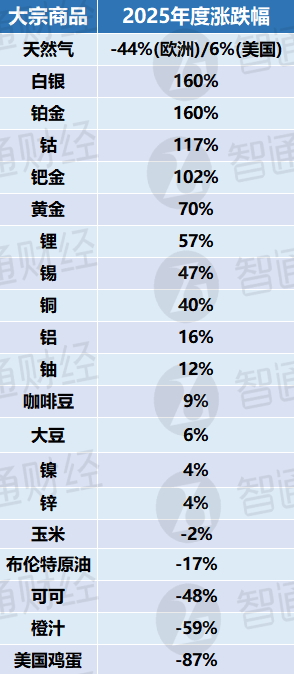
Key Insights - The global commodity market in 2025 shows a clear divergence, with energy and agricultural prices declining while precious metals (like gold and silver) and industrial metals (like copper) continue to rise and reach new highs. This situation is influenced by changes in global demand, geopolitical tensions, monetary policy adjustments, and the development of the new energy industry. This divergence is expected to persist into 2026, with energy prices anticipated to further decline due to oversupply, while precious metal prices are projected to continue rising [1]. Energy - The global crude oil market in 2025 experienced significant volatility, with Brent crude prices fluctuating between $60 and $70 per barrel by year-end. Geopolitical tensions and policy changes were key drivers of price movements, with prices peaking at $83 per barrel early in the year due to U.S. sanctions on Russia [3][5]. - In the second half of 2025, the market shifted from being geopolitically driven to one characterized by oversupply and weak demand, leading to a downward trend in oil prices. OPEC+ adjusted its strategy from production cuts to phased increases, while U.S. production reached historical highs, resulting in rapid inventory accumulation [5][6]. - For 2026, the oil market is expected to face severe oversupply pressures, with Brent crude prices projected to drop further. Analysts predict a price range of $56 to $60 per barrel, with some forecasts suggesting a potential dip to $51 per barrel in early 2026 [7]. Natural Gas - The global natural gas market in 2025 showed a "high then low" pattern, with prices initially rising due to cold weather and geopolitical factors but later declining as new U.S. production came online and demand slowed in Asia [8][10]. - In 2026, the market is expected to transition from a "tight balance" to "periodic oversupply," driven by increased LNG production from the U.S., Qatar, and Canada. Despite ample supply, demand is projected to rise by 2%, providing some price support [10]. Uranium - The uranium market in 2025 transitioned from "de-bubbling" to "structural support," with prices rebounding from a low of approximately $63 per pound to around $81-83 per pound by year-end. This was driven by renewed demand from nuclear power and AI data centers [11][13]. - For 2026, expectations are for uranium prices to accelerate upward, with forecasts suggesting prices could reach $91 per pound, with some estimates as high as $135 per pound due to increasing demand and supply constraints [14]. Precious Metals - Precious metals experienced a "historic rally" in 2025, with gold prices rising approximately 70% and silver prices soaring over 160%. This was fueled by central bank purchases, ETF inflows, and a low-interest-rate environment [15][17]. - For 2026, major financial institutions predict continued bullish trends for gold, with average prices expected to range from $4,500 to $5,000 per ounce, driven by central bank strategies and concerns over U.S. dollar credit [18][19]. Industrial Metals - The industrial metals market in 2025 was characterized by extreme differentiation, with copper prices reaching historical highs due to demand from AI data centers and global grid upgrades. Copper prices exceeded $12,700 per ton [21]. - In 2026, copper and tin are expected to remain strong, with copper potentially reaching $15,000 per ton, while tin prices may rise to $44,000 per ton due to ongoing supply constraints [28]. Agricultural Products - Cocoa prices fell significantly in 2025 after reaching a peak in 2024, while coffee prices exhibited a high-level fluctuation, with expectations for a return to balance in 2026 as supply improves [25][27]. - For 2026, cocoa is expected to see a surplus of about 150,000 tons, leading to price declines, while coffee prices are projected to drop significantly due to increased production in Brazil and Colombia [29][32].