
货币政策调整

Search documents
张瑜:资产重“扩圈”,债券再思辩
一瑜中的· 2026-03-13 03:51
Group 1 - The core viewpoint is that 2025 is seen as a turning point for bond assets, transitioning from strong to weak, supported by three main reasons [2] - The first reason is the shift in residents' investable assets from "contraction" to "expansion," which is expected to increase the pressure on bond yields [20] - The second reason is the improvement in the economic cycle, which is anticipated to lead to upward pressure on bond yields as the distribution of deposits changes [33] - The third reason is the change in monetary policy focus from "quantity" to "structure," which is also expected to exert upward pressure on bond yields [36] Group 2 - The concept of investable assets is defined as the portion of disposable income that residents allocate beyond consumption, including stocks, funds, real estate, and deposits [5] - Since 2018, there has been a continuous "contraction" of residents' investable assets due to regulatory changes and economic downturns, leading to a significant increase in defensive deposits [7][24] - The "contraction" of investable assets has resulted in longer durations for bank liabilities and increased demand for long-duration bonds, causing bond yields to decline significantly [28] Group 3 - In 2025, a new "expansion" of investable assets is expected, driven by technological innovations and stable stock market policies, which will enhance the attractiveness of riskier assets [31] - The distribution of deposits is crucial for economic circulation; when deposits flow to enterprises, it stimulates production and investment, improving the economic cycle [10] - The upward trend in the "scissors difference" between enterprise and resident deposits indicates a recovery in the economic cycle, leading to upward pressure on bond yields [10] Group 4 - The relationship between resident deposits and monetary policy is characterized by a "seesaw" effect; as deposits shift towards non-bank institutions, the central bank may suppress interest rate declines to avoid systemic risks [11] - Historical data suggests that when the economic cycle improves, the volatility of funds tends to increase, which may lead to upward movements in interest rates [39] - The recovery in profit expectations reduces the likelihood of interest rate cuts, as historical trends show that rate cuts typically occur during periods of declining industrial profits [41]


资产重扩圈,债券再思辨
Huachuang Securities· 2026-03-05 09:27
Group 1: Key Changes in Bond Market - 2025 is identified as a turning point for bond assets, shifting from strong to weak due to three main factors[1] - The first factor is the transition of residents' investable assets from "contraction" to "expansion," which reduces the attractiveness of fixed-income assets[1] - The second factor is the improvement in economic circulation, leading to upward pressure on bond yields as corporate cash flow improves and deposit growth increases[1] - The third factor is the change in monetary policy stance, with a shift from a focus on quantity to a focus on structure, limiting the bullish outlook for bonds[1] Group 2: Investable Assets and Economic Impact - Since 2018, residents' investable assets have been in a "contraction" phase, leading to a preference for risk-free government bonds[1] - In 2025, the expansion of investable assets is driven by technological breakthroughs and stable stock market policies, encouraging risk-taking for higher returns[1] - The distribution of deposits is crucial for economic circulation; when deposits move from residents to enterprises, it enhances economic activity[8] - The ratio of new deposits to M2 has significantly decreased, indicating that less money is being locked in residents' accounts and more is flowing into the real economy[8] Group 3: Monetary Policy and Future Outlook - The monetary policy framework is expected to remain moderately accommodative, but the likelihood of a return to unconventional easing is decreasing[12] - Historical data suggests that significant interest rate cuts typically occur during periods of negative profit growth, which is less likely as profit expectations improve[12] - The shift in economic structure, with new economy sectors surpassing old economy sectors, reduces the necessity for aggressive monetary policy interventions[12]
美联储理事米兰,下调今年降息幅度,预期就业好转
Sou Hu Cai Jing· 2026-02-21 00:42
Group 1 - The core viewpoint is that Federal Reserve Governor Milan announced a moderate reduction in interest rate cuts for this year, reflecting an optimistic outlook on the U.S. economy and job market [1] Group 2 - The reason for the reduction in interest rate cuts is based on recent positive employment data and an accelerating economic recovery, which helps balance economic growth and inflation control [2] Group 3 - The expectation of an improving job market is supported by factors such as faster economic recovery, government policies aimed at boosting employment, and a sustained demand for hiring from businesses [3] Group 4 - Milan's speech has had a notable impact on financial markets, with investors adopting a cautiously optimistic stance, believing this will contribute to steady economic growth and provide clearer policy guidance for businesses [4]
机构:新西兰联储明年起将货币政策会议次数提至8次 或能略微缩短政策滞后时间
Xin Lang Cai Jing· 2026-02-19 05:37
Core Viewpoint - The Reserve Bank of New Zealand will increase its annual policy decision meetings from 7 to 8 starting in 2027 to better align with the transition to monthly CPI data reporting from next year [1] Group 1 - The decision to increase meeting frequency is procedural rather than directional [1] - The adjustment may slightly reduce the lag effect of policy changes [1] - Following the implementation, the sensitivity of the New Zealand dollar and interest rates to unexpected changes in the monthly consumer price index may increase [1] Group 2 - The decision dates have been confirmed until February 2028, with the February 2027 meeting date being moved forward by one week [1] - The monetary policy committee retains the flexibility to make unconventional decisions if financial or economic conditions necessitate [1]
尽管美国1月消费者价格涨幅低于预期,小幅提升了市场对6月降息的押注
Sou Hu Cai Jing· 2026-02-17 16:36
Group 1 - The core viewpoint of the articles is that the lower-than-expected Consumer Price Index (CPI) for January has increased market speculation regarding a potential interest rate cut by the Federal Reserve in June [1][2] - The January CPI data indicates a gradual easing of inflationary pressures, which is a critical factor for the Federal Reserve in its monetary policy decisions [1] - The market's rising expectations for a June rate cut could significantly impact borrowing costs, investment returns, and consumer prices, potentially stimulating economic growth and boosting market confidence [1][2] Group 2 - The CPI data serves as a new reference point for future monetary policy adjustments, suggesting that if inflation continues to slow, the Federal Reserve may consider further easing measures, including rate cuts [2] - Overall, the lower-than-expected CPI has sparked renewed speculation and anticipation regarding future monetary policy changes, particularly the likelihood of a June rate cut, which could have profound effects on the lending market, investment landscape, and overall economic activity [2]
美国一月非农就业数据大超预期,打压市场降息预期七月概率高
Sou Hu Cai Jing· 2026-02-13 06:01
Core Insights - The strong performance of the U.S. non-farm payroll data for January has significantly impacted market expectations regarding interest rate cuts, leading to a reduction in such expectations [1][2] - The robust job growth indicates resilience and growth momentum in the U.S. economy, providing the Federal Reserve with greater policy flexibility [1] - The market's previous anticipation of interest rate cuts due to economic or inflationary pressures may be altered by the strong non-farm employment data, suggesting the Fed may adopt a wait-and-see approach in the short term [1] Economic Indicators - January's non-farm payroll data showed job additions far exceeding market expectations, reflecting a strong labor market [1] - The positive employment data suggests that the Federal Reserve may not be in a hurry to implement interest rate cuts, at least in the near term [1][2] Future Policy Outlook - July is identified as a critical observation period for potential changes in monetary policy, influenced by seasonal economic adjustments and global economic uncertainties [1] - Despite the current positive data, there are concerns regarding future risks such as changes in the global economic landscape and geopolitical tensions, which could affect the Fed's decision-making [2]
【环球财经】机构称土耳其央行或于3月暂停降息
Xin Hua Cai Jing· 2026-02-10 12:53
Group 1 - The core viewpoint of the article highlights that Turkey's inflation data for January exceeded expectations, increasing uncertainty regarding monetary policy adjustments, with a potential pause in interest rate cuts expected in March [1] - The Consumer Price Index (CPI) in Turkey rose by 4.84% month-on-month in January, with a year-on-year increase of 30.65%, driven by rising food prices and price adjustments at the beginning of the year [1] - The Central Bank of Turkey has reduced the policy interest rate from 46% to 37% since July 2025, with the next monetary policy committee meeting scheduled for March 2026 [1] Group 2 - The CEO of Isbank, Hakan Aran, indicated that maintaining the interest rate could signal policy firmness to the market [1] - Based on January's data, the Central Bank's previous inflation forecast for the end of 2026, which was between 13% and 19%, is now considered invalid, with a new lower limit of at least 19% and a more reasonable range potentially moving to 19% to 25% [1] - Financial analyst Serpil Tuncer from Istanbul believes that due to fluctuations in food prices and persistent inflation in the service sector, the Central Bank is more likely to adopt a "wait-and-see" approach in the March meeting [1]
别急!黄金暴跌并不是真正的拐点,和2013年完全不同,普通人还有上车的机会
Sou Hu Cai Jing· 2026-02-05 16:37
Core Viewpoint - The global gold market experienced its most severe turbulence in 40 years, with a dramatic drop in gold prices following the nomination of Kevin Warsh as the next Federal Reserve Chairman, shifting market expectations from aggressive monetary easing to maintaining high interest rates and reducing the balance sheet [1][3][6] Group 1: Market Reaction - On January 30, 2026, the London spot gold price peaked at $5,598 per ounce before plummeting nearly $670, a drop of 12.92%, reaching a low of $4,682 per ounce [1][3] - The Shanghai Gold Exchange Au9999 contract saw a daily drop of over 9%, with some gold jewelry prices adjusting down by 15% [3] - The panic among investors was evident, with many rushing to liquidate their holdings, leading to long queues at gold shops [3][11] Group 2: Economic Factors - The direct trigger for the price drop was the nomination of Kevin Warsh, a known hawk, which altered market expectations regarding monetary policy [3][6] - Prior to the crash, gold prices had surged significantly, with a 67% increase in 2025, leading to a market that was severely overbought [3][8] - The relative strength index (RSI) for gold reached 90, indicating extreme overbought conditions, while non-commercial net long positions in gold futures were at 68%, well above the historical average of 45% [3][8] Group 3: Market Structure - Central banks globally increased their gold holdings, with net purchases reaching 863 tons in 2025, while Tether became the largest private holder with 140 tons [5] - The leverage in gold futures increased by 37% compared to early 2025, exacerbating market vulnerability [6][9] - The strong performance of the US dollar and rising Treasury yields further pressured gold prices, with the dollar index rising 1.01% on January 30, reaching a seven-month high [6][8] Group 4: Historical Context - The recent crash shares similarities with past significant declines in gold prices, notably in 1980 and 2013, driven by aggressive Federal Reserve policies and economic recovery signals [9][11] - Unlike previous crashes, the current decline is characterized by a rapid adjustment but with stronger fundamental support due to increased central bank demand for gold [9][11] Group 5: Consumer Behavior and Market Dynamics - The price drop led to a bifurcation in consumer behavior, with some investors liquidating assets while younger consumers took the opportunity to purchase gold [11][13] - Retail strategies were quickly adjusted, with brands like Chow Tai Fook changing pricing strategies and online platforms promoting discounted gold [11][13] - The volatility in the gold market highlighted the complexities and vulnerabilities of modern financial markets, posing challenges to global financial stability [11][13]

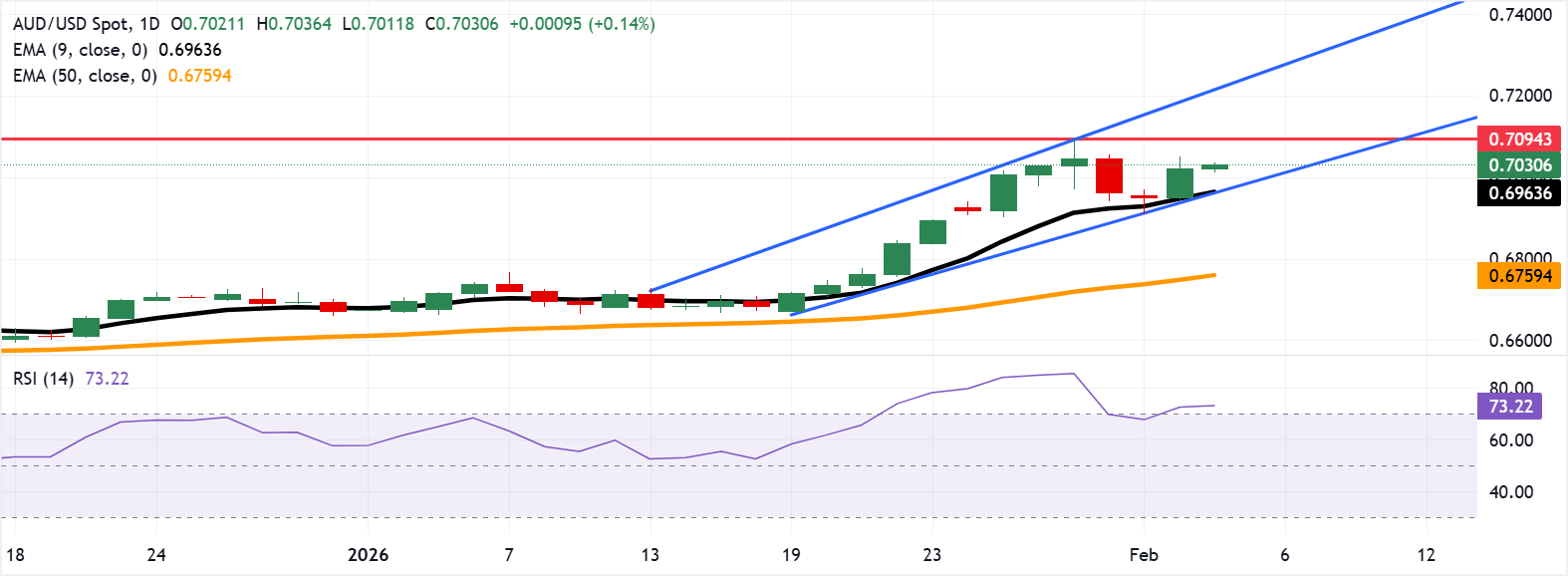
BlueberryMarkets:澳元兑美元涨至0.7094,受中澳因素推动
Sou Hu Cai Jing· 2026-02-04 08:30
Group 1 - The Australian dollar (AUD) has continued its upward trend against the US dollar (USD), reaching a high of 0.7094, the highest since January 2023, driven by positive economic data from China and Australia, a resumption of the interest rate hike cycle by the Reserve Bank of Australia (RBA), and a weakening USD index [1][2] - China's economic performance directly impacts the AUD, with improvements in service and manufacturing PMIs indicating a positive outlook for Australian commodity exports [2][3] - Australia's domestic economy showed strong performance, with the composite PMI rising from 51.0 to 55.7, marking the strongest expansion in 45 months, and the services PMI reaching its highest level since February 2022 [3] Group 2 - The RBA raised the official cash rate by 25 basis points to 3.85%, marking its first rate hike since November 2023, driven by higher-than-expected inflation data [4] - Inflation pressures in Australia are significant, with the December CPI rising by 1.0%, exceeding expectations, and the January TD-MI inflation indicator showing a year-on-year increase of 3.6% [4][5] - Market expectations for further rate hikes by the RBA have increased, with an 80% probability of a rate hike in May and potential additional hikes totaling around 40 basis points within the year [6] Group 3 - The USD index has been weak, trading around 97.40, influenced by a lack of key economic data from the US and cautious statements from Federal Reserve officials regarding interest rates [6] - Despite stronger-than-expected PPI data in the US, market expectations for an early rate cut by the Federal Reserve have not completely dissipated, maintaining a weak outlook for the USD [6] Group 4 - Technically, the AUD/USD is in an upward channel, with a strong bullish trend, although it may face short-term adjustment pressure due to being in the overbought zone [8] - Key resistance for the AUD/USD is at the 0.7100 level, with potential to test the upper channel at 0.7210, while support is concentrated around the 9-day EMA at 0.6964 [8]
黄金暴跌,市场总有轮回。
Sou Hu Cai Jing· 2026-02-02 20:40
Group 1 - The current market situation is characterized as a "repricing of risk assets" rather than a simple price correction, indicating a collective reassessment of long-ignored assumptions [3][5] - The macroeconomic environment has shifted, with signals from the Federal Reserve suggesting a potential slowdown in interest rate cuts, leading to a reevaluation of assets that thrived on low rates and high liquidity [4][5] - The tightening of liquidity and the strengthening of the dollar have forced long positions in various assets, including gold, to be liquidated, resulting in simultaneous declines in these safe-haven assets [6][7] Group 2 - Bitcoin and gold are both influenced by macroeconomic trends but differ significantly in their belief systems, funding structures, and correction mechanisms [20] - The recent decline in gold prices is attributed to its status as a central bank asset, which provides a buffer against severe drops, unlike Bitcoin, which is more volatile [21] - Gold is recognized as a universal hard currency with intrinsic value, and its price is expected to rise in the long term due to limited supply and increasing global demand, despite short-term fluctuations [23]