供给侧经济学

Search documents
人物|下届美联储主席呼之欲出,特朗普为何对他青睐有加?
Sou Hu Cai Jing· 2025-12-07 02:02
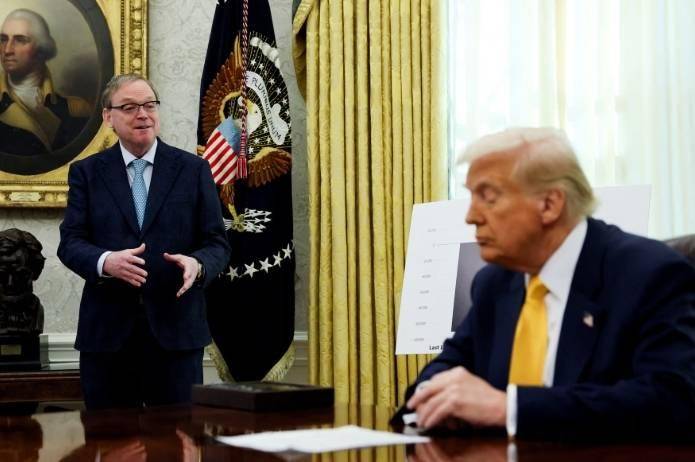
Core Viewpoint - The potential appointment of Kevin Hassett as the next Federal Reserve Chairman by President Trump raises questions about the future independence of the Fed and its monetary policy direction [1][15]. Group 1: Hassett's Background and Rise - Kevin Hassett, a 62-year-old conservative economist, has gained prominence in Washington due to his loyalty to Trump and pragmatic policy views [3]. - Hassett's upbringing in Greenfield, Massachusetts, and his academic achievements laid the foundation for his career in economics [4]. - He graduated with a 3.9 GPA from Swarthmore College, where he was influenced by Keynesian and supply-side economics [4][5]. Group 2: Career Path - After earning his PhD from the University of Pennsylvania, Hassett worked as a research assistant at the Federal Reserve Board, which sparked his interest in monetary policy [5]. - His career transitioned from academia to policy-making, serving as a professor and later joining the American Enterprise Institute, where he led research on various economic issues [6][8]. - Hassett's experience as an economic advisor during multiple presidential campaigns, including Trump's, has solidified his reputation within the Republican economic circle [9]. Group 3: Economic Views and Policy Implications - Hassett's economic philosophy is rooted in supply-side economics, advocating for tax cuts, deregulation, and trade protection to achieve high growth [11]. - He supports a more transparent Federal Reserve and has criticized its operations as "black box" practices, advocating for congressional oversight [11][13]. - Unlike current Fed Chairman Jerome Powell, Hassett favors a dovish monetary policy, suggesting quicker interest rate cuts to avoid economic downturns [11][13]. Group 4: Relationship with Trump and Future Prospects - Hassett's close relationship with Trump, characterized by loyalty and shared economic views, positions him as a favored candidate for the Fed chairmanship [14]. - His experience and understanding of the Fed's internal workings make him a strong contender compared to other candidates [14]. - If appointed, Hassett's leadership could signify a shift in the Fed's role from a technical institution to a policy tool aligned with Trump's agenda [15].

深度丨福山对话彼得蒂尔:关于经济不平等、政府效率、技术进步和全球化
Z Finance· 2025-03-04 05:22
Core Viewpoint - The discussion highlights the increasing wealth inequality in the U.S., the inefficiency of government, and the stagnation of technological progress, suggesting that these issues are interconnected and may lead to significant societal consequences [2][3][6]. Summary by Sections Wealth Inequality - The disparity between the wealth of the top 1% and the bottom 99% has been growing at an unprecedented rate, potentially surpassing levels seen in the early 20th century [2][3]. - The right-wing has largely ignored this issue, either denying its existence or deeming it unimportant, which is seen as a significant blind spot [2][3]. Government Inefficiency - Government efficiency has deteriorated, with rising expenditures failing to yield proportional improvements in governance [3][4]. - Examples include the prolonged construction times for infrastructure projects compared to historical benchmarks, indicating a decline in operational effectiveness [3][4]. Technological Stagnation - There is a concern that technological progress has slowed since the late 1960s, with significant innovations becoming rare outside of specific sectors like computing and finance [6][7]. - The stagnation in technological advancement is linked to broader economic growth issues, leading to political cynicism and a zero-sum perception of economic competition [7][10]. Globalization's Impact - Globalization has created a "winner-takes-all" environment, adversely affecting the middle class and white-collar workers, particularly through labor arbitrage with countries like China [12][20]. - The benefits of globalization have not been evenly distributed, leading to increased inequality and social unrest [12][20]. Education and Innovation - The education system is criticized for perpetuating a bubble, with many students accumulating debt without securing corresponding employment opportunities [27][29]. - There is a call for a reevaluation of educational investments and a shift towards recognizing non-college career paths as viable options [27][29]. Future Considerations - The discussion raises philosophical questions about the role of government in planning for the future, particularly in the context of technological innovation and economic policy [15][17]. - The potential for long-term societal issues stemming from demographic changes and technological stagnation is emphasized, suggesting a need for proactive policy adjustments [23][24].