
经济停滞

Search documents
如果市场拿着"1970剧本",而黄金刚刚重演了"1971-1973年大涨后的首次大跌"
华尔街见闻· 2026-03-26 12:11
Core Viewpoint - The report from Huatai Securities emphasizes that while historical patterns can provide insights, they do not repeat exactly. The 1970s stagflation can be divided into three phases: initial inflation speculation, a tug-of-war between inflation and economic stagnation, and finally, economic stagnation dominating with inflation receding [2]. Group 1: Historical Context and Asset Performance - The analysis of the 1970s shows that gold was the only major asset to achieve positive real returns after adjusting for inflation, despite experiencing significant drawdowns during its long-term uptrend [5][8]. - Gold's performance during key periods in the 1970s was exceptional, with a total increase of 829.1% from January 1966 to December 1985, making it the best-performing asset class [8][9]. - The first oil crisis (October 1973 to March 1974) saw gold rise by 76.5%, while the S&P 500 fell by 13.2% [8][9]. Group 2: Current Market Dynamics - Recent market conditions have led to gold and silver underperforming, primarily due to a strong dollar and liquidity constraints, which have caused investors to liquidate gold for cash [14][16]. - The current phase is characterized by a tightening liquidity environment, which has resulted in significant outflows from gold, indicating its role as a "liquidity withdrawal machine" [26][29]. - The market is currently oscillating between the first and second phases of stagflation, with concerns about inflation reigniting and liquidity tightening [22][30]. Group 3: Investment Strategy and Future Outlook - Investors should focus on key variables that will determine gold's next trend, including the persistence of oil price shocks, the peak of the dollar, and the potential for credit risk exposure [30][31]. - The report suggests that gold's volatility will continue, reflecting a pattern of "upward—liquidation—then upward" similar to the 1970s, as investors adapt to the current market conditions [31].


关税执念从何而起?80年代日本成宿敌,让特朗普耿耿于怀三十年!
Sou Hu Cai Jing· 2025-10-27 10:21
Core Insights - Trump's trade policy is deeply influenced by the economic conditions of Japan in the 1980s, with trade issues remaining a central topic during his recent visit to Tokyo [1][3] - Japan's economic status has significantly declined, now ranking fourth globally, which contrasts with Trump's perception of Japan as a competitive threat [3][5] - The U.S.-Japan trade agreement includes Japan committing to a 15% tariff on U.S. goods and a promise to invest $550 billion in the U.S. [3] Group 1 - Trump's view of Japan as a competitor is outdated, as Japan has not been a direct competitor to the U.S. for decades [3][5] - Japan's economy has faced prolonged stagnation since the 1991 real estate bubble burst, leading to low investment and demand [3][5] - Structural issues such as an aging population and labor shortages are prompting Japan to accept more foreign workers [5][8] Group 2 - The historical context of U.S.-Japan relations reflects changes in the global economic landscape and Trump's enduring economic views [7] - Despite challenges, Japan's strengths in high-end manufacturing, technological innovation, and social stability position it to find new growth opportunities [8]
德国央行:德国二季度经济恐停滞不前
news flash· 2025-07-16 11:20
Core Viewpoint - The German economy is likely to stagnate in the second quarter of the year after a surprisingly strong expansion at the beginning of the year, according to the German central bank's monthly report [1] Economic Performance - The report indicates that the growth effects from previous periods are fading, leading to a potential stagnation in the second quarter [1] - The overall trend of the economy remains "generally weak" [1] External Risks - The central bank warns that the recent threat by U.S. President Trump to impose a 30% tariff poses "significant economic downside risks" [1] - The export sector in Germany is expected to face additional challenges due to U.S. tariff policies in the short term [1] Market Sentiment - Recent improvements in sentiment indicators may be partly due to market hopes for more expansionary fiscal policies [1] - However, the positive impact of such policies on economic performance is expected to manifest with a delay [1]
今晚,恐又反转!
Sou Hu Cai Jing· 2025-07-08 09:55
Group 1 - Gold prices experienced volatility, initially dropping below $3,300 to $3,296.37 before rebounding to close at $3,336.19 [1] - The U.S. stock market saw a collective decline, with the Dow Jones down 0.94% to 44,406.36 points, the S&P 500 down 0.79% to 6,229.98 points, and the Nasdaq down 0.92% to 20,412.52 points [1] - The U.S. government announced new tariffs on imports from 14 countries, with rates ranging from 25% to 40% depending on the country [4] Group 2 - The EU is still negotiating with the U.S. for a bilateral trade agreement before July 9, amidst rising tensions over tariffs [5] - Concerns are growing that the new tariffs could exacerbate inflation in the U.S., impacting consumer spending [6] - The U.S. Treasury Secretary indicated that the market is factoring in potential interest rate cuts by the Federal Reserve, with expectations of two cuts remaining this year [8] Group 3 - The Reserve Bank of Australia decided to maintain its cash rate at 3.85%, contrary to market expectations of a rate cut [9] - Recent unexpected rate cuts by central banks in Poland and Norway highlight a trend of monetary policy adjustments in response to economic conditions [11] - Investor sentiment in the U.S. stock market has shifted, with a recovery in indices despite ongoing concerns about tariffs and inflation [11]

6月19日电,国际货币基金组织警告欧元区面临陷入经济停滞的风险。
news flash· 2025-06-19 14:40
Core Viewpoint - The International Monetary Fund (IMF) has warned that the Eurozone is at risk of falling into economic stagnation [1] Group 1 - The IMF's warning highlights potential economic challenges facing the Eurozone [1]
IMF警告称:欧元区面临陷入经济停滞的风险。
news flash· 2025-06-19 14:38
Core Insights - The IMF warns that the Eurozone is at risk of falling into economic stagnation [1] Economic Outlook - The IMF highlights that the Eurozone's economic growth is slowing down, with projections indicating a potential stagnation in the near future [1] - Key factors contributing to this risk include high inflation rates and rising interest rates, which are impacting consumer spending and business investments [1] Policy Recommendations - The IMF suggests that Eurozone countries should implement structural reforms to enhance productivity and competitiveness [1] - It emphasizes the need for coordinated fiscal policies to support economic growth and mitigate the risks of stagnation [1]
国际货币基金组织警告欧元区面临陷入经济停滞的风险。
news flash· 2025-06-19 14:38
Core Insights - The International Monetary Fund (IMF) has warned that the Eurozone is at risk of falling into economic stagnation [1] Economic Outlook - The IMF's warning highlights concerns over the Eurozone's economic growth prospects, indicating potential challenges ahead [1] - The organization suggests that without significant policy adjustments, the region may struggle to achieve sustainable growth [1] Implications for Investment - Investors may need to reassess their strategies in light of the IMF's caution regarding the Eurozone's economic stability [1] - The potential for stagnation could impact various sectors within the Eurozone, leading to a reevaluation of investment opportunities [1]
韩国总统李在明:(就追加预算)经济停滞太严重了,是时候动用预算了。
news flash· 2025-06-19 06:41
Core Viewpoint - The South Korean President Lee Jae-myung emphasizes the severity of economic stagnation and advocates for the utilization of the budget to address the situation [1] Group 1 - The economic stagnation in South Korea is described as being too severe, prompting the need for additional budget measures [1]
财政刺激力压关税阴云 德国投资者信心超预期逆转
智通财经网· 2025-06-17 12:31
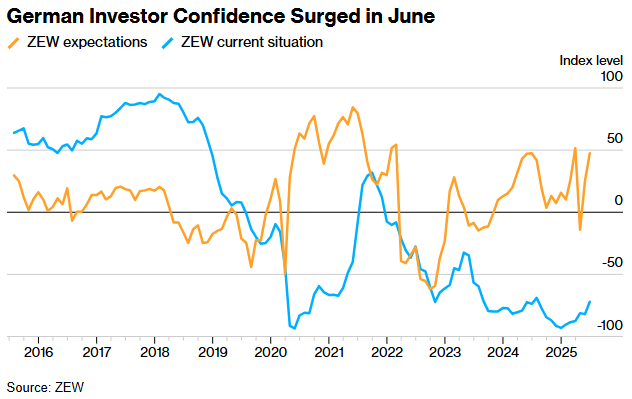
Group 1 - German investor confidence has unexpectedly rebounded, driven by an anticipated surge in public spending that offsets concerns over U.S. tariffs [1][4] - The ZEW economic sentiment index rose from 25.2 in May to 47.5 in June, significantly surpassing the median forecast of 35 [1][5] - The current situation index also showed improvement, indicating a stronger economic outlook [1] Group 2 - ZEW Chairman Achim Wambach stated that the fiscal stimulus policies announced by the new government are expected to boost the economy, alongside recent interest rate cuts by the European Central Bank [5] - Analysts predict that Germany will return to growth in 2025 after two consecutive years of contraction, with a GDP growth forecast of 0.2%, which is more optimistic than many recent forecasts of zero growth [5][9] - Deutsche Bank economist Mark Schatenberg noted that while the data exceeded expectations, potential risks from escalating military conflicts in the Middle East have not yet been reflected in the index [9] Group 3 - The German central bank's president, Joachim Nagel, indicated that revised output data for the first quarter could lead to positive growth in 2025, although the central bank still anticipates economic stagnation [9] - If structural issues are decisively addressed, Germany could become a "success story," with growth forecasts of 0.7% and 1.2% for 2026 and 2027, respectively, primarily due to increased defense and infrastructure spending [9] - Some institutions have raised their growth forecasts, with the Ifo Institute increasing its projection by 0.7 percentage points to 1.5%, and the Kiel Institute forecasting a growth of 1.6% [9]
德国投资者信心跃升 财政刺激措施超过贸易担忧影响
news flash· 2025-06-17 10:46
Group 1 - Investor confidence in the German economic outlook has improved significantly, primarily due to an upcoming surge in public spending that offsets concerns over U.S. tariffs [1] - The ZEW expectation index rose to 47.5 in June, up from 25.2 in the previous month, exceeding the median forecast [1] - The current situation indicator also showed improvement, reinforcing the assessment that the fiscal policy measures announced by the new German government could boost the economy [1] Group 2 - Achim Wambach, president of ZEW, stated that recent European Central Bank interest rate cuts may end Germany's nearly three-year economic stagnation [1]