保险公司偿付能力

Search documents
2025年第四季度偿付能力“体检”结果出炉 5家险企未达标
Jin Rong Shi Bao· 2026-02-25 02:46
Core Viewpoint - The solvency of insurance companies is crucial for their ability to fulfill compensation and payment responsibilities, and recent reports indicate that while most companies are solvent, five have failed to meet regulatory standards [1][2]. Group 1: Solvency Reports - A total of 57 life insurance companies and 77 property insurance companies have disclosed their solvency reports for Q4 2025, with the majority showing sufficient solvency and manageable risks [1]. - Five insurance companies have been identified as failing to meet solvency standards, specifically due to issues with core solvency adequacy ratios and risk ratings [2]. Group 2: Companies Failing to Meet Standards - The companies that did not meet solvency standards include Qianhai Property Insurance, Asia-Pacific Property Insurance, Anhua Agricultural Insurance, and Huahui Life, all rated as C class due to risk rating failures [2]. - Changsheng Life is the only company that failed due to a comprehensive solvency adequacy ratio falling below the required 100%, reported at 79.7% [2]. Group 3: Reasons for Non-Compliance - Common reasons cited for the failure to meet solvency standards include deficiencies in corporate governance, poor operational conditions, and changes in key personnel [2]. - Huahui Life specifically noted that its risk rating was downgraded due to incomplete governance rectification efforts, while Changsheng Life attributed its solvency decline to prolonged low interest rates necessitating increased solvency reserves [2]. Group 4: Improvement Plans - The five companies have outlined plans to improve their solvency status through a combination of capital management and operational adjustments [3][4]. - Qianhai Property Insurance plans to enhance capital management, reduce operational costs, and improve risk management through various measures [3]. - Anhua Agricultural Insurance aims to strengthen risk management and adjust investment strategies to align asset allocation with risk profiles [3]. - Changsheng Life is focusing on long-term bond investments to improve solvency ratios and is accelerating capital replenishment efforts [4]. - Huahui Life is implementing a four-pronged approach to address risk management and compliance issues [4]. Group 5: Companies on the Edge - Additionally, some companies are on the regulatory "warning line," such as Beida Fangzheng Life, which has a comprehensive solvency adequacy ratio of 114.78%, just above the critical threshold [5][6]. - The management of Beida Fangzheng Life has acknowledged risks related to market fluctuations and is committed to improving asset-liability matching and overall business quality [6]. Group 6: Industry Outlook - The insurance industry faces significant challenges in ensuring that companies not meeting solvency standards can effectively implement internal reforms and capital adjustments to overcome these hurdles in the upcoming year [6].
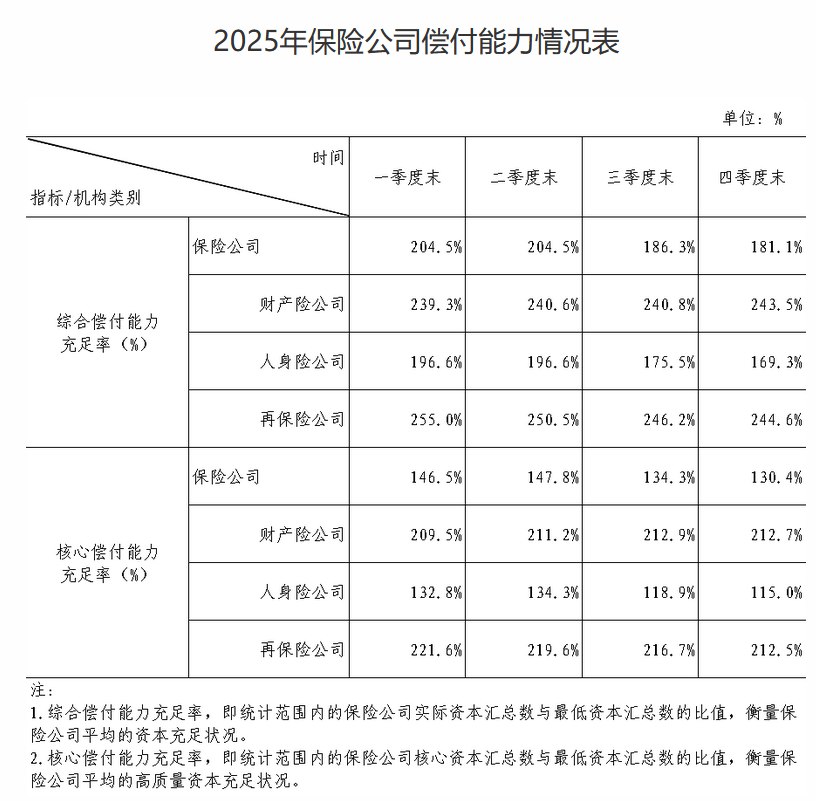
金融监管总局:四季度末保险公司核心偿付能力充足率130.4%
Xin Lang Cai Jing· 2026-02-12 11:21
Core Viewpoint - The National Financial Regulatory Administration released the solvency status of insurance companies for the end of 2025, indicating a comprehensive solvency adequacy ratio of 181.1% and a core solvency adequacy ratio of 130.4% as of the fourth quarter [1][4]. Summary by Category Comprehensive Solvency Adequacy Ratio - The comprehensive solvency adequacy ratio for insurance companies decreased from 204.5% in Q1 to 181.1% in Q4 [3][6]. - Property insurance companies maintained a high ratio, ending Q4 at 243.5% [3][6]. - Life insurance companies saw a decline from 196.6% in Q1 to 169.3% in Q4 [3][6]. - Reinsurance companies also experienced a decrease, ending Q4 at 244.6% [3][6]. Core Solvency Adequacy Ratio - The core solvency adequacy ratio for insurance companies fell from 146.5% in Q1 to 130.4% in Q4 [3][6]. - Property insurance companies had a stable core ratio, ending Q4 at 212.7% [3][6]. - Life insurance companies showed a decline from 132.8% in Q1 to 115.0% in Q4 [3][6]. - Reinsurance companies' core ratio decreased from 221.6% in Q1 to 212.5% in Q4 [3][6].

五家险企2025年四季度偿付能力不达标
Zhong Guo Jing Ying Bao· 2026-02-11 03:28
Core Insights - Five insurance companies have failed to meet solvency standards as per their fourth-quarter solvency reports for 2025, including Anhua Agricultural Insurance, Asia-Pacific Property Insurance, Qianhai Property Insurance, Changsheng Life Insurance, and Huahui Life Insurance [1][2] Group 1: Solvency Standards - According to the "Insurance Company Solvency Management Regulations," insurance companies must have a core solvency adequacy ratio of at least 50% and a comprehensive solvency adequacy ratio of at least 100%, along with a risk comprehensive rating of B or above to be considered solvent [1] - Among the non-compliant companies, Anhua Agricultural Insurance, Asia-Pacific Property Insurance, Qianhai Property Insurance, and Huahui Life Insurance have a risk comprehensive rating of C, while Changsheng Life Insurance has a comprehensive solvency adequacy ratio of 79.7%, which is below the required 100% [1] Group 2: Risk Management Issues - A continuous C rating indicates significant issues in corporate governance, internal controls, or risk management for the affected companies [1] - Anhua Agricultural Insurance reported that its C rating was primarily due to risks in corporate governance [2] - Asia-Pacific Property Insurance disclosed that over 88% of its equity is pledged or frozen, affecting its risk comprehensive rating [1]
同病不同因?长生人寿、华汇人寿偿付能力“亮红灯”
Nan Fang Du Shi Bao· 2026-02-06 13:46
Core Insights - The solvency of insurance companies is crucial for fulfilling policy obligations and resisting market risks [2] - Despite overall positive trends in the domestic insurance industry in 2025, Changsheng Life Insurance and Huahui Life Insurance face significant solvency challenges, making them notable risk cases in the sector [2] Changsheng Life Insurance - In 2025, Changsheng Life reported an insurance business income of 1.926 billion yuan, a year-on-year decline of 32.39%, and a net loss of 512 million yuan, significantly larger than the previous year's loss of 192 million yuan [3] - As of the end of 2025, the core solvency adequacy ratio was 64.8%, and the comprehensive solvency adequacy ratio was 79.7%, both below regulatory standards [3] - The company's operational difficulties stem from poor investment strategies leading to continuous losses, compounded by a rigid capital replenishment mechanism that limits its ability to mitigate risks [3][4] - Significant investment losses in Q4 2025 included a 194 million yuan investment in a real estate debt project, resulting in a 29 million yuan impairment, and a 46.13 million yuan investment in a trust, leading to a 21 million yuan impairment, both negatively impacting solvency ratios [4] Huahui Life Insurance - Huahui Life's core solvency adequacy ratio was 2169.11% and the comprehensive solvency adequacy ratio was 2185.27% as of the end of 2025, indicating sufficient solvency [6] - However, the company has a persistent C-class risk rating due to unresolved governance issues, which prevents it from meeting solvency standards [6] - Governance failures have led to operational stagnation, with the company unable to launch new products or expand its business effectively, resulting in a near standstill in operations [6][7] - In 2025, Huahui Life reported total insurance business income of 795,300 yuan and a net loss of 7.1 million yuan, with total assets of 695 million yuan and net assets of 580 million yuan [7] Industry Challenges - Both Changsheng Life and Huahui Life exemplify the broader challenges faced by small and medium-sized insurance companies, including capital replenishment difficulties and governance issues [10] - Regulatory measures for companies with inadequate solvency include supervisory talks, submission of plans to improve solvency, and restrictions on executive compensation and dividends [8] - The industry is experiencing heightened competition and regulatory standards, making it essential for companies to enhance governance, risk management, and operational capabilities to ensure sustainable development [10]

5家保险公司偿付能力“亮红灯”
Zheng Quan Ri Bao· 2026-02-06 03:50
Core Insights - Five insurance companies have reported non-compliance with solvency requirements for Q4 2025, primarily due to inadequate risk ratings and solvency ratios [1][2] Group 1: Solvency Compliance - According to the solvency management regulations, insurance companies must meet three criteria: core solvency ratio above 50%, comprehensive solvency ratio above 100%, and risk rating of B or above [2] - The five non-compliant companies include Huahui Life Insurance, Anhua Agricultural Insurance, Changsheng Life Insurance, Qianhai United Property Insurance, and Asia-Pacific Property Insurance [2] - Changsheng Life Insurance's non-compliance is due to a comprehensive solvency ratio below regulatory requirements, while the other four companies have risk ratings classified as C [2][5] Group 2: Governance Issues - Huahui Life Insurance has governance structure deficiencies, including unqualified board members, which hampers its operational capabilities [3][4] - The company faces significant operational constraints, with limited product offerings and market competitiveness, reporting an insurance revenue of approximately 795,000 yuan and a net loss of about 70.71 million yuan in 2025 [3] Group 3: Capital Supplementation Strategies - Asia-Pacific Property Insurance plans to attract strategic investors and optimize its business structure to improve solvency ratios [3] - Qianhai United Property Insurance aims to enhance capital management, reduce operational costs, and adjust business strategies to improve profitability and solvency [3] - The industry has collectively raised 145.472 billion yuan through various capital supplementation methods, including equity financing and issuing capital supplementary bonds [6]
偿付能力体检未达标 5家险企触发“连锁反应”
Xin Lang Cai Jing· 2026-02-05 17:12
Core Viewpoint - Five insurance companies have failed to meet solvency standards as of the fourth quarter of 2025, raising concerns about their ability to fulfill policyholder obligations and the potential consequences of continuous non-compliance [1][2]. Group 1: Companies Failing to Meet Solvency Standards - The five companies that did not meet solvency standards include Anhua Agricultural Insurance, Asia-Pacific Property Insurance, Qianhai Property Insurance, Changsheng Life Insurance, and Huahui Life Insurance [1]. - Among these, four companies have consistently failed to meet solvency standards in recent years, indicating a pattern of ongoing issues [1][2]. Group 2: Reasons for Non-Compliance - The primary reasons for non-compliance include weak capital foundations, limited business scale and diversity, and inadequate risk management practices [2][3]. - Specific issues cited include capital shortages, improper asset allocation, and deficiencies in risk control and compliance management [2][3]. Group 3: Impacts of Non-Compliance - Non-compliance with solvency standards can lead to significant operational restrictions, including limitations on new business, management changes, and potential loss of market reputation [5][6]. - Regulatory measures may include increased scrutiny, operational restrictions, and even potential takeover or bankruptcy proceedings for non-compliant companies [5][6]. Group 4: Responses and Strategies for Improvement - Companies are taking steps to address solvency issues, such as capital supplementation, improving corporate governance, and enhancing risk management frameworks [7][9]. - Specific strategies include engaging strategic investors, optimizing capital allocation, and utilizing technology to improve risk assessment and operational efficiency [7][9]. Group 5: Challenges in Improving Solvency - Companies face challenges in raising capital due to low shareholder willingness and a tough market financing environment, making it difficult to improve solvency ratios [9]. - Additionally, companies with low risk ratings must overcome internal cultural resistance and establish systematic control frameworks to enhance governance and risk management [9].
五家险企偿付能力体检待达标,将触发哪些“连锁反应”
Bei Jing Shang Bao· 2026-02-05 14:28
Core Viewpoint - Five insurance companies failed to meet solvency requirements as of February 5, 2025, highlighting ongoing challenges in the industry regarding capital adequacy and risk management [1][3]. Group 1: Solvency Status - The solvency reports indicate that three property insurance companies (Anhua Agricultural Insurance, Asia-Pacific Property Insurance, Qianhai Property Insurance) and two life insurance companies (Changsheng Life and Huahui Life) did not meet the solvency standards [1][3]. - The solvency requirements include a core solvency adequacy ratio of at least 50%, a comprehensive solvency adequacy ratio of at least 100%, and a risk comprehensive rating of B or above [3]. - Changsheng Life's solvency was primarily affected by its comprehensive solvency adequacy ratio, which stood at 79.7%, while its core solvency adequacy ratio was 64.8% [3]. Group 2: Causes of Non-Compliance - Continuous non-compliance with solvency standards is often linked to weak capital foundations, limited business scale, and insufficient risk management capabilities in smaller insurance companies [4]. - Specific issues contributing to non-compliance include capital shortages, improper asset allocation, and governance deficiencies [4][12]. - Smaller companies often face challenges such as unstable profitability and limited capital replenishment channels, exacerbated by market competition [4][12]. Group 3: Impacts of Non-Compliance - Non-compliance with solvency requirements can lead to regulatory scrutiny, operational restrictions, and potential reputational damage, affecting customer trust and business operations [5][7]. - Companies may face limitations on new business, management changes, and increased financial pressure due to higher borrowing costs and capital replenishment difficulties [7][8]. - Regulatory changes have heightened the requirements for solvency, further complicating the situation for companies already struggling to meet existing standards [8]. Group 4: Responses and Strategies - Companies are taking various measures to address solvency issues, including capital replenishment, governance improvements, and risk management enhancements [9][10]. - Strategies include attracting strategic investors, optimizing capital allocation, and enhancing internal controls to improve risk management [9][12]. - Successful examples of companies that have improved their solvency status include Sanxia Life, Zhu Feng Property Insurance, and Fude Property Insurance, which have implemented effective risk mitigation strategies [9]. Group 5: Future Considerations - The path to improving solvency is complex, with challenges such as low shareholder willingness to invest and the need for time to optimize asset-liability structures [11][12]. - Companies are encouraged to adopt a "capital-saving" development model, focusing on niche markets and enhancing operational efficiency to achieve sustainable solvency recovery [13].

5家保险公司偿付能力“亮红灯”
Zheng Quan Ri Bao· 2026-02-04 16:18
Core Insights - Five insurance companies have reported non-compliance with solvency requirements for Q4 2025, primarily due to inadequate risk ratings and solvency ratios [1][2] Group 1: Solvency Compliance - According to the regulations, insurance companies must meet three criteria: core solvency ratio above 50%, comprehensive solvency ratio above 100%, and risk rating of B or above [2] - The non-compliant companies include Huahui Life Insurance, Anhua Agricultural Insurance, Changsheng Life Insurance, Qianhai United Property Insurance, and Asia-Pacific Property Insurance [2] - Changsheng Life Insurance's non-compliance is due to a comprehensive solvency ratio of 79.7%, which is below the regulatory threshold [5] Group 2: Governance Issues - Huahui Life Insurance has governance structure deficiencies, including unqualified board members, which hampers its operational capabilities [3][4] - The company faces significant operational constraints, limiting its product offerings and market competitiveness, with reported insurance revenue of approximately 0.795 million and a net loss of about 70.71 million in 2025 [3] Group 3: Capital Supplementation Strategies - Asia-Pacific Property Insurance plans to attract strategic investors and optimize its business structure to improve solvency ratios [3] - Qianhai United Property Insurance aims to enhance capital management and adjust business strategies to improve profitability and solvency [3] - The industry has collectively raised 145.472 billion through various capital supplementation methods, including equity financing and issuing capital supplementary bonds [6]
大额增资频出:险企“补血”潮起,保险行业偿付能力大考倒计时
Xin Lang Cai Jing· 2025-12-09 11:54
Core Viewpoint - The Chinese insurance industry is experiencing a new wave of capital replenishment, with approximately 20 insurance companies announcing capital increase plans as of December 2025, driven by stricter regulatory requirements and market challenges [1][14]. Group 1: Industry Capital Increase Overview - Nearly 20 insurance companies have disclosed capital increase plans or received approvals since 2025, with 12 already approved [1][15]. - Companies that have completed or received approval for capital increases include major players such as Ping An Life, Taikang Pension, and Huatai Insurance [1][3]. - The capital increase actions in 2025 are characterized by large scale and concentration, with Ping An Life proposing a record capital increase plan of nearly 20 billion yuan [3][16]. Group 2: Regulatory and Market Drivers - The upcoming end of the transition period for the "Insurance Company Solvency Supervision Rules (II)" has led to stricter requirements for solvency ratios, particularly core solvency ratios, putting pressure on some insurance companies to meet standards [1][4]. - The implementation of the new insurance contract standard (IFRS 17) and the ongoing low interest rate environment have posed challenges to the profitability and internal capital accumulation capabilities of insurance companies [1][4][17]. - The dual drivers of regulatory pressure and market challenges are pushing the industry from passive capital replenishment to proactive capital management [5][18]. Group 3: Motivations for Capital Increases - The motivations for the capital increase plans can be categorized into three main types: capital reserve demands from growth-oriented insurers, equity optimization and solvency consolidation, and further business development [6][18]. - Growth-oriented insurers like Hengqin Life are seeking to build capital reserves to address increasing capital consumption due to expanding business scale [20]. - Established companies like Huatai Insurance are addressing long-standing equity issues and solvency pressures through capital increases, aiming to improve their financial stability and operational capabilities [21][22]. Group 4: Future Outlook and Industry Trends - The trend of capital increases reflects a recognition of the long-term value of the Chinese insurance industry, with foreign and state-owned investors playing significant roles [28]. - The ability to convert the replenished capital into operational efficiency and risk management will be crucial for sustainable development in the industry [28]. - As industry differentiation intensifies, companies with weak capital strength may face greater pressure, while those with clear strategies and solid foundations are likely to seize opportunities for high-quality growth [28].
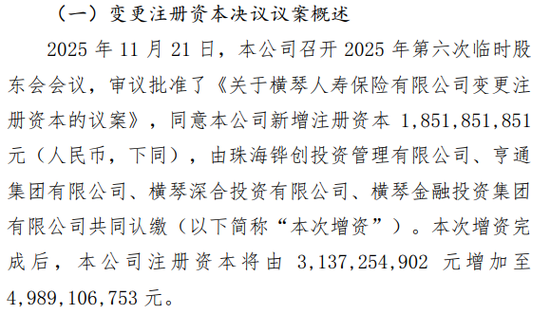
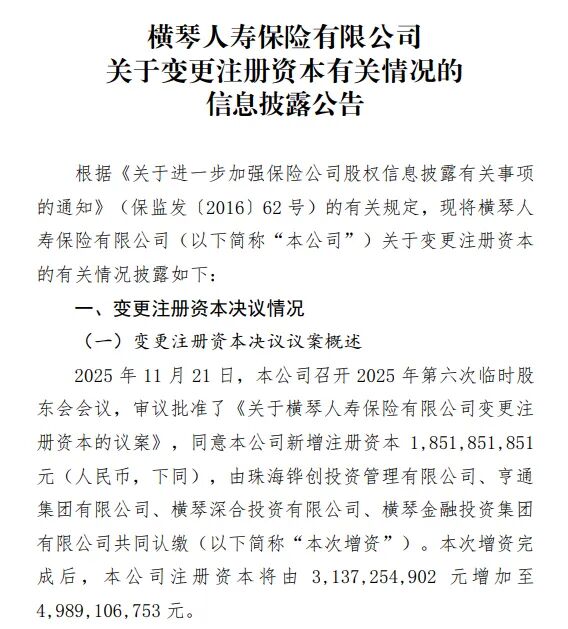
18.52亿元!横琴人寿再谋增资,新增两家国资股东
Guo Ji Jin Rong Bao· 2025-12-05 14:17
Core Viewpoint - Insurance companies are actively increasing their capital as the year-end approaches, with Hengqin Life Insurance Co., Ltd. announcing an increase in registered capital by 1.852 billion yuan [1][4]. Group 1: Capital Increase Details - Hengqin Life's capital increase amounts to 2 billion yuan, with existing shareholders Zhuhai Huachuang Investment Management Co., Ltd. and Hengtong Group Co., Ltd., along with new shareholders Hengqin Shenhe Investment Co., Ltd. and Hengqin Financial Investment Group Co., Ltd. participating [6]. - After the capital increase, Hengqin Life's registered capital will rise from 3.137 billion yuan to 4.989 billion yuan, pending approval from the Guangdong Financial Regulatory Bureau [6][7]. - The ownership structure will change, with Zhuhai Huachuang maintaining a 49% stake, Hengtong Group increasing its stake from 12.75% to 13.59%, and the three other shareholders' stakes diluted to 8.02% each [7]. Group 2: Financial Performance - Hengqin Life has experienced rapid growth in premium income, with figures rising from 0.863 billion yuan in 2017 to 8.52 billion yuan in 2023, although a slight decline to 8.229 billion yuan is expected in 2024 [10]. - The company faced losses in its early years but turned profitable in 2020, achieving a net profit of 0.059 billion yuan, although it returned to losses in 2022 with a net loss of 0.179 billion yuan [10][11]. - For the first three quarters of 2025, Hengqin Life reported insurance business income of 5.673 billion yuan, a year-on-year decrease of 22.83%, and a net loss of 0.326 billion yuan, though the loss narrowed by 13.29% compared to the previous year [11]. Group 3: Future Outlook and Strategies - Hengqin Life plans to issue up to 1.1 billion yuan in capital supplement bonds to improve its capital adequacy and support sustainable business development [11]. - Industry experts suggest that insurance companies should focus on high-quality development rather than merely scaling up, emphasizing the need for optimized business structures, improved operational efficiency, and effective asset-liability management [12].