保险次级债

Search documents
基于《保险公司资产负债管理办法(征求意见稿)》的分析:2503险企偿付能力报告传递了哪些信息?
Hua Yuan Zheng Quan· 2026-02-01 06:42
Report Industry Investment Rating - Not provided in the content Core Views of the Report - The new "Insurance Company Asset - Liability Management Measures (Draft for Comment)" has five major changes, aiming to strengthen the supervision of insurance companies' asset - liability management and guide long - term operations [2]. - In 25Q3, the solvency indicators of the insurance industry declined, mainly due to the increase in equity capital occupation and the pressure on both the asset and liability sides [2]. - The rise in long - term bond yields and the good performance of the A - share market in 25Q3 improved the investment returns of the insurance industry and reduced industry risks, but the credit risks of some under - performing insurers need attention [2]. - Large - scale life insurance companies have an advantage in scale premium growth, while small and medium - sized insurers show significant differentiation [2]. - The issuance scale of insurance sub - debt has shrunk [2]. Summary by Relevant Catalogs New "Insurance Company Asset - Liability Management Measures (Draft for Comment)" - **Five major changes**: System integration, organizational framework improvement, clear regulatory indicators, optimized indicator calculation methods, and improved regulatory measures [2][4]. - **Regulatory indicators for property insurance companies**: Precipitation fund coverage ratio to prevent short - term fund long - term investment, income coverage ratio and pressure - scenario liquidity coverage ratio to guide long - term operations [2][5]. - **Regulatory indicators for life insurance companies**: Effective duration gap to prevent asset - liability table fluctuations, comprehensive investment income coverage ratio and net investment income coverage ratio to guide long - term operations [2][5]. 25Q3 Insurance Industry Solvency - **Solvency indicators**: The comprehensive solvency ratio was 186.3% and the core solvency ratio was 134.3%, down 18.2 and 13.5 percentage points respectively from 25Q2, mainly due to the decline of life insurance companies [2]. - **Reasons for the decline**: Increased equity asset allocation, higher risk factors for equity assets under the new rules, and pressure on both the asset and liability sides [2]. 25Q3 Insurance Industry Investment and Profit - **Investment returns**: The rise in long - term bond yields and the good performance of the A - share market improved investment returns, with the total net profit of most insurers with outstanding insurance sub - debt increasing from 92.7 billion yuan in Q2 to 246.9 billion yuan in Q3 [2][24]. - **Profit differentiation**: Among 41 insurers with available data and outstanding insurance sub - debt, property insurance companies' net profit decreased by 3.306 billion yuan in 25Q3, while life insurance companies' net profit increased by 155.65 billion yuan [2]. Scale Premium Growth of Insurance Companies - **Large - scale life insurance companies**: As of 25Q3, China Post Life and New China Life had year - on - year scale premium growth rates of 18.65% and 17.96% respectively, showing relatively high and stable growth [2]. - **Small and medium - sized life insurance companies**: There was significant differentiation, with some companies having high growth rates and others having negative growth [2]. Insurance Sub - debt Issuance - **Issuance scale**: In 2024, 117.5 billion yuan of insurance sub - debt was issued, with 57.3 billion yuan in 24Q3. In 2025, 104.2 billion yuan was issued, a 11.3% year - on - year decrease. As of January 22, 2026, only 5 billion yuan was issued [2]. Investment Recommendations - Screened state - owned and central - owned enterprise insurance company sub - debt with a valuation yield > 2.2%, core solvency ratio > 100%, comprehensive solvency ratio > 150%, and risk comprehensive rating of BBB or above, such as 24 China Property Insurance Capital Supplementary Bond, 25 Great Wall Life Perpetual Bond 01, etc. [3]



国债ETF5至10年(511020)多空胶着,机构:年内上证有望站上3700
Sou Hu Cai Jing· 2025-07-11 03:30
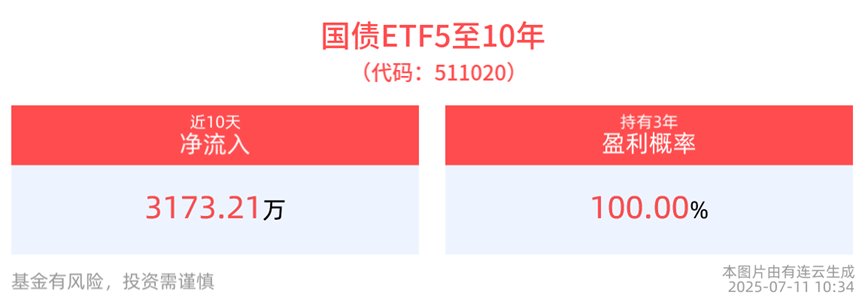
Core Viewpoint - The bond ETF for 5 to 10 years has shown a mixed performance with a recent price of 117.49 yuan and a year-to-date increase of 5.34% as of July 10, 2025 [3] Group 1: Performance Metrics - The bond ETF has a recent trading volume of 631.07 million yuan with a turnover rate of 0.42% [3] - The fund's total size has reached 1.496 billion yuan [3] - Over the past five years, the net value of the bond ETF has increased by 21.89% [3] - The highest monthly return since inception was 2.58%, with the longest consecutive monthly gain being 10 months and a maximum increase of 5.81% [3] - The annual profit percentage stands at 100.00%, with a monthly profit probability of 72.69% [3] - The Sharpe ratio over the last two years is 1.28 [4] Group 2: Risk and Drawdown - The maximum drawdown for the bond ETF this year is 2.15%, compared to a benchmark drawdown of 0.59% [4] Group 3: Fees and Tracking Accuracy - The management fee for the bond ETF is 0.25%, and the custody fee is 0.05% [5] - The tracking error for the past month is 0.018%, closely following the index of active bonds with maturities of 5, 7, and 10 years [6] Group 4: Market Sentiment and Outlook - Recent market adjustments in the bond sector are attributed to rumors regarding real estate stimulus and investment constraints in rural commercial banks [6] - Institutions suggest that a new round of interest rate cuts of 10-20 basis points is needed to support the 10-year government bond yield [6] - The trading activity in the secondary market shows mixed results among different banking sectors, with significant movements in large banks and rural commercial banks [6] - The outlook remains cautiously optimistic for long-duration bonds and certain types of municipal and dollar bonds [6]