信托回归本源业务

Search documents
信托资产规模超32万亿元 营收、利润实现“双增”
Xin Lang Cai Jing· 2025-12-22 20:23
Core Insights - The trust industry in China is showing positive adjustments towards "returning to its roots," with significant growth in trust asset scale and operational performance [1][2][3] Group 1: Industry Performance - As of June 2025, the total trust asset scale reached 32.43 trillion yuan, marking a year-on-year increase of 20.11% [1] - In the first half of 2025, the industry achieved operating income of 34.362 billion yuan, a 3.34% increase compared to the same period in 2024, and a total profit of 19.676 billion yuan, up 0.45% year-on-year [1] - The trust industry has transitioned from traditional financing and channel trust models to asset management and asset service trusts, which are now the main drivers of growth [1][2] Group 2: Business Structure - Asset management trusts have become the primary growth engine, with a balance of approximately 24.43 trillion yuan, accounting for 75.33% of total trust assets [1] - Asset service trusts have also shown steady growth, with a balance of at least 8 trillion yuan, representing 24.67% of total trust assets [1] - By mid-2025, securities investment trusts emerged as the dominant product within asset management trusts, growing to 12.48 trillion yuan and comprising 51.09% of the total scale of funding trusts [2] Group 3: Market Position - The trust industry has strengthened its position within the overall asset management sector, which reached a total asset management scale of 174.50 trillion yuan by mid-2025, reflecting a growth of approximately 5.57% from the end of 2024 [3] - Trust assets rank third in the asset management industry, following insurance asset management and public funds [3] - Experts suggest that trust companies should focus on their core business, improve governance, and develop clear strategic plans for sustainable business models in the new era [3]
信托业“断舍离”:剥离非核心资产,加速回归本源主业
2 1 Shi Ji Jing Ji Bao Dao· 2025-12-02 12:01
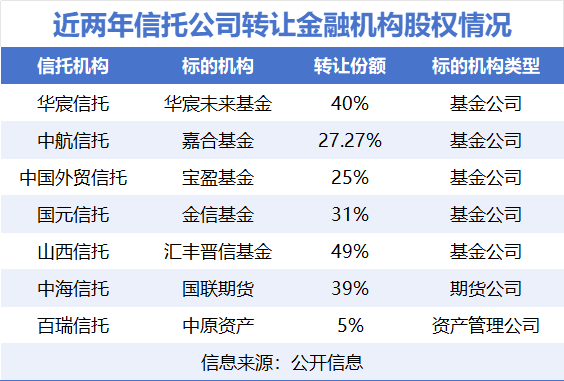
Core Viewpoint - The trust industry is accelerating its return to core business, with a wave of divestitures of non-core financial equity continuing to emerge [1][7]. Group 1: Trust Company Actions - Huachen Trust plans to transfer 40% equity of Huachen Future Fund for 17.2 million yuan, with the transfer period from November 24 to December 19 [1]. - Other trust companies, including Baorui Trust and Zhonghai Trust, have also sold stakes in subsidiaries like funds and futures, indicating a trend of concentrated divestiture [1][4]. - Huachen Future Fund has reported poor financial performance, with a net profit of -2 million yuan in 2024 and -1.14 million yuan by Q3 2025, leading to negative equity of -388.63 million yuan [2][3]. Group 2: Industry Trends - The trend of divesting non-core financial equity is not random but a collective response to common pressures, including regulatory requirements and the need for cash flow [7][9]. - Regulatory changes since 2021 have mandated trust companies to divest assets that are not aligned with their core business, contributing to the current wave of divestitures [7][8]. - The industry is experiencing a shift from a "financial supermarket" model to focusing on core trust services, optimizing asset structures, and enhancing competitive advantages [8][9]. Group 3: Financial Performance and Market Outlook - The return on equity (ROE) for trust companies has declined from 14% in 2017 to around 4% in 2023, indicating a need for companies to streamline operations and focus on high-value, low-capital businesses [8]. - The divestiture of non-core assets is expected to free up capital for higher-value services, with the potential for increased concentration in the fund and futures sectors [9]. - Future focus will be on whether divestitures will expand into more areas and how to balance the separation of non-core businesses with collaborative development [9].