
证券投资信托

Search documents
2025年4只信托产品收益翻倍,信托业多项重磅政策出台
2 1 Shi Ji Jing Ji Bao Dao· 2026-02-02 04:29
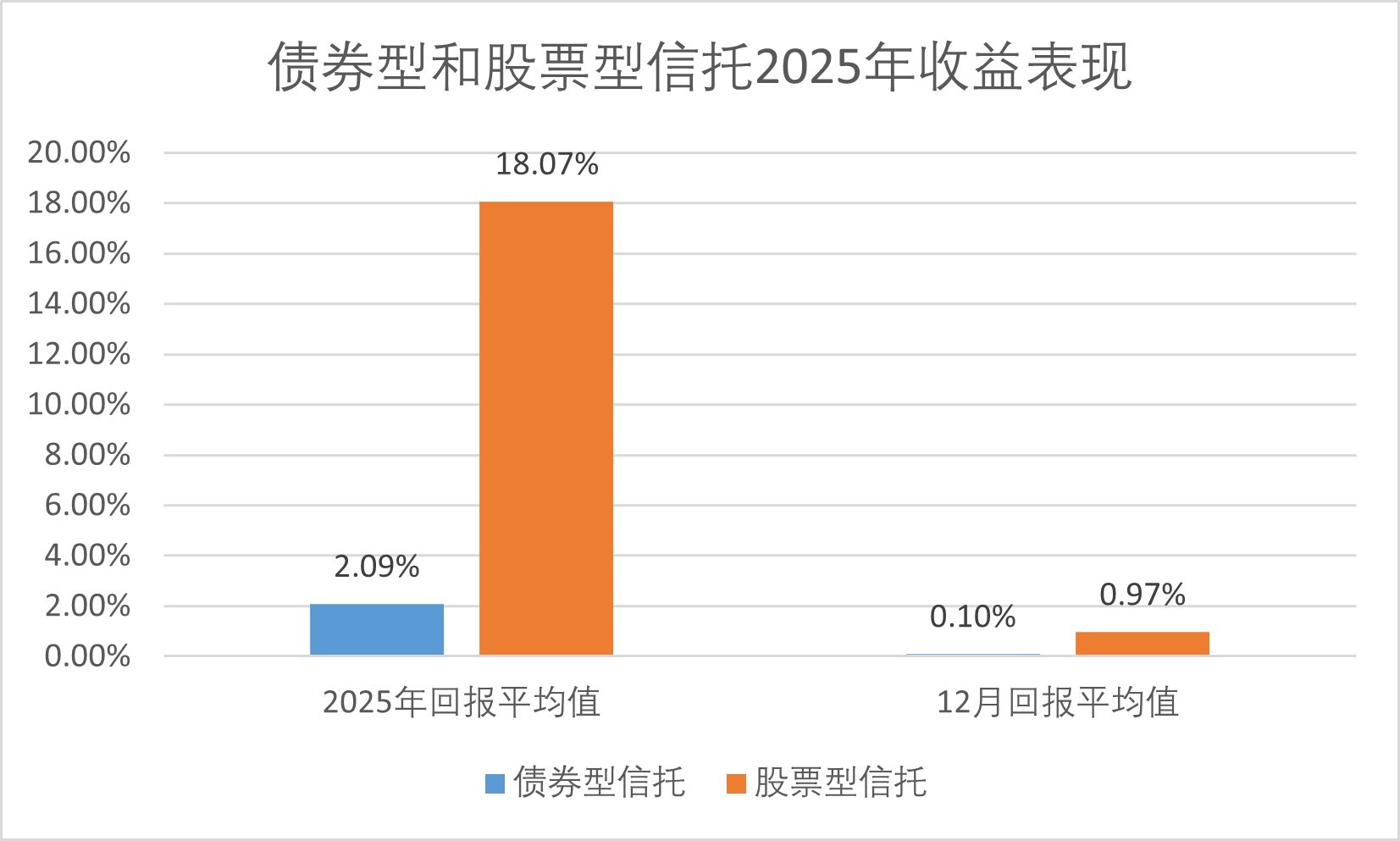
Group 1: Trust Product Issuance - In 2025, a total of 17,095 trust products were issued, representing a year-on-year increase of 4.02% [1] - Among these, 11,831 were securities investment trusts, accounting for 69.21% of the total, which is an increase of 11.14 percentage points compared to 2024 [1] - The issuance of securities investment trusts saw a significant rise in the second half of 2025, increasing from 59.83% at the beginning of the year to around 70% [1] Group 2: Securities Investment Trust Performance - The average return for stock-type trusts in 2025 was 18.07%, while bond-type trusts had an average return of only 2.09% [2] - Major stock indices saw significant gains in 2025, with the Shanghai Composite Index rising by 18.41%, the Shenzhen Component Index by 29.87%, and the ChiNext Index by 49.57% [1] Group 3: Investment Strategy Performance - The best-performing strategy in 2025 was the macro strategy, with an average return of 27.49% [5] - The second-best was the combination fund strategy, yielding an average return of 18.36%, primarily driven by strong FOF product performance [5] - Quantitative long strategies achieved an impressive average return of 38.87% [5] Group 4: Top Performing Trust Products - The highest return for a bond-type trust in 2025 was 40.99% for "Zhongguo Trust Fengtai No. 5" [8] - The top-performing stock-type trust was "Waihuo Trust Jingkun No. 1," with a staggering return of 797.49% [9] - Four stock-type trusts achieved returns that doubled in 2025 [9] Group 5: Trust Company Performance - The best-performing trust company for stock-type trusts in 2025 was Huaren Trust, with an average return of 62.40% [14] - BaiRui Trust led in bond-type trust performance with an average return of 12.09% [13] - Companies like Guomin Trust and Jilin Trust ranked lower in average returns for bond-type trusts [13] Group 6: Major Industry Events - In January 2025, the State Council issued guidelines for the high-quality development of the trust industry, setting clear goals for 2029 and 2035 [17] - The first comprehensive revision of the Trust Company Management Measures in 18 years was announced in September 2025, which will reshape the industry landscape [18] - The trust asset scale surpassed 32 trillion yuan by mid-2025, marking a year-on-year growth of 20.11% [21]

营收和利润双增 信托业或已触底回暖
Jin Rong Shi Bao· 2025-12-24 02:46
Core Viewpoint - The Chinese trust industry is showing signs of recovery with a significant increase in total assets and operational performance in the first half of 2025, indicating a potential turnaround despite ongoing challenges in transformation [1][2]. Group 1: Industry Performance - As of June 2025, the total trust asset scale reached 32.43 trillion yuan, marking a year-on-year growth of 20.11% [1]. - The industry achieved operational revenue of 34.36 billion yuan, a 3.34% increase year-on-year, and a total profit of 19.68 billion yuan, up by 0.45% [1]. - The dual increase in revenue and profit suggests that the industry may have hit bottom and is beginning to recover, although the pains of transformation remain evident [1]. Group 2: Asset Management Trusts - Asset management trusts are the primary growth engine, with a balance of approximately 24.43 trillion yuan, accounting for 75.33% of total trust assets, reflecting a year-on-year increase of 22.46% [2]. - The overall asset management scale in China reached 174.50 trillion yuan, with trust assets ranking third after insurance asset management and public funds [2]. - Securities investment trusts have become the dominant product type, growing to 12.48 trillion yuan and representing 51.09% of the total scale of asset management trusts [2]. Group 3: Non-standard vs. Standard Assets - The proportion of non-standard assets in the total scale of funds trusts has decreased from 54.52% at the end of 2022 to 39.70% in the first half of 2025, indicating a shift towards standard assets [3]. Group 4: Asset Service Trusts - Asset service trusts are steadily growing and have become an important growth engine for the trust industry, with various applications in wealth management and social services [4]. - As of June 2025, the scale of wealth management, administrative management, risk disposal, and asset securitization service trusts reached 4.37 trillion yuan, 2.80 trillion yuan, 2.60 trillion yuan, and 1.43 trillion yuan, respectively [4]. - Despite current limitations in the asset service trust business, there is potential for development as regulatory barriers are gradually addressed [4]. Group 5: Future Directions - Industry experts suggest that trust companies should focus on their core business, improve governance, and develop clear strategic plans to build sustainable business models and foster innovation [5].
信托资产规模超32万亿元 营收、利润实现“双增”
Xin Lang Cai Jing· 2025-12-22 20:23
Core Insights - The trust industry in China is showing positive adjustments towards "returning to its roots," with significant growth in trust asset scale and operational performance [1][2][3] Group 1: Industry Performance - As of June 2025, the total trust asset scale reached 32.43 trillion yuan, marking a year-on-year increase of 20.11% [1] - In the first half of 2025, the industry achieved operating income of 34.362 billion yuan, a 3.34% increase compared to the same period in 2024, and a total profit of 19.676 billion yuan, up 0.45% year-on-year [1] - The trust industry has transitioned from traditional financing and channel trust models to asset management and asset service trusts, which are now the main drivers of growth [1][2] Group 2: Business Structure - Asset management trusts have become the primary growth engine, with a balance of approximately 24.43 trillion yuan, accounting for 75.33% of total trust assets [1] - Asset service trusts have also shown steady growth, with a balance of at least 8 trillion yuan, representing 24.67% of total trust assets [1] - By mid-2025, securities investment trusts emerged as the dominant product within asset management trusts, growing to 12.48 trillion yuan and comprising 51.09% of the total scale of funding trusts [2] Group 3: Market Position - The trust industry has strengthened its position within the overall asset management sector, which reached a total asset management scale of 174.50 trillion yuan by mid-2025, reflecting a growth of approximately 5.57% from the end of 2024 [3] - Trust assets rank third in the asset management industry, following insurance asset management and public funds [3] - Experts suggest that trust companies should focus on their core business, improve governance, and develop clear strategic plans for sustainable business models in the new era [3]
超越银行理财!信托资产规模升至32.43万亿元,证券投资占比首超50%
Sou Hu Cai Jing· 2025-12-22 14:38
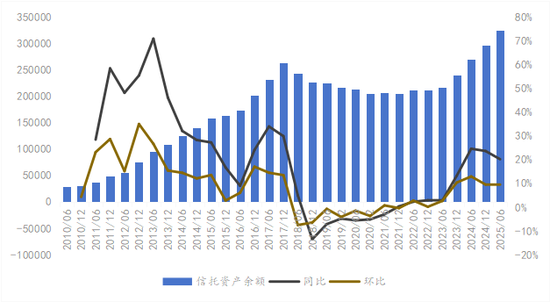
Core Insights - The trust industry in China is experiencing a significant transformation, with trust asset scale reaching 32.43 trillion yuan by mid-2025, marking a year-on-year increase of 5.43 trillion yuan or 20.11% [2][3] - Standard assets have become the dominant configuration method, with securities investment trusts surpassing 50% of the total trust assets for the first time, indicating a departure from the traditional "financing + channel" model [2][5] Industry Growth and Market Position - The trust industry's asset scale has rebounded from a low of 20.49 trillion yuan at the end of 2020 to a historical high of 32.43 trillion yuan by mid-2025, following a period of adjustment and optimization since 2018 [3][4] - In the broader asset management industry, the total scale reached 174.50 trillion yuan, with the trust sector holding the third-largest position, following insurance and public funds [3][4] Business Structure and Growth Engines - Asset management trusts are identified as the primary growth engine, while asset service trusts serve as the secondary growth engine, with significant contributions from wealth management and administrative service trusts [4][6] - By mid-2025, wealth management service trusts reached 4.37 trillion yuan, administrative management service trusts at 2.80 trillion yuan, and risk disposal service trusts at 2.60 trillion yuan [4] Shift to Standardized Assets - The proportion of standardized assets in asset management trusts has significantly increased, with 61.60% of funds directed towards financial markets, including 44.33% towards securities markets [5][6] - Securities investment trusts reached 12.48 trillion yuan, accounting for 51.09% of total funds, marking a critical shift in the asset management trust landscape [5] Revenue and Profit Growth - The trust industry reported a revenue of 34.36 billion yuan and a profit of 19.68 billion yuan in the first half of 2025, reflecting a year-on-year increase of 3.34% and 0.45% respectively, indicating a recovery from previous declines [7][8] - This growth is attributed to the optimization of business structures and the implementation of the "three classifications" policy, showcasing the industry's resilience and correct transformation path [7][8] Future Outlook - The industry is expected to continue focusing on the "three classifications" policy, enhancing its core business and improving its service capabilities to better support the real economy [8]

超2万亿资金“搬家”证券市场,资管业“老三”触底反弹?
Di Yi Cai Jing· 2025-12-21 12:34
Core Viewpoint - The trust industry in China has experienced a significant transformation, with a notable shift towards asset management trusts and asset service trusts, leading to a recovery in revenue and profit growth after a period of decline [1][2][4]. Group 1: Industry Overview - As of mid-2025, the total trust asset scale in China reached 32.43 trillion yuan, marking a significant milestone as it surpassed the scale of the wealth management market [1][4]. - The trust industry has faced profitability pressures, with profits having been halved from peak levels in recent years, but signs of recovery are emerging as revenue and profit growth turned positive in the first half of 2025 [2][3]. Group 2: Financial Performance - In the first half of 2025, the trust industry achieved operating income of 343.62 billion yuan and total profit of 196.76 billion yuan, reflecting year-on-year increases of 3.34% and 0.45%, respectively [2]. - The overall profit for 2024 was reported at 230.87 billion yuan, a decrease of 192.87 billion yuan compared to 2023, indicating a significant decline in profitability prior to the recovery [2]. Group 3: Asset Allocation Trends - Trust funds have increasingly shifted towards financial markets, with 15.05 trillion yuan allocated to this sector by mid-2025, representing 61.60% of total trust assets, a substantial increase from 42.38% at the end of 2022 [5][6]. - The allocation to bonds remains dominant, with 9.36 trillion yuan directed towards the bond market, while investments in stocks and funds totaled only 1.47 trillion yuan [6]. Group 4: Asset Service Trusts - Asset service trusts are emerging as a significant area of growth, with wealth management service trusts reaching 4.37 trillion yuan and administrative management service trusts at 2.80 trillion yuan by mid-2025 [7]. - Despite the potential for growth, asset service trusts face challenges such as regulatory constraints and the need for a more defined business model [8][9]. Group 5: Future Outlook - The industry is expected to see further development in asset service trusts, particularly in wealth management, as regulatory barriers are gradually addressed, paving the way for more robust business models [9]. - The "three-category" regulation is reshaping the functions of trust businesses, enhancing both wealth management and asset management capabilities [9].
32.43万亿元,行业已触底回暖?
Jin Rong Shi Bao· 2025-12-21 04:41
Core Viewpoint - The Chinese trust industry is showing signs of recovery with a significant increase in total trust assets and operational performance in the first half of 2025, indicating a potential turnaround after a challenging period [1][2]. Group 1: Trust Industry Performance - As of June 2025, the total trust asset scale reached 32.43 trillion yuan, a year-on-year increase of 20.11% [1] - The industry achieved operating income of 34.36 billion yuan, a 3.34% increase compared to the same period in 2024, and a total profit of 19.68 billion yuan, up 0.45% year-on-year [1] - The dual increase in operating income and profit suggests that the industry may have hit bottom and is beginning to recover, although challenges in transformation remain [1] Group 2: Asset Management Trusts - Asset management trusts accounted for approximately 24.43 trillion yuan, representing 75.33% of total trust assets, with a year-on-year growth of 22.46% [2] - The overall asset management industry in China reached 174.50 trillion yuan, with trust assets ranking third after insurance asset management and public funds [2] - Securities investment trusts have become the dominant product type, increasing from 34.34% of total asset management trusts at the end of 2022 to 51.09% by mid-2025 [2] Group 3: Non-standard vs. Standard Assets - The proportion of non-standard assets in the total scale of funds trusts decreased from 54.52% at the end of 2022 to 39.70% by mid-2025, indicating a shift towards standard assets [3] Group 4: Asset Service Trusts - Asset service trusts are experiencing steady growth and have become an important growth engine for the trust industry, with various applications in wealth management and social services [4] - By June 2025, the scale of wealth management, administrative management, risk disposal, and asset securitization service trusts reached 4.37 trillion yuan, 2.80 trillion yuan, 2.60 trillion yuan, and 1.43 trillion yuan, respectively [4] - Despite current limitations in the asset service trust business, there is potential for future development as regulatory barriers are gradually addressed [4] Group 5: Future Directions for Trust Companies - Industry experts suggest that trust companies should focus on their core business, improve governance, and develop clear strategic plans to establish sustainable business models and navigate the transformation towards innovation [5]
32.43万亿元!行业已触底回暖?
Jin Rong Shi Bao· 2025-12-21 03:45
Core Insights - The trust industry in China has shown signs of recovery, with total trust assets reaching 32.43 trillion yuan as of June 2025, marking a year-on-year growth of 20.11% [1] - The industry achieved operating income of 34.36 billion yuan and total profit of 19.68 billion yuan in the first half of 2025, indicating a slight increase compared to the previous year [1] Group 1: Asset Management Trusts - Asset management trusts are the primary growth engine, with a balance of approximately 24.43 trillion yuan, accounting for 75.33% of total trust assets, reflecting a year-on-year increase of 22.46% [2] - The trust industry's market position in the overall asset management sector has improved, with total assets in the asset management industry reaching 174.50 trillion yuan, where trust assets rank third after insurance and public funds [2] - Securities investment trusts have become the dominant product type, growing to 12.48 trillion yuan and representing 51.09% of the total asset management trust scale [2] Group 2: Non-standard vs. Standard Assets - The allocation ratio between non-standard and standard assets is shifting, with non-standard assets decreasing from 54.52% in 2022 to 39.70% in the first half of 2025 [3] Group 3: Asset Service Trusts - Asset service trusts are steadily growing and have become an important growth engine for the trust industry, with various applications in wealth management and social services [4] - As of June 2025, the scale of wealth management, administrative management, risk disposal, and asset securitization service trusts reached 4.37 trillion yuan, 2.80 trillion yuan, 2.60 trillion yuan, and 1.43 trillion yuan respectively [4] - Despite current limitations in the asset service trust business, there is potential for future growth, particularly in family trusts, as regulatory barriers are gradually addressed [4] Group 4: Future Directions - Industry experts suggest that trust companies should focus on their core business, improve governance, and develop clear strategic plans to establish sustainable business models in the new era [5]
中国信托业协会:上半年全行业信托资产规模余额32.43万亿元
Xin Lang Cai Jing· 2025-12-19 12:18
Core Viewpoint - In the first half of 2025, the Chinese trust industry demonstrated resilience amid complex international conditions, achieving a stable and improving overall performance, with trust asset scale continuing to grow steadily and business structure optimizing under the "three classifications" policy [1][34]. Group 1: Trust Asset Scale Growth - Since 2018, the trust industry has entered a transformation phase, with trust asset scale recovering from a low of 20.49 trillion yuan at the end of 2020 to a historical peak of 29.56 trillion yuan by the end of 2024, marking a 44.27% increase over four years [2][35]. - As of June 2025, the total trust asset scale reached 32.43 trillion yuan, an increase of 2.87 trillion yuan from the end of the previous year, representing a growth of 9.73%, and a year-on-year increase of 5.43 trillion yuan, or 20.11% [2][35]. Group 2: Business Structure Optimization - The "three classifications" policy has led to asset management trusts and asset service trusts replacing traditional financing and channel trusts, becoming the main drivers of growth since 2021. Asset management trusts accounted for approximately 75.33% of total trust assets, while asset service trusts made up at least 24.67% [3][36]. - The trust industry has strengthened its market position within the broader asset management sector, with total asset management scale reaching 174.50 trillion yuan in the first half of 2025, where trust assets ranked third at 32.43 trillion yuan [6][38]. Group 3: Asset Service Trust Development - Asset service trusts have shown steady growth and have become an important growth engine for the trust industry, covering various types such as wealth management, administrative management, risk disposal, and new asset service trusts [9][41]. - As of June 2025, wealth management service trusts reached 4.37 trillion yuan, administrative management service trusts 2.80 trillion yuan, risk disposal service trusts 2.60 trillion yuan, and asset securitization service trusts 1.43 trillion yuan [9][41]. Group 4: Asset Management Trusts - Asset management trusts remain the dominant business in the trust industry, with a balance of approximately 24.43 trillion yuan, representing a 9.80% increase from the end of the previous year and a 22.46% year-on-year growth [11][43]. - The investment in standardized assets has become the main focus, with trading financial assets making up 60.30% of the total scale of asset management trusts as of June 2025 [15][46]. Group 5: Industry Capital Strength - The trust industry has seen a slight increase in inherent assets and owners' equity, with inherent assets reaching 926.43 billion yuan and owners' equity at 772.18 billion yuan, indicating improved capital accumulation and risk resistance capabilities [25][54]. - The industry reported a slight improvement in operating performance, with operating income of 34.36 billion yuan and total profit of 19.68 billion yuan in the first half of 2025, reflecting signs of recovery after previous declines [29][59].
资管信托政策出台,债券产品回暖,中诚信托收大额罚单丨信托月报
2 1 Shi Ji Jing Ji Bao Dao· 2025-11-18 12:17
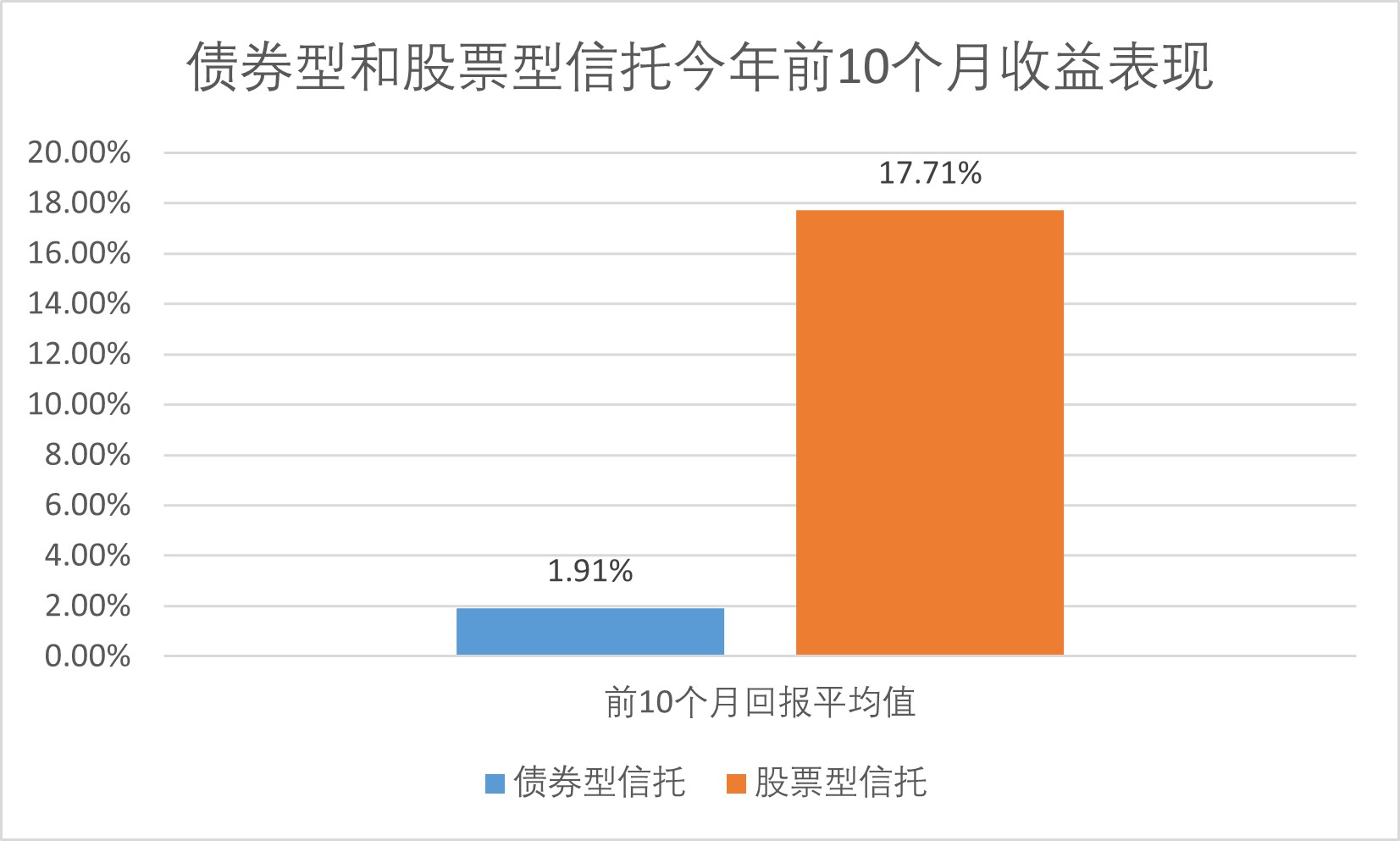
Group 1: Trust Product Issuance - In October, the issuance of trust products decreased by 15.87% month-on-month, totaling 1,124 products [1] - Among these, 877 were securities investment trusts, accounting for 78.02% of the total, with a slight increase of 0.24 percentage points from September [1] - The scale proportion of securities investment trusts rose from 36.43% in September to 42.37% in October [1] Group 2: Performance of Securities Investment Products - The stock market showed mixed results in October, with the STAR 50 Index down by 5.33% while the Shanghai Composite Index rose by 1.85% [2] - Bond-type trusts saw improved returns, with an average return of 1.91% for the first ten months of the year, while stock-type trusts' average return decreased to 17.71%, down from 18.58% in the previous nine months [2] Group 3: Investment Strategies Performance - Macro strategy remains the best-performing strategy with an average return of 25.89% over the first ten months, followed by stock strategy at 20.51% and combination fund strategy at 17.14% [6] - In October, the average return for stock strategy was negative at -0.80% [6] - Quantitative long strategies within stock strategies had an average return of 34.67% over the first ten months, maintaining positive returns in October [7] Group 4: Specific Trust Products Performance - The highest return for bond-type trusts in the first ten months was from "Huaxin Trust Wisdom Investment No. 154," with a return of 46.99% [8] - "Qihang No. 12" ranked second with a return of 40.51%, while "Huaxin Trust Wisdom Investment No. 153" ranked third with a return of 39.53% [9] - "Foreign Trade Trust Jingkun No. 1" achieved a remarkable return of 247.57% over the first ten months, with a monthly return of 131.70% in October [10] Group 5: Regulatory Developments in the Trust Industry - The National Financial Regulatory Administration has released a draft for public consultation on the "Asset Management Trust Management Measures," emphasizing the positioning of asset management trusts as private asset management products [18] - The draft prohibits channel business, fund pool business, and rigid repayment, requiring full-process management in sales, investment, risk control, and information disclosure [18] - The trust industry has seen significant penalties, with Zhongcheng Trust fined 6.6 million yuan for various violations, indicating ongoing regulatory scrutiny [19] Group 6: Industry Growth Metrics - The total asset management scale of the trust industry has surpassed 32 trillion yuan, marking a 9.7% increase from the previous year [20] - This growth positions the trust industry as the third largest in the asset management sector, following insurance asset management and public funds [20]
62家信托公司披露2020年年报 行业进入提质增效重塑阶段
Bei Jing Shang Bao· 2025-08-08 06:59
Core Insights - The trust industry has entered a phase of quality improvement and restructuring after ten years of high growth, with 62 trust companies disclosing their 2020 annual reports [1] - The report from Yunnan Trust indicates that under favorable policies and proactive transformation, the scale of securities investment trusts has increased significantly [1][3] - The industry is facing challenges with a notable decline in net profit, despite 60% of companies reporting an increase in net profit [2] Industry Overview - In 2020, the scale of securities investment trusts reached 2.26 trillion yuan, a year-on-year increase of 15.44%, accounting for 13.87% of the total [1][3] - The total revenue from trust business for 62 companies was 83.283 billion yuan, reflecting a year-on-year growth of 5.76% [1] - The net profit for the industry in 2020 was 47.590 billion yuan, a decrease of 10.11% from 52.945 billion yuan in 2019, marking the end of a growth trend [2] Business Segment Analysis - The scale of industrial and commercial enterprise trusts decreased significantly to 4.96 trillion yuan, a decline of 9.64% compared to 5.49 trillion yuan in 2019 [2] - Financial institution trust investments fell to 1.98 trillion yuan, down 20.76% year-on-year, indicating a tightening regulatory environment [3] - The report highlights a shift towards family trusts, asset securitization, and service trusts as emerging opportunities for growth in the industry [4] Strategic Insights - The report emphasizes the importance of proactive management and strategic clarity for trust companies to navigate the current regulatory landscape [3][4] - Companies that are clear in their development strategies and have strong business layouts are positioned in the leading tiers of the industry, while those lacking innovation face significant challenges [3] - The development of asset securitization is gaining traction, supported by regulatory policies and increasing interest from financing parties and investors [4]