
信托本源

Search documents
聚焦本源 重塑业态 信托公司管理办法18年来首次大修
Zhong Guo Zheng Quan Bao· 2025-09-16 01:16
Core Points - The revised "Trust Company Management Measures" marks the first amendment after 18 years, aiming to promote the trust industry's core principles, deepen reform, and effectively prevent risks, set to take effect on January 1, 2026 [1] Group 1: Business Scope Clarification - The new regulations define the business scope of trust companies into three categories: trust business, asset liability business, and other businesses [2] - The previous five types of trust business have been consolidated into three: asset service trust, asset management trust, and public welfare trust [2] - The regulations allow trust companies to apply for liquidity support loans from the Trust Industry Guarantee Fund Company and clarify the prohibition of providing external guarantees [2] Group 2: Governance Mechanism Enhancement - The revised measures require trust companies to strengthen shareholder behavior management and conduct regular evaluations of major shareholders [3] - Trust companies must appoint a Chief Compliance Officer to oversee compliance management and internal control systems [3] - The board of directors is held accountable for compliance management and risk control effectiveness, enhancing corporate governance and operational transparency [3] Group 3: Prohibited Behaviors - The new regulations explicitly prohibit trust companies from promising profit guarantees, providing channel services, and engaging in fund pool operations [4] - Trust companies are not allowed to invest trust funds directly in commercial bank credit assets or in industries prohibited by laws and regulations [4] - The measures aim to guide trust companies back to their core business of asset and wealth management, avoiding excessive diversification and promoting sustainable industry development [5]
信托公司管理办法18年来首次大修
Zhong Guo Zheng Quan Bao· 2025-09-15 20:22
Core Points - The revised "Trust Company Management Measures" aims to promote the core essence of trust, deepen reform and transformation, and effectively prevent risks, set to take effect on January 1, 2026 [1] Business Scope - The new measures clarify that the business scope of trust companies includes three categories: trust business, asset liability business, and other businesses [1] - The previous five types of trust business have been adjusted to three: asset service trust, asset management trust, and public welfare trust [1] - The measures allow trust companies to apply for liquidity support loans from the Trust Industry Guarantee Fund Company and specify that they can provide investment advisory, consulting, and custodial services for financial institutions and their managed asset management products [1][2] Governance Mechanism - The revised measures require trust companies to strengthen shareholder behavior management and conduct regular evaluations of major shareholders [2] - Trust companies must report any violations by shareholders or actual controllers to the financial regulatory authority and implement corrective measures [2] - The board of directors is held responsible for compliance management and risk control, and a Chief Compliance Officer must be appointed to oversee internal control and compliance management systems [2] Prohibited Behaviors - The revised measures explicitly prohibit trust companies from promising guaranteed returns, providing channel services, and engaging in fund pool operations [3][4] - Trust companies must ensure that the management and disposal of trust assets comply with legal regulations and the terms of trust documents, and they cannot invest trust funds directly in commercial bank credit assets [3][4] - Various other prohibited actions include misleading investors, engaging in improper transactions with related parties, and using trust assets for non-trust purposes [4] Industry Implications - The new measures are expected to enhance the governance structure of trust companies, improving operational transparency and supporting high-quality development in the trust industry [3] - By clarifying business scope and operational rules, the measures guide trust companies to focus on core businesses such as asset management and wealth management, promoting healthy and sustainable development in the industry [4]
引导信托公司回归本源 《信托公司管理办法》时隔18年首次修订
Zhong Guo Zheng Quan Bao· 2025-09-14 01:37
Core Viewpoint - The National Financial Supervision Administration has revised the "Trust Company Management Measures," which will take effect on January 1, 2026, marking the first revision in 18 years, aimed at promoting the trust industry's core functions, deepening reform, and effectively preventing risks [1][4][9] Summary by Sections General Provisions - The revised measures consist of 8 chapters and 75 articles, covering general principles, establishment and changes of institutions, corporate governance, internal control and risk management, business scope and operational rules, supervision and management, risk disposal and market exit, and supplementary provisions [4] Business Scope - The business scope of trust companies has been narrowed to three categories: trust business, asset liability business, and other business [5] - Trust business has been adjusted from five categories to three: asset service trust, asset management trust, and public welfare trust [6] Internal Control and Risk Management - Trust companies are required to strengthen shareholder behavior management and conduct regular evaluations of major shareholders [8] - The board of directors is responsible for compliance management and risk control, and a chief compliance officer must be appointed to oversee internal control and compliance management systems [8] Implementation and Transition - The revised measures will replace the original measures established in 2007, which have become outdated and insufficient for current risk prevention and regulatory needs [9] - Trust companies must develop rectification plans for existing businesses that do not comply with the new measures and gradually reduce their scale [9]

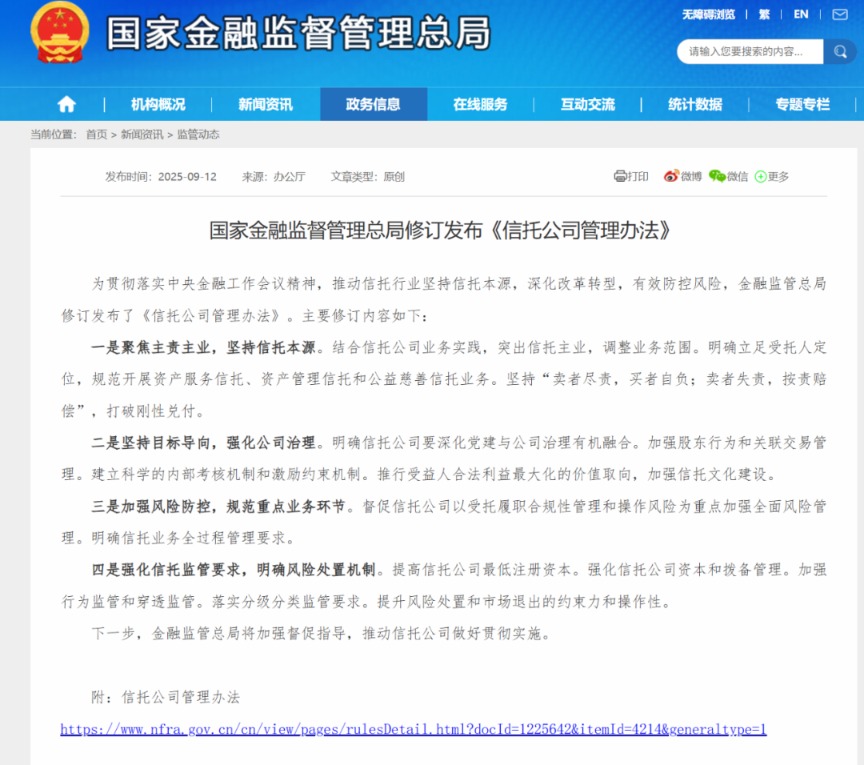
最新!信托公司管理办法正式发布!
Jing Ji Guan Cha Bao· 2025-09-12 11:44
Core Viewpoint - The Financial Regulatory Bureau has revised the "Trust Company Management Measures" to enhance the trust industry by focusing on its core responsibilities, deepening reforms, and effectively preventing risks [1][2]. Group 1: Main Revisions - The revised measures emphasize the core business of trust companies, adjusting their business scope to focus on asset service trusts, asset management trusts, and public welfare trusts, while breaking the rigid repayment model [7][8]. - The measures aim to strengthen corporate governance by integrating party building with corporate governance, enhancing shareholder behavior management, and establishing internal assessment mechanisms [7][9]. - Risk prevention is prioritized, with a focus on compliance management and operational risk, requiring comprehensive risk management throughout the trust business process [7][10]. Group 2: Business Scope Adjustments - The business scope has been narrowed to three main areas: asset service trusts, asset management trusts, and public welfare trusts, while eliminating unrelated intermediary businesses [8]. - New provisions allow trust companies to apply for liquidity support loans from the Trust Industry Guarantee Fund Company and to issue bonds directed at shareholders and related parties [8]. Group 3: Corporate Governance Requirements - Trust companies are required to establish a specialized committee for the protection of the rights of clients and beneficiaries, led by independent directors [9]. - There are enhanced requirements for managing shareholder behavior and related transactions, including regular evaluations and reporting of violations [9]. Group 4: Risk Management and Internal Controls - Trust companies must strengthen internal controls and risk management, ensuring that risk preferences align with risk management capabilities [10][11]. - The measures specify requirements for the entire trust business process, including documentation, risk disclosure, and asset management [10]. Group 5: Recovery and Disposal Arrangements - The revised measures enhance the enforceability and operability of recovery and disposal plans, allowing trust companies to seek liquidity support and issue bonds [12]. Group 6: Rectification of Existing Trust Businesses - Trust companies are required to identify and rectify existing businesses in accordance with the new measures, with progress monitored by the Financial Regulatory Bureau [13].
金融监管总局:明确信托买卖双方权责定位 打破刚性兑付
智通财经网· 2025-09-12 10:48
Core Viewpoint - The Financial Regulatory Bureau has revised the "Management Measures for Trust Companies," which will take effect on January 1, 2026, focusing on core responsibilities, risk prevention, and enhancing corporate governance in the trust industry [1][2]. Group 1: Key Revisions - The revised measures emphasize the core business of trust companies, clarifying their roles as trustees and regulating asset service trusts, asset management trusts, and charitable trusts [1][4]. - The principle of "seller responsibility, buyer risk" is reinforced, breaking the rigid repayment structure [1][4]. - Trust companies are required to deepen the integration of party building and corporate governance, enhancing shareholder behavior and related party transaction management [1][4]. Group 2: Risk Management and Governance - Trust companies must strengthen comprehensive risk management, focusing on compliance and operational risks throughout the trust business process [1][22]. - The minimum registered capital for trust companies will be increased, and there will be stricter capital and provision management requirements [1][22]. - A scientific internal assessment and incentive mechanism must be established to maximize the legitimate interests of beneficiaries [1][19]. Group 3: Regulatory Requirements - The measures specify enhanced regulatory requirements, including behavior supervision and penetrating regulation, to improve risk disposal and market exit mechanisms [1][22][45]. - Trust companies are required to establish a recovery and disposal plan mechanism, which must be updated regularly and approved by the regulatory authority [1][50]. - The regulatory authority will implement a tiered and classified supervision approach based on the risk status and systemic impact of trust companies [1][61].