
打破刚性兑付

Search documents
银行理财业绩比较基准调整展示方式,投资者直呼“看不懂”
Hua Xia Shi Bao· 2026-02-26 11:35
Core Viewpoint - Recent adjustments in the performance benchmark display of wealth management products by banks are a response to the new regulatory requirements aimed at enhancing transparency and protecting investor rights [2][4]. Group 1: Changes in Performance Benchmark Display - Many banks are shifting from traditional single-value or range-based performance benchmarks to market interest rate or index combination types [2][3]. - The new benchmark display methods include four main forms: single value, range value, benchmark interest rate, and index combination [3]. - For example, Everbright Wealth adjusted its product benchmarks to align with market indices, reflecting a broader trend among financial institutions [3][4]. Group 2: Regulatory Compliance and Market Response - The adjustments are primarily driven by the upcoming implementation of the "Asset Management Product Information Disclosure Management Measures," which mandates clearer and more consistent disclosures [4][5]. - The volatility in the bond market this year has prompted the need for benchmarks that can adapt to market changes, ensuring compliance with the new regulations [4][5]. Group 3: Investor Education and Understanding - The complexity of the new benchmark display methods may increase the difficulty for investors to understand the products, highlighting the need for enhanced investor education [5][6]. - Financial institutions are encouraged to simplify explanations and provide clearer case studies to help investors grasp product characteristics [5][6]. - The new regulations require that the reasons for benchmark selection and calculation methods be clearly communicated to investors [5][6].


见证历史!知名保险公司53亿巨债官宣违约,撕开行业刚兑面纱
Mei Ri Jing Ji Xin Wen· 2025-10-11 14:30
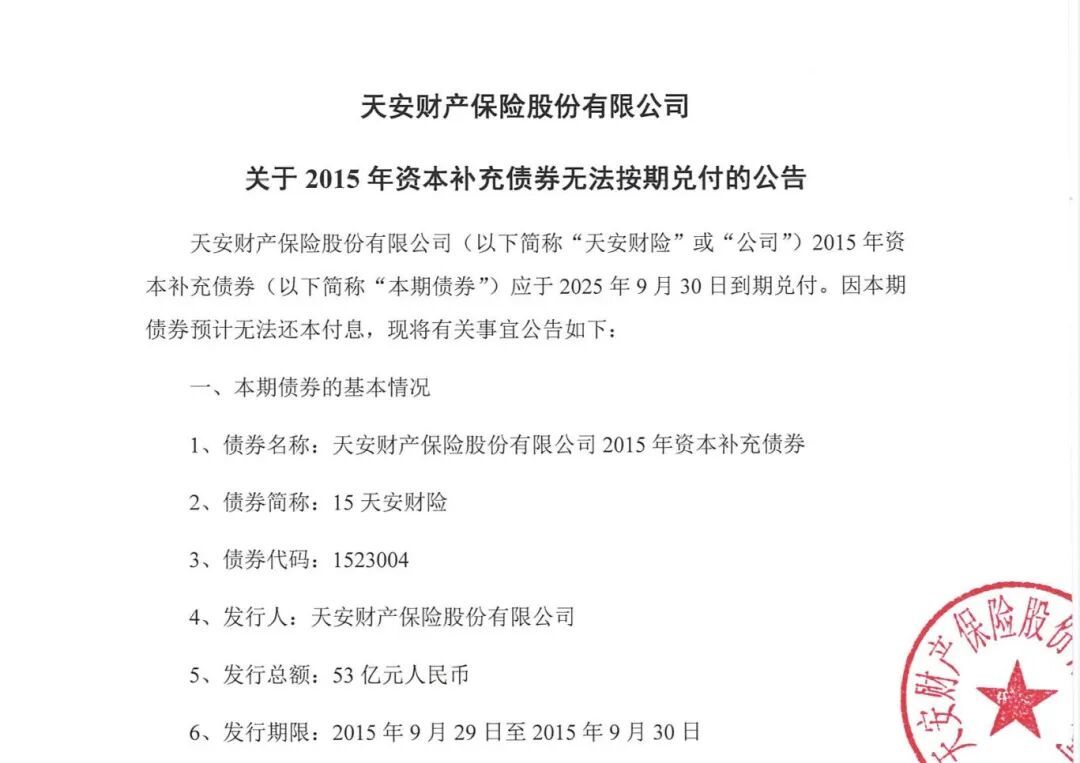
Core Viewpoint - Tianan Property Insurance Co., Ltd. announced that it is unable to repay the principal and interest of its 2015 capital supplement bond due on September 30, 2025, due to insufficient solvency ratio and inability to meet other liabilities [1][3] Group 1: Company Situation - The bond, known as "15 Tianan Insurance Bond," was issued on September 29, 2015, with a total scale of 5.3 billion and a 10-year term, featuring a segmented interest rate of 5.97% for the first five years and 6.97% for the latter five years if not redeemed [3] - Since the second quarter of 2020, the company has suspended the disclosure of quarterly solvency reports, with its solvency ratios at 185.59% and 236.99% as of the end of Q4 2019 [1] - The company has been under regulatory takeover since July 2020, and it did not exercise its redemption option for the bond in September 2020, leading to interest being accrued without payment [3] Group 2: Industry Implications - This event marks the first bond default in the insurance sector, indicating a shift away from rigid repayment practices and towards a more market-oriented risk pricing mechanism [1][6] - Analysts suggest that investors need to reassess the risk-return characteristics of capital instruments issued by financial institutions, particularly insurance companies, as market pricing becomes more refined [6][7] - The incident is expected to have a short-term impact on market sentiment, widening credit spreads, but the systemic risk is considered limited due to the small size and low systemic importance of Tianan [7][8] Group 3: Future Solutions - Potential solutions for the bond issue may include debt restructuring with extended repayment terms or a full write-off of the capital debt, similar to the full write-off of 6.5 billion in subordinate capital bonds by Baoshang Bank in 2020 [4] - The company is currently coordinating with bondholders to address their concerns and manage the risk disposal process [3][4]
有序压降存量待整改业务!信托公司管理办法时隔18年大修,明年起实施
Di Yi Cai Jing· 2025-09-15 11:45
Core Viewpoint - The revised "Trust Company Management Measures" aims to enhance the regulatory framework for trust companies, focusing on business scope, shareholder responsibilities, and risk management, effective from January 1, 2026 [1][2][3]. Summary by Sections Business Structure Adjustment - The revised measures reduce the business scope of trust companies from 11 categories to three: trust business, proprietary asset-liability business, and other business [2][3]. - Trust business is further categorized into asset service trusts, asset management trusts, and public welfare trusts [3]. Regulatory Enhancements - The minimum registered capital for trust companies is raised from 300 million to 500 million yuan [6]. - New governance requirements include establishing a specialized committee for the protection of client rights and enhancing shareholder behavior management [6]. Risk Management - Trust companies are required to implement a recovery and disposal plan mechanism, which must be updated regularly and approved by regulatory authorities [8]. - The measures specify that investments in non-standard debt assets must not exceed 30% of the company's net asset balance [7]. Prohibited Practices - Trust companies are explicitly prohibited from promising that trust assets will not incur losses or guaranteeing minimum returns [3]. - The revised measures ban channel services and fund pool operations that circumvent financial regulations [3]. Transition and Compliance - Trust companies must identify and rectify non-compliant businesses, lock in their scale, and implement a timeline for orderly reduction [9][10].
金融监管总局:明确信托买卖双方权责定位 打破刚性兑付
智通财经网· 2025-09-12 10:48
Core Viewpoint - The Financial Regulatory Bureau has revised the "Management Measures for Trust Companies," which will take effect on January 1, 2026, focusing on core responsibilities, risk prevention, and enhancing corporate governance in the trust industry [1][2]. Group 1: Key Revisions - The revised measures emphasize the core business of trust companies, clarifying their roles as trustees and regulating asset service trusts, asset management trusts, and charitable trusts [1][4]. - The principle of "seller responsibility, buyer risk" is reinforced, breaking the rigid repayment structure [1][4]. - Trust companies are required to deepen the integration of party building and corporate governance, enhancing shareholder behavior and related party transaction management [1][4]. Group 2: Risk Management and Governance - Trust companies must strengthen comprehensive risk management, focusing on compliance and operational risks throughout the trust business process [1][22]. - The minimum registered capital for trust companies will be increased, and there will be stricter capital and provision management requirements [1][22]. - A scientific internal assessment and incentive mechanism must be established to maximize the legitimate interests of beneficiaries [1][19]. Group 3: Regulatory Requirements - The measures specify enhanced regulatory requirements, including behavior supervision and penetrating regulation, to improve risk disposal and market exit mechanisms [1][22][45]. - Trust companies are required to establish a recovery and disposal plan mechanism, which must be updated regularly and approved by the regulatory authority [1][50]. - The regulatory authority will implement a tiered and classified supervision approach based on the risk status and systemic impact of trust companies [1][61].