
信用卡权益调整

Search documents
弱水三千,精准滴灌:信用卡客群价值创造的回归
Jin Rong Jie Zi Xun· 2026-02-13 08:22
Core Viewpoint - The credit card industry is transitioning from a "mass irrigation" approach to a "precise drip" strategy, focusing on value creation and customer needs rather than mere scale expansion [1][2][3] Group 1: Industry Changes - Multiple banks have announced adjustments to credit card product benefits, indicating a shift in the industry towards more targeted offerings [1] - The implementation of new regulations has prompted banks to reassess their business models and focus on high-quality development rather than rapid expansion [2] - The competitive landscape has led to an "involution" in benefits competition, increasing operational costs and diminishing marginal returns [2] Group 2: Adjustments in Benefits - Recent adjustments in credit card benefits show a mix of increases and decreases, reflecting a more nuanced approach to customer needs [4] - Banks are discontinuing low-efficiency co-branded cards and optimizing benefit structures to focus on target customer groups [3][4] - New benefits include exclusive offers for specific customer segments, enhancing the perceived value of holding a credit card [4] Group 3: Customer-Centric Strategies - The industry is moving towards a model that emphasizes deep engagement with core customer groups, aligning benefits with actual customer needs [5][6] - Promotional activities are being used as a complementary strategy to enhance customer engagement and satisfaction [5] - Banks are implementing tailored services based on customer behavior and preferences, optimizing resource allocation for better outcomes [6]
白金信用卡权益大缩水:贵宾厅限次、酒店减量⋯⋯银行吐槽没赚头,“羊毛党”薅了个寂寞
3 6 Ke· 2025-12-10 09:50
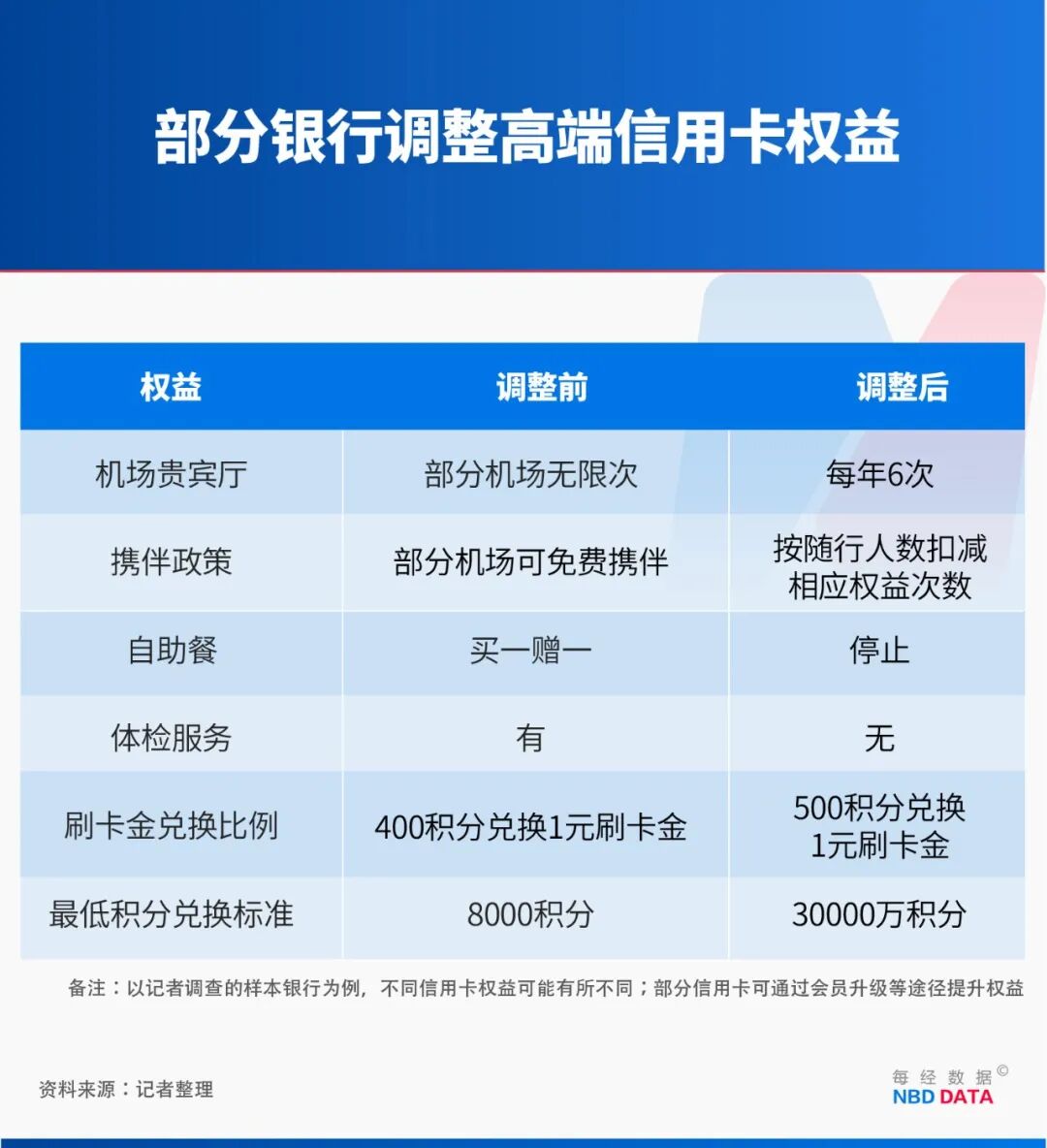
Core Viewpoint - The high-end credit card benefits are being significantly reduced by multiple banks, leading to a decline in the perceived value of these cards, as banks struggle with profitability in this segment [1][5][7]. Group 1: Benefit Reductions - Many banks are cutting back on high-cost benefits such as unlimited airport lounge access, reducing it to a maximum of six visits per year [5][6]. - The redemption thresholds for rewards points are being raised, with some banks changing the conversion rate from 400 points to 500 points for one unit of cash back [5][6]. - Additional benefits like complimentary dining and health check services are being eliminated entirely [5][6]. Group 2: Profitability Challenges - High-end credit cards are not profitable for banks due to high costs associated with benefits and low interchange fees, which average around 0.3% in China [7][8]. - The typical high-end cardholder often uses the card solely for payments without generating interest income for the bank, further complicating profitability [7][8]. - The presence of "arbitrageurs" exploiting card benefits has led to increased costs for banks, prompting them to tighten rules around benefit usage [9]. Group 3: Strategic Shifts - Banks are shifting focus from expanding customer bases to managing existing high-value clients, emphasizing a strategy of resource allocation towards wealth management and private banking [10][13]. - High-end credit cards are viewed as tools for identifying valuable customers and enhancing overall profitability through cross-selling opportunities in other financial services [10][13]. - The credit card industry is transitioning into a phase of maintaining existing customers rather than aggressively acquiring new ones, as the market becomes saturated [19][20].

年轻人为何抛弃信用卡?权益缩水,临近年末积分兑条毛巾都靠抢
Bei Jing Ri Bao Ke Hu Duan· 2025-12-03 03:57
Core Viewpoint - The decline in credit card attractiveness among consumers, particularly younger individuals, is attributed to reduced benefits, increased redemption thresholds, and aggressive marketing tactics by banks [1][5][9]. Group 1: Consumer Experience - Many credit cardholders report a significant reduction in benefits, such as access to airport lounges and lower redemption rates for rewards, leading to dissatisfaction [3][4]. - The requirements for promotional offers have become more stringent, with higher spending thresholds and additional tasks needed to qualify for benefits, causing frustration among users [3][4]. - Complaints about the difficulty of redeeming points for rewards have increased, with many items quickly going out of stock or requiring more points than before [3][4]. Group 2: Bank Policies and Adjustments - Several banks have announced plans to adjust credit card benefits, including reducing the number of times certain perks can be used and eliminating popular rewards [4][5]. - The adjustments are primarily driven by banks' need to control costs and respond to low usage rates of certain benefits [5]. Group 3: Marketing and Consumer Trust - Aggressive marketing tactics, including misleading promotions and persistent sales calls, have led to a decline in consumer trust towards credit card offerings [6][7]. - Consumers have reported feeling pressured into unnecessary spending or services, such as installment plans, without clear communication of the associated costs [6][7]. Group 4: Market Trends - The shift in consumer preferences towards alternative credit products, particularly among younger demographics, is evident as they favor flexible, fee-free options that align better with their spending habits [9]. - Banks are encouraged to explore differentiated customer targeting and improve service offerings to retain and attract credit card users [9].

多家银行调整高端信用卡权益
Jin Rong Shi Bao· 2025-08-08 07:59
Core Viewpoint - Recent adjustments to high-end credit card benefits by multiple banks indicate a shift towards a more sustainable and long-term operational model in the credit card industry, reflecting the pressures faced by banks in a competitive market [1][4]. Group 1: Bank Adjustments - Several banks, including China Merchants Bank, Everbright Bank, and HSBC China, have announced updates to their high-end credit card products, such as increasing usage thresholds and adjusting applicable ranges [1]. - China Merchants Bank's adjustments include changing the annual fee waiver conditions for its high-end credit cards, moving from "10,000 points for annual fee waiver" to "10,000 points + 180,000 yuan in rigid spending for annual fee waiver" [2]. - Over 10 banks have made similar adjustments to their high-end credit card benefits this year, with notable changes including the removal of airport lounge services and reductions in overseas spending cashback [3]. Group 2: Market Dynamics - The credit card market is entering a phase of stock competition, characterized by declining growth rates in card issuance and rising customer acquisition costs [3]. - Experts suggest that banks are raising thresholds to filter customers, directing resources towards high-spending and high-contribution users, which may enhance overall profitability in the credit card sector [3]. - Since 2025, over 30 credit card centers have been closed, indicating a trend towards consolidation and efficiency within the industry [3]. Group 3: Expert Opinions - Analysts view the current adjustments not merely as a reduction in benefits but as proactive measures by banks to pursue sustainable business models and promote overall industry health [4].
