债券收益率无序上升

Search documents
国际黄金强势反弹,国内金饰价格却跌破1500元大关。周大福一天跌61元,老凤祥也扛不住了,你敢买吗?
Sou Hu Cai Jing· 2026-02-19 03:17
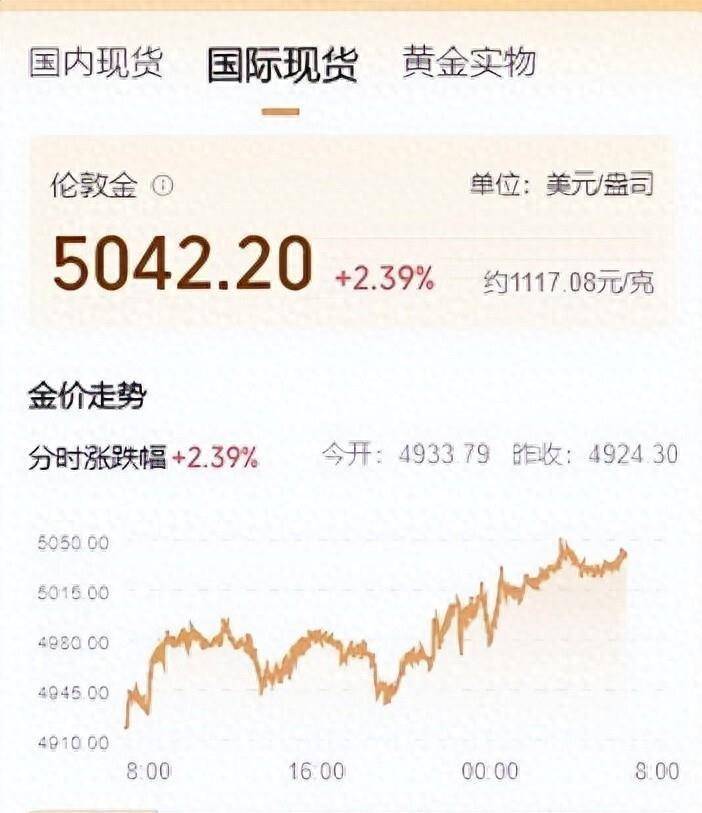
Price Movements in Domestic and International Gold Markets - The price of gold jewelry from major domestic brands has dropped below the psychological threshold of 1500 yuan per gram, with prices reported at 1499 yuan from Chow Tai Fook and 1510 yuan from Lao Feng Xiang, reflecting a decrease of 61 yuan per gram in just one day [1][7] - In contrast, international gold prices have surged, with spot gold rising from 4878.89 USD to 5042.20 USD, marking a daily increase of 2.39% [3][8] - The domestic gold market is experiencing a lag in price adjustments compared to international markets, influenced by fixed costs such as brand premiums and processing fees [11] Geopolitical Influences on Gold Prices - The recent progress in US-Iran negotiations has reduced the likelihood of military conflict, leading to a withdrawal of some safe-haven funds from the gold market [13] - Despite the positive developments, uncertainties remain as Iran refuses to discuss its ballistic missile program, complicating the potential for a formal agreement [9][13] Federal Reserve's Monetary Policy Outlook - Federal Reserve officials have expressed differing views on interest rate adjustments, with some indicating a potential for 75 basis points of rate cuts, while others advocate for maintaining stable rates for a period [5][9][13] - The latest survey from Bank of America shows that 50% of fund managers consider "going long on gold" as the most crowded trade, indicating a strong interest in gold as an investment [5][6] Market Sentiment and Investment Trends - The allocation towards commodities has reached its highest level since May 2022, with a net 28% overweight in commodities among surveyed fund managers [6][11] - The cash levels among investors have slightly increased from a record low, indicating a cautious approach amidst market volatility [11]





美联储降息之路布满荆棘?美银调查:“第二波通胀”成头号风险
Sou Hu Cai Jing· 2025-09-17 05:07
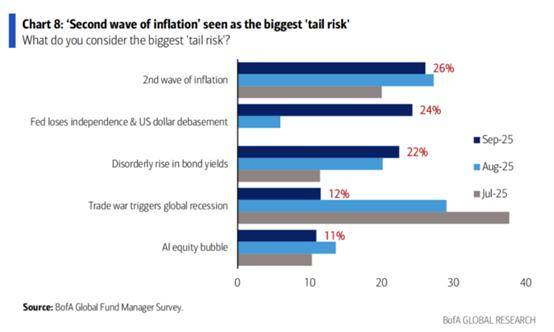
Group 1 - The core concern among fund managers has shifted from "trade war causing global recession" to "second wave of inflation" as the biggest tail risk, with 26% of managers identifying it as such, a slight decrease from August [1] - 24% of fund managers view the loss of Federal Reserve independence and dollar depreciation as the largest tail risk, while 22% cite disorderly rise in bond yields [1] - Only 12% of fund managers consider "trade war causing global recession" as the biggest risk, significantly down from 29% in August [1] Group 2 - The survey indicates that "long on the tech giants" remains the most crowded trade, with 42% of fund managers holding this view, slightly down from 45% in August [3] - Other popular trades include long on gold (25%), short on the dollar (14%), and long on cryptocurrencies (9%) [3] - The survey was conducted from September 5 to 11, involving 165 fund managers managing a total of $426 billion in assets [3] Group 3 - Recent economic indicators show signs of rising inflation in the U.S., prompting some economists to advise the Federal Reserve to avoid significant rate cuts [4] - The U.S. Consumer Price Index (CPI) rose by 0.4% month-over-month in August, exceeding market expectations of 0.3%, with a year-over-year increase of 2.9%, accelerating by 0.2 percentage points from July [4] Group 4 - The Federal Reserve began a two-day meeting on September 16, with widespread expectations for a rate cut of 25 basis points, marking the first cut in nine months [5] - Investors are particularly focused on the Fed's future policy path, with the upcoming dot plot and comments from Powell expected to provide further insights [5]